Logistics app development is not about putting a live map on a screen — it is about whether a transport owner can see, from one dashboard, which vehicle is where, which consignment is delayed, and which delivery has verifiable proof. Yes: it can end dispatch errors, ghost deliveries, and missing proof-of-delivery paperwork, provided it digitizes the trip sheet, makes electronic POD mandatory on every drop, and connects completed trips to billing. Without those three, it is an expensive GPS toy.
A transport owner with twenty-five trucks cannot ride in every cabin. Loads are assigned over phone calls, trip sheets are filled in from memory, and when a customer says “we never received it,” the owner has no evidence to answer with. This article examines what logistics app development must actually do: the money leaks it closes, the data the fleet already has, what the system must never do alone, and how to test the idea in 30 days on five vehicles before spending on a full platform.

Where does a transport business actually lose money?
Before discussing technology, name the specific leaks. The expensive problems are rarely about fuel prices or tolls — they are about information that never reaches the owner.
Why do dispatch errors multiply?
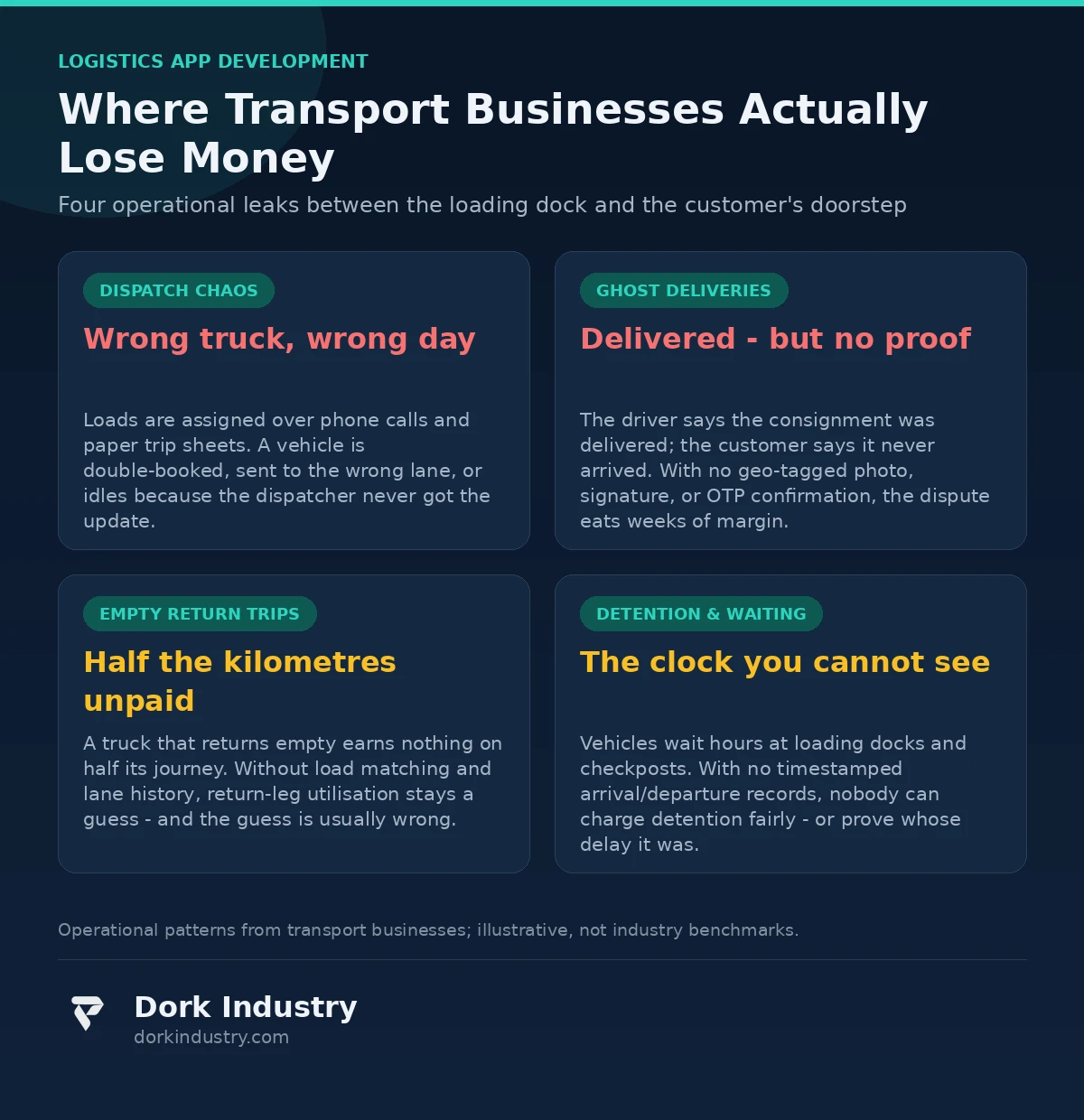
Dispatch happens over phone calls, WhatsApp voice notes, and paper trip sheets. A vehicle gets double-booked. A load is assigned to a truck that is still 300 kilometres away. Every one of these errors is invisible until it becomes a missed delivery — and a customer who starts shopping for another transporter.
What are ghost deliveries — and why do PODs go missing?
A ghost delivery is a consignment the driver swears was delivered and the customer swears never arrived. Paper PODs travel back in the driver’s bag, days or weeks late, if at all — lost, smudged, or never collected because the receiver’s clerk was “not available.” With no verifiable proof, the transporter cannot invoice with confidence and the customer cannot be argued with. The dispute eats margin for weeks.
Why do empty return trips quietly eat the margin?
A truck that returns empty earns nothing on half its kilometres while burning the same fuel. Most transporters know their return-leg utilisation is poor but cannot measure it — the data lives in scattered registers. Without lane history and load matching, dispatchers keep sending trucks back empty because that is how the lane has always worked.
How does detention and waiting time silently inflate costs?
Vehicles wait hours at loading docks, factory gates, and checkposts. With no timestamped arrival and departure records, nobody can bill detention fairly — or prove whose delay it was. Meanwhile the driver is paid for the day, the truck earns nothing while parked, and the next load slips. Detention is a clock nobody is watching.
What data does your fleet already generate — and what is missing?
Most transporters already generate the raw material: trip sheets, fuel bills, toll receipts, weighbridge slips, driver call logs, e-way bill records, and customer challans. What is missing is structure and timing. The data is not connected, not timestamped at the moment it happens, and not owned by the business in a usable form.
A logistics app does not create new work for drivers and dispatchers, and that principle should guide any logistics app development: it captures the work they already do — loading, departure, arrival, unloading, delivery confirmation — in a form the owner can actually use. Design the driver app around the driver’s incentives at a dusty loading dock with patchy network: offline-first capture, minimal taps, and immediate personal benefit. If the people entering data do not benefit from the app, the data will be incomplete within weeks.
What must logistics app development actually deliver?
A generic “fleet tracking app” with dots on a map is not the answer. One that gives an owner control covers five operational areas.
What should the dispatcher see every morning?
- Every vehicle’s live position, status (loaded, empty, idle, maintenance), and current trip
- Today’s loading and unloading schedule with assigned vehicles and drivers
- Delayed consignments flagged automatically against promised delivery windows
- Vehicles idle for more than a set threshold, with the reason visible
- Lane-wise utilisation: which routes make money, which bleed it
- Customer-wise receivables tied to delivered-but-unbilled trips
How does electronic proof of delivery end payment disputes?
Electronic POD (ePOD) replaces the paper challan that travels in the driver’s bag. On delivery, the driver app captures a geo-tagged photograph of the unloaded goods, the receiver’s signature on the phone screen (or an OTP sent to the receiver’s registered mobile), and an automatic timestamp with location. The trip cannot be closed — and the invoice cannot be generated — without it. When a customer disputes a delivery, the owner answers with a photograph, a signature, a timestamp, and coordinates. The discipline matters more than the technology: no POD, no trip closure, no exceptions.
How do you stop fuel pilferage and route deviations?
Fuel is the single largest operating cost, and the easiest to leak. The app should reconcile fuel fills (from fuel-card or UPI receipts) against the kilometres the GPS actually recorded, per vehicle, per trip. A truck that consistently returns 15% worse mileage than its siblings on the same lane is either mechanically unwell or being siphoned — either way, the owner now knows which truck to look at. The data simply makes pilferage unprofitable and uneconomical to hide.
How should billing, e-way bills, and compliance flow?
According to the official E-Way Bill system — run by the National Informatics Centre under the GST Network — goods worth more than ₹50,000 moved across India require an e-Way Bill generated on the official e-Way Bill portal. A logistics app should generate the trip record, the e-way bill reference, and the customer invoice from the same completed-trip event, so billing follows delivery instead of chasing it. Faster billing is faster cash — and this is where the app pays for itself.
What about driver performance and incentives?
The driver app should make the driver’s life easier, not just monitored: digital trip sheets (no more lost paper), advance and expense logging, one-tap breakdown reporting with location, and rest-stop logging. Performance data — on-time percentage, POD compliance, fuel efficiency — feeds a fair incentive structure, never a surveillance scorecard. The moment drivers feel watched rather than supported, they will find ways to feed the system fiction.
What does the math look like? An illustrative example
Consider a 25-truck fleet where each truck runs one 800-km round trip per week (400 km each way), 48 weeks a year. Assume an illustrative operating cost of ₹45 per kilometre — fuel, driver wages, maintenance, tolls, insurance. That is ₹36,000 per round trip — about ₹4.3 crore in annual operating cost across the fleet. These are stated assumptions for illustration, not industry benchmarks.
Now the leaks. If one in four return legs runs empty, that is 300 unpaid 400-km legs a year — 120,000 dead kilometres costing roughly ₹54 lakh. Load matching and lane-history data that cut empty returns from 25% to 10% would save about ₹32 lakh a year. And if 6 POD disputes a month each delay a ₹50,000 invoice by 20 days and consume 4 staff-hours to resolve, the business carries roughly ₹2 lakh in receivables perpetually stuck in dispute and burns nearly 300 staff-hours a year arguing about deliveries. The point of the arithmetic is not the exact numbers — it is that the leaks are measurable, and measurability is what makes them fixable.
Should you build or buy? An honest breakdown
Not every transporter needs custom logistics app development. The honest options, in order of investment:
| Approach | Best for | Relative investment | Where it breaks |
|---|---|---|---|
| Paper trip sheets + phone dispatch | Under 5 vehicles on fixed, repeat lanes | Minimal | Breaks the moment you need proof of delivery or the fleet grows |
| Off-the-shelf TMS subscription | Standard dispatch, tracking, and billing workflows | Low subscription | Cannot model unusual lanes, detention rules, or customer-specific POD formats |
| White-label driver app | Branded driver experience without building | Medium | You inherit their roadmap and limitations; ePOD formats may not match your customers |
| Custom logistics app development | 20+ vehicles, multi-lane operations, or unique workflows | Highest | Overkill for a small fleet on standard lanes |
At Dork Industry, we regularly advise small fleets against custom builds when a packaged transport management system fits. A credible technology partner should be willing to tell you that you do not need custom development. If every consultation ends with a quotation for a custom app, get a second opinion. The pattern is the same one we see in related operations work — for example, field-service businesses weighing offline job tracking and ecommerce operations fixing order leakage between checkout and dispatch.
What should the system never do alone?
Technology boundaries in logistics app development matter as much as features — especially where algorithms meet people.
- Never auto-penalize a driver from GPS data alone. A route deviation might be a road closure, a dhaba stop, or a police diversion. Flag the anomaly for the dispatcher; let a human ask the driver what happened before any consequence.
- Never let an algorithm reassign or cancel a load mid-trip without dispatcher override. Automated re-optimization is useful as a suggestion. The dispatcher owns the final call, because the algorithm does not know the customer relationship.
- Never expose live shipment details beyond the named receiver. Customer tracking links should show status and ETA — not the driver’s name, phone number, or exact live location. Driver safety and customer privacy are non-negotiable.
- Never let e-way bill or compliance failures fail silently. If an e-way bill cannot be generated or is about to expire mid-transit, the system must escalate to a human immediately — a detained vehicle costs more per hour than any software.
- AI should suggest loads, not assign them over safety limits. “Three return loads are available on this lane” is useful. Auto-assigning a load that pushes a driver past safe duty hours is not — duty-hour and rest decisions stay human.
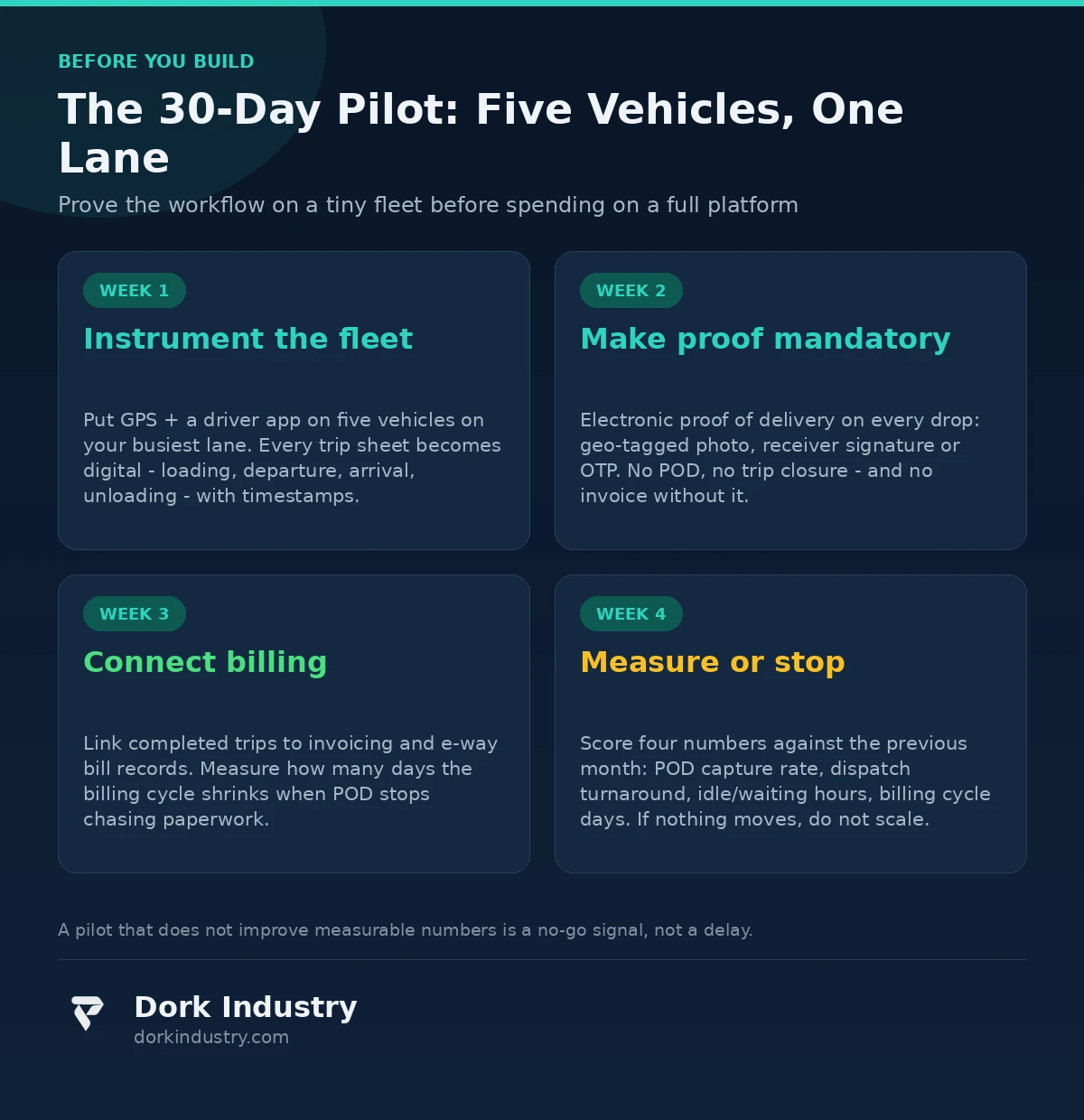
How do you test it in 30 days before full investment?
The lowest-risk path is a five-vehicle pilot on your busiest lane, with a fixed scope and measurable outcomes:
- Five vehicles, one lane, GPS plus a driver app on every pilot vehicle
- Digital trip sheets: loading, departure, arrival, and unloading captured with timestamps
- Electronic POD mandatory on every drop — geo-tagged photo plus signature or OTP
- Completed trips linked to invoicing and e-way bill records
- Measure against the previous month: POD capture rate, dispatch turnaround time, idle/waiting hours, billing cycle days
If POD capture and billing speed do not measurably improve in the pilot, a bigger logistics app development investment will not fix it either. The pilot validates the workflow, not just the software. This is the assessment Dork Industry runs before quoting any logistics project: map the current dispatch process, name the leaks, then decide what software earns its cost.
What actually drives the cost of logistics app development?
Logistics app pricing varies widely because scope does. The real cost drivers are:
- Fleet size and roles: 5 trucks with one dispatcher vs 100 trucks with lane managers, branch offices, and customer logins changes the data model significantly
- Tracking hardware: phone-based GPS vs dedicated AIS-140-compliant devices and fuel sensors, including installation and SIM management
- ePOD complexity: photo + signature vs barcode/RFID scanning, multi-drop consignments, and customer-specific POD formats
- Billing and compliance integration: GST invoicing, e-way bill generation, detention computation, and reconciliation with your accounting system
- Customer visibility: a tracking portal or app for your customers adds a whole second product surface
- Offline-first driver app: proper offline sync for low-network routes is real engineering, not a checkbox
- Platforms: Android-only driver app vs Android + iOS, plus web dashboards for dispatchers and owners
Anyone quoting a fixed price without asking about fleet size, POD formats, and billing workflows is guessing. According to the World Bank’s 2023 Logistics Performance Index, end-to-end supply-chain digitalization — especially in emerging economies — is allowing countries to shorten port delays by up to 70%. The macro trend is clear; the question is only whether your fleet captures its share of it.
Frequently asked questions
Does a small fleet need a logistics app, or is a TMS subscription enough?
Under about 10 vehicles on fixed, repeat lanes, a packaged transport management system on subscription is usually enough and far cheaper. Custom logistics app development earns its cost when you have 20+ vehicles, multiple lanes, customer-specific POD formats, or detention and billing rules that packaged software cannot model.
How long does logistics app development take?
A focused pilot — dispatcher dashboard, driver app with ePOD, and basic billing linkage for a handful of vehicles — can be live in 4–6 weeks. A full platform with customer tracking, detention computation, e-way bill automation, and accounting integration typically runs 3–6 months depending on scope and hardware.
Can the driver app work on routes with poor network coverage?
Yes, but only if it is built offline-first: trip events, POD photos, and signatures are captured locally and synced when the network returns, with conflict handling so nothing is lost or duplicated. A driver app that requires constant connectivity will produce fiction on exactly the routes where you most need truth.
How does electronic proof of delivery hold up in a payment dispute?
Far better than a paper challan that may never reach the office. A geo-tagged photo of the delivered goods, a receiver signature or OTP, and an automatic timestamp with coordinates form a verifiable evidence chain. In our experience, most POD disputes collapse the moment this evidence is shown — the dispute was usually about missing proof, not missing goods.
What does a logistics app pilot cost?
A five-vehicle pilot with a dispatcher dashboard, offline-first driver app, and mandatory ePOD is a fraction of a full build. Its job is to prove measurable improvement in POD capture, dispatch turnaround, and billing speed before larger investment. Request a pilot scoping call for a concrete estimate.
About Dork Industry
Dork Industry (dorkindustry.com) is a custom software development company building mobile apps, AI automation, and IoT systems for businesses across India. Our team designs logistics and fleet platforms, field-service apps, and industrial IoT — from 30-day pilots on a handful of vehicles to full multi-lane rollouts with billing and compliance integration.
The bottom line
The question is not whether a transporter needs logistics app development. It is whether the owner can see — from one screen — which vehicle is idle, which consignment is delayed, which delivery has proof, and which invoice is stuck. If the answer is no, the technology decision is really an operations decision wearing a software costume.
Running a transport fleet and want to know what a logistics app would change in your specific operation?
We map your current dispatch, POD, and billing process and show you exactly what software would (and would not) fix, before any development is discussed.
Request a logistics mobile workflow assessment WhatsApp +91 8210792477