Mobile app development cost in India can range from about ₹1–3 lakh for a discovery prototype to ₹60 lakh or more for a regulated, multi-role enterprise platform. The useful number is not the cheapest headline estimate: it is the price of a clearly defined release, including product discovery, design, mobile development, backend and admin work, integrations, testing, security, deployment, handover and the first operating period.
Quick answer
For early planning, allow ₹4–10 lakh for a focused validation MVP, ₹10–25 lakh for a production business app, ₹25–60 lakh for a multi-role product with several integrations, and ₹60 lakh+ for complex or regulated enterprise delivery. These are Dork Industry planning bands, not fixed market prices. Compare vendors only after normalizing the same workflows, platforms, integrations, acceptance tests, ownership and support period.
This buyer’s guide is for founders, product leaders and established businesses comparing app-development proposals. It explains what changes the budget, how to detect exclusions, when Flutter, native development or a web app makes sense, and how to compare the three-year cost rather than a misleading build-only quote.
What are the key mobile app development cost takeaways?
- Price business workflows and user roles, not a loose list of screens.
- Normalize every quote across discovery, app, backend, admin, integrations, QA, launch and handover.
- Do not assume cross-platform development is automatically cheaper; validate device, performance and native-feature requirements.
- Separate the initial build from cloud, licences, maintenance, store operations and planned enhancements.
- Tie payments to demonstrable acceptance evidence, source-code access and documented handover.
Before you sign a quote, see our guide on how to compare AI automation providers in India.
Already have two mobile-app quotations?
Dork Industry can normalize both proposals against the same scope, expose exclusions and prepare a decision-ready delivery and three-year cost comparison.
Why was this mobile app development cost topic selected?
Fresh external Google Ads Keyword Planner research completed for this guide measured an average 720 monthly searches in India for the exact phrase mobile app development cost in India, with a +38.9% three-month change at the time of research. A related commercial query, ecommerce app development cost, measured 210 monthly searches and +90.9% three-month growth. These advertising-platform estimates are directional rather than guaranteed organic traffic, but they show current demand from buyers trying to budget or compare a purchase.
| India keyword research snapshot | Average monthly searches | Three-month change | Buyer signal |
|---|---|---|---|
| mobile app development cost in India | 720 | +38.9% | Budgeting and vendor comparison |
| app development cost calculator | 260 | −58.8% | Early cost estimation |
| ecommerce app development cost | 210 | +90.9% | Solution-specific purchase planning |
| Flutter app development cost | 90 | −54.5% | Platform-specific comparison |
The selected keyword had the strongest combination of absolute demand, positive momentum and broad commercial fit. The declining calculator and Flutter variants remain useful supporting concepts but were not strong enough to lead this article. This decision was based on external demand rather than Dork Industry’s existing Search Console queries.
Original research finding: across this four-query comparison, the combined directional demand was 1,280 average monthly searches. The selected exact query contributed 720 searches, or 56.25% of that measured set. The two growing queries represented 930 searches, or 72.66% of the combined demand, while the two declining variants represented 350. This does not predict ranking or enquiries; it documents why the growing, purchase-stage cost query was prioritized over narrower variants.
India is the natural primary market because the selected exact query is explicitly India-focused and the service can be delivered across the country without artificial city doorway pages. The same quote-comparison framework also helps international companies evaluating an Indian development partner.
What do the top five ranking guides cover—and what is missing?
Current leading results from Astha Technologies, Vrinsoft, Zethic, SolGuruz and SparxIT cover broad price ranges, complexity, hourly rates, app categories, platform choices, design, backend work, maintenance and hidden costs. Zethic and SolGuruz are particularly comprehensive on cost factors.
The buyer-side gap is quote normalization. Two proposals may use the same label—“ecommerce app” or “MVP”—while including different user roles, admin controls, integration depth, test coverage, security work, analytics, store-release support and intellectual-property terms. This guide therefore treats cost comparison as an evidence problem, not a price-table contest.

How much does mobile app development cost in India in 2026?
The following planning bands help frame an initial conversation. They are not quotations. A documented discovery exercise is required before a responsible fixed estimate or delivery plan can be produced.
| Delivery level | Indicative planning band | Typical outcome |
|---|---|---|
| Discovery or interactive prototype | ₹1–3 lakh | Validated workflows, prototype, architecture assumptions and delivery backlog |
| Focused validation MVP | ₹4–10 lakh | One primary user journey, limited roles, basic backend and controlled release |
| Production business app | ₹10–25 lakh | Android/iOS delivery, admin operations, analytics, integrations, QA and launch |
| Multi-role integrated platform | ₹25–60 lakh | Several workflows, permissions, payments or enterprise integrations and observability |
| Regulated or complex enterprise product | ₹60 lakh+ | Advanced security, auditability, high availability, device/IoT or complex data requirements |
A small-looking app can exceed a larger screen count if it handles complex permissions, offline synchronization, payments, live location, Bluetooth or IoT devices, high-risk personal data, real-time events or legacy-system integrations.
What should a complete app-development quote include?
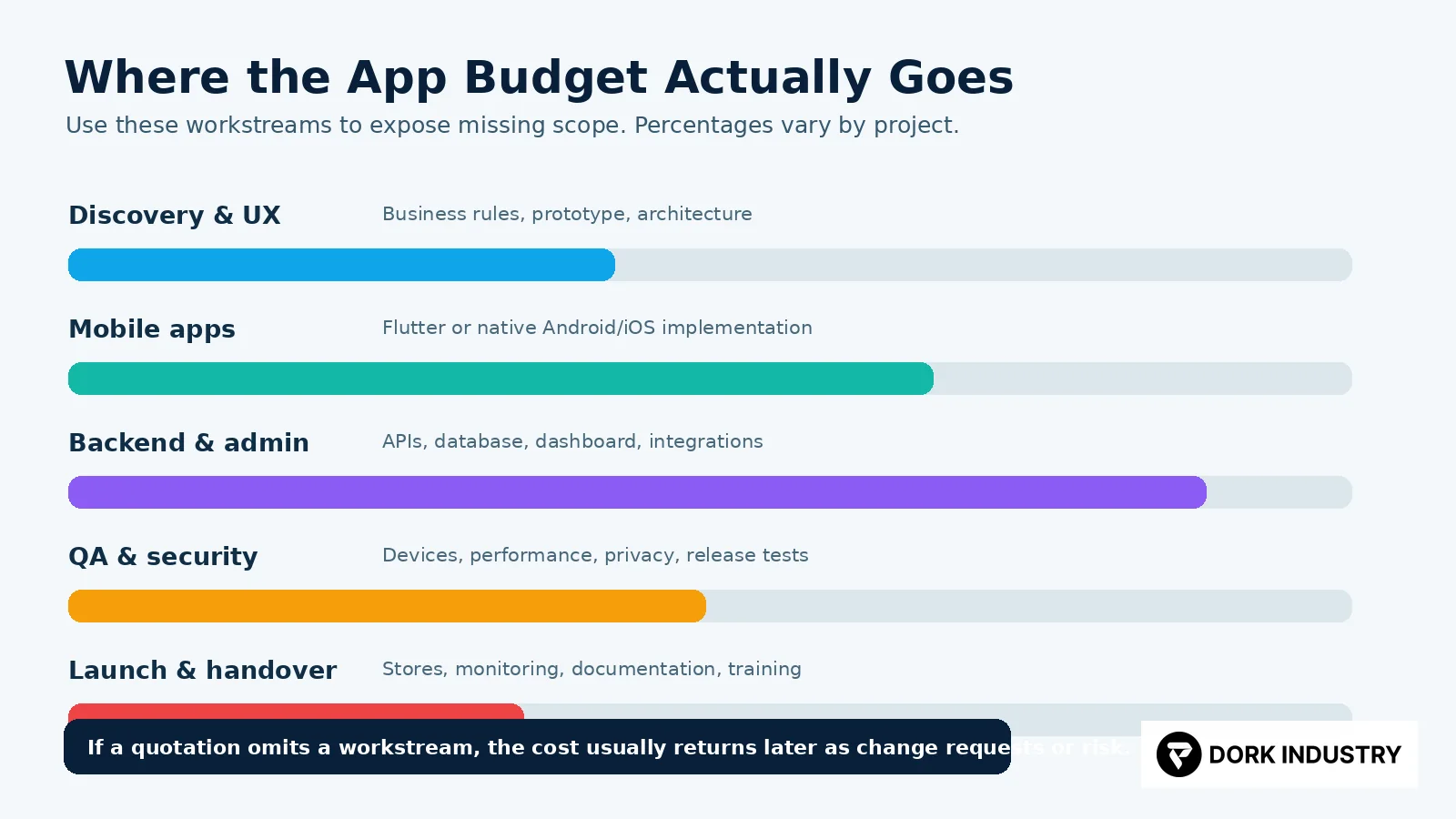
Use this normalized model when reviewing each vendor:
Total build cost = discovery and UX + mobile implementation + backend and admin + integrations + QA and security + launch and handover.
1. What is included in discovery and product definition?
The proposal should identify user roles, priority workflows, business rules, exception paths, nonfunctional requirements, integrations, data ownership and measurable release outcomes. A prototype is useful only when it resolves a decision—not when it merely makes the proposal look complete.
2. What exactly will the mobile application support?
Confirm Android and iOS versions, phones and tablets, orientation, accessibility, localization, offline behavior, notifications, deep links, biometric use and native-device features. “Both platforms” is not enough detail.
3. Are backend APIs and an admin portal included?
Most operational apps need identity, permissions, data validation, notifications, reporting, content or catalogue management and support tooling. Confirm who builds and owns the API, database and administration interface. Review Dork Industry’s guide to buying custom API development services if APIs are a material part of the scope.
4. How deep are third-party integrations?
A payment gateway, ERP, CRM, shipping provider, map service, identity provider or IoT platform requires more than connecting an endpoint. Price authentication, field mapping, validation, retries, reconciliation, rate limits, monitoring, sandbox access and failure ownership.
5. What testing and security evidence will be delivered?
The proposal should define supported devices, functional and regression coverage, performance testing, accessibility checks, security review and defect-severity rules. The OWASP Mobile Application Security Verification Standard provides a recognized control framework. Requirements should be selected according to risk rather than copied indiscriminately.
6. What happens at launch and handover?
Confirm store accounts, certificates, privacy disclosures, release ownership, analytics, crash reporting, monitoring, source repositories, infrastructure access, build pipelines, credentials, technical documentation and knowledge transfer. Apple’s App Store Review Guidelines and Android’s app quality guidance should inform release readiness.
Should you choose native, Flutter or a progressive web app?
| Option | Best fit | Cost risk to examine |
|---|---|---|
| Native Android and iOS | Platform-specific experience, demanding performance or extensive native features | Separate implementation and test effort; duplicated changes if architecture is poorly shared |
| Flutter | Shared product experience across Android and iOS with a suitable plugin ecosystem | Custom native bridges, complex platform differences and unsupported dependencies |
| Progressive web app | Fast reach through the browser where native capability and store distribution are not essential | Device-feature limits, browser differences and reduced fit for some consumer journeys |
Do not choose a platform from a generic savings percentage. Run a technical spike for the hardest native feature, offline requirement or integration, then price the validated architecture.
How does cost change by app type?
- Internal operations app: permissions, offline entry, approvals, audit history, device management and ERP synchronization often matter more than visual polish.
- Ecommerce app: catalogue accuracy, search, promotions, payment states, fulfilment, returns, analytics and customer identity drive complexity.
- Booking or marketplace app: availability, commissions, provider onboarding, cancellation, disputes, payouts and fraud controls must be specified.
- Delivery or field-service app: background location, route data, proof of service, offline queues, battery use and operations dashboards affect scope.
- AI, AR or IoT app: model or device behavior, latency, data permissions, fallback handling and monitoring require a proof of concept before full pricing.
How do you normalize two app-development quotations?
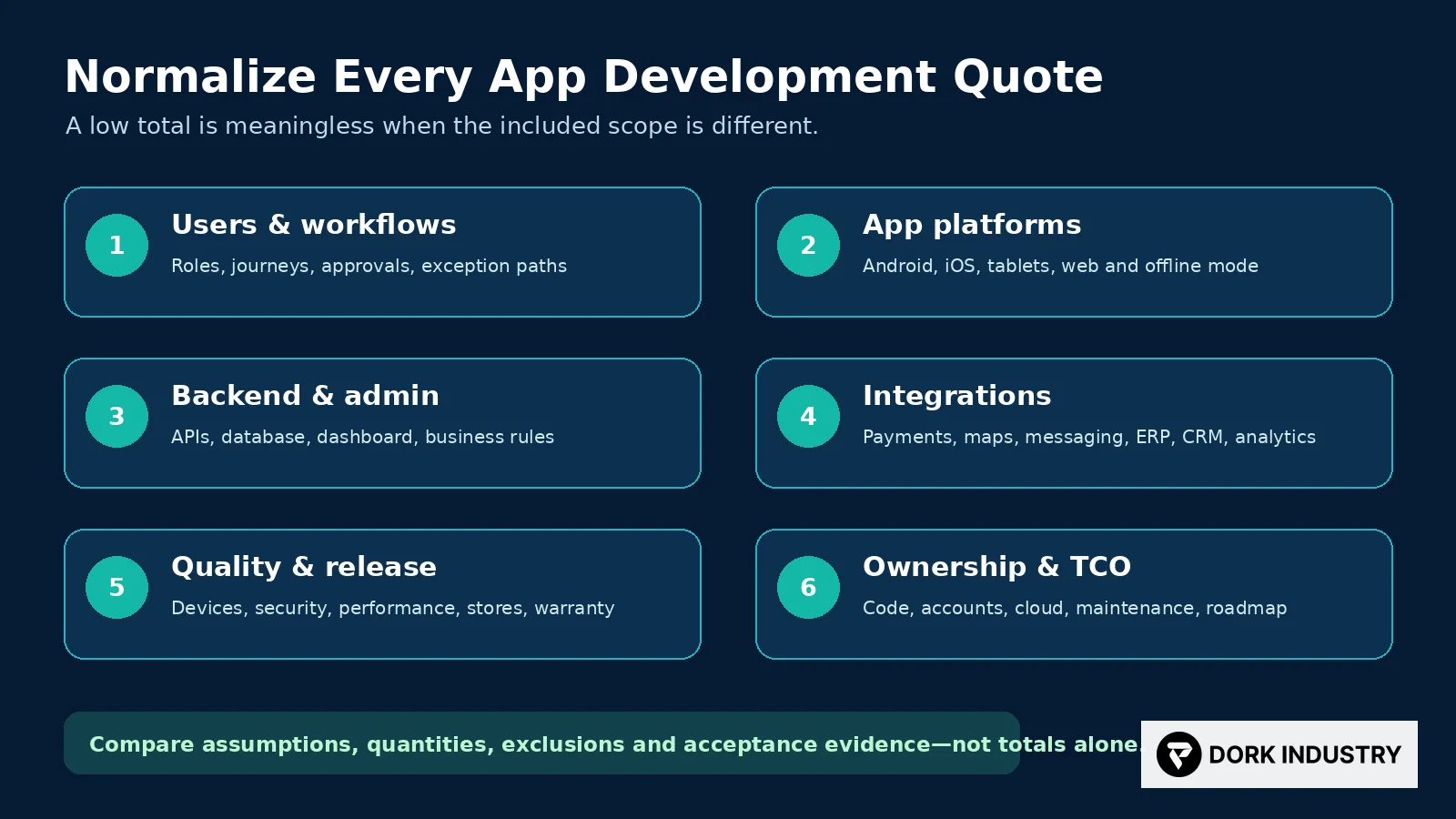
Create one row for every required capability and ask both vendors to mark it as included, excluded, assumption, client dependency or separately priced. Then compare these fields:
- User and workflow: role, trigger, happy path, exception path and completion evidence.
- Platform: supported operating systems, devices, browser/admin requirements and accessibility.
- Data: source, owner, migration volume, validation, retention, deletion and export.
- Integration: system, direction, frequency, error handling, reconciliation and sandbox readiness.
- Quality: device matrix, test types, performance targets, security requirements and defect warranty.
- Ownership: source code, designs, cloud accounts, store accounts, licences and reusable components.
- Delivery: milestones, acceptance evidence, change process, deployment and handover.
- Operations: monitoring, support hours, response targets, maintenance and enhancement capacity.
If a vendor cannot convert a proposal into this matrix, the price is not yet decision-ready.
Which exclusions usually create budget overruns?
- Admin portal, reporting and customer-support tools.
- Production-ready backend infrastructure and environment separation.
- Data migration, cleaning and reconciliation.
- Integration failure handling and operational monitoring.
- App-store assets, policy remediation and resubmission support.
- Third-party licences, messaging, maps, payment or AI usage charges.
- Security testing, privacy documentation and accessibility remediation.
- Source-code handover, build automation and knowledge transfer.
How should milestone payments and acceptance work?
A calendar date is not acceptance evidence. Each milestone should name the environment, test data, workflow, observable result, defect threshold and approver. A practical sequence is discovery approval, clickable workflow validation, architecture/integration spike, incremental working releases, user acceptance, store-ready release and operational handover.
Keep a meaningful final payment linked to repository access, build reproducibility, production credentials, documentation and knowledge transfer. If you are running a formal selection, use Dork Industry’s custom software RFP checklist to structure vendor evidence.
What is the three-year total cost of a mobile app?
Three-year total cost = initial build + cloud and licences + support and maintenance + store and compliance operations + internal administration + planned enhancements + contingency.
Ask vendors to separate fixed, usage-based and optional costs. Model at least a base, growth and downside scenario for users, transactions, storage, notifications, third-party APIs and support demand. A lower build quote can be more expensive if it creates high cloud consumption, proprietary dependency or repeated manual operations.
How can you reduce app cost without reducing quality?
- Choose one measurable business outcome and one primary user journey for the first release.
- Prototype the riskiest workflow or integration before committing to the complete build.
- Use established platform capabilities for standard identity, payments and messaging where appropriate.
- Move low-frequency operational tasks to a web admin portal instead of forcing every function into the app.
- Define analytics and support operations before launch so the team can learn from real use.
- Defer low-value variants, not testing, security, ownership or handover.
Get a decision-ready mobile app estimate
Send Dork Industry your workflow brief or two existing proposals. We can prepare a normalized scope, architecture assumptions, risk register, delivery options and three-year cost view before you hire.
Email: support@dorkindustry.com | WhatsApp: +91 8210792477
Frequently asked questions about mobile app development cost in India
What is the average mobile app development cost in India?
A focused MVP may fall around ₹4–10 lakh, while a production business app may require ₹10–25 lakh. Multi-role, integrated or regulated products can require ₹25–60 lakh or substantially more. Scope, risk, integrations and acceptance requirements determine the actual estimate.
Is Flutter cheaper than native mobile development?
Flutter can reduce duplicated interface and business-logic work when Android and iOS requirements are similar. It may not reduce cost when the app needs substantial native bridges, platform-specific behavior or unsupported device capabilities. Validate the hardest feature first.
How long does it take to build a mobile app?
A narrow prototype may take weeks; a production app commonly takes several months; a complex platform may need phased delivery. The credible schedule depends on decision speed, integration readiness, test coverage, store review and how much scope is truly fixed.
Does the quote include backend and admin development?
Never assume it does. Ask for separate line items covering APIs, database, identity, permissions, admin workflows, reporting, notifications, infrastructure, monitoring and production support.
How much should mobile app maintenance cost?
Maintenance should be estimated from the supported platforms, dependencies, cloud services, release cadence, monitoring, security updates and service levels. Ask for a capacity and response model rather than accepting an unexplained percentage of build cost.
Who should own the app source code and store accounts?
The commercial agreement should state ownership explicitly. For a custom-funded build, the client should normally control the repositories, cloud tenancy, store accounts, certificates, production credentials and paid third-party accounts, subject to agreed third-party licences.
Can Dork Industry compare an existing app-development proposal?
Yes. Dork Industry can compare scope, architecture, integrations, security, delivery evidence, ownership, support and three-year cost. The output can be used to clarify the current vendor or create a fair request for competing proposals.
What should you do before requesting a quote?
Write down the primary user, the operational problem, the successful outcome, required platforms, existing systems, sensitive data, critical exceptions and the date or event driving the project. Then ask each vendor to price the same normalized scope.
For a mobile app development cost assessment or quotation comparison, email support@dorkindustry.com or message Dork Industry on WhatsApp.
About the author: The Dork Industry Editorial Team creates implementation-focused guidance with input from mobile app, Flutter, Android, iOS, backend, API integration, cloud and automation practitioners. Recommendations are grounded in buyer requirements, current primary technical sources and practical delivery review.
Research note: Keyword and competitor research was completed on 18 October 2026. Keyword Planner figures are directional averages and can change by location, date and match behavior. Planning bands are Dork Industry estimates for early budgeting, not fixed quotations. Primary technical references include OWASP MASVS, Apple App Store Review Guidelines and Android app-quality guidance.