Custom software development for a hacked web application is not about adding features — it is about deciding, in the first hours, whether you recover or just repaint. Yes: a hacked web app can be cleaned up and hardened so the same attack does not work twice, but only if recovery follows a strict order — contain, diagnose, rebuild from clean — and the rebuild fixes the underlying weakness instead of restoring vulnerable code.
This article walks through what a hack actually costs, how break-ins usually happen, what to do in the first 72 hours, what the rebuild must change, what automation must never decide alone, and how to test the fix in a 30-day pilot before committing to a full rebuild.

What does a hacked web application actually cost?
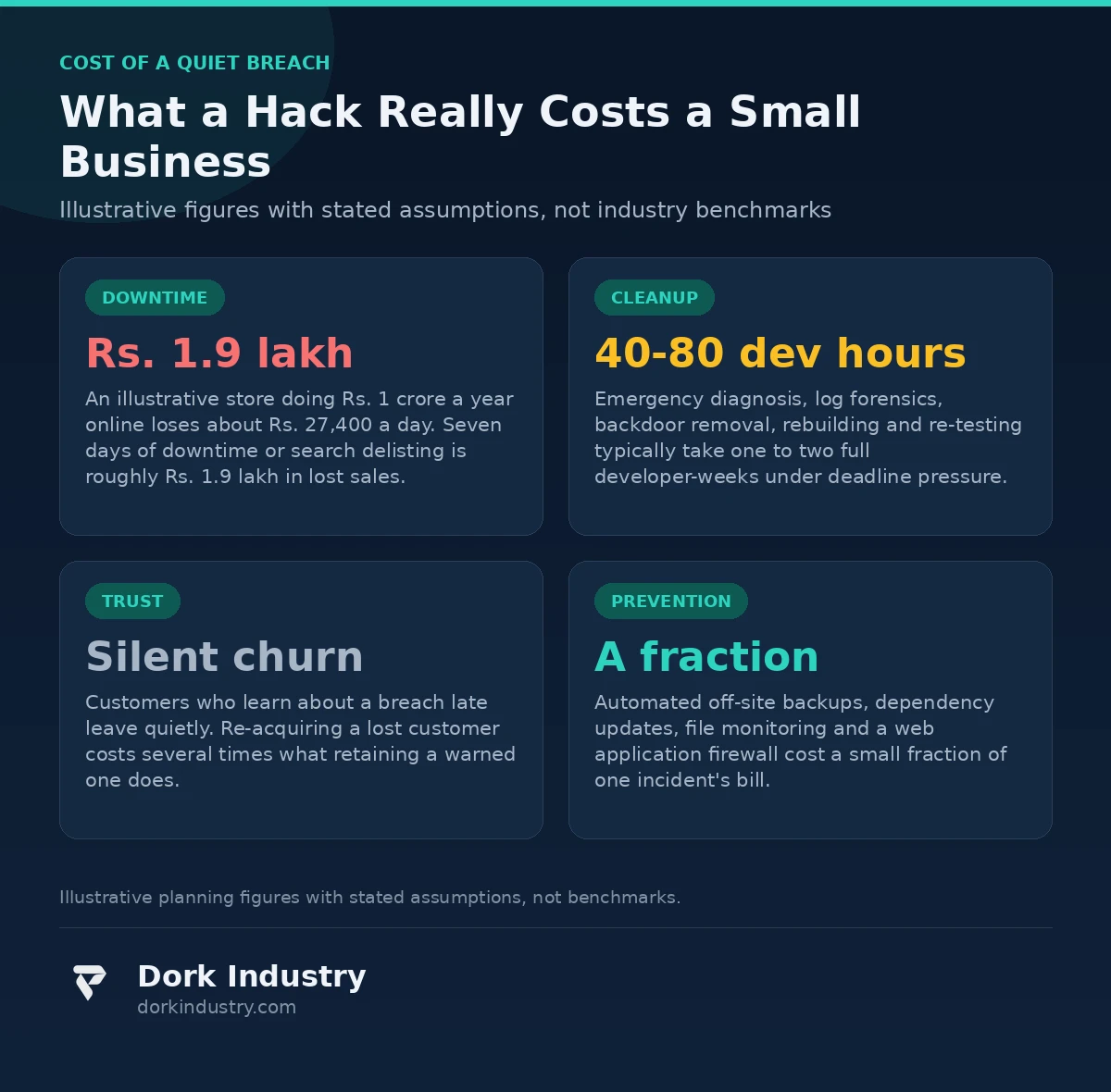
The invoice for emergency cleanup is usually the smallest line item. The expensive costs compound while the breach stays unresolved.
Why does downtime cost more than the fix?
Every day the application is offline, defaced, or flagged by browsers, it loses sales it will never recover. An illustrative online store doing ₹1 crore a year loses about ₹27,400 of sales a day it stays down or blacklisted — seven days is roughly ₹1.9 lakh gone, before a single developer hour is billed. These are illustrative figures with stated assumptions, not industry benchmarks.
Why is a Google “dangerous site” flag so damaging?
When a compromised site starts serving malware or spam, browsers warn visitors away and search listings carry the flag. According to Google’s hacked-site documentation, recovery means cleaning every infected page, verifying ownership, and requesting a review — and the flag stays until the review passes. Organic traffic built over years can collapse in days and take months to return.
What does stolen customer data cost?
If the application stored customer details, addresses, or payment references, the breach becomes a trust problem. Customers who learn about a compromise late — or from someone other than you — leave quietly. Re-acquiring a lost customer costs several times what retaining an honestly warned one does.
Why do repeat hacks cost more than the first one?
A first breach is an emergency. A second breach of the same application is a pattern — and patterns end vendor contracts, payment-processor relationships, and customer patience. The rebuild after the first incident is the cheapest chance you will get to stop the pattern.
How do web applications actually get hacked?
Most break-ins are not sophisticated. According to OWASP’s Top 10, the most common web application weaknesses are well documented — and attackers automate probes for them across millions of sites. The entry point is usually one of five doors left open.
Are unpatched plugins and dependencies the biggest risk?
For content-management systems and frameworks, yes. A known vulnerability in a popular plugin gets exploit code published within days, and bots scan for unpatched versions automatically. If the application’s dependencies have not been updated in a year, the attacker did not need skill — they needed a search engine.
What is SQL injection, and why does it still work?
SQL injection happens when an application builds database queries from raw user input — a login form, a search box, a URL parameter — without sanitizing it. An attacker types database commands into those fields and the application runs them. It is one of the oldest known web flaws and still compromises applications built without basic input validation.
How do attackers steal login credentials?
Shared admin passwords, passwords reused from other breaches, and logins with no second factor are still common. Attackers automatically try leaked username-password pairs against admin panels — a technique called credential stuffing. One reused password is often all it takes.
How do hackers stay inside unnoticed?
The first payload is often a “web shell” — a small hidden file that gives the attacker a remote console inside your server. From there they read files, add backdoor accounts, and return even after passwords change. This is why changing passwords alone never fixes a hack.
What should you do in the first 72 hours?
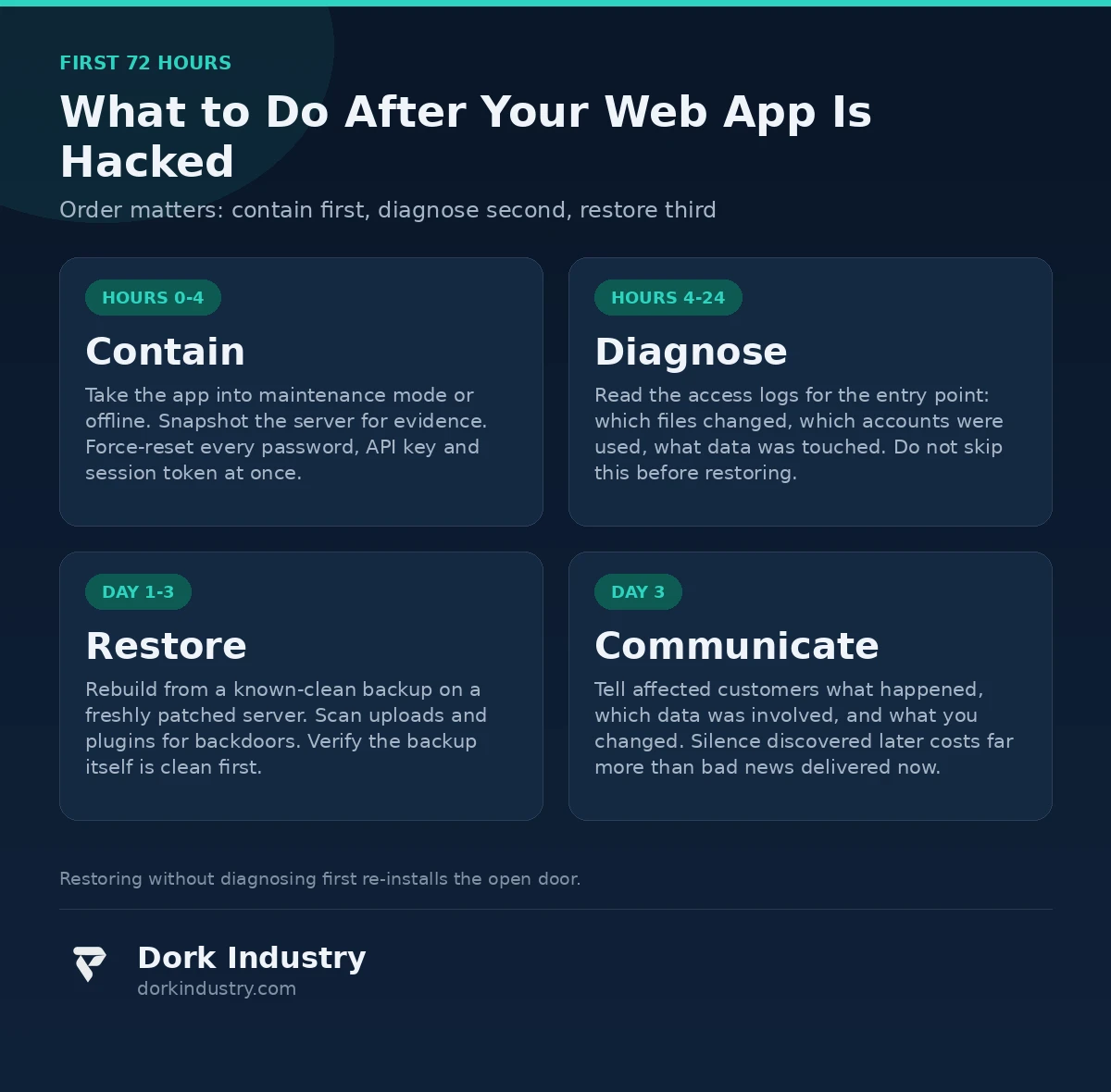
Order matters more than speed: restoring before finding the entry point re-installs the open door.
Hours 0–4: How do you contain the damage?
- Put the application into maintenance mode or take it offline — stop serving visitors a compromised site
- Take a full snapshot of the server first; it is your evidence and your rollback
- Force-reset every password, API key, session token, and database credential at once — assume all are compromised
Hours 4–24: How do you find the entry point?
- Compare file modification times against your last known-good state — files changed at odd hours are suspects
- Read the web server access logs for the days before discovery; look for requests to unusual URLs or repeated probes
- List admin and database users for accounts you did not create
- Check what data was touched: customer tables, order records, uploaded files
Days 1–3: How do you restore safely?
- Rebuild on a freshly patched server — do not restore onto the compromised one
- Restore only from a backup that predates the earliest sign of intrusion, and scan it before it goes live
- Scan uploads, media folders, and plugin directories for web shells and backdoor code
- Bring the application up behind a web application firewall before reopening it to traffic
Day 3: When do you tell your customers?
As soon as you know which data was involved. Say what happened, which data was affected, and what you changed. Silence discovered later costs far more than bad news delivered now.
What data do you already have to find the entry point?
You rarely need expensive forensic tools. The evidence is usually sitting in logs nobody has read.
- Web server access logs: every request, timestamped — the attacker’s footprints are here
- File modification times: files changed at 3 AM by nobody on your team are the payload
- Admin and database user lists: backdoor accounts stand out immediately
- Backup timestamps: your last backup before the first suspicious change is your restore point
- Payment gateway and email logs: show whether the attacker used your integrations (sending spam, testing stolen cards)
If your application does not keep access logs or track file changes, that is the first gap the rebuild must close. You cannot diagnose what you cannot see.
How does custom software development rebuild it safely?
A cleanup removes the intruder. Custom software development removes the reason the intruder got in — which packaged fixes cannot do. The rebuild must change the architecture, not just the files.
What does a clean-room rebuild actually change?
- Dependency updates: framework, plugins, and libraries moved to patched versions — with a process that keeps them patched, not a one-time update
- Input validation everywhere: every form field, URL parameter, and API input is validated and sanitized; database queries use parameterized statements so injected commands cannot execute
- Authentication hardening: unique admin credentials, enforced second-factor login, and lockout after repeated failed attempts
- Least-privilege access: the database user can only do what the application needs — no file-system access, no admin rights
- Secrets management: API keys and credentials moved out of code into a managed secrets store
- Upload restrictions: uploads limited by type and size, stored outside the web root, scanned before serving
What monitoring must the rebuild include?
- File-integrity monitoring that alerts when application files change unexpectedly
- Failed-login and anomaly alerting on admin panels
- Automated off-site backups with tested restores — a backup you have never restored is a hope, not a plan
- Security headers (CSP, HSTS, X-Frame-Options) configured at the server level
- A web application firewall in front of the application, with rules tuned to its actual traffic
Why is “just restore the backup” not enough?
A backup restores the application’s state — including the vulnerable code that caused the breach. Restoring without fixing the weakness is scheduling the next incident. The honest question is never “how fast can we go back online” but “what are we changing before we do”.
What must the system never do alone?
Automation and AI belong in recovery — alerting, log triage, pattern detection — but hard boundaries matter when every decision is hard to reverse.
- Never auto-delete customer data during cleanup. Quarantine suspicious records; a human decides what is evidence and what is safe to remove.
- Never restore from a backup without human verification that the backup predates the intrusion. An automated restore can re-deploy the attacker’s code.
- Never let monitoring silently take the site offline without a human in the loop. False positives during a recovery destroy customer confidence a second time.
- Never hide a breach behind automation. Customer notification is a human decision about wording, timing, and responsibility — no system should decide who gets told.
- AI should triage, not judge. “These 14 requests at 3:12 AM match a known attack pattern — review them” is useful. Letting a model decide which customer accounts to suspend is not.
Should you repair, rebuild, or buy? An honest breakdown
Not every hacked application needs custom software development to recover. The honest options, in order of investment:
| Approach | Best for | Relative investment | Where it breaks |
|---|---|---|---|
| Hardened repair | Standard CMS sites with a known, patched vulnerability | Lowest | Leaves custom code and old architecture untouched |
| Managed WAF + monitoring service | Buying time while planning the rebuild | Low subscription | Shields the symptom; the weak code still exists |
| Custom rebuild on the same platform | Custom applications worth keeping | Medium | Needs developers who understand both the old code and the attack |
| Full custom software development | Business-critical apps, customer data at stake, repeat incidents | Highest | Overkill for a brochure site with no transactions |
At Dork Industry, we regularly advise against full rebuilds when a hardened repair plus monitoring will genuinely hold. A credible technology partner should tell you when the cheaper option is enough — if every assessment ends with a full-rebuild quotation, get a second opinion. For applications that crash under load rather than attacks, our web development services cover the performance side of the same discipline.
How do you test the fix in 30 days before full investment?
A full rebuild is a significant commitment. The pilot proves the approach on a bounded scope first:
- Week 1 — containment audit: snapshot, log review, entry-point identification, and a written incident report
- Week 2 — hardened rebuild of one module: the breached component rebuilt with input validation, patched dependencies, and second-factor authentication
- Week 3 — monitoring proof: file-integrity alerts, failed-login detection, and a test restore from backup
- Week 4 — attack simulation: controlled probes against the rebuilt module to verify the original entry point is closed
If the rebuilt module cannot withstand a controlled re-test of the original attack, the architecture is wrong — and you learn that in 30 days instead of after a second breach. This is the assessment Dork Industry runs before quoting any recovery project: name the entry point, fix it in one module, prove it holds, then scope the rest.
What actually drives the cost of the recovery?
Recovery pricing varies because scope does. The real cost drivers are:
- Breach depth: a defaced homepage vs a database exfiltration vs planted backdoors across the server — forensics time scales with depth
- Backup quality: clean, recent, tested backups cut the rebuild to days; no usable backup means rebuilding from scratch
- Codebase age: applications on end-of-life frameworks or PHP versions need migration, not just patching
- Data obligations: customer data exposure adds notification, evidence preservation, and documentation work
- Integration surface: payment gateways, SMS providers, and third-party APIs each need key rotation and re-testing
- Monitoring depth: basic alerting vs full file-integrity monitoring, WAF tuning, and backup-restore drills
Anyone quoting a fixed cleanup price without asking about backups, framework versions, and what data was touched is guessing.
Frequently asked questions
How do I know my web application was hacked?
Common signs: visitors see strange redirects or spam content, browsers flag the site as dangerous, the admin password stops working, unknown admin accounts appear, traffic spikes to odd URLs, or customers report suspicious emails sent in your name. Check file modification times and access logs first — the evidence is usually there.
Should I just restore from backup and move on?
Only if the backup predates the intrusion and you have fixed the entry point. Restoring a vulnerable application is scheduling the next breach. At minimum, identify how the attacker got in, patch that weakness, scan the backup for backdoors, and rebuild on a patched server.
How long does recovery take?
Containment and diagnosis typically take 1–3 days. A hardened rebuild of the affected components runs 3–6 weeks depending on codebase age and breach depth. A full architectural rebuild of a business-critical application is a 2–4 month program — which is why the 30-day pilot exists.
Can a web application firewall alone stop the next attack?
A WAF blocks known attack patterns and buys time, but it shields the symptom. If the underlying code still accepts unsanitized input or runs outdated dependencies, a new attack variant will get through. Use a WAF as one layer of the rebuild, not as the recovery.
What does a security audit cover before any rebuild?
We examine access logs, file changes, admin accounts, and backup integrity to identify the entry point; review the codebase and dependencies for known weaknesses; and deliver a prioritized fix list with a 30-day pilot scope. You walk away with the evidence, the numbers, and an honest repair-vs-rebuild recommendation. Request a free application security audit to start.
The bottom line
The question after a hack is not “how fast can we restore the backup” but “what are we changing before we go back online”. A recovery that skips diagnosis restores the open door; a rebuild that skips architecture hardens nothing. The businesses that keep their customer trust contained it fast, found the entry point honestly, rebuilt the weakness instead of repainting it, and told customers what happened plainly.
Start with the 72-hour discipline, prove the fix on one module in 30 days, and let a controlled re-test of the original attack — not a feature list — decide whether the full custom software development rebuild earns its cost.
Get a free application security audit for your hacked web application
We examine your access logs, file changes, admin accounts, and backup integrity to identify exactly how the attacker got in. You walk away with a written incident report, a prioritized fix list, a 30-day pilot scope, and an honest repair-vs-rebuild recommendation.
Request your free application security audit WhatsApp +91 8210792477
About Dork Industry
Dork Industry (dorkindustry.com) is a custom software development company building web platforms, mobile apps, AI automation, and IoT systems for businesses across India. Our team handles incident response, application hardening, and secure rebuilds — from 72-hour containment audits to full production rebuilds. Explore our custom software development services for the full scope.