
Mobile app development can fix onboarding drop-off — but only when it starts with measurement, not redesign. Yes: a disciplined rebuild of the first 72 hours of a user’s journey can lift activation and 30-day retention measurably, provided you instrument the funnel first, give the first session one clear job to finish, defer permission requests until the moment of need, and add a nudge sequence for users who stall. An app that is downloaded and never opened again does not have a marketing problem. It has a first-impression problem, and first impressions in software are fixable engineering problems — if you can see exactly where users leave.
This article examines why users vanish between install and the second open: the four leaks that kill first sessions, the data you already generate but never look at, the concrete mobile app development interventions that work, what automation must never do alone, when a rescue is cheaper than a rebuild, and how to test all of it in 30 days before committing to a full investment.

Where do apps actually lose users after install?
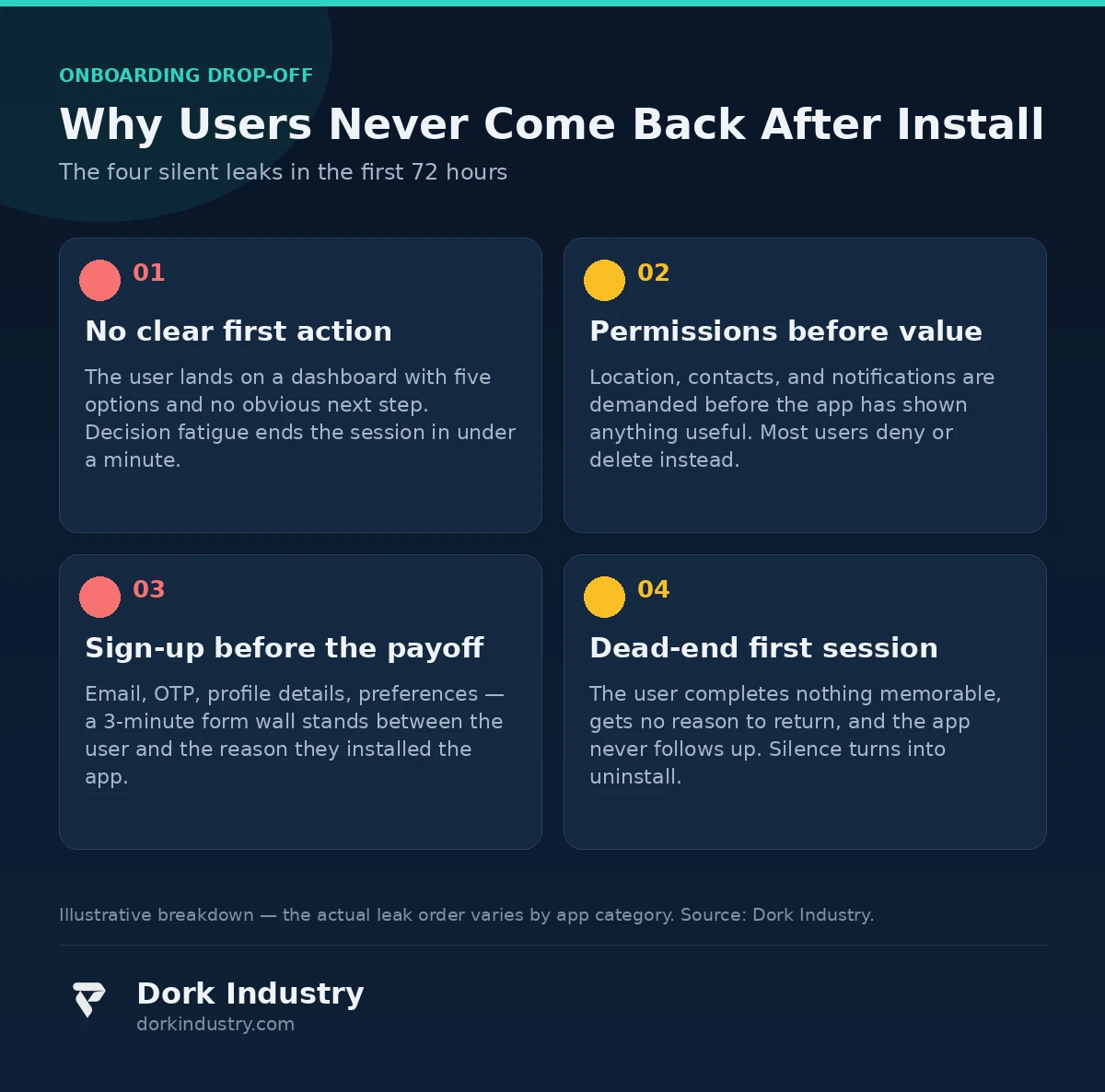
Onboarding drop-off is rarely one dramatic failure. It is a series of small exits: a screen that confuses, a prompt that arrives too early, a form that asks too much, and silence afterwards. Each one alone loses a fraction of users; together they compound into an install base that never activates. Before discussing technology, it is worth naming the specific leaks — because each demands a different fix.
Why does the first screen fail?
The user opens the app to a dashboard with five options and no obvious next step. Every untaken decision is an exit opportunity: research in onboarding design consistently shows that the first session succeeds when the app hands the user one clear job — one button, one task, one payoff. A dashboard is for day 30. Day 0 needs a doorway.
Why do permission prompts kill installs?
Location, contacts, and notification permission are demanded before the app has demonstrated anything useful. According to Google’s documentation on requesting app permissions, developers should request permissions in context — at the moment the user needs the feature — because requests that appear unrelated to the current task are the ones users deny. A denied notification permission is often a permanently lost re-engagement channel.
Why does sign-up come before the payoff?
Email, OTP, profile details, preferences — a three-minute form wall stands between the user and the reason they installed the app. Every field is friction; every field is a place to quit. The apps that retain let the user experience the core value first and collect identity later, at the point where an account genuinely adds something (syncing, saving, purchasing).
Why does the first session end in silence?
The user completes nothing memorable, gets no reason to return, and the app never follows up. According to Apple’s Human Interface Guidelines on onboarding, onboarding should get people to content or functionality quickly, with as little input as possible — and crucially, the session should end with a reason to come back. An app that goes quiet after a stalled first session has abandoned the user, not the other way around.
What data do you already have — and what is it missing?
Most app owners have almost no onboarding data and believe they have plenty. What they usually have is aggregate vanity numbers: total installs, total users, maybe a crash rate. What they need — and usually lack — is a screen-by-screen event funnel: which percentage of fresh installs reaches each screen, how long each step takes, where permission dialogs are denied, and how many users return within 24 and 72 hours. According to Firebase’s analytics documentation, event-based tracking can be wired into a first session in days, not months — the instrumentation itself is the cheapest part of any mobile app development rescue.
The principle is the same one behind our work on other operational apps, like the multi-location gym management platform we designed: design the data capture around the workflow people already follow, and the owner can finally see the business. Here the “business” is the funnel. If you cannot quote your activation rate, your day-1 retention, and your permission-denial rate from memory, you are redesigning blind.

What does the math look like? An illustrative example
Consider a consumer app spending ₹6 lakh a month on user acquisition, driving 20,000 installs at ₹30 per install. If only 35% of installers ever complete the first meaningful action (activation), the business is effectively paying for 20,000 installs to get 7,000 real users — a true cost of roughly ₹86 per activated user. If onboarding fixes lift activation from 35% to 50%, those same 20,000 installs yield 10,000 activated users: 3,000 extra users every month at zero additional ad spend, equivalent to ₹1.8 lakh a month in acquisition value recovered.
Retention multiplies the effect. Suppose day-30 retention moves from 8% to 14% through a better first week and a nudge sequence. Over a year of 20,000 monthly installs, that six-point lift compounds into tens of thousands of additional monthly active users — the audience that subscription, in-app purchase, or advertising revenue actually monetizes. These are illustrative figures with stated assumptions, not industry benchmarks; your activation rate, CPI, and retention curve will differ. But the math structure is universal: in onboarding work, you are buying users you already paid for, at a fraction of their acquisition cost.
What should mobile app development actually change in the first session?
Fixing onboarding is not a redesign project. It is a small set of concrete interventions, each mapped to one of the leaks above. The order matters: measure first, then remove friction, then add the nudge back.
How do you design the first 60 seconds?
Give the first session exactly one job to finish — the smallest version of the app’s core value. A fitness app should start a first workout, not ask for a fitness goal. A finance app should show one insight from one connected account, not demand a full profile. The “aha moment” must arrive before the second minute, with one primary button on every screen. Everything else — settings, profile, discovery — moves to day 2 and beyond.
When should the app ask for permissions?
Only at the moment of need, with one sentence of context explaining why. A delivery app asks for location when the user taps “find food near me,” not on the welcome screen. This is not just good manners — it is platform policy moving in this direction, and denied permissions permanently close channels you will need later for re-engagement. Audit every permission prompt in your current flow and move each one to the screen where its value is obvious.
How do you collect profile data without a form wall?
Progressive profiling: ask for one piece of information at the time it unlocks something. Name and email at account creation; preferences when personalization visibly improves; phone number when OTP-gated features are touched. Each request should feel like a trade — data for visible value — never like paperwork. If a field is not used by any feature within the first week, delete it from onboarding entirely.
How do you bring stalled users back?
A short, respectful sequence: a push notification at 24 hours reminding them where they left off (deep-linked to that exact screen), an email at 72 hours offering a shortcut to finish setup, and a human message at day 7 — a support-style check-in, not a discount blast. The goal is re-entry into the flow, not a generic “we miss you.” Cap the sequence; a user who ignores three nudges needs a different product conversation, not a fourth push.
What should the app never do alone?
Automation boundaries in mobile app development matter as much as features — especially where re-engagement touches real people.
- Never shame or guilt-trip lapsed users. “You haven’t worked out in 9 days” feels like surveillance. Nudges should offer a next step, not report on the user’s failures.
- Never auto-enroll users in notification-heavy programs based on predicted interest. Opt-in beats opt-out for trust, and a user who disables all notifications is harder to win back than one who never enabled them.
- Never let algorithms decide who gets human help. Flag stalled high-value users for a human check-in; do not let a churn model silently write anyone off.
- Never personalize with data the user did not knowingly give. A welcome-back message referencing inferred details (“noticed you’re in Mumbai”) destroys trust faster than any bug.
- Never send more than three unanswered nudges in a single sequence. Persistence past that point is spam, and spam trains users to ignore everything you send.
Should you rebuild or fix the existing app? An honest breakdown
Not every drop-off problem needs a rebuild. Most onboarding rescues are surgical changes to an existing app — and any honest mobile app development partner will say so before quoting. The options, in order of investment:
| Approach | Best for | Relative investment | Where it breaks |
|---|---|---|---|
| Funnel instrumentation only | You have no idea where users leave | Minimal | Measurement without action changes nothing |
| Onboarding flow redesign | Clear leaks, healthy core product | Low–medium | Cannot fix an app users do not value |
| Full UX + analytics overhaul | Multiple leaks plus blind spots in data | Medium | Takes 6–10 weeks; needs real user volume to validate |
| Full app rebuild | Legacy codebase, broken architecture, or a dead product | Highest | Overkill when the product works and only the first session fails |
At Dork Industry, we regularly advise against rebuilds when a flow redesign will do. A credible technology partner should be willing to tell you that your app does not need rebuilding — only its first 72 hours do. If every consultation ends with a quotation for a full rewrite, get a second opinion.
How do you test it in 30 days before full investment?
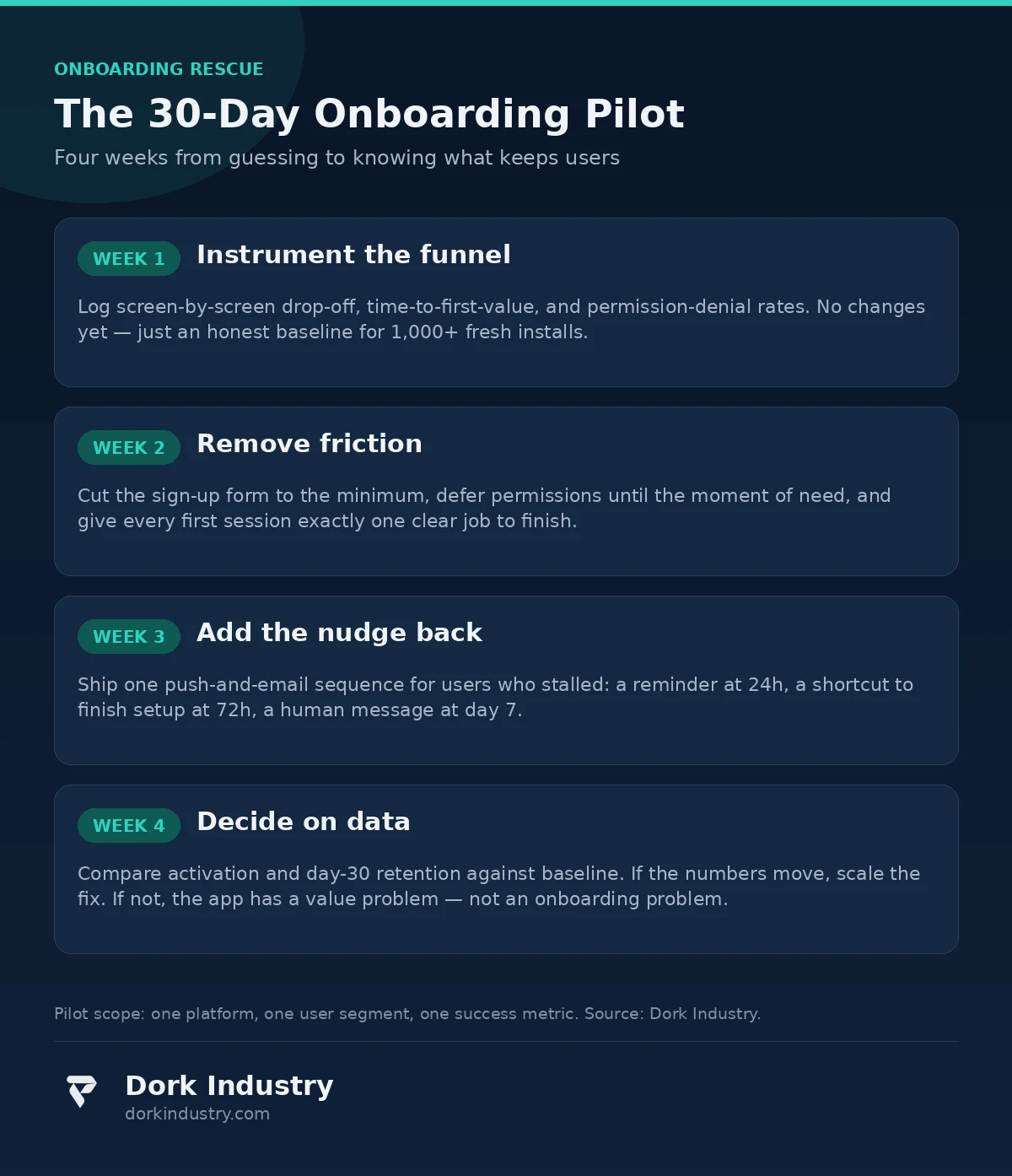
The lowest-risk path is a single-segment pilot with a fixed scope and measurable outcomes — the same discipline we recommend for every custom software development engagement:
- One platform (the one with the most installs), one user segment, one success metric: activation rate
- Week 1: instrument the funnel — screen-level events, permission denials, time-to-first-value
- Week 2: ship the friction removals — one clear first action, deferred permissions, progressive profiling
- Week 3: ship the nudge sequence — 24h push, 72h email, day-7 human check-in
- Week 4: compare against baseline and decide
Measure: activation rate, day-1 and day-7 retention, permission-denial rate, and time-to-first-value — against the week-1 baseline. If activation and early retention do not move, the app has a value problem, not an onboarding problem, and no amount of mobile app development polish will fix it. The pilot validates the product hypothesis, not just the flow. This is the assessment Dork Industry runs before quoting any onboarding project: map the current funnel, name the leaks, then decide what software earns its cost.
What actually drives the cost of an onboarding rescue?
Onboarding rescue pricing varies because scope does. The real cost drivers are:
- Analytics state: an app with event tracking in place starts week 2 immediately; one without it needs instrumentation first
- Platforms: Android only vs Android + iOS vs a cross-platform codebase — each multiplies testing, not just code
- Permission and notification plumbing: push providers, deep links, email sequences, and the consent logic around them
- Backend dependencies: whether activation events, user states, and nudge triggers need new APIs or already exist
- Experimentation setup: feature flags and A/B testing so each change can be measured rather than shipped on faith
Anyone quoting a fixed price without asking about your current analytics, platforms, and backend event support is guessing.
Frequently asked questions
Can mobile app development really fix onboarding drop-off, or is it a product problem?
Both can be true, and the funnel tells you which one you have. If users complete the first session but never return, onboarding fixes help. If most users never finish the first meaningful action, test whether the core value is clear at all — a pilot that measures activation before and after flow changes answers this in 30 days.
How long does an onboarding rescue take?
A 30-day pilot (instrument, de-friction, nudge, decide) is the standard first engagement. A full flow redesign with analytics, both platforms, and experimentation setup typically runs 6–10 weeks depending on backend dependencies.
Do we need to rebuild the app to fix onboarding?
Almost never. Most rescues are surgical: reordering screens, deferring permission prompts, replacing the sign-up wall with progressive profiling, and adding a re-engagement sequence. A rebuild is only justified when the codebase itself cannot support the changes.
What metrics prove the onboarding fix worked?
Activation rate (installs that complete the first meaningful action), day-1 and day-7 retention, permission-denial rate, and time-to-first-value — each measured against a pre-change baseline. Vanity metrics like total installs are irrelevant to onboarding quality.
Will push notifications annoy users and cause uninstalls?
They will if they are generic, frequent, or sent without consent context. A short, deep-linked sequence (24h, 72h, day 7) that resumes exactly where the user left off typically re-engages without backlash. More than three unanswered nudges is spam — cap the sequence.
The bottom line
The question is not whether users like your app. It is whether your app gives a new user one clear thing to do in the first 60 seconds, asks for nothing before proving value, and follows up when they stall. Users who download and never come back are not rejecting your product — they never met it. The funnel was the introduction, and the introduction failed.
Start by instrumenting what you have, fix one leak at a time for 30 days, and let activation and early-retention numbers — not redesign opinions — decide whether mobile app development for onboarding earns its place in your roadmap.
Request Your Free UX & Onboarding Audit
Wondering where your installs actually go? In a free audit, we instrument your first-session funnel, name the exact screens and prompts where users leave, and show you the 30-day fix sequence we would run first — with the math on what recovered activations are worth to your acquisition budget.
Request your free UX & onboarding audit WhatsApp +91 8210792477
About Dork Industry
Dork Industry (dorkindustry.com) is a custom software development company building mobile apps, AI automation, and IoT systems for businesses across India. Our team designs onboarding flows, retention analytics, and re-engagement systems — from 30-day funnel audits to full app builds and rescues.