Mobile app development for multi-location gyms is rarely about the app itself — it is about whether the owner can see the business. Yes: one well-designed app can give a gym owner centralized control over memberships, renewals, trainer operations, payments, and branch profitability, provided it is designed around staff workflows and piloted in one branch before full rollout. A gym owner with three branches faces a problem no amount of hiring solves: they cannot be in three places at once. Renewals slip through cracks, trainers run members through personal WhatsApp chats the owner never sees, and nobody can say which branch — or which trainer, or which plan — is actually profitable.
This article examines whether a mobile app can give a gym owner real operational control across locations: what it must do, what data it needs, what it should never do, and how to test the idea in 30 days before committing to full development.

Where do multi-location gyms actually lose money?
Before discussing technology, it is worth naming the specific leaks. In our experience working with fitness businesses, the expensive problems are rarely about equipment or rent. They are about information that never reaches the owner.
Why are membership renewals missed?
Expiring memberships are not followed up systematically. Front-desk staff remind members when they remember. Trainers mention it in passing. Every missed renewal is revenue that walked out the door. Winning that member back costs far more than retaining them.
Why do trainers run the business on personal WhatsApp?
Workout plans, diet charts, session rescheduling, and payment nudges live in trainers’ personal chats. When a trainer leaves, their member relationships leave with them. The owner has no visibility into follow-ups. There is no record of commitments made and no way to ensure consistent service.
Why is branch profitability invisible?
Revenue is known. But which branch earns it, which membership plans drive it, which trainers retain members, and which expenses eat it — that picture is usually assembled monthly in a spreadsheet, weeks too late to act on.
Why are trial visitors forgotten?
A prospect takes a trial session, shows interest, and is never followed up because no system owns the lead. Trial-to-membership conversion is one of the highest-leverage numbers in a gym business. Most gyms cannot even measure it.

What must mobile app development deliver for a multi-location gym?
A generic “gym app” with a class schedule and a logo is not the answer. An app that gives an owner control needs to cover five operational areas.
What should the owner see every morning?
- Today’s attendance across all branches, in one view
- Active, expiring, and expired memberships with renewal status
- Pending payments and failed transactions
- New leads and trial visits, with follow-up ownership
- Branch-wise revenue and expense snapshots
- Trainer-wise retention and session numbers
How should membership and billing work?
- Branch-specific and cross-branch membership plans
- Automated renewal reminders (SMS, WhatsApp, push) before expiry
- Online payment links and reconciliation with actual receipts
- Freeze, transfer, and upgrade workflows with approval trails
- GST-compliant invoicing for Indian gym businesses
How do trainer operations move out of personal WhatsApp?
According to Meta’s WhatsApp Business Platform documentation, businesses can send structured template messages — renewal reminders, payment updates, appointment confirmations — at scale through the official API. This is the compliant way to do what trainers already do informally: the gym keeps the conversation history, the member relationship belongs to the business, and nothing depends on a trainer’s personal phone.
- Session scheduling and attendance marking
- Workout and diet plan delivery inside the app — not personal WhatsApp
- Member progress photos and measurements, stored against the member record
- Follow-up task lists: who to call, who missed sessions, whose plan needs updating
- Trainer performance visibility for the owner without micromanagement
What keeps members from leaving?
- Attendance-drop alerts: members whose visit frequency is falling
- Win-back campaigns targeted at the right segment, not blast offers to everyone
- Renewal propensity signals combining attendance, payment history, and engagement
How is multi-branch administration handled?
- Central membership plans with branch-level overrides
- Cross-branch member access rules
- Central lead allocation with branch assignment
- Franchise-level reporting and permissions
- Equipment maintenance logs per branch
What data does your gym already have — and what is it missing?
Most gyms already generate the raw material: attendance registers (even paper ones), payment receipts, trainer notebooks, WhatsApp histories. What is missing is structure. The data is not connected, timestamped, or owned by the business.
A management app does not create new work for staff, and that principle should guide any mobile app development for gyms: It captures the work they already do — check-ins, payments, session notes — in a form the owner can actually use. The most common implementation failure is designing for the owner’s dashboard while making data entry painful for trainers and front-desk staff. If the people entering data do not benefit from the app, the data will be incomplete within weeks.
What does the math look like? An illustrative example
Consider a 3-branch gym with 1,500 active members paying an average of ₹2,500 per month. That is ₹37.5 lakh in monthly membership revenue. If just 5% of renewals slip through poor follow-up each year — 75 members — the gym loses roughly ₹22.5 lakh in annual revenue, before counting the higher cost of acquiring replacements. These are illustrative figures with stated assumptions, not industry benchmarks. But they show why renewal leakage is usually the first problem worth fixing: a 2-percentage-point improvement in renewal rate is worth ₹9 lakh a year to this gym.
Trial conversion carries similar leverage. If a branch sees 40 trial visitors a month and converts 10 of them, that is a 25% conversion rate. A system that assigns every trial to a staff member, reminds them to follow up, and tracks the outcome — lifting conversion to 35% — adds 4 members per month per branch. At ₹2,500 a month, that is ₹1.2 lakh in additional annual revenue per branch, from follow-up discipline alone.
Should you build or buy? An honest breakdown
Not every gym needs custom mobile app development. The honest options, in order of investment:
| Approach | Best for | Relative investment | Where it breaks |
|---|---|---|---|
| WhatsApp + spreadsheets | A single small gym with under 200 members | Minimal | Breaks the moment you add a second branch |
| Off-the-shelf gym software | Standard billing, attendance, and basic CRM | Low subscription | Cannot model unusual workflows |
| White-label member app | Branded experience without building | Medium | You inherit their roadmap and limitations |
| Custom mobile app development | Multi-branch, franchise, or unique workflows | Highest | Overkill for a single standard gym |
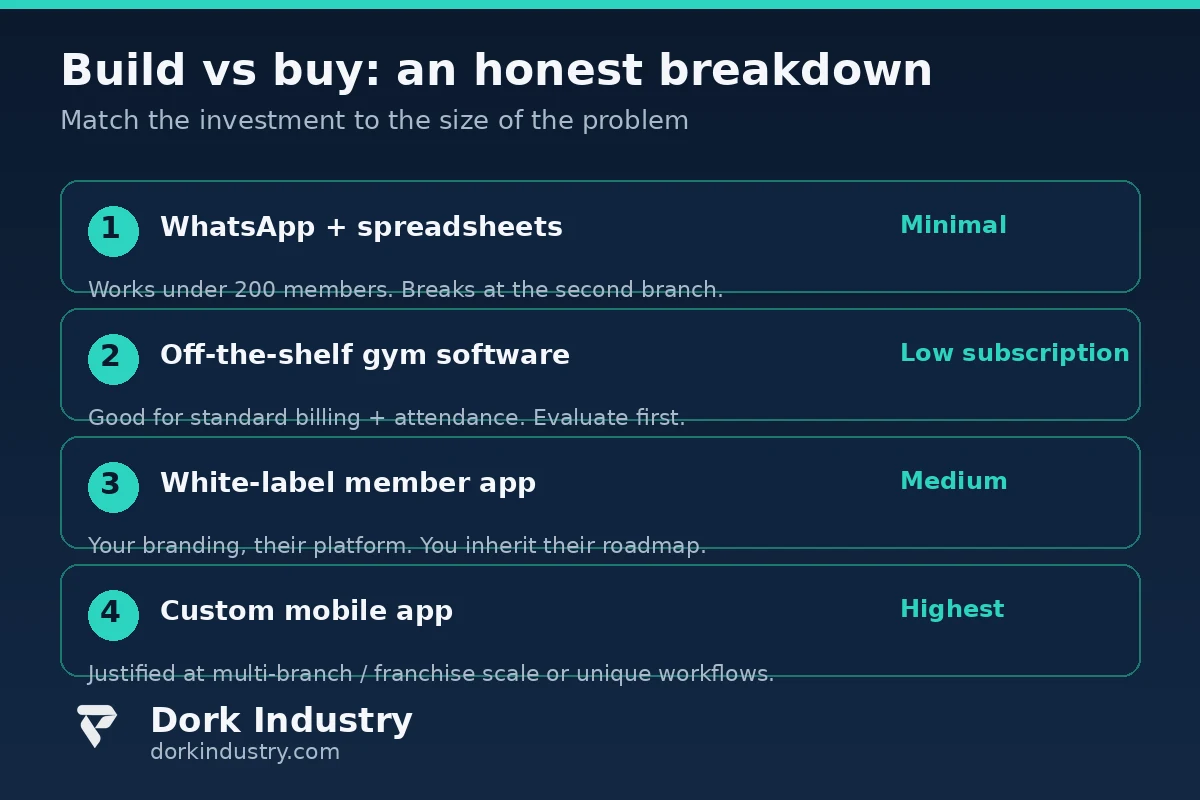
At Dork Industry, we regularly advise gyms against custom builds when packaged software fits. A credible technology partner should be willing to tell you that you do not need custom development. If every consultation ends with a quotation for a custom app, get a second opinion.
What should the app never do?
Technology boundaries in mobile app development matter as much as features — especially where AI enters the picture.
- Never auto-cancel or penalize members based on attendance algorithms. Flag at-risk members for human follow-up. Do not let software end relationships.
- Never expose trainer performance rankings publicly among staff. Performance data is a management tool, not a leaderboard.
- Never send automated messages that feel robotic. A renewal reminder should read like it came from the gym, with a human name attached and a human to reply to.
- Never lock member data into a format you cannot export. Your member list is a business asset. Any platform must offer full data export.
- AI should prioritize follow-ups, not label members. “These 12 members show declining attendance — consider a check-in call” is useful. Scoring members as “likely to quit” in a visible profile is not.
How do you test it in 30 days before full investment?
The lowest-risk path is a single-branch pilot with a fixed scope and measurable outcomes:
- One branch, one membership type, 20–50 members
- Member login, digital attendance, renewal reminders, trainer schedules, payment links, owner dashboard
- Run for 30 days
- Measure: renewal rate vs the previous 30 days, trial-to-member conversion, trainer follow-up completion, owner time spent on admin
If renewals and follow-ups do not measurably improve in the pilot, a bigger mobile app development investment will not fix it either. The pilot validates the workflow, not just the software. This is the assessment Dork Industry runs before quoting any gym project: map the current process, name the leaks, then decide what software earns its cost.

What actually drives the cost of gym mobile app development?
Gym app pricing varies widely because scope does. The real cost drivers are:
- Branches and roles: single gym vs multi-branch with franchise permissions changes the data model significantly
- Payment integration: UPI, cards, recurring mandates, and reconciliation logic — UPI is India’s dominant retail digital payment rail (see NPCI’s UPI product page and the Unified Payments Interface overview), so UPI intent flows and mandate handling are non-negotiable
- Communication channels: SMS, WhatsApp Business API, and push notification setup and templates
- Hardware integration: biometric or RFID attendance devices, if required
- Platforms: Android only vs Android + iOS vs Flutter cross-platform
- Analytics depth: basic reports vs retention modeling and forecasting
Anyone quoting a fixed price without asking about branches, payment flows, and attendance hardware is guessing.
Frequently asked questions
Does a gym need a custom app, or is gym management software enough?
For a single branch with standard billing and attendance needs, configured gym software is usually enough and far cheaper. Custom development earns its cost at multi-branch scale, with franchise models, or when your workflows do not fit packaged software.
How long does gym mobile app development take?
A focused pilot (one branch, core workflows) can be live in 4–6 weeks. A full multi-branch platform with payments, hardware integration, and analytics typically runs 3–6 months depending on scope.
Can the app reduce dependence on trainers’ personal WhatsApp?
Yes — and this is one of the highest-value outcomes. Moving plans, scheduling, and follow-ups into the business’s own app means member relationships belong to the gym, not to individual trainers’ phones.
What does a gym app pilot cost?
A single-branch pilot with core workflows (attendance, renewals, payments, owner dashboard) is a fraction of a full build. The pilot’s job is to prove measurable improvement in renewals and follow-ups before larger investment. Request a pilot scoping call for a concrete estimate.
Will members actually use the app?
Adoption follows value: if the app gives members easy booking, visible progress, and one-tap renewal, they use it. If it is just a digital notice board, they will not. Design the member side around their incentives, not the owner’s reporting needs.
About Dork Industry
Dork Industry (dorkindustry.com) is a custom software development company building mobile apps, AI automation, and IoT systems for businesses across India. Our team designs gym management platforms, field-service apps, and industrial IoT — from 30-day pilots to full multi-branch rollouts.
The bottom line
The question is not whether a gym needs mobile app development. It is whether the owner can see — from one screen — which members are leaving, which renewals are pending, which trainers are following up, and which branch is actually making money. If the answer is no, the technology decision is really an operations decision wearing a software costume.
Start with the workflow, pilot it in one branch for 30 days, and only then scale the mobile app development, and let measured renewal and retention numbers — not feature lists — decide whether to build further.
Before you sign a quote, see our comparison of best AI automation companies in India.
Running a single gym or a growing chain and want to know what a management app would change in your specific operation?
We map your current membership, billing, and follow-up process and show you exactly what software would (and would not) fix, before any development is discussed.
Request a gym-app workflow assessment WhatsApp +91 8210792477