
AI automation for construction purchase orders and vendor invoices is not about removing people from procurement — it is about stopping the money leaks between the purchase order, the delivery, and the payment. Yes: AI automation can take over the repetitive spine — reading vendor invoices, matching them against purchase orders and site receipts, routing approvals, and flagging duplicates and rate deviations — provided humans keep the final say on payments, variations, and suppliers. A company running five sites cannot say with certainty whether the 2,000 bags of cement billed at ₹345 were ever delivered at the agreed rate against a valid purchase order.
This article examines where construction procurement loses money, why ERP software has not fixed it, what an AI automation intervention looks like, what the system must never do alone, and how to test the idea in a 30-day pilot.
Why was this AI automation topic selected?
Fresh Google Ads Keyword Planner research measured 9,900 average monthly searches in the US for the exact phrase ai automation, with +22.2% three-month growth, LOW advertiser competition, and a high top-page bid of $2,343.73 — advertisers paying that much per click is a strong buyer-intent signal. A related query, ai process automation, showed 110 searches, +28.6% growth, and a $3,549.23 high bid. These advertising-platform estimates are directional, but they show current demand from buyers evaluating automation for operational processes like procurement.
Original Dork Industry analysis of Google Ads Keyword Planner data retrieved on 20 October 2026.
Where does construction procurement actually lose money?
In our experience with construction businesses, the expensive problems are rarely about negotiation skill. They are about documents that never get compared to each other.
How do duplicate and inflated vendor invoices slip through?
A vendor invoices by email, the site engineer forwards a scan by WhatsApp, and a week later the collection team follows up with a duplicate. Without a system that checks every invoice against what is already in the system, the same bill is paid twice. Rate drift is quieter but more expensive: the PO agrees ₹345 per bag of cement, but invoices arrive at ₹352, then ₹358. Nobody compares line items against the PO at scale, so the drift compounds across hundreds of deliveries.
Why do site teams buy outside the purchase order system?
A concrete pour cannot wait for head-office approval, so the site engineer orders from the nearest supplier by phone. These emergency purchases are sometimes necessary — but without a system that captures them, they are never matched against budgets, rates float freely, and the same supplier gets two different rates for the same material in the same month.
Where do approval delays cost more than the invoices themselves?
An invoice sits with a project manager for six days, then with accounts for four more. Meanwhile, the vendor stops delivering the next consignment because the previous one was not paid. Work slows, the schedule slips, and the company ends up paying a “priority” premium to the same vendor to resume supply. The delay, not the invoice value, was the expensive part. Delay also has a statutory price tag: according to the MSME Samadhaan portal, buyers who delay payment to MSE suppliers beyond 45 days owe compound interest at three times the RBI-notified bank rate (MSMED Act, Section 16).
How do measurement and billing disputes quietly inflate bills?
Subcontractor RA bills arrive with quantities the site team disputes — 240 cubic metres of excavation against the vendor’s 265. These disputes get settled in phone calls, not documents, and nobody checks whether the same compromise is being struck every month with the same subcontractor.
Why does this keep happening when the ERP already exists?
Most construction companies have accounting software. The problem is that procurement does not live inside it — it lives in WhatsApp chats, Excel rate sheets, paper goods-receipt notes, and the site engineer’s memory. The ERP only sees what someone retypes into it, weeks late and often wrong.
This is the gap AI automation closes. It sits upstream of the ERP, reading the messy real-world inputs — scanned invoices, WhatsApp photos of challans, email rate quotations — and converting them into structured, matchable data.
What data does your company already have that an AI system can use?
No new sensors or data warehouse needed. Your company already holds the raw material:
- BOQ and estimate rates — the baseline for every purchase.
- Historical purchase orders and invoices — the rate history that reveals drift and duplicate billing.
- Site receipt notes and challans — the delivery evidence that proves what actually arrived.
- Vendor ledgers — payment history, outstanding balances, and the relationships behind them.
- Measurement books and RA bills — the subcontractor quantities behind billing disputes.
The first week of any serious project is data inventory, not coding: locating these sources, scanning what exists only on paper, and defining the source of truth for each check.
What does the AI automation intervention actually look like?
Forget the image of a robot buying cement. The intervention is a document-processing and approval pipeline with AI at each choke point:
How does 3-way matching catch overbilling automatically?
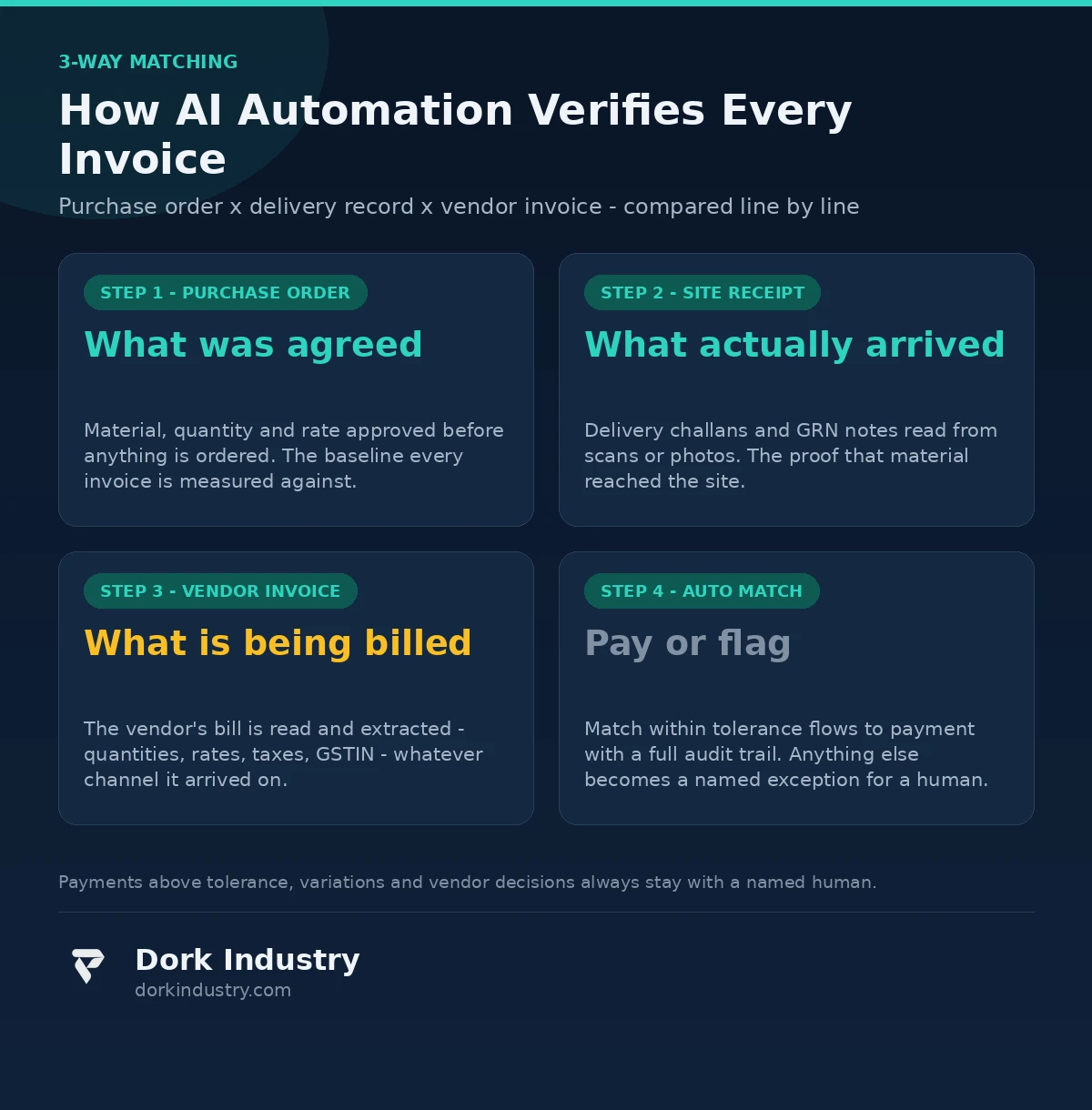
Every invoice is matched against three documents: the purchase order (agreed material and rate), the goods receipt / challan (what actually arrived), and the invoice itself (what the vendor is billing). AI reads all three — scans and photos included — extracts quantities, rates, taxes and vendor details, and compares them. A match within tolerance moves forward; anything else becomes an exception with the discrepancy named.
What happens to invoices that match within tolerance?
They flow straight to the payment queue with a complete audit trail — who supplied, what was ordered, what arrived, what was billed. No one retypes or prints them. Tolerance bands are set by material category: cement and steel get tight bands, consumables looser ones.
How are exceptions and escalations handled?
Mismatches go to an intelligent human queue showing the exact difference (rate, quantity, tax, GSTIN mismatch), suggests the likely cause from history, and routes it to the right person with an SLA clock. A project manager sees exceptions in a morning digest, not scattered WhatsApp forwards — and an exception unreviewed for 48 hours escalates automatically.
What about the vendor side of the process?
A vendor portal changes the dynamic: vendors upload invoices once and see their own status — received, matched, in approval, paid. The same AI reading layer that processes distributor purchase orders works here too, adapted to construction invoice formats. This single change eliminates most “where is my payment” calls and most duplicate submissions, because the vendor can see that the invoice is already in the system.
What should the system never do alone?
An AI procurement system is a verification and routing engine. It must never:
- Release payments above a set threshold without human approval — set hard limits per role; the system queues, people sign.
- Approve variation claims or extra items — a variation changes the contract; only a human with site context should agree.
- Accept materials on behalf of the site — the GRN is a human certification that material arrived in acceptable condition. The system can read it, not sign it.
- Terminate or blacklist a vendor — the system can score reliability; acting on the score is a human commercial decision.
- Certify subcontractor measurements for final payment — AI can highlight discrepancies; the certifying engineer resolves them.
The working rule: the system prepares every decision and makes routine ones within pre-approved limits — but anything that spends non-routine money, changes a contract, or judges quality stays with a named human.
Should you buy a procurement module or build custom?
Honest answer first: if you run a single site with a handful of vendors, buy. Standard ERP procurement modules and invoice-processing SaaS handle straightforward PO-to-payment flows more cheaply than custom development.
If you are evaluating partners, our guide to choosing an AI automation company in India covers the questions worth asking. Build custom when your reality does not fit the template:
- Multi-site operations where each site has different approval hierarchies, tax registrations, or rate cards.
- Mixed vendor channels — WhatsApp photos, email scans, portal uploads, paper — that off-the-shelf OCR handles inconsistently, especially with Indian invoice formats, GST line items, and regional-language documents.
- Subcontractor RA-bill workflows with measurement books, retention deductions, and TDS — workflows generic tools were never designed for.
- ERP integration where the handoff must be seamless, not an export-import ritual.
A common middle path works well: buy the accounting core, build the AI reading-and-matching layer that feeds it.
What does a 30-day pilot look like?
The smallest safe pilot runs on one site, one material category, and changes nothing about how payments are released.
Days 1–7: data inventory. Collect three months of purchase orders, delivery challans, and vendor invoices for one category (cement is ideal — high volume, standard rates).
Days 8–14: pipeline prototype. The system reads a sample of invoices, extracts line items, and 3-way matches them against POs and challans. Output: a matches/mismatches/duplicates report, reviewed by your accounts team — no payments touched.
Days 15–21: parallel run. The pipeline processes new invoices alongside your existing process — measure what it catches that yours missed: duplicates, rate drift, tax errors.
Days 22–30: decision. The pilot report shows the leakage found, the time saved per invoice, and the exception rate. If the numbers do not justify a full build, you keep the report.
What does it cost to build — and what drives the price?
Forget fixed price lists — these are the drivers that move the number:
- Document variety: clean PDFs vs. WhatsApp photos of crumpled challans in mixed languages. Dirtier input costs more to read.
- Match complexity: simple PO-to-invoice matching vs. multi-line BOQ items, part deliveries, retention, and TDS on subcontractor bills.
- Approval workflow depth: a flat two-level approval vs. site-wise hierarchies with delegation rules.
- Integration: whether the system posts into your ERP’s API or needs a custom connector.
- Vendor portal scope: read-only status vs. full self-service with uploads, dispute threads, and payment advices.
Anyone quoting a fixed price without seeing your invoices, approval chain, and ERP is guessing.
What does procurement leakage actually cost? (Illustrative math)
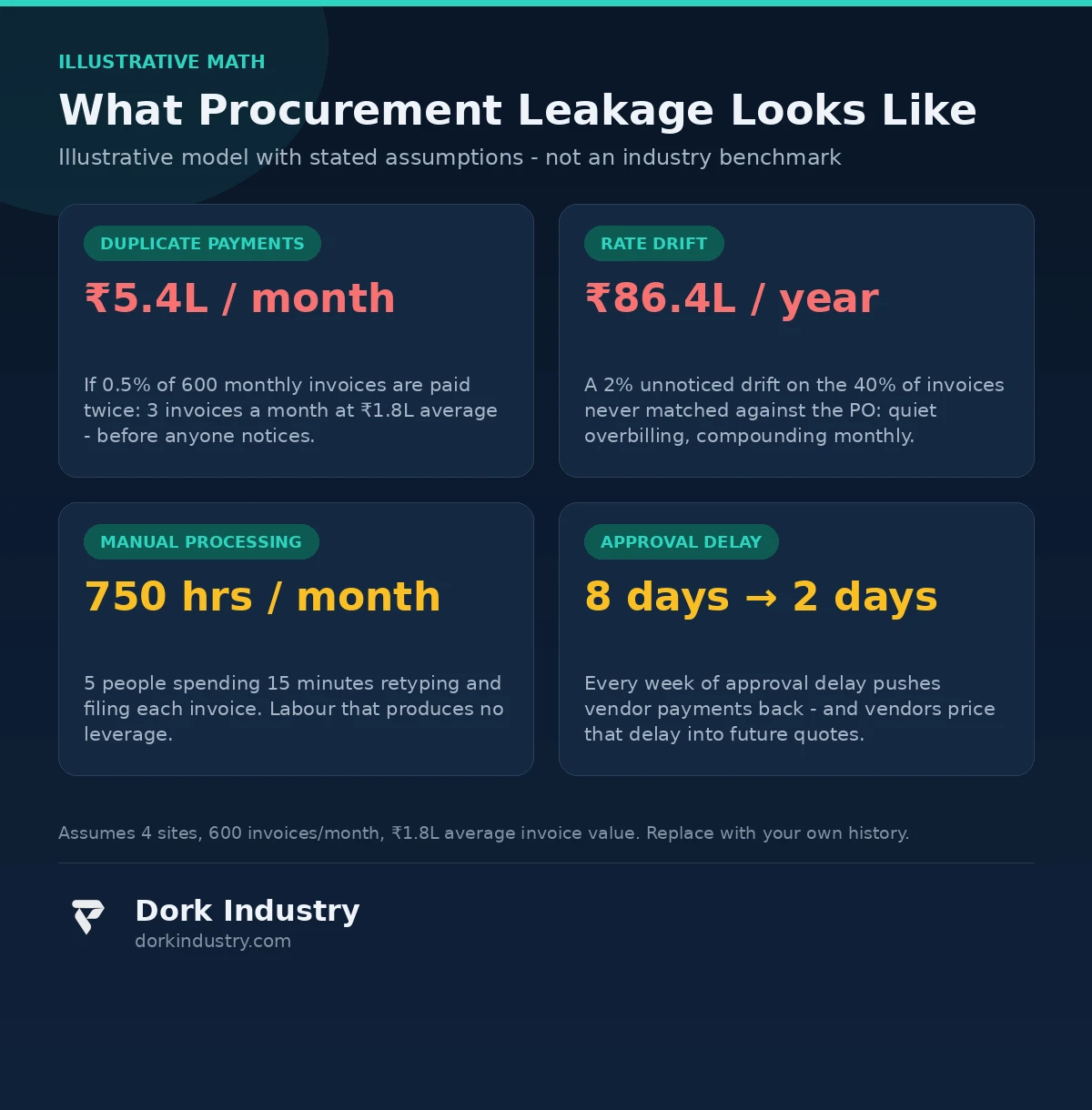
The figures below are an illustrative model with stated assumptions — they show how leakage compounds, not your actual numbers.
Assumptions: a mid-size contractor, 4 sites, 600 invoices/month, ₹1,80,000 average invoice value, 40% of invoices never line-item-matched against the PO, 5-person accounts team.
- Duplicate payments: 0.5% of invoices paid twice = 3 invoices a month — ₹5,40,000 a month before anyone notices.
- Rate drift: 2% drift on the 40% of invoices never matched = ₹86,40,000 a year in quiet overbilling.
- Approval delay cost: vendors price payment delays into future quotes — cutting the approval cycle from 8 days to 2 is worth more than any discount negotiation.
- Manual processing cost: 5 people × 15 minutes × 600 invoices = 750 hours a month of retyping — work that produces no leverage.
The point of the math: leakage is a hundred small mismatches a month, each too small to investigate manually, compounding into a number nobody budgets for.
Manual procurement vs. AI-assisted procurement
| Step | Manual process | With AI automation |
|---|---|---|
| Invoice capture | Retyped from email, WhatsApp, paper — weeks late | Read automatically from any channel, structured on arrival |
| PO matching | Spot checks on a fraction of invoices | Every invoice matched against PO and challan |
| Duplicate detection | Found by accident, if ever | Automatic — same vendor, same amount, same reference window |
| Rate drift | Invisible until a dispute | Flagged against PO rate history with tolerance bands |
| Approvals | Scattered messages, no SLA | Routed queue with escalation clocks |
| Vendor status queries | “Where is my payment?” calls to accounts | Self-service portal with live status |
| Payment release | Human decision | Still a human decision — above tolerance, always |
Frequently asked questions
How can I automate purchase orders and vendor invoices in construction?
Start upstream of your accounting software, not inside it. Set up a pipeline that reads every invoice and challan, matches each invoice against its purchase order and site delivery record, routes only the exceptions to humans, and posts matched invoices to your ERP. A 30-day pilot on one site and one material category proves the model before you change any payment process.
Can AI really read handwritten challans and crumpled invoice photos?
Printed invoices, GST e-invoices, and typed documents read reliably today. Handwritten challans are the hard case — the honest design routes low-confidence reads to a human verifier and learns from the corrections. The goal is reading well enough that humans only touch the exceptions.
What about GST compliance and e-invoicing rules?
The system should validate GSTIN formats, reconcile tax line items, and verify e-invoice IRN/QR references. According to Cleartax’s e-invoicing FAQs, businesses above ₹5 crore turnover must report B2B invoices to the Invoice Registration Portal and receive a unique Invoice Reference Number — your automation should check that reference exists rather than trusting a printed QR code.
Will this work if our vendors refuse to use a portal?
Yes — the portal is an accelerator, not a prerequisite. The pipeline accepts invoices however vendors send them today: email, WhatsApp photos, scanned paper. Vendors adopt it when portal-submitted invoices get paid faster by skipping the manual queue.
How long before we see results?
The pilot typically surfaces its first findings — duplicates, rate drift, unapproved purchases — within the 30-day parallel run, because it re-examines three months of history. Full multi-site rollout, including vendor onboarding, usually takes 8–12 weeks after the pilot decision.
The bottom line
Construction procurement does not lose money in one dramatic fraud. It loses money in the gap between the purchase order, the delivery record, and the invoice — three documents nobody compares at scale. AI automation closes that gap: it reads every document, matches every invoice, routes only the exceptions to humans, and keeps a complete audit trail. Payments above tolerance, variations, and vendor relationships stay with named humans.
Start with one site, one material category, and 30 days of parallel running. Let the duplicates and rate drift it finds in your own invoice history decide whether construction purchase order automation earns its place.
Sitting on a pile of vendor invoices nobody has matched against actual deliveries?
Send Dork Industry a sample of your purchase orders and vendor invoices. We will run 3-way matching on them, name the duplicates and rate drift we find, and show you the 30-day pilot we would run on one site .
Request your free construction procurement automation assessment WhatsApp +91 8210792477
About Dork Industry
Dork Industry (dorkindustry.com) is a custom software development company building mobile apps, AI automation, and IoT systems for businesses across India. Our team designs document-processing pipelines, approval automation, and vendor management systems — from 30-day procurement pilots to full multi-site rollouts.