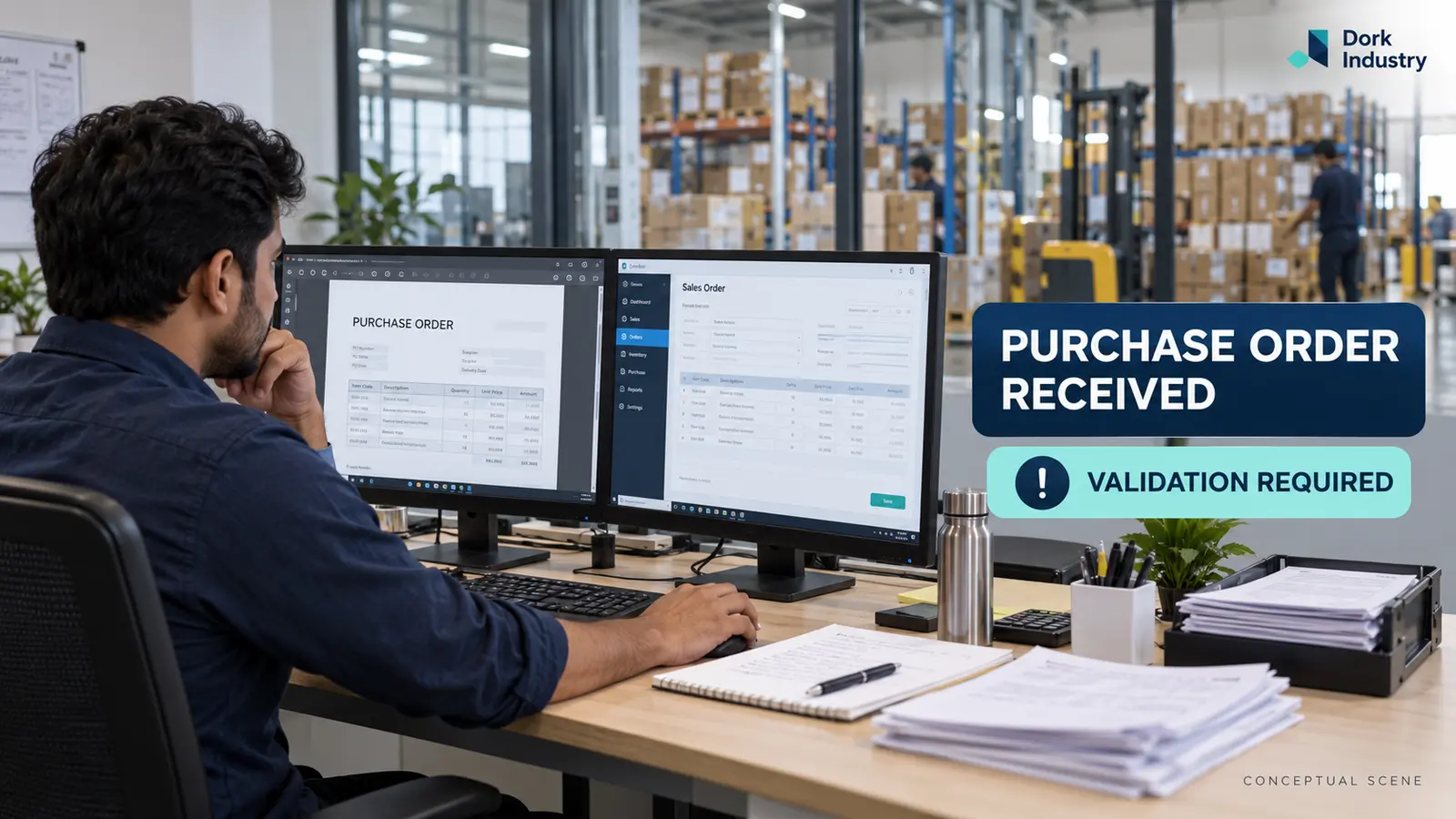
AI purchase order automation for distributors is a controlled document-to-order workflow. It should convert emailed or portal-submitted customer POs into validated draft sales orders—not post uncertain data directly into the ERP. A dependable workflow extracts document fields, matches customer and SKU masters, checks commercial rules, detects duplicates and routes exceptions to an authorised employee. Dork Industry can assess the workflow, build a proof of concept, integrate it with existing software or provide developers for implementation.
On this page
- What business problem does PO automation solve?
- How should the workflow operate?
- What should and should not be automated?
- Which data and integrations are required?
- How should exceptions and approvals work?
- Build, configure or integrate?
- How should the solution be tested?
- When should you hire an automation developer?
- Frequently asked questions
What business problem does AI purchase order automation for distributors solve?
Distributor sales teams often receive customer purchase orders as PDFs, scans, spreadsheets or email attachments. An employee rekeys the customer, PO number, SKU, quantity, unit of measure, requested date, price and delivery address into an ERP or order-management system. The costly failure is not typing alone: it is creating a duplicate order, mapping a customer description to the wrong SKU, accepting an expired price, overlooking a credit hold or promising stock that is unavailable.
Current commercial offerings also frame the problem as document capture followed by master-data validation and draft order creation, rather than a generic chatbot. According to a current Microsoft Marketplace purchase-order agent listing, the offered workflow includes PDF/email capture, vendor and item validation, draft creation and approval controls. This supports a buyer journey around integration and controlled implementation, but it does not prove results for Dork Industry or for any reader.
How should the purchase order automation workflow operate?
- Capture: collect the original document, email metadata and attachment hash.
- Classify: confirm that the file is a customer PO and select the relevant extraction model.
- Extract: return header fields, delivery details and line-item tables with confidence and source coordinates.
- Validate: match customer, PO number, SKU, unit, price, tax, credit and available-to-promise stock.
- Route: send ambiguous or policy-sensitive fields to the correct employee.
- Create a draft: write only an idempotent draft sales order through a supported API or controlled integration.
- Confirm and audit: retain the source, decisions, changes, approver and final ERP reference.
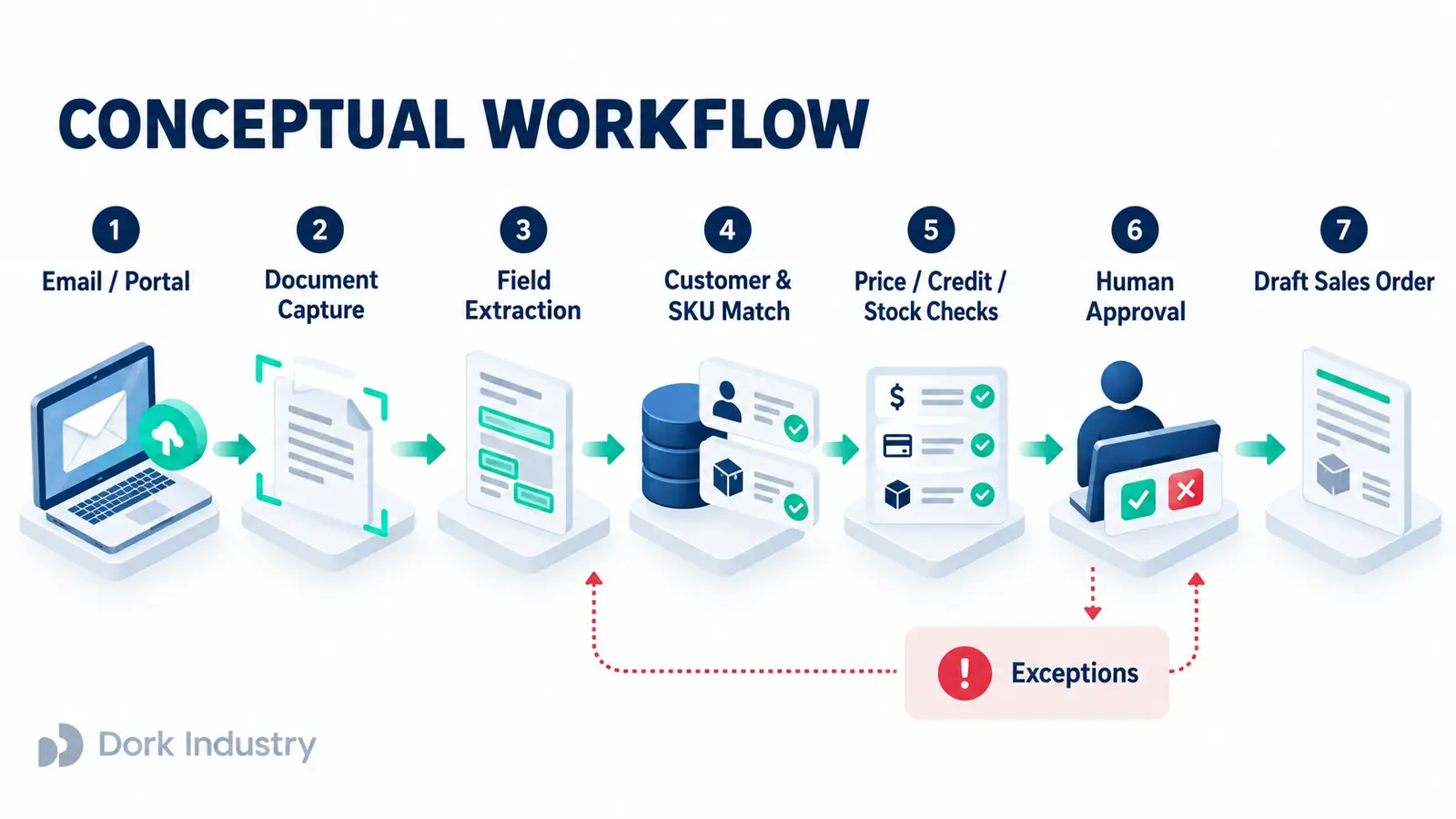
What should and should not be automated?
| Decision | Automation role | Human control |
|---|---|---|
| Read PO number and lines | Extract fields and source locations | Review low-confidence or conflicting fields |
| Match customer and SKU | Suggest exact or approved alias matches | Approve new aliases and ambiguous products |
| Check price, tax and credit | Apply deterministic master-data rules | Approve commercial exceptions |
| Check duplicate PO | Compare customer, PO number, document hash and open orders | Resolve legitimate revisions or resubmissions |
| Create ERP transaction | Create a draft only after required checks pass | Release orders that affect credit, allocation or commitments |
According to Microsoft’s Document Intelligence confidence guidance, field-level confidence can help decide whether a result is accepted or sent for human review. Confidence is not a business rule: even a clearly extracted price can be commercially invalid. Validation must use the distributor’s own customer, item, contract, tax, stock and credit data.
Which data and integrations are required?
A proof of concept needs representative, anonymised POs across major customer formats, including scans and multi-page line tables. It also needs the customer master, SKU catalogue, units and conversions, price lists, tax rules, warehouse stock, credit status, delivery locations and duplicate-order logic. Poor master data will surface as exceptions; an AI model should not silently invent a match.
Typical integrations include a monitored mailbox or customer portal, document storage, an extraction service, a review interface and the ERP/order API. Dork Industry’s AI/ML implementation service can address extraction and model operations, while custom software development can cover workflow, validation, dashboards and integration. This is distinct from our related guide to AI invoice data extraction, which concerns supplier invoices rather than incoming customer orders.
How should exceptions and approvals work?
Route exceptions by reason, not into one shared queue. Sales operations can resolve customer/SKU mapping; finance can handle credit or tax; commercial managers can approve price deviations; warehouse staff can address allocation and requested dates. Each task should display the original document beside the extracted value, matched master record, failed rule and proposed action.
Microsoft also documents approval workflows that combine automation with human sign-off. For purchase orders, the approval record should include the decision, actor, timestamp, comment and before/after values. A rejection must not create a partial ERP order. Timeouts, reassignment and unavailable approvers also need explicit handling.
Should you configure a tool, build custom software or integrate the ERP?
| Option | Best when | Primary risk |
|---|---|---|
| Configure an existing document tool | Formats are stable and the ERP has supported connectors | Limited commercial-rule or line-item handling |
| Custom integration layer | Extraction exists but validation and ERP APIs differ | Weak ownership of master-data mappings |
| Custom workflow application | Multiple branches, warehouses, price rules and exception roles are involved | Overbuilding before a measured proof of concept |
| Developer augmentation | An internal team owns the product but lacks integration or AI capacity | Unclear backlog, access boundaries or acceptance criteria |
Start with one document channel, one ERP company and a defined customer segment. Measure field accuracy, exception reasons, duplicate prevention, draft-order correctness and reviewer effort separately. Do not promise an ROI before the baseline and pilot results are measured.
How should AI purchase order automation be acceptance-tested?
Use a holdout set the implementation team did not tune against. Include clear PDFs, scans, repeated PO numbers, revised orders, unknown SKUs, unit conversions, contract-price conflicts, credit holds, unavailable stock and multi-address customers. The pass condition is a correct draft or a correctly routed exception—not maximum straight-through processing.
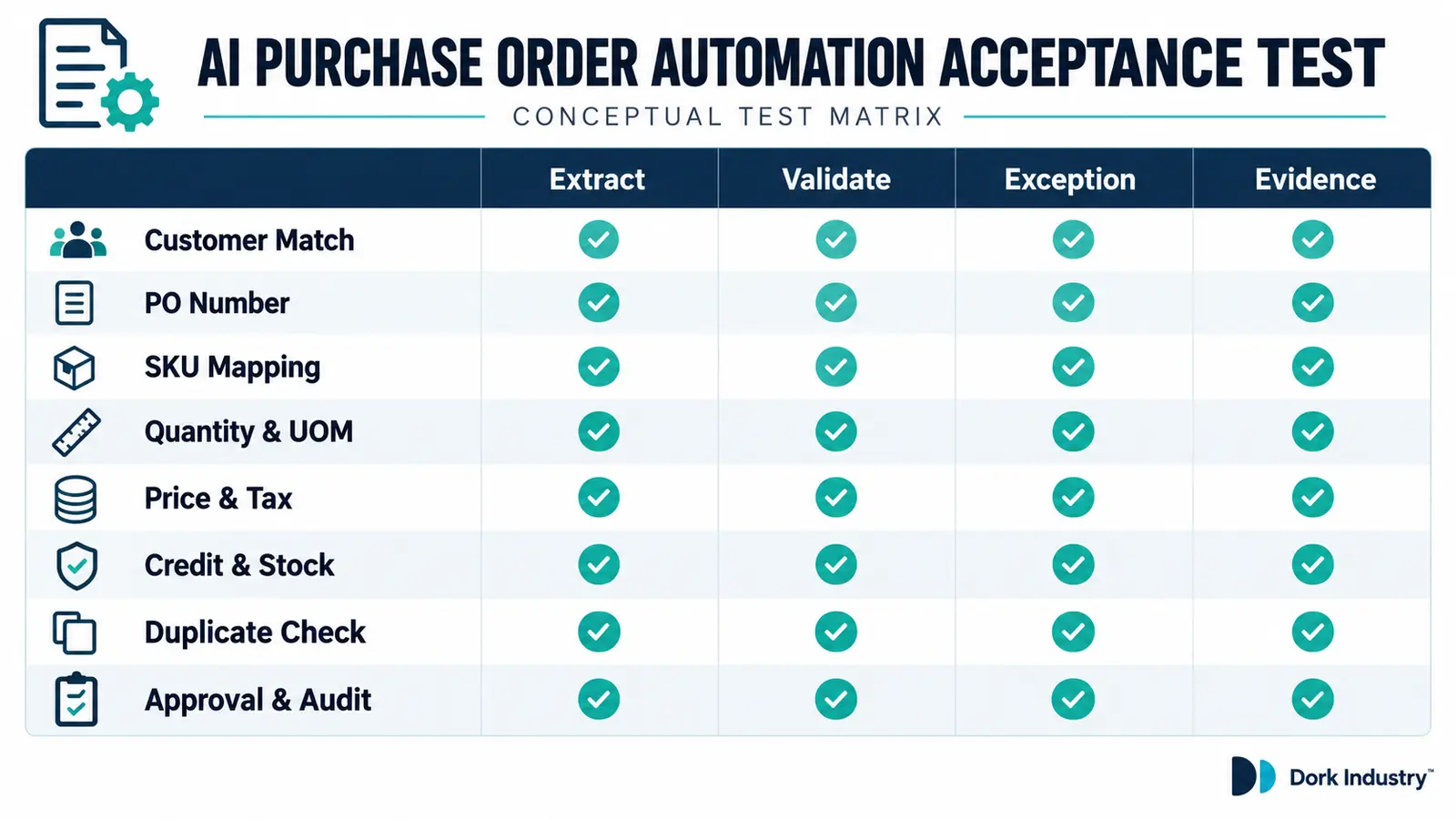
| Test | Expected result | Evidence |
|---|---|---|
| Duplicate submission | No second draft is created | Document hash and idempotency log |
| Unknown SKU alias | Order stops for mapping review | Source line and reviewer decision |
| Price mismatch | Contract rule and variance are shown | Master version and approval |
| Low-confidence quantity | Field is highlighted and cannot auto-pass | Confidence, source region and correction |
| Credit hold | Draft follows the configured hold policy | Credit status and authorised release |
| ERP timeout | Safe retry does not create a duplicate | Request ID and final order reference |
When should you hire an automation developer?
Hire specialist support when POs contain complex tables, customer descriptions do not match ERP SKUs, pricing and credit rules live across systems, APIs are unreliable or reviewers need a purpose-built exception screen. Ask for a discovery map, anonymised test set, integration design, security boundaries, acceptance criteria, deployment plan and operational monitoring.
Dork Industry can deliver a scoped proof of concept, integrate AI into the existing order workflow or provide a developer through staff augmentation. For adjacent sales-document automation, see our guide to AI quotation automation for industrial distributors.
Request a purchase-order automation assessment
Share the current PO channels, ERP, approximate document variety, validation rules and anonymised exception examples. Dork Industry can define a proof of concept, integration scope and acceptance test without promising unmeasured savings.
Frequently asked questions
Can AI create a sales order directly from a PDF purchase order?
It can extract a proposed order, but the workflow should validate customer, SKU, quantity, unit, price, tax, credit, stock and duplicates before creating a reviewable ERP draft. High-risk exceptions require an authorised employee.
Does a high confidence score mean the field is valid?
No. Confidence estimates extraction certainty, not whether the price, SKU, tax treatment or credit decision is commercially correct. Validate extracted data against current master records and business rules.
How should revised purchase orders be handled?
Identify revisions using customer, PO number, document version, attachment hash and existing order state. Route material changes for review instead of silently creating another order or overwriting an approved transaction.
What should happen when a customer description does not match an SKU?
Present ranked approved matches with the source line, but require review for uncertain mappings. Save an alias only through an authorised master-data process so one correction does not create future errors.
Can this work with an existing ERP?
Usually, if the ERP provides a supported API, import mechanism or controlled integration point. The design must preserve idempotency, permissions, validation, error handling and an audit trail.
What should we provide for an implementation assessment?
Provide anonymised PO examples, channels, ERP details, customer and SKU structures, price and credit rules, exception owners, approval limits, expected draft fields and acceptance scenarios. Do not send production credentials in an enquiry.
Want this automated for your business?
Book a free assessment — we map the workflow, check data readiness, and outline a pilot you can measure.