
Custom software development can keep an Indian exporter’s New Zealand shipments FTA-ready — yes — but not by filing anything with customs on your behalf. What it does is remove the paperwork errors that silently eat the duty preference: it checks every product’s HS code against the agreement’s rules of origin, assembles a complete preferential certificate-of-origin pack from your ERP data, tracks which shipments claimed the preference and which didn’t, and gives your CHA one clean file instead of a week of email threads. The duty saving is the entire prize — up to 10% of shipment value on lines like textiles, engineering goods and auto components — and one rejected origin claim wipes it out. What software must never do is sign the legal origin declaration for you; that signature stays human, always.
This article covers what changed on 20 October 2026, why the paperwork is now the bottleneck instead of the tariff, where an exporter actually loses money on FTA documentation, what an automation system concretely consists of, the honest arithmetic with stated assumptions, build-versus-buy, what technology must never decide alone, and how to test it on one product line for 30 days.
Key takeaways
- New Zealand eliminated tariffs on all Indian goods from 20 October 2026 — the preference is worth up to 10% of shipment value on textiles, engineering goods, auto components and more.
- The preference is not automatic: exporters must prove rules of origin with a certificate of origin or approved-exporter self-declaration, or the buyer pays full MFN duty.
- One failed origin claim on a ₹45-lakh shipment can cost roughly ₹3.3 lakh in lost preference plus demurrage and rework (stated assumptions).
- Custom software automates five jobs: HS-code classification, rules-of-origin checks, CoO pack assembly, preference-claim tracking, and a single document dashboard for your CHA.
- Software must never sign the legal origin declaration, auto-file with customs, or overrule your CHA’s judgment on a disputed classification.
- Pilot on one NZ-bound product line for 30 days and measure CoO first-pass acceptance, document-prep hours per shipment, and preference-claim capture rate.
What changed on 20 October 2026 — and why exporters are suddenly the bottleneck
On 20 October 2026 the India–New Zealand Free Trade Agreement entered into force. New Zealand’s Trade and Investment Minister Todd McClay exchanged ratification documents with India’s High Commissioner to New Zealand, H.E. Ms Muanpuii Saiawi, in Parliament — and from that day, New Zealand eliminated tariffs on all Indian goods. According to TradeBridge Advisors’ breakdown of the agreement, the lines that gain most are exactly the ones where New Zealand applied its highest rates, up to 10%: textiles, apparel and home furnishings; leather and footwear; gems and jewellery; engineering goods, machinery and auto components; processed foods; pharmaceuticals and medical devices; chemicals, plastics, rubber and electronics.
The scale of the opening is real. Bilateral merchandise trade stood at USD 1.3 billion in 2024-25, up 49% on the previous year. Indian engineering exports to New Zealand jumped from USD 47.8 million to USD 68.3 million in a single fiscal — and New Zealand imports nearly USD 11 billion of engineering products a year, so the headroom is enormous. Pharma gets zero-duty access across 90 tariff lines into a market importing USD 1.4 billion of pharmaceuticals annually; marine products enter a USD 260-million import market duty-free; agriculture and processed food span 1,379 tariff lines. New Zealand even pledged USD 20 billion of investment into India over 15 years.
But here is the catch every exporter briefing mentions and almost nobody prices: the preference is conditional. According to Whalesbook’s impact analysis, exporters must adhere to strict rules of origin and obtain the right certifications to qualify — and failure to meet the criteria negates the competitive advantage entirely. A Tiruppur knitwear exporter or a Ludhiana auto-component maker doesn’t lose the 10% at the negotiating table; they lose it at a desk in their own office, when the certificate of origin goes out with the wrong HS code, a missing supplier declaration, or an origin calculation nobody can reconstruct when NZ customs asks.
The agreement does give exporters procedural help: the trade facilitation chapter commits to release of standard cargo within 48 hours and perishables within 24, advance rulings, single-window procedures, AEO recognition — and a choice between a traditional certificate of origin and self-declaration by approved exporters. That choice is precisely where software earns its keep: self-declaration shifts the compliance burden onto the exporter’s own records, which must be complete, consistent and auditable on demand.
The expensive problem: the preference dies in the paperwork
Talk to any mid-size exporter and the FTA story sounds the same. The commercial team celebrates the duty saving; the documentation team inherits a new, unforgiving workflow they run on spreadsheets and memory:
- HS-code drift. The product was classified three years ago for a different market. Nobody re-checks whether that classification still holds under this agreement’s product-specific rules — until a claim is questioned.
- Origin evidence scattered across inboxes. Supplier declarations proving regional value content live in email threads, WhatsApp chats and a shared drive folder named “final_final”. When NZ customs or your own auditor asks for the audit trail, reconstruction takes days.
- CHA ping-pong. Your customs house agent sends the shipping bill back twice because the invoice description doesn’t match the packing list, which doesn’t match the CoO application. Each round-trip costs a day; a missed vessel sailing costs a week.
- Preference leakage. Nobody tracks which shipments actually claimed the NZ preference and which sailed on MFN terms because the CoO wasn’t ready in time. The 7–10% saving simply never materialises — invisible, unmeasured, unrecovered.
- Self-declaration risk. Approved-exporter status is a privilege: one sloppy declaration and the status — and the 24/48-hour facilitation benefits tied to trusted-trader standing — is at risk.
None of this is a tariff problem. It is an information-assembly problem, repeated on every shipment, under deadline, with legal consequences. That is exactly the shape of problem custom software development is good at.

What custom software development actually builds for an FTA exporter
Forget “AI-powered trade platforms” as a slogan. A working system does five concrete, boring, valuable jobs:
1. HS-code classification assistant. You feed it the product master — descriptions, materials, manufacturing steps. It proposes the HS code with its reasoning and flags the lines where the agreement’s product-specific rule is strict (change-of-tariff-heading vs. regional value content). A human confirms; the decision and its basis are stored with the product forever.
2. Rules-of-origin checker. For each shipment, it pulls the bill of materials and supplier declarations, computes regional value content or checks the tariff-shift rule, and gives a pass/fail/need-more-evidence verdict per line item — before the goods leave the factory gate. Evidence gaps surface as tasks (“supplier declaration missing for fasteners, HS 7318”), not as surprises at the port.
3. Certificate-of-origin pack assembler. It generates the CoO application, commercial invoice with the origin declaration text, packing list and supporting annexures from one data source, so the four documents can never contradict each other. For approved exporters, it manages the self-declaration register: sequential numbering, authorised signatories, retention periods.
4. Preference-claim tracker. Every NZ-bound shipment gets a status: preference claimed, preference pending, sailed MFN (with the reason). Management finally sees the leakage number — the percentage of eligible value that actually captured the duty saving — which is the KPI the whole project is about.
5. One dashboard for the CHA. Your customs house agent gets a single secure link per shipment: all documents, the origin calculation, the declaration history. Email threads collapse to exceptions only.
Integrations matter more than features: the system should read from your existing ERP or Tally (product masters, BOMs, invoices), push shipping bills toward ICEGATE-format data your CHA already uses, and keep multi-currency invoicing consistent — the NZD invoice, the INR books and the USD letter of credit must agree to the paisa.
What the technology must never do alone
Draw these lines in the requirements document before a single screen is built:
- Never sign the origin declaration. The legal declaration of origin is a human attestation with liability attached. Software prepares, verifies and presents — a named, authorised person signs.
- Never auto-file with customs. Filing stays with your CHA or your authorised signatory. Automation that files on its own creates liability nobody agreed to.
- Never overrule a disputed classification. When the HS code is genuinely ambiguous, the system must escalate to your CHA or a trade consultant — not pick the friendlier duty rate.
- Never be the only record. Supplier declarations and origin calculations must exist as human-readable, exportable files, not only inside the application’s database. If you change vendors, your compliance history walks out with you.
- Never promise preference on ineligible goods. Re-exports, minimal processing and non-originating materials have hard rules; a system that “finds a way” is a fraud machine.
Honest build-vs-buy
Do not build custom software if your situation is simple. If you export two products to New Zealand through one CHA, your CHA’s documentation service plus a disciplined spreadsheet will carry you — and several ERP export modules (Tally, SAP Business One, Odoo) already generate CoO applications and track shipments adequately at that scale.
Build when the complexity crosses any of these lines: multiple product lines with different rules of origin; multiple plants or job-workers feeding one export order; supplier declarations arriving from dozens of vendors; or you are pursuing approved-exporter self-declaration, where the audit trail itself is the product. At that point the off-the-shelf module bends and your team starts maintaining shadow spreadsheets again — which is the cost you were trying to kill.
A middle path exists and is usually the right first step: buy the ERP export module for document generation, and build only the rules-of-origin checker and preference tracker as a custom layer on top. You get 70% of the value at 30% of the cost, and you learn your real requirements before committing to a full build.
The numbers: what one failed shipment costs (assumptions labelled)
Exporters decide on gut feel because nobody shows them the arithmetic. Here it is, with every assumption on the table so you can substitute your own numbers:
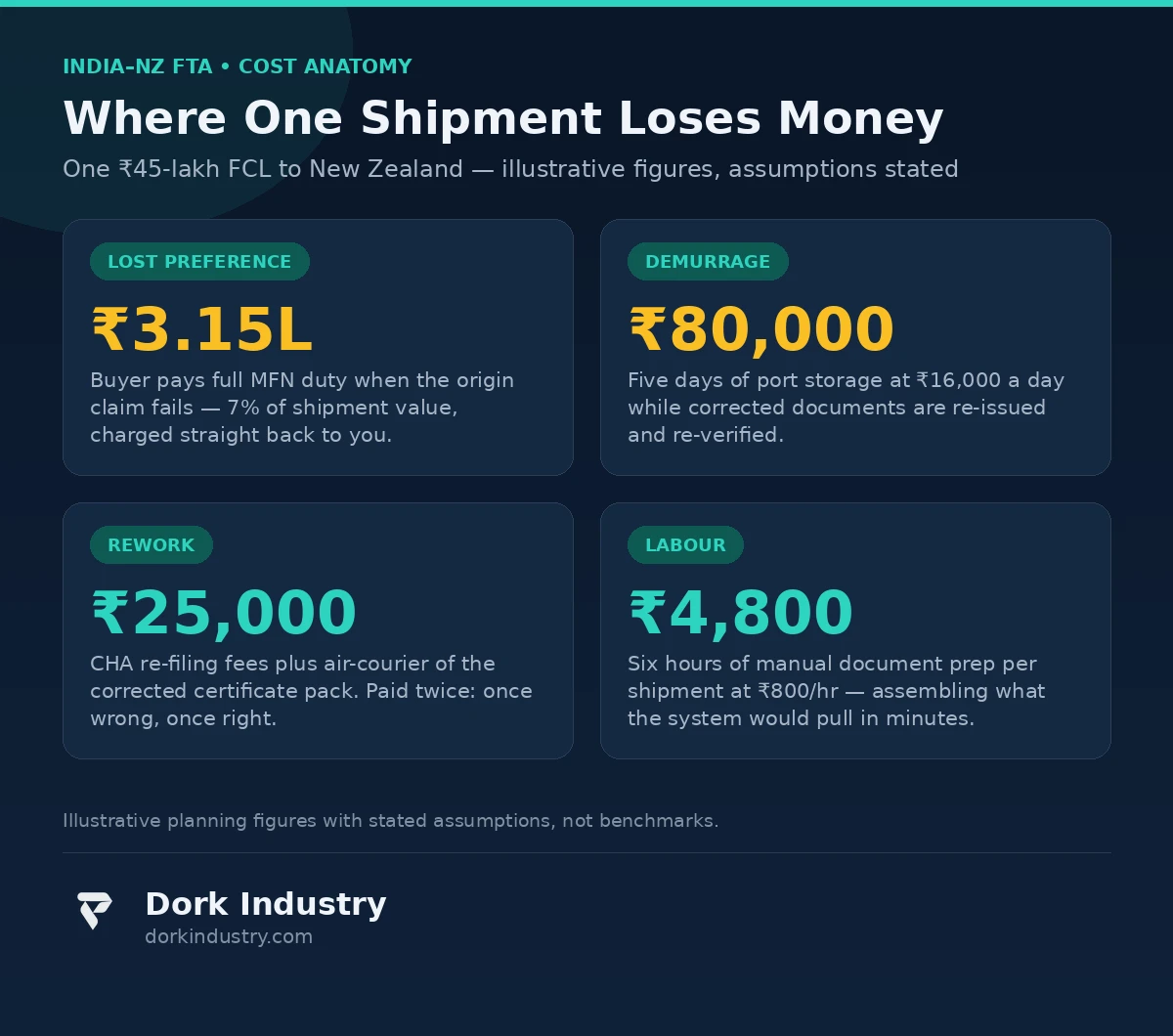
Assumptions: one FCL shipment, invoice value ₹45,00,000; average NZ tariff eliminated 7% (agreement range 5–10%); CHA documentation fee ₹25,000 per shipment; demurrage and port storage ₹16,000/day; one failed origin claim per 40 shipments under manual process (2.5% failure rate); corrected documents take 5 working days to re-issue and re-verify.
| Cost line | Manual process | With automation |
|---|---|---|
| Lost duty preference (buyer pays MFN, charged back to you) | ₹3,15,000 | ₹0 |
| Demurrage: 5 days × ₹16,000 | ₹80,000 | ₹0 |
| CHA rework + re-filing | ₹25,000 | ₹0 |
| Document prep labour per shipment (6 hrs × ₹800) | ₹4,800 | ₹1,200 (1.5 hrs review) |
| Expected failure cost per shipment (2.5% × ₹4,20,000) | ₹10,500 | ~₹1,000 (0.25% residual) |
| Total expected cost per shipment | ₹15,300 + tail risk of ₹4.2L | ~₹2,200 |
Read the last row carefully: the labour saving is the smallest part. The real money is the tail risk — one failed claim in forty wipes out the margin on the other thirty-nine. An exporter shipping 100 FCLs a year to New Zealand carries roughly ₹10–11 lakh of expected annual paperwork-failure cost under a manual process, against a system that costs a fraction of that to build and run. Your numbers will differ; the shape of the curve won’t.
The smallest safe pilot: 30 days, one product line
Do not “digitise exports” as a project. Run this instead:
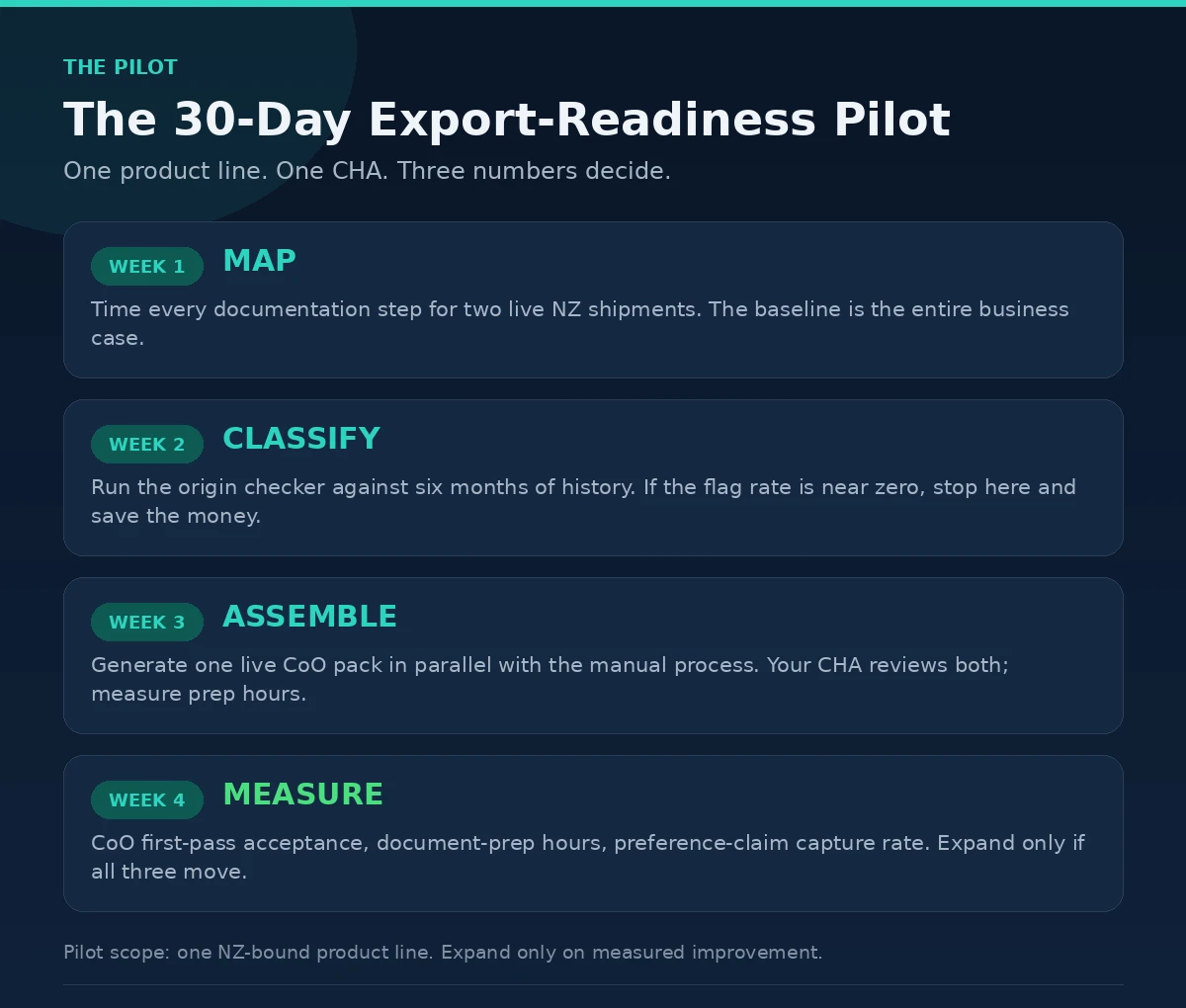
- Week 1 — map. Pick one NZ-bound product line and one CHA. Document the current flow end to end: who classifies, who collects supplier declarations, who assembles the CoO pack, where it waits. Time every step for two live shipments. This baseline is the whole business case.
- Week 2 — classify. Load the product master into the rules-of-origin checker. Run it against the last six months of shipments for that line and count how many would have been flagged. If the flag rate is near zero, your process is already fine — stop here and save the money.
- Week 3 — assemble. Generate the CoO pack from the system for one live shipment, in parallel with the manual process. Your CHA reviews both. Measure: document-prep hours, round-trips, first-pass acceptance.
- Week 4 — measure. Three numbers decide: CoO first-pass acceptance rate vs. baseline, document-prep hours per shipment, and preference-claim capture rate (eligible shipments that actually sailed with the preference). If all three move, expand to the next product line. If not, you spent a month learning instead of a year building the wrong thing.
Frequently asked questions
What documents does an Indian exporter need to claim the New Zealand FTA preference?
Proof of origin plus the commercial set. Under the agreement you choose between a traditional preferential certificate of origin and self-declaration if you hold approved-exporter status. Either way you need the commercial invoice carrying the origin declaration, an accurate HS classification for every line, and the underlying evidence — supplier declarations and origin calculations — retained and producible if NZ customs verifies the claim. The trade facilitation chapter also brings 48-hour standard cargo release and 24-hour release for perishables, but only when the documentation is complete on arrival.
Can software really get rules of origin right?
It can get the mechanics right — tariff-shift checks and regional value content math are deterministic once the inputs are clean. What it cannot do is judge the inputs: whether a supplier declaration is trustworthy, whether a process counts as more than minimal processing, whether a classification is genuinely ambiguous. Treat it as a tireless checker with perfect memory, not as a trade lawyer. The signature stays human.
We already run Tally/SAP — do we still need custom software?
Maybe not. If your ERP’s export module already generates CoO applications and your shipment volume is low, add discipline before you add software: standard document checklists, a supplier-declaration calendar, a preference-claim log. Build custom only when you have multiple product lines with different origin rules, scattered supplier evidence, or approved-exporter ambitions — the points where the standard module starts generating shadow spreadsheets.
How long does approved-exporter self-declaration take to set up?
The status itself is an application to the authorities; the hard part is what it demands afterwards — complete, consistent, auditable origin records for every self-declared consignment, retained for years. Most exporters should treat the record-keeping system as the real project and the application as the paperwork on top. Build the records first, apply second.
What happens if New Zealand customs rejects our origin claim?
The buyer pays the full MFN duty — typically 5–10% of shipment value on the affected lines — and the commercial pain lands on you through the contract, the relationship, or both. Repeated failures can draw verification audits across your shipments. This is why the pilot measures first-pass acceptance: the cost of a rejection dwarfs the cost of prevention.
Why was this topic selected?
Dork Industry publishes one trending analysis each day on a development with immediate operational consequences for Indian businesses. This topic was selected because the India–New Zealand Free Trade Agreement entered into force on 20 October 2026, eliminating New Zealand tariffs on all Indian goods — a same-day event creating urgent documentation pressure for exporters in textiles, engineering goods, auto components, pharma and processed foods. Demand check (Google Ads Keyword Planner, United States): “custom software development” — 1,900 average monthly searches, growing +18.8% over three months, LOW advertiser competition, high top-page bid USD 5,885.43 — clearing both the volume and buyer-intent bars. Original Dork Industry analysis. Search and news data retrieved on 20 October 2026.
The bottom line
The India–New Zealand FTA handed Indian exporters a 5–10% price advantage on a silver platter — and then made them fill in the form to collect it. The exporters who capture the preference won’t be the ones with the best product; they’ll be the ones whose origin paperwork is right the first time, every time. That is an information-assembly problem, and it is solvable: classify once, verify origin before the goods move, assemble the CoO pack from a single source of truth, and track every claim. Start with one product line, measure for 30 days, and let the first-pass acceptance rate tell you whether to expand.
Shipping to New Zealand and dreading the FTA paperwork?
Dork Industry will map your current export documentation flow — HS classifications, supplier-declaration coverage, CoO turnaround and where preferences are leaking — and show you exactly which product line to pilot automation on first. You walk away with a measured 30-day pilot plan and an honest verdict on whether custom software earns its cost for your exports, before any development is discussed.
Request your free export-readiness assessment WhatsApp +91 8210792477
About Dork Industry
Dork Industry (dorkindustry.com) is a custom software development company building AI automation, mobile apps, and IoT systems for businesses across India — from 30-day pilots to full production rollouts.
[…] Theme code rarely controls the core hosted payment-method list, but custom carts, checkout extensions, payment customizations and apps can influence the journey or eligibility. If the cart itself is broken, use the Shopify Add to Cart repair guide. If a promotion changes the outcome, compare the Shopify discount diagnosis. […]