
AI development can match parts to orders automatically before dispatch — yes, and for a parts distributor shipping the wrong item every week, that check is usually worth more than any new sales channel. The system compares the part on the order, the part in the bin, and the part the customer actually needs, flags every mismatch before the box is sealed, and hands a human the exceptions instead of asking pickers to memorise thousands of look-alike parts. It does not replace the picker, the stores manager, or the returns decision — it stops the wrong part leaving the building in the first place.
A wrong-part shipment is rarely one person’s mistake. It is what happens when part numbers, supersessions, kits, and customer descriptions disagree, and the only check is a tired human at the end of a long shift. This article covers why wrong parts ship, what data you already hold, what a real matching system does, what it must never do alone, and how to test it in 30 days.
What does a wrong-part shipment actually cost you?
The invoice value of the part is the smallest part of the loss. A wrong shipment triggers return freight, re-picking, re-shipment, and a customer who now has a machine standing idle while the right part travels back and forth. For a service customer, that idle machine is the real damage: a vehicle off the road, a production line stopped, a pump that cannot run. The customer does not remember that you fixed it; they remember that the job stopped.
Then there is the quieter cost. Every wrong shipment teaches your team to distrust the system: pickers double-check everything by hand, stores managers keep unofficial “safe” stock, and the whole warehouse gets slower around an unchanged error rate.
Why do customers stop ordering after one wrong part?
Because a wrong part is not a delay — it is a broken promise about competence. A late delivery is forgiven; a part that does not fit, for a machine that is already down, reads as carelessness. Repeat orders are where a parts business makes its margin, so losing a repeat customer over a preventable mismatch is the most expensive outcome of all.
Why do the wrong parts keep shipping?
Wrong parts ship because the same physical item can carry several identities, and nothing in the warehouse forces them to agree.
How do supersessions and substitutes cause mismatches?
A manufacturer replaces part A with part B, then part B with part C. The old number stays in the catalogue, in customer purchase histories, and on the bin label. A picker who knows the old number picks the old part — or the new part, depending on which shelf they reach first. Without a single supersession chain that the picking system enforces, every substitution is a judgement call made under time pressure.
Why do look-alike parts defeat visual checking?
Bearings, seals, filters, and fasteners differ by millimetres. Two parts can share a shape, a colour, and a bin, and differ only in bore size or thread pitch. Visual checking catches the obviously wrong part; it cannot reliably catch the nearly-right one. That is exactly the class of error that repeats weekly, because the picker genuinely believed the part was right.
How do kits and assemblies hide the error?
When an order is a kit — a seal kit, a service kit, a repair set — the picker checks the kit, not each component. One wrong seal inside a kit ships as a “correct” kit and is only discovered at the customer’s workshop, mid-repair. Kits multiply the damage of a single mismatch because the error is discovered later, by the customer, at the worst moment.
Why does the catalogue disagree with the warehouse?
Descriptions get copied from supplier sheets, shortened for the website, and edited by sales staff. The warehouse system holds the supplier code, the order holds the customer code, and the bin holds a handwritten label from three years ago. The data was simply never reconciled into one identity per part.
What data do you already have to fix this?
Most parts businesses already hold the raw material for a matching system — in five places that never meet.
- Order history: which part numbers customers actually ordered, and which ones came back
- Returns data: the wrong-part returns, with the reason codes your team already writes
- Supplier catalogues: the manufacturer numbers, supersession chains, and specifications
- Bin and stock records: where each part physically lives, and what is actually on the shelf
- Fitment data: which parts fit which machines, models, and years — often in sales heads, not systems
The missing piece is not more data. It is a single part identity: one record per physical part, with every alias, supersession, and customer code mapped to it, and a rule that nothing ships unless the picked part resolves to the ordered identity.
What does AI development actually do at the picking bench?
A real parts-matching system runs four checks before the box is sealed.
How does the system match the order to the part?
When an order is released, the system resolves the ordered line to a single part identity: the current manufacturer number, its valid supersessions, and its fitment constraints for the customer’s machine. If the line is ambiguous, it is flagged for a human before picking starts, not discovered at dispatch.
How does it check the pick itself?
At the bin, the picker scans the part’s barcode or QR code. According to GS1 standards, a common language to identify, capture and share supply chain data is what keeps information accurate — and that is exactly what the scan enforces: the scanned identity must equal the ordered identity, or the system stops the pick. A photo check can add a second layer for look-alike parts, comparing the picked item’s shape and markings against the expected part, but the barcode identity is the primary gate.
How does it handle kits and multi-line orders?
Each kit component is checked individually against the bill of materials, and every line of a multi-line order is checked before any line is sealed — so one wrong component holds the order instead of shipping with nine correct ones.
What happens when the system is unsure?
It stops and asks. An uncertain match goes to an exception queue with the evidence attached: the order line, the scanned identity, the supersession chain, and the fitment data. A human resolves it, and that resolution is recorded — so the next identical case is no longer uncertain. The system gets more accurate by learning from human decisions, not by guessing harder.
What must the system never do alone?
The human boundaries matter more here than in most automation, because a wrong “fix” ships a wrong part with a computer’s confidence behind it.
- It must never substitute a part on its own authority. A substitute ships only when a human has approved that substitution for that customer and that machine.
- It must never override a fitment constraint. If the part does not fit the customer’s model and year, the order stops, even if the part number looks close.
- It must never rewrite the catalogue. Supersession changes, new aliases, and fitment rules are approved by a human and logged; the system proposes, it does not publish.
- It must never clear its own exceptions. An unresolved mismatch is a held order, not a warning to click past.
- It must never use customer order history to guess a part. “This customer usually orders X” is not evidence that today’s order is X.
- It must never hide its reasoning. Every match, flag, and override must show its evidence, so a human can audit any shipment afterwards.
What does the math look like? An illustrative example
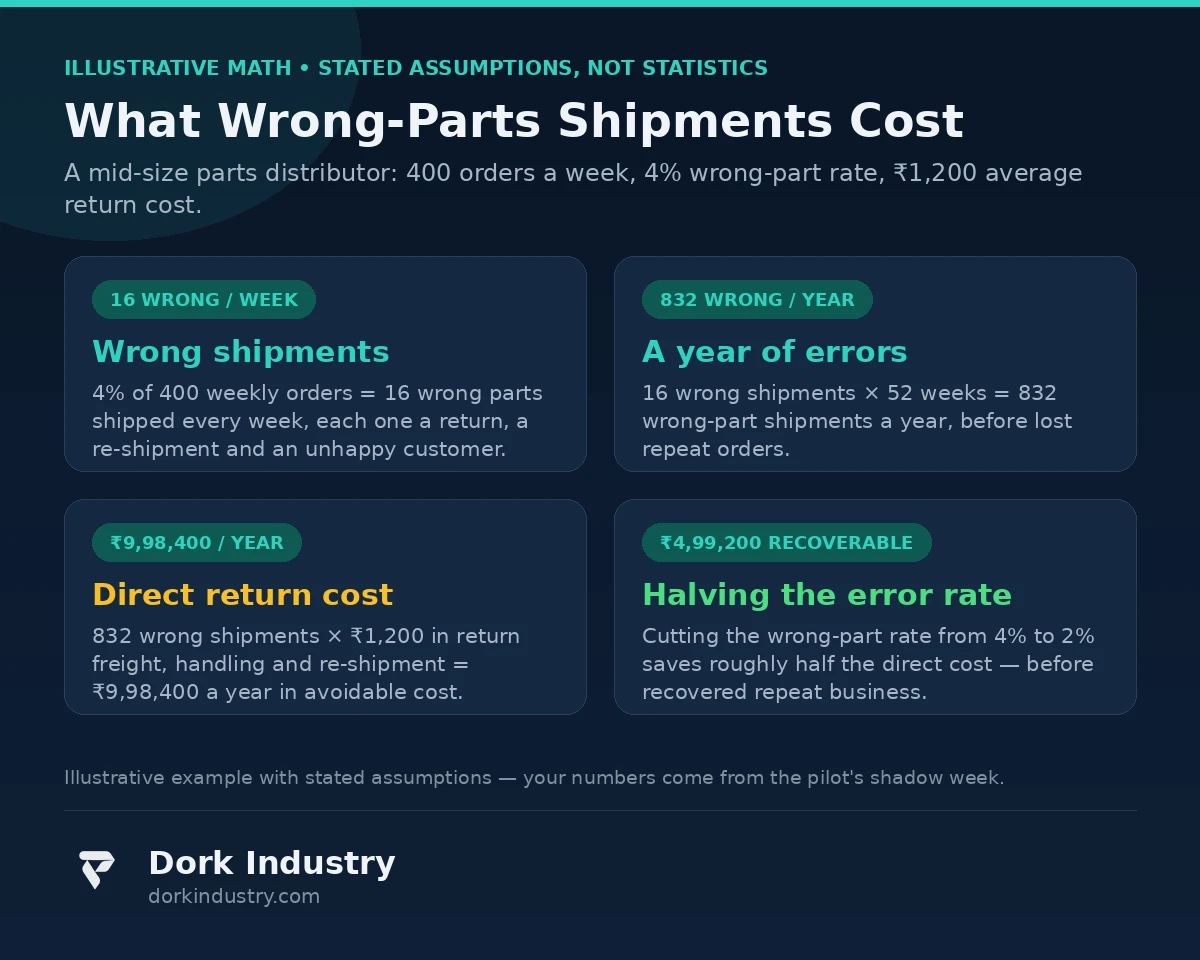
Consider a mid-size parts distributor shipping 400 orders a week with a 4% wrong-part rate — 16 wrong shipments a week, 832 a year. If each wrong shipment costs an average of ₹1,200 in return freight, handling, and re-shipment, the direct cost is ₹9,98,400 a year. These are illustrative figures with stated assumptions, not industry benchmarks: your rate and your return cost will differ, and the pilot below exists to measure your real ones.
Halving the rate to 2% saves roughly ₹4,99,200 a year in direct cost alone. That figure excludes the recovered repeat orders, the avoided idle-machine claims, and the picking time currently spent double-checking everything by hand. The leverage is in the rate, not the return cost: every percentage point of wrong-part rate is worth about ₹2,49,600 a year to this distributor.
Should you build or buy? An honest breakdown
Not every parts business needs custom AI development. The honest options, in order of investment:
| Approach | Best for | Relative investment | Where it breaks |
|---|---|---|---|
| Barcode scanning only | A small store with one catalogue and few look-alikes | Low | Checks the scan, not the identity — supersessions and kits still slip through |
| Off-the-shelf warehouse software | Standard picking, stock, and dispatch workflows | Subscription | Cannot model your supersession chains or fitment rules |
| Warehouse software + matching module | Businesses with clean part data and standard kits | Medium | Breaks when your catalogue, aliases, or fitment data are messy |
| Custom AI development | Messy catalogues, look-alike parts, kits, and fitment rules | Highest | Overkill if your wrong-part rate is already near zero |
According to ISO’s quality management guidance, consistent, controlled processes — not individual heroics — keep errors down as a business grows. If your error rate is a process problem (identities disagree, kits unchecked, exceptions unlogged), a system enforcing the process is the fix. If it is one careless week, it is a management problem, and software will not help.
What does a 30-day pilot look like?
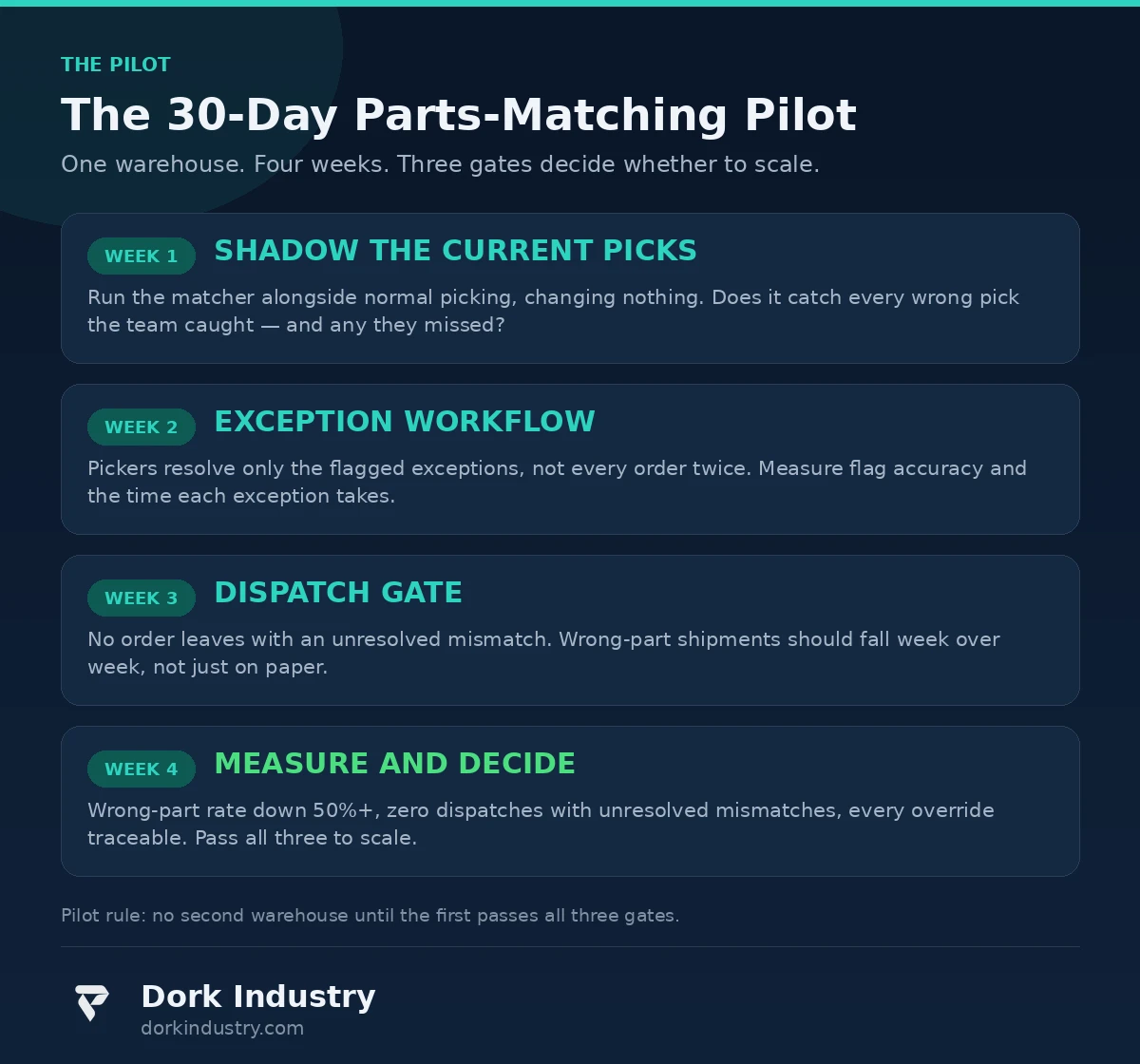
One warehouse, one product family, four weeks. The pilot proves the rate, not the technology.
- Week 1 — Shadow the current picks. Run the matcher alongside normal picking, changing nothing. Does it catch every wrong pick the team caught — and any they missed? Measure the true wrong-part rate for the first time.
- Week 2 — Exception workflow. Pickers resolve only the flagged exceptions, not every order twice. Measure flag accuracy and the time each exception takes. If flags are mostly false alarms, the identity data needs work before anything else.
- Week 3 — Dispatch gate. No order leaves with an unresolved mismatch. Wrong-part shipments should fall week over week, not just on paper.
- Week 4 — Measure and decide. Wrong-part rate down 50% or more, zero dispatches with unresolved mismatches, and every override traceable to a named human. Pass all three gates to scale; fail any one and fix the data first.
What drives the cost of building this?
Three things dominate the cost, and none of them is the matching model itself.
- Catalogue cleanup. Reconciling aliases, supersessions, and fitment data is the bulk of the work — and the bulk of the value. A system built on dirty part identities just automates the wrong answers faster.
- Integration. The matcher must read orders, stock, and bin data in real time. If those live in three systems that do not talk, integration — not AI — is the project.
- Exception workflow. The queue, the evidence view, and the audit trail are what make the system trustworthy. A matcher without a good exception workflow gets switched off within a month.
Businesses already scanning at picking start cheaper and faster.
What should you do this week?
Pull your last 90 days of returns and tag every wrong-part return with its cause: supersession, look-alike, kit component, or catalogue error. That table tells you whether you have a matching problem, a catalogue problem, or a kit problem — and exactly what the pilot must prove.
The bottom line
Wrong parts ship because part identities disagree and the only check is a human at the end of a long shift. AI development can enforce a single part identity, check every pick against the order, and hold every mismatch for a human — but only if the catalogue is reconciled, substitutes stay human-approved, and exceptions are never auto-cleared. Pilot it in one warehouse, on one product family, against three gates. If it halves your wrong-part rate in 30 days, scale it. If it does not, you have learned that your problem is the data, not the technology — and that is still a valuable answer.
Are wrong parts still leaving your warehouse every week?
Dork Industry will audit your last 90 days of wrong-part returns, map your supersession and kit risks, and show you what a parts-matching pilot would check in your warehouse — before you commit to building anything.
Request a free parts-accuracy AI assessment WhatsApp +91 8210792477
Frequently asked questions
Can AI development really match parts to orders automatically?
Yes, for the checking step: the system resolves the ordered line to a single part identity, verifies the scanned part against it, and holds mismatches for a human. It automates verification, not judgement — substitutes, fitment exceptions, and catalogue changes stay human-approved.
What if our part catalogue is messy?
Then catalogue cleanup is the project, and the pilot proves it in week one: flag accuracy collapses when aliases and supersessions disagree. That cleanup alone usually cuts errors before the matcher goes live at dispatch.
Do pickers need new hardware?
Usually a handheld scanner or a phone with a camera, plus barcode or QR labels on bins and parts. If you already scan at picking, the matcher slots into the existing scan step. If you pick from printed lists, budget for scanners and a short behaviour-change period.
How are kits handled differently from single parts?
Every component of a kit is checked individually against the kit’s bill of materials, not just the kit as a whole. That catches the single wrong seal inside a service kit that a kit-level check would ship as correct.
When should we not build a custom matching system?
When your wrong-part rate is already near zero, your catalogue is clean, and errors come from one-off carelessness rather than identity disagreements. In that case, barcode scanning plus a dispatch checklist is cheaper, and custom AI development would be overkill.
About Dork Industry
Dork Industry is a software development company building custom web, mobile, AI, and IoT systems for businesses across India. We work on the unglamorous operational problems — matching, reconciliation, tracking, and verification — where a small error rate quietly costs real money every week. Our approach is pilot-first: prove the improvement on one warehouse, one product family, or one workflow, with named gates, before scaling anything. Learn more about our custom software development and IoT automation work, or talk to us about your warehouse.

[…] Theme code rarely controls the core hosted payment-method list, but custom carts, checkout extensions, payment customizations and apps can influence the journey or eligibility. If the cart itself is broken, use the Shopify Add to Cart repair guide. If a promotion changes the outcome, compare the Shopify discount diagnosis. […]