Yes — AI automation can reconcile Input Tax Credit before you file. It matches every purchase invoice in your books against GSTR-2B, groups the exceptions by cause, and leaves only the genuine decisions to a human. It does not file your return for you, and it must not claim credit you cannot evidence. It stops the filing-week scramble where your accountant discovers, days before the deadline, that the credit your books promise and the credit the portal recognises are two different numbers.
In brief: how AI automation fixes GST reconciliation
AI automation reconciles Input Tax Credit before you file: it imports your purchase register and the GSTR-2B file, auto-matches the clean majority, and queues only the exceptions — missing supplier filings, wrong GSTINs, value differences, and credit notes — with a recommended action for each.
- Every invoice is accounted for: matched, unmatched with a cause, or flagged as blocked, time-barred, or reversed — nothing sits unexplained at filing time.
- Supplier follow-ups become dated, written requests with the exact invoice details, instead of phone calls nobody can evidence later.
- The GSTR-3B figure comes from the reconciled register, so the credit you claim is the credit you can defend if a notice arrives.
Key takeaways
- A business booking 300 purchase invoices a month, with 15% unmatched, parks an illustrative ₹54,000 of Input Tax Credit every month and spends about 32 hours matching lines by hand.
- Most mismatches fall into four buckets: in your books but not in GSTR-2B, in GSTR-2B but not in your books, present in both with different values, or credit notes handled late.
- A real reconciliation system is concrete: import both sides, auto-match on GSTIN plus invoice number plus financial year, apply tolerance rules for rounding, and queue exceptions by cause.
- The system must never claim credit on its own authority, edit an invoice number to force a match, or accept a GSTR-2B line for a supply you cannot evidence — a human owns each of those decisions.
- Run the 30-day pilot on one GSTIN and pass all three gates — every invoice accounted for, zero unexplained differences, no filing-week overtime — before rolling out.
Can AI automation reconcile Input Tax Credit before you file?
Yes. AI automation reconciles Input Tax Credit before you file by doing the matching work that currently eats your accountant’s week: it compares your purchase register line by line against GSTR-2B, the auto-generated statement of inward supplies the GST portal builds from your suppliers’ filings. When the two sides agree, the invoice moves to the eligible pool without human touch. When they disagree, the system says exactly how they disagree — missing, wrong GSTIN, different value, credit note pending — and queues that invoice for a named person to resolve.
This article covers what unmatched invoices actually cost, why the books and GSTR-2B drift apart, what a real reconciliation system does, what it must never do alone, and how to test it in 30 days on one GSTIN.

What does an unmatched invoice actually cost you?
The visible cost is parked credit. An invoice in your books that never appears in GSTR-2B cannot be claimed in that period. If the supplier files late, you claim it later; if the supplier never files, or the Section 16(4) deadline passes, that credit is lost for good.
Then there is the notice cost. Claiming more Input Tax Credit in GSTR-3B than GSTR-2B supports can draw a DRC-01C notice asking you to justify the excess or reverse it with interest. Answering that notice means reconstructing, months later, which invoices were genuinely yours and which were errors — from records kept under filing-week pressure. And there is the cost nobody counts until it is too late: the accountant’s filing week itself, when reconciliation is done by hand against a deadline instead of as a routine.
Why do the books and GSTR-2B drift apart?
The books and GSTR-2B drift apart because they are written by different people, at different times, from different documents. Your register is written when goods arrive; GSTR-2B is written when your supplier files GSTR-1 — or fails to, files late, or files against the wrong GSTIN.
How does a supplier’s late filing become your problem?
When a supplier has not filed GSTR-1 for the period, the invoice exists in your purchase register but has nowhere to show up in your GSTR-2B. This is the most common mismatch, and it has the cleanest remedy: a dated, written follow-up to the supplier, tracked until the invoice appears. The expensive version is the same mismatch discovered a year later, when the supplier has stopped answering and the Section 16(4) window is closing.
Why do small value differences add up?
A supplier files ₹1,18,000 where your books say ₹1,17,940 — rounding, a freight line captured differently, or a tax rate applied at 18% on one side and 12% on the other. Each difference is small; across hundreds of invoices, the aggregate is a gap nobody can explain without going line by line. Tolerance rules exist for exactly this: differences below a threshold can be bulk-accepted with a documented rule, while larger ones go to a human.
What about invoices in GSTR-2B that are not in your books?
Something was filed against your GSTIN that you never recorded — usually an invoice that never reached accounts payable, occasionally a supplier entering your GSTIN by mistake for another buyer. This category looks like free credit, and it is the most dangerous one to claim: credit for a supply you cannot evidence with an invoice and receipt of goods is exactly the kind of claim that comes back at assessment.
How do credit notes and blocked credits complicate the picture?
A supplier credit note issued after your draft GSTR-2B was generated reduces the credit you can claim, and ignoring it leaves excess credit in your records. Separately, some credits are blocked by law — Section 17(5) covers items like motor vehicles for non-specified purposes and food and beverages — so a perfect data match still does not make an invoice eligible. Matching proves the numbers agree; eligibility is a separate question the system must check, not assume.
What data do you already have?
Almost everything a reconciliation system needs already exists in your business. Your purchase register holds the supplier GSTIN, invoice number, invoice date, taxable value, and tax amounts. The GST portal gives you the GSTR-2B file for the same period and GSTIN, and your accounting software holds the payment dates that matter for reversal rules.
What does a real GST reconciliation system do?
A real system is concrete, not an “AI GST” slogan. It has five working parts.
How does auto-matching clear the boring majority?
Most lines match exactly — in most books, 70 to 85% of lines agree on invoice number, GSTIN, taxable value, and tax amounts. The system matches those automatically, so your accountant stops spending the week confirming lines that were never a problem. Matching must use GSTIN plus invoice number plus financial year: a supplier who books your March invoice in April puts it in a different financial year’s statement.
How are exceptions grouped so a human can actually clear them?
Exceptions are grouped by cause — missing in GSTR-2B, extra in GSTR-2B, value differences, credit notes, duplicates — each with its own remedy: chase the supplier, verify the supply, accept within tolerance, or reverse. The system shows the field-level difference, so the accountant decides from evidence. According to the GST portal’s own guidance, GSTR-2B is generated from suppliers’ filed returns and the Invoice Management System lets recipients act on each invoice — accept, reject, or keep pending — before the statement is recomputed.
How do supplier follow-ups stop being phone calls?
For every invoice missing from GSTR-2B, the system drafts a follow-up naming the supplier, the invoice number, the amount, and the period, and records when it was sent and what came back. That written trail is what you need if a mismatch ever becomes a notice response: oral assurances that a supplier “will file next week” are worthless in a DRC-01A reply, but a dated trail of requests and responses is evidence.
What does the eligibility check add beyond matching?
After matching, the system applies eligibility rules in the same pass: blocked under Section 17(5), past the payment window, past the Section 16(4) deadline, or reduced by a credit note. The output is one worksheet — eligible credit, blocked credit, and reversals by rule.
How does filing change when the register is already reconciled?
The GSTR-3B figure is taken from the reconciled register, not typed from a separate summary. The matched register, the mismatch list, and the ITC summary export as audit-ready records, so the filing is the end of a documented process rather than a number your accountant hopes survives scrutiny.
What must the system never do alone?
A reconciliation system must never claim credit on its own authority. Auto-matching a line is a data operation; deciding that a disputed invoice, a borderline blocked credit, or a supplier’s late correction should be claimed is a judgement that belongs to a named human, with the full exception history in front of them.
It must also never edit an invoice number to force a match: the original number must stay supported by the source document. And it must never accept a GSTR-2B line for a supply you cannot evidence: appearing in GSTR-2B is a reporting fact, not proof you received the goods or are entitled to the credit.
According to the GST portal’s Invoice Management System, recipient actions feed back into the recomputed GSTR-2B — which is why those actions must be deliberate, documented, and human-approved.
Should you build custom or buy a reconciliation tool?
Be honest here: not every business needs custom AI automation. If you book a few dozen purchase invoices a month from a handful of suppliers, your accounting software’s built-in GSTR-2B reconciliation plus a monthly discipline may be enough.
Build when your problem is specific: multiple GSTINs, hundreds of suppliers, branch-wise registers, and an ITC position your team must defend under scrutiny. Custom pays when the exception queue and follow-up workflow must mirror your real filing process.
| Approach | When it fits | Watch out for |
|---|---|---|
| Accounting software’s built-in reconciliation | Low invoice volume, few suppliers, one GSTIN | Exception handling and supplier follow-up tracking may be shallow, and the workflow may not match your filing calendar |
| AI automation, custom-built | Multiple GSTINs, high invoice volume, supplier follow-up trails, ITC scrutiny | Costs more up front; needs a pilot to prove the return |
| Spreadsheets and portal tables only | Tiny volume, one GSTIN, rare mismatches | Breaks the moment invoice volume, supplier count, or notice pressure grows |
What does the 30-day pilot look like?
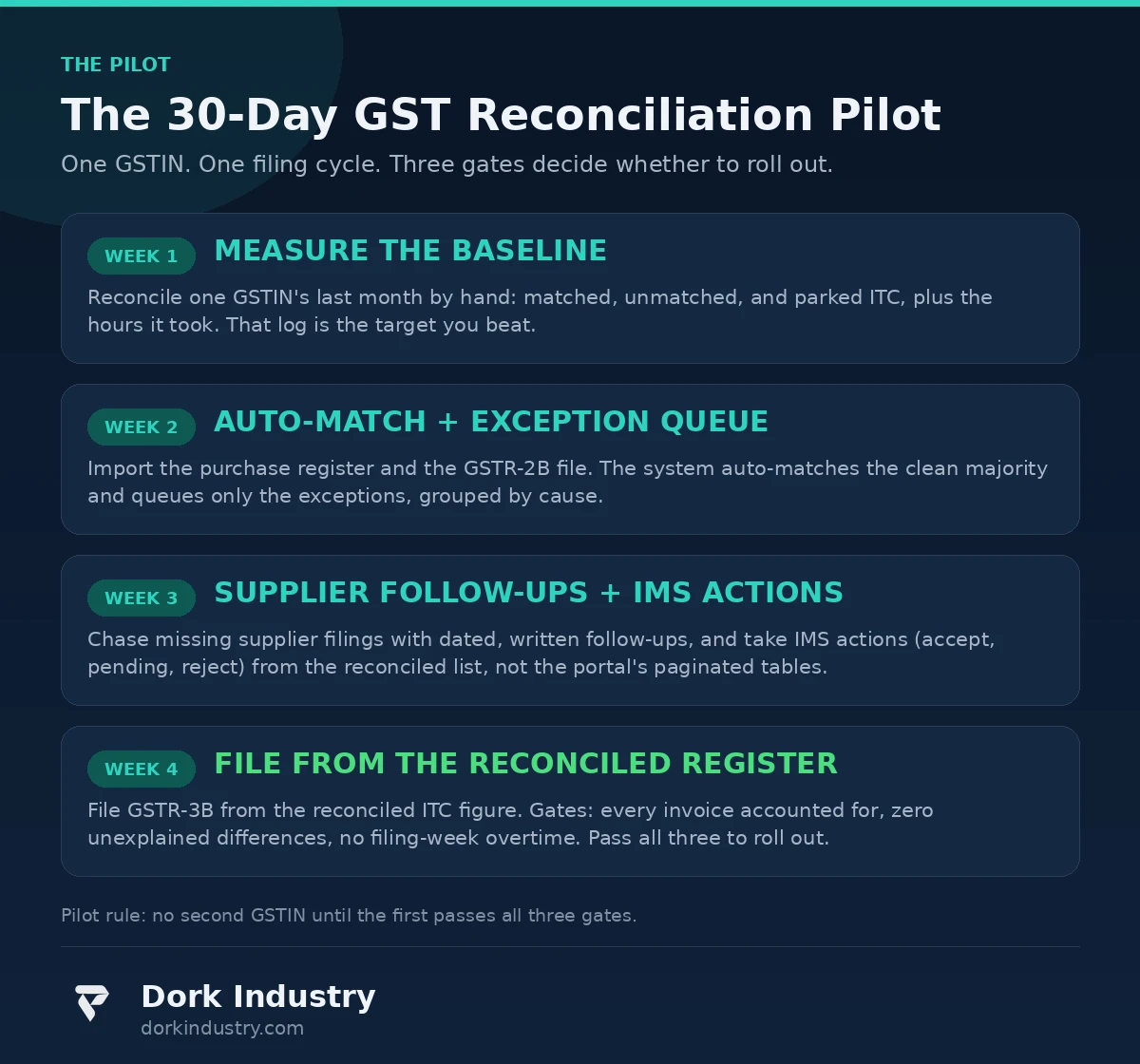
Pick one GSTIN, not the whole business. Week one, measure the baseline: reconcile that GSTIN’s last month by hand and log the hours it took. Week two, import the purchase register and the GSTR-2B file, auto-match the clean majority, and compare the exception queue against the hand-reconciled list.
Week three adds supplier follow-ups and IMS actions from the reconciled list. Week four, file GSTR-3B from the reconciled register and measure against three gates: every invoice accounted for, zero unexplained differences, and no filing-week overtime. Pass all three to roll out.
What drives the cost?
Cost follows scope, not slogans. A single-GSTIN matcher with fixed tolerance rules costs less than a multi-GSTIN system with supplier follow-up automation, IMS action workflows, eligibility and reversal rules, and audit-ready exports. The biggest cost driver is usually integration: connecting the system to the purchase registers and accounting software your team already uses, without breaking filings already in flight.
Budget in phases: the pilot GSTIN first, then rollout funded by the hours and parked credit the pilot freed. For the same pattern in other operations, see Dork Industry’s custom software development services and web development services.
Illustrative data: what unmatched invoices cost (stated assumptions, not statistics)
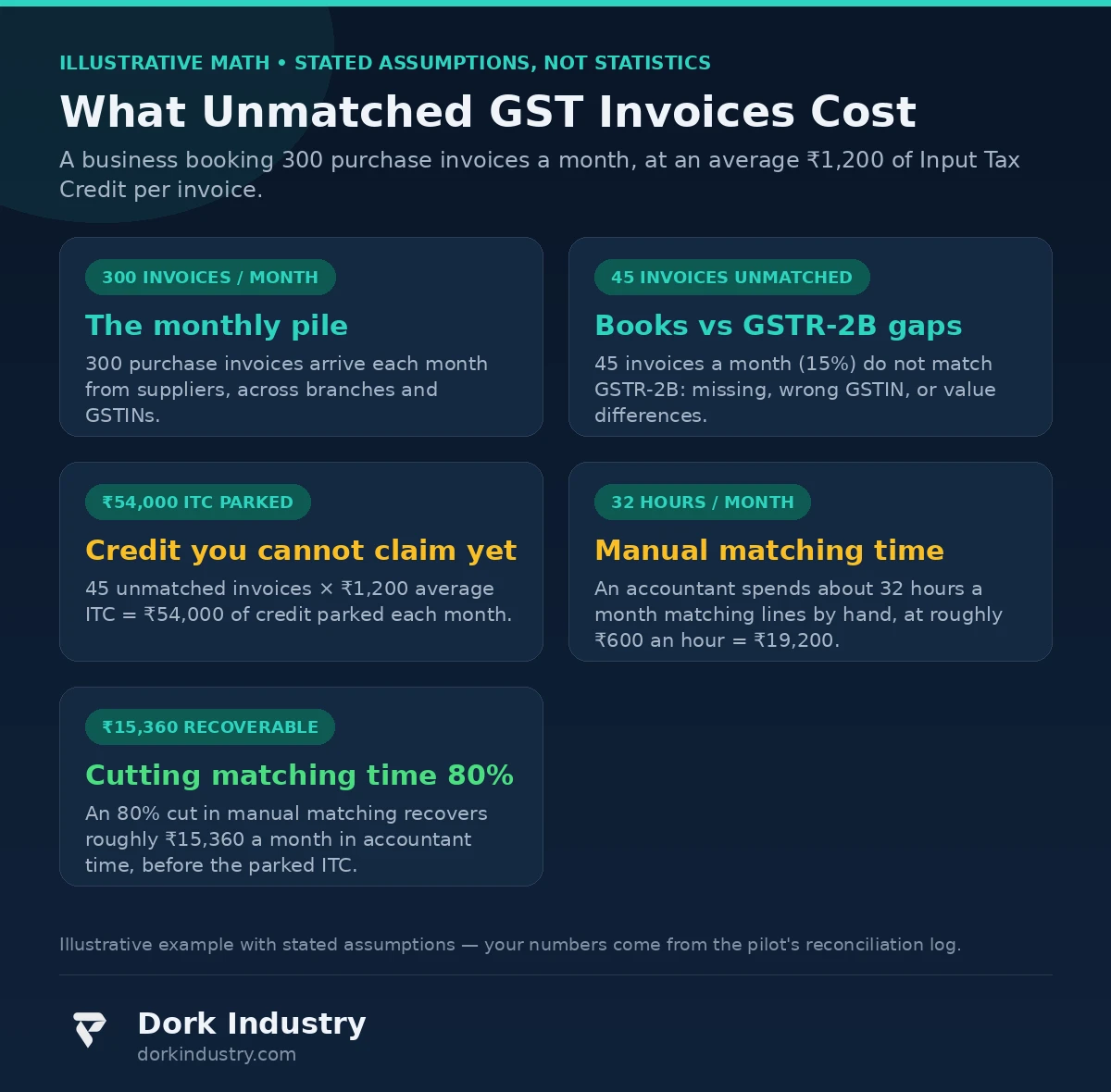
The following example is illustrative, with its assumptions stated openly — a way to size the problem, not a claim about your business. A business booking 300 purchase invoices a month, at ₹1,200 of Input Tax Credit each, with 45 invoices (15%) unmatched, parks 45 × ₹1,200 = ₹54,000 of credit a month. An accountant spending 32 hours a month matching by hand, at ₹600 an hour, costs ₹19,200 a month; an 80% cut recovers roughly ₹15,360 a month, before any parked credit is released.
The bottom line
GSTR-2B is the earliest warning you get that your books and your suppliers’ filings disagree, and filing week is the worst time to hear it. AI automation moves that warning to the start of the month: the clean majority matches itself, exceptions arrive grouped by cause, and the GSTR-3B figure comes from a register you can defend. Start with one GSTIN’s reconciliation log, run the pilot, and let your own matched rate make the case.
Is your accountant still losing a week every month to GST invoice matching?
Dork Industry will map your purchase register, GSTR-2B exceptions, and filing calendar, then show exactly how AI automation reconciles your Input Tax Credit before the deadline for one GSTIN.
Request a free GST reconciliation assessment WhatsApp +91 8210792477
Frequently asked questions
What happens if I claim ITC on an invoice that is not in GSTR-2B?
The portal may issue Form DRC-01C, requiring you to justify the excess credit or reverse it with applicable interest within the given window. Reconciling before filing — and keeping the supplier follow-up trail — is what lets you answer that notice from evidence instead of memory.
Is it possible for GSTR-2B to show an invoice that is not in my books?
Yes, if a supplier enters your GSTIN incorrectly for another buyer, or if an invoice never reached your accounts team. Do not claim that credit; verify the supply first, and ask the supplier to amend the entry in their next GSTR-1 filing if it is not yours.
What is the deadline for claiming ITC for a specific financial year?
Under Section 16(4), ITC for a financial year must be claimed by 30th November of the following financial year or by the date of filing the annual return for that year, whichever is earlier. After that, the credit is permanently barred — which is why parked invoices need chasing months before the deadline, not in its final week.
Can a matched invoice still be ineligible for ITC?
Yes. A match confirms data consistency, not legal eligibility. Credit may still be blocked under Section 17(5), time-barred, subject to reversal, or unavailable because another statutory condition — such as receipt of goods or payment within the required window — is not met.
Should invoice numbers be edited to create an exact match?
No. The original invoice number must remain supported by the source document. Editing it to force a match destroys the audit trail; the correct remedy is to find why the two sides differ — wrong GSTIN, wrong financial year, or a supplier correction — and fix the cause.
About Dork Industry
Dork Industry is a software development company building custom web, mobile, AI, and IoT systems for businesses across India. The team designs systems around the client’s real commercial rules — filing calendars, approval stages, and audit trails included — and proves them with small pilots before wider rollout. Learn more at dorkindustry.com.