
Quick answer: An AI agent development company Delhi buyer should choose is one that can prove workflow discovery, production architecture, data permissions, RAG controls, integrations, evaluation, human approvals, security, observability, commercial ownership and handover. Start with one reversible workflow and require measurable pilot evidence before allowing live actions.
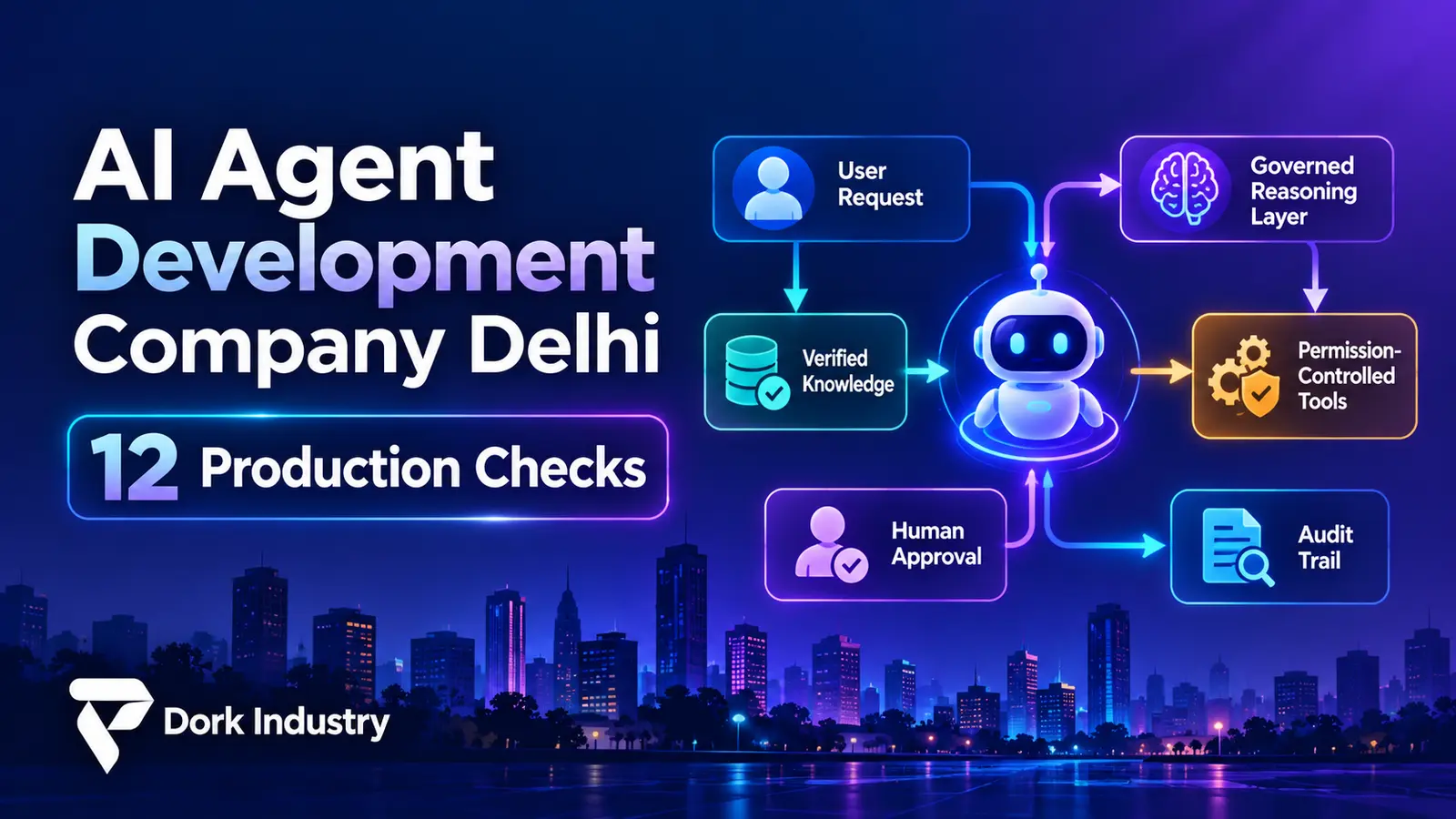
Original framework data: Dork Industry grouped the 12 checks below into three decision areas. Five checks (41.7%) examine engineering and operating controls, four checks (33.3%) examine governance and safety, and three checks (25.0%) examine commercial continuity and handover. These percentages classify this article’s framework; they are not industry performance statistics.
| Decision area | Checks | Share |
|---|---|---|
| Engineering and operations | 5 of 12 | 41.7% |
| Governance and safety | 4 of 12 | 33.3% |
| Commercial continuity | 3 of 12 | 25.0% |
Source and method: Dork Industry original classification of the 12 checks in this guide. Risk categories were cross-checked against the NIST AI Risk Management Framework and OWASP guidance cited below.
Methodology: On 9 October 2026, Dork Industry analysed a defined buyer-side checklist of 12 controls (n=12). The largest group contains five engineering and operating checks; the smallest contains three commercial-continuity checks, a difference of two checks or 16.7 percentage points. The calculation is reproducible from the numbered framework and does not estimate project-success rates.
Reviewed on 9 October 2026. Written by Nishant Singh for Dork Industry.
What should decision-makers know first?
- Diagnose one business workflow before comparing platforms or model names.
- Keep consequential actions behind deterministic policy checks and human approval.
- Require a representative evaluation set containing failures and adversarial inputs.
- Separate discovery, integration, model usage, monitoring and support costs.
- Demand documentation, rollback procedures and an exit or handover plan.
For the commercial service scope, technical boundaries and consultation route, review Dork Industry’s AI agent development services. If the requirement is primarily a user-facing product, compare AI application development services.
What is an AI agent in practical business terms?
An AI agent is software that can interpret a goal, retrieve permitted information, choose from approved tools and complete or recommend a sequence of actions. A useful business agent is not an unrestricted autonomous employee. It operates inside defined permissions, records its actions and hands high-risk decisions to a person.
For example, an enquiry agent may read a website form, classify the requirement, check the CRM for duplicates, prepare a response and assign the lead. It should not silently change pricing, promise delivery dates or expose customer records. The workflow, not the model name, determines whether the project creates value.
Why do AI agent projects fail after a convincing demo?
An AI agent development company Delhi proposal should explain why a demonstration is not production evidence. Demos usually contain clean inputs, one happy path and a person ready to correct mistakes. Production contains incomplete records, conflicting instructions, inaccessible systems, timeouts and exceptional cases. A project fails when the buyer and vendor have not defined what the agent may read, what it may change, when it must stop and how a human can reconstruct its decision.
- No single owner for the business outcome
- No reliable source of truth for customer, product or policy data
- Broad system permissions granted before controls are tested
- No test set containing exceptions and deliberately misleading inputs
- No cost, latency or fallback limit
- No operating process for corrections, incidents and model changes
Which business workflows are suitable for a first AI agent?
The best first workflow is frequent, measurable and reversible. It has enough historical examples to test, but a mistake does not immediately create legal, safety or financial harm. Start where an employee currently gathers information from several systems and applies a documented rule before preparing a recommendation.
| Workflow | Useful agent task | Keep human approval for |
|---|---|---|
| Sales enquiries | Deduplicate, enrich, classify and prepare routing | Commercial promise, discount or rejection |
| Customer support | Retrieve policy and draft a cited answer | Refund, account change or sensitive complaint |
| Purchase operations | Compare requisition, stock and approved vendors | Vendor selection and purchase commitment |
| Finance operations | Extract fields and flag mismatches | Payment release and ledger correction |
| Internal knowledge | Find approved documents and answer with citations | Legal, HR or compliance interpretation |
How should a company diagnose the workflow before requesting proposals?
Before asking an AI agent development company Delhi team for estimates, observe ten recent cases from start to finish. Record the trigger, systems opened, information copied, decisions made, exceptions, approvals, elapsed time and final outcome. If two experienced employees follow different unwritten rules, automation will reproduce the disagreement rather than remove it.
- Name one outcome, such as reducing manual qualification time without increasing incorrectly routed leads.
- List every data source and identify its owner.
- Mark actions as read-only, draft-only, approval-required or prohibited.
- Collect normal, incomplete, duplicate, contradictory and adversarial examples.
- Define what the agent must do when a system, model or document is unavailable.
- Choose a baseline and a go/no-go threshold before development begins.
What can and cannot be automated safely?
An agent can retrieve documents, summarize permitted information, populate a draft, call a constrained API and route work. It cannot make unreliable source data trustworthy, remove accountability from regulated decisions or guarantee that a probabilistic model will never make an error. High-impact actions need deterministic checks and human authorization.
Separate reasoning from execution. The model may suggest an action, but a policy layer should verify the user, fields, amount, customer status and permission before an API call is allowed. For destructive or financial actions, require an explicit approval token and create an immutable audit record.
AI Agent Development Company Delhi: Which 12 Checks Matter?
When shortlisting an AI agent development company Delhi businesses should demand evidence for every production claim. The following checks turn a sales comparison into a verifiable procurement decision.
1. Does the AI agent development company tie discovery to a measurable workflow?
The provider should inspect real cases, exceptions, owners and baseline performance before proposing technology. Require one measurable outcome and clearly excluded decisions.
2. Can the AI agent development company explain the production architecture?
Ask it to map the model gateway, retrieval, orchestration, policy layer, tools, queues, logs, approvals and fallback paths. A chatbot screen is not an operating architecture.
3. Has the AI agent development company integrated comparable business systems?
Relevant experience should cover governed connections to CRM, ERP, ecommerce, databases and identity systems. Request evidence of retry, duplicate-prevention and recovery design.
4. Does the AI agent development company enforce least-privileged permissions?
Tools should be separated by user, department, environment and action type. Read access does not justify write access, and write access does not justify approval authority.
5. Can the AI agent development company make grounded answers cite approved sources?
RAG should respect document-level permissions, freshness and ownership. Reviewers must be able to open the evidence supporting a material answer.
6. Does the AI agent development company build a representative evaluation set?
The evaluation should contain normal, incomplete, duplicate, contradictory and adversarial cases with measurable pass criteria agreed before development.
7. Does the AI agent development company define explicit human controls?
Approval, escalation, correction and emergency-stop paths must identify responsible roles and response expectations. High-impact actions should never depend on model confidence alone.
8. Does the AI agent development company test agent-specific security threats?
Tests should cover prompt injection, data leakage, poisoned documents, excessive agency and unsafe tool calls as well as conventional application risks.
9. Can the AI agent development company make every important action traceable?
Observability should capture correlation IDs, retrieved evidence, policy decisions, tool calls, errors, cost and latency without storing secrets or unnecessary personal data.
10. Does the AI agent development company keep changes controlled and reversible?
Prompt, policy, tool, retrieval and model versions need release records, evaluation evidence and rollback procedures. Silent production changes weaken accountability.
11. Does the AI agent development company separate all material costs?
Discovery, data work, pilot engineering, integrations, cloud, model usage, monitoring, maintenance and support should be estimated separately with volume assumptions.
12. Will the AI agent development company provide a complete handover?
Require architecture, source-code terms, deployment records, test assets, runbooks, administrator training, credential ownership and an exportable backlog.
What architecture should a production AI agent include?
An AI agent development company Delhi architecture should normally include an authenticated user channel, an orchestration layer, a model gateway, retrieval from approved knowledge, a policy and permission layer, constrained tools, event logging and a human-review queue. Each component should be replaceable without rewriting the entire workflow.
The agent should carry a correlation ID across the request so an operator can reconstruct what happened. Tool inputs should be validated against schemas. Retries must be idempotent so a timeout cannot create a second order, duplicate lead or repeated notification. Long-running work should use a queue rather than keeping the user request open indefinitely.
How should RAG and company knowledge be controlled?
Retrieval-augmented generation, or RAG, gives a model selected information at answer time. It is useful only when document ownership, freshness, access and citations are controlled. Indexing every shared-drive file into one unrestricted store can expose confidential information and make outdated drafts look authoritative.
- Attach owner, effective date, confidentiality and source URL metadata.
- Enforce the user’s access rights before retrieval, not after generation.
- Prefer approved policies and product records over informal messages.
- Show citations that let a reviewer open the exact source.
- Expire or re-index superseded material through a documented process.
- Return “insufficient evidence” when reliable material is unavailable.
Which security questions should buyers ask?
Ask how the system limits prompt injection, sensitive-data disclosure, excessive agency and insecure tool use. The OWASP guidance for LLM applications provides a useful risk checklist, while the NIST AI Risk Management Framework helps teams organize governance, measurement and risk treatment.
Confirm data retention, model-provider terms, encryption, regional hosting needs, secret management, role-based access, audit-log access and incident response. Production secrets must never be embedded in prompts or source code. The vendor should demonstrate how a tool call is denied when policy conditions are not met.
How do NIST and OWASP strengthen the selection framework?
NIST organizes its AI RMF Core around four functions: Govern, Map, Measure and Manage. Its Playbook aligns suggested actions to those four functions and explicitly says it is not a checklist to follow in its entirety. An AI agent development company Delhi evaluation can use the four functions to test governance, context mapping, measurement and response ownership without pretending that framework adoption guarantees safety.
The OWASP 2025 guidance identifies ten major risk categories for LLM and generative-AI applications. Its published material treats prompt injection as LLM01:2025 and excessive agency as LLM06:2025. Those two categories directly support this guide’s requirements for adversarial testing, constrained tools and least-privileged permissions. Review the four NIST AI RMF functions, the OWASP 2025 Top 10, LLM01 prompt injection and LLM06 excessive agency.
What does current enterprise research say about buying AI agents?
IBM’s June 2025 AI Projects to Profits study surveyed 2,900 executives. Respondents expected AI-enabled workflows to rise from 3% to 25% by the end of 2025, 70% called agentic AI important to their organization’s future, 69% identified improved decision-making as its leading benefit, and 83% expected agents to improve process efficiency and output by 2026. A separate IBM CEO study reported that only 25% of AI initiatives had delivered expected ROI and only 16% had scaled enterprise-wide. These are global survey findings rather than guaranteed outcomes for a Delhi buyer, but they reinforce the need to connect ambition to a measurable workflow, governance and pilot evidence.
For procurement, the useful lesson is not “adopt because others are adopting.” It is that an AI agent development company Delhi proposal should define the baseline, target improvement, test population, error tolerance and stop rule before engineering begins. That makes the commercial decision auditable even when market enthusiasm changes.
How should an AI agent be evaluated before launch?
Evaluation must measure the complete workflow, not only whether an answer sounds good. Build a frozen test set from real redacted cases and score retrieval quality, factual support, classification, tool selection, field accuracy, policy compliance and final business outcome.
| Measure | Question | Example launch rule |
|---|---|---|
| Supported answer rate | Are material claims backed by approved evidence? | Meet the agreed threshold on the frozen test set |
| Unsafe action rate | Did the agent attempt a prohibited operation? | Zero unresolved critical attempts |
| Tool success | Did the correct system action complete once? | No duplicate side effects in replay tests |
| Escalation quality | Did uncertain cases reach the correct person? | All high-risk cases routed correctly |
| Cost and latency | Is performance usable at expected load? | Within the agreed budget and response target |
Do not publish invented benchmark claims. Measure against your own workflow, data and expected concurrency. A lower-cost model with reliable retrieval and controls may outperform a more capable model inside an uncontrolled design.
Should you buy, configure or build an AI agent?
An AI agent development company Delhi assessment should compare all three routes before recommending custom engineering.
| Option | Best fit | Main trade-off |
|---|---|---|
| Buy | Standard workflow supported by an existing product | Fast start but limited control and differentiation |
| Configure | Common process with company-specific systems and rules | Moderate speed; connector and platform constraints remain |
| Build | Distinct workflow, proprietary data or complex integrations | More control but higher engineering and operating responsibility |
A custom build is justified when the workflow differentiates the business, existing products cannot enforce required controls, or integration complexity dominates licensing. Buying is usually better when the process is standard and switching cost is acceptable. A vendor should be willing to recommend “do not build” when configuration is sufficient.
What should an AI agent proposal cost include?
Compare every AI agent development company Delhi proposal by scope rather than one headline price. Require separate estimates for discovery, data preparation, prototype, production engineering, each integration, evaluation, security review, cloud and model usage, monitoring, documentation, training and post-launch support. Define assumptions about monthly requests, document volume, users and response targets.
Ask what happens if the model provider, API pricing or required integration changes. Contract terms should state ownership of source code, prompts, evaluation data, configuration and operational documentation. They should also define how confidential data may be used and whether it can train any external model.
What is a practical 30-day AI agent pilot plan?
An AI agent development company Delhi pilot should reserve explicit time for challenge testing and an evidence-based stop decision.
- Days 1–5 — map: confirm owner, baseline, cases, data, prohibited actions and approval policy.
- Days 6–10 — prepare: create the evaluation set, access model, tool schemas and success thresholds.
- Days 11–18 — build: connect a sandbox, implement retrieval, policy checks, logging and a human queue.
- Days 19–23 — challenge: test missing data, conflicting documents, prompt injection, timeouts, duplicates and permission failures.
- Days 24–27 — shadow: run beside the existing process without independent live actions.
- Days 28–30 — decide: compare outcome, risk, workload, cost and support needs; expand, revise or stop.
Original pilot allocation: This framework assigns 5 days (16.7%) to mapping, 5 days (16.7%) to preparation, 8 days (26.7%) to building, 5 days (16.7%) to challenge testing, 4 days (13.3%) to shadow operation and 3 days (10.0%) to the decision review. These percentages describe this 30-day pilot only and allow a buyer to verify whether risk testing receives adequate time.
AI agent pilot worksheet
| Field | Record before work starts |
|---|---|
| Business outcome | One measurable result and current baseline |
| Workflow boundary | Trigger, completion point and excluded decisions |
| Systems | Owner, read/write permission and sandbox availability |
| Test set | Normal, exceptional, adversarial and high-risk cases |
| Human approval | Actions requiring review and maximum response time |
| Go/no-go rules | Accuracy, safety, cost, latency and operational thresholds |
| Rollback | Kill switch, queue handling and return to manual process |
Why is Delhi a relevant market for AI agent development?
Delhi and the surrounding NCR market combine service businesses, distributors, manufacturers, technology teams and multi-location operations. The supplied target-area analysis identifies demand across ERP modernization, field-sales systems, warehouse workflows, industrial monitoring and enterprise automation. Geography should affect discovery and support—not replace proof of technical capability.
A Delhi buyer should still evaluate remote delivery, security, documentation and ongoing support. Local access can help workshops and integration discovery, but production quality depends on architecture, testing and operating discipline. Dork Industry’s LangChain development and integration services, custom web application development and technology assessment route support the controlled implementation path described here.
The right AI agent development company Delhi engagement should end with documented tests, ownership boundaries and a reversible operating process—not dependency on a demonstration environment.
Frequently asked questions about AI agent development companies in Delhi
How long does a first AI agent pilot take?
A tightly bounded pilot can often be assessed in about 30 days when data owners, sandbox access and test cases are ready. Complex legacy integrations or regulated approvals may require longer. The schedule should be based on dependencies, not a generic promise.
Can an AI agent connect with an existing CRM or ERP?
Yes, when the system exposes a supported API, webhook, database view or controlled integration method. The design should use least-privileged service accounts, validated schemas, idempotency and audit logs. Direct database writes are usually riskier than governed APIs.
Do we need to replace our existing software?
Usually not. An agent can sit above approved systems to retrieve information, prepare work and call constrained tools. Replacement is justified only when the current system cannot provide reliable data, permissions or integration interfaces.
Which model is best for an AI agent?
There is no universally best model. Select by measured task quality, privacy terms, latency, availability, cost and tool-use reliability. Keep a model gateway where practical so the workflow is not permanently coupled to one provider.
How do we prevent hallucinations?
Hallucinations cannot be eliminated by instruction alone. Reduce risk with approved retrieval, citations, structured outputs, deterministic validation, refusal when evidence is weak, representative evaluation and human approval for consequential actions.
What should we bring to the first assessment?
Bring ten recent cases, the current process, data sources, exception examples, access constraints, desired outcome and a responsible owner. Redact personal or confidential information until a suitable agreement and secure transfer method are in place. This gives an AI agent development company Delhi team enough evidence to scope a responsible pilot.
If you are comparing providers to build this, see our comparison of best AI automation companies in India, which rates eight providers on delivery, integrations, governance and pricing.
Turn one workflow into a controlled AI pilot
Dork Industry provides workflow assessment, AI agent development, RAG, CRM/ERP integration, automation engineering and developer hiring. Start with evidence and a go/no-go plan.
Sources and further reading
- NIST AI Risk Management Framework
- OWASP Top 10 for Large Language Model Applications
- NIST AI RMF Playbook
How was this guide researched?
Dork Industry reviewed the five organic results returned for the target query on 9 October 2026. The results included two long company-list articles, one agency directory, and two local service pages. They supported commercial comparison but generally offered limited buyer-side detail on least-privilege tools, failure recovery, evaluation datasets, duplicate side effects, rollback and measurable pilot acceptance. This guide addresses those decision gaps without copying competitor content.
For broader service evaluation, compare Dork Industry’s AI automation services in India and custom AI application development services. These pages separate workflow automation, application engineering and agent-specific delivery scope.
[…] Theme code rarely controls the core hosted payment-method list, but custom carts, checkout extensions, payment customizations and apps can influence the journey or eligibility. If the cart itself is broken, use the Shopify Add to Cart repair guide. If a promotion changes the outcome, compare the Shopify discount diagnosis. […]