AI development for ecommerce catalogs is rarely about the writing itself — it is about whether your products ever get listed properly. Yes: AI development can turn supplier data sheets into first-draft product descriptions that a human then reviews and approves, and for catalogs with thousands of SKUs this is often the difference between a store that launches on time and one that stalls on blank product pages. If your team has ever sat on a shipment of 2,000 new products while three copywriters tried to research, write, and SEO-optimize every listing by hand, this article is about that exact bottleneck: why it exists, what data you already have, how an AI drafting pipeline works, where human judgment must stay in charge, and how to test it on one category in 30 days.
This article examines whether AI development can turn supplier PDFs, Excel files, and spec tables into catalog-ready first drafts: what it does well, what it must never do alone, and the economics of building or buying such a system.

Where does catalog content actually lose you money?
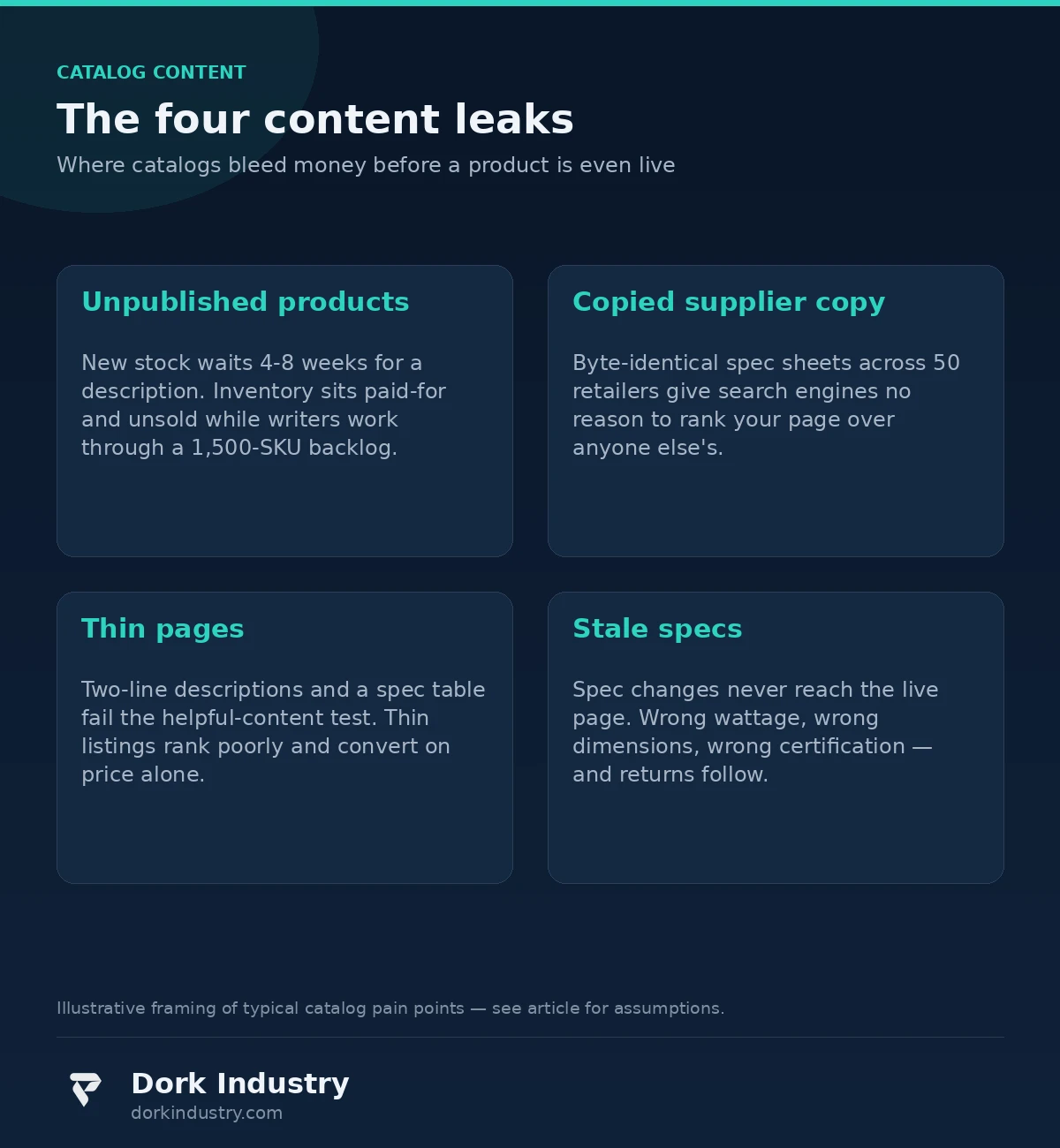
Before discussing technology, it is worth naming the specific leaks. In our experience working with ecommerce businesses, the expensive problems are not about photography or pricing. They are about words — thousands of missing, duplicated, or embarrassing product descriptions.
Why do new products sit unpublished for weeks?
A shipment arrives, the ERP gets the SKUs, and then everything stops. The content team has a backlog of 1,500 products and can write maybe 40 descriptions a week. New products wait 4–8 weeks for their page to exist — weeks of zero online sales for inventory that is already paid for and sitting in the warehouse.
Why does your catalog read like the supplier’s PDF?
Under deadline pressure, writers copy the supplier’s spec sheet, add a line of marketing copy, and publish. When fifty other retailers do the same, your pages carry byte-identical content — and search engines have little reason to rank yours above anyone else’s. The catalog “exists” but converts and ranks like a clone of every competitor.
Why is thin content quietly killing your rankings?
According to Google’s own guidance on AI-generated content, automation itself is not the problem — what matters is whether the content is helpful, original, and produced with appropriate human oversight. Hundreds of listings with a two-line description and a spec table fail that test regardless of who wrote them. Thin catalog pages rank poorly, attract little long-tail traffic, and leave comparison shoppers with nothing to buy on except price.
Why can’t your content team keep up with changes?
Suppliers update specs, swap components, and send corrected certificates. Every change should ripple into the descriptions — and mostly it does not, because re-writing is manual. The result is listings that quietly describe the wrong wattage or last year’s certification, and a returns problem that support blames on “customers not reading.”
Why does supplier data arrive unusable?
Supplier data sheets were never designed for your storefront. A typical export mixes formats: one supplier sends neat Excel sheets, another a 40-page PDF in the original language with specs buried in a table on page 27, a third sends scanned images of printed datasheets. Units are inconsistent, variant structure varies, and half the fields your templates need — key selling points, use cases, care instructions — do not exist in the source material.
This is why off-the-shelf “AI product description” plugins disappoint: they assume clean input. Real supplier data is messy, and the unglamorous engineering work — extraction, normalization, attribute mapping — is where a purpose-built pipeline earns its keep. The writing step is the easy part. Turning a messy supplier PDF into a normalized spec table is what separates a demo from a working system.
What data does your catalog already have — and what is it missing?
Most retailers already generate the raw material: supplier PDFs and Excel files, ERP records with SKU and pricing, warehouse data (weight, dimensions, packaging), customer reviews and Q&A, and internal search logs showing what shoppers type. What is missing is structure: attributes are not mapped to your taxonomy, selling points are not separated from specifications, and nobody has defined which claims are approved for public copy.
A content pipeline does not invent your products — it organizes what suppliers and your team already know. That principle should guide any AI development for catalog content: surface facts from source documents and draft from them, never hallucinate features no document supports. Treat the AI as a research assistant with a typewriter: everything it writes must trace back to a source field.

How does an AI description pipeline actually work?
A working system has four stages. Each one is automatable, but each needs different guardrails.
How are specs extracted from supplier PDFs and Excel files?
Document ingestion parses each supplier format into a common structure: OCR for scanned PDFs, table extraction for datasheets, column mapping for spreadsheets. A per-supplier mapping profile learns where the voltage, the dimensions, and the certifications live in that supplier’s layout. New documents get an extraction-confidence score; low-confidence pages route to a human for mapping, and the mapping is reused for every future file from that supplier. The model is instructed to return machine-readable attribute-value pairs against your taxonomy — not prose — so downstream steps consume facts, not sentences.
How is a first draft written from a spec table?
Drafting takes the normalized attribute table plus your brand templates: headline pattern, feature-bullet format, tone rules, and category-specific sections (fabric and fit for apparel; capacity and compatibility for electronics). The model writes the draft constrained to the attributes it was given, with citations back to source fields so a reviewer can check any claim in one click. Drafts are generated per variant family — one draft covers the whole size run of a T-shirt, with variant fields filled from the attribute table.
How does brand voice stay consistent?
Voice is enforced by template and by review data, not by hoping the model “sounds like you.” The style guide is encoded as generation rules — sentence length caps, forbidden words, required sections, units formatting — and every accepted or edited draft feeds a quality log. Drift shows up fast: if reviewers keep rewriting the intro paragraph, the template gets fixed. This is also where SEO hygiene lives: keyword placement rules, minimum content depth per category, and uniqueness checks against your own catalog before anything publishes.
Where does a human review the draft?
Every draft lands in a review queue: the draft, the source attributes it was built from, and a diff view when re-generating an existing listing. Reviewers approve, edit-and-approve, or reject with a reason code — and rejection reasons feed back into the templates, so the system improves with every correction. Nothing publishes without an approval event, and every published page keeps its source-trace: which supplier document, which mapping version, which template, which reviewer.
What does the math look like? An illustrative example
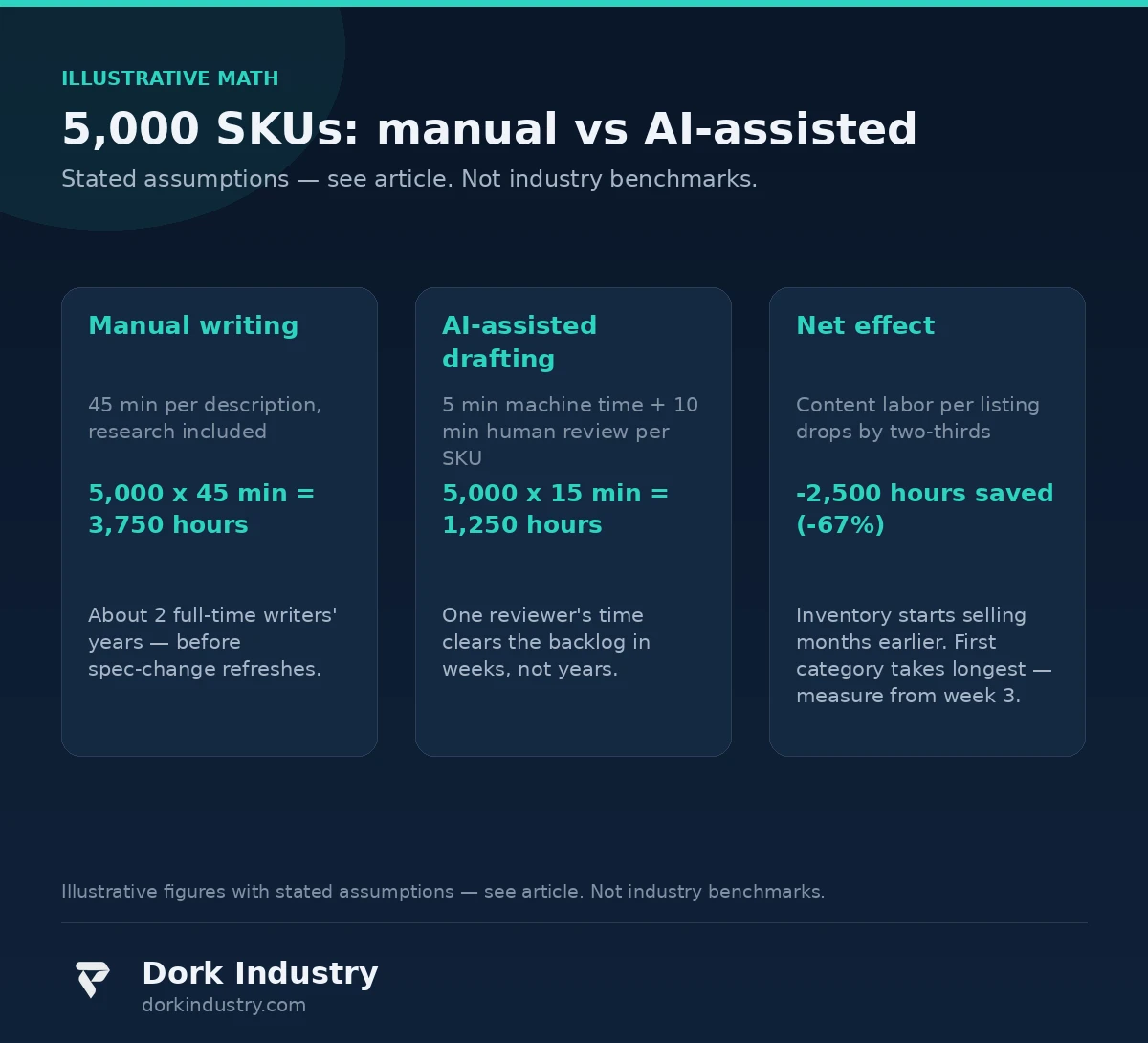
Consider a mid-size online retailer with 5,000 SKUs to list. Assumptions (stated, not benchmarks): a writer takes roughly 45 minutes per description including research; a working year is ~1,800 productive hours; an AI-assisted workflow takes ~5 minutes of machine time plus ~10 minutes of human review per draft. Manual effort for the backlog alone: 5,000 × 45 minutes = 3,750 hours, or about two full-time writers’ years — before refreshes when specs change.
With a drafting pipeline, the same 5,000 descriptions cost about 1,250 human hours (15 minutes each): a ~67% reduction in content labor, and more importantly, the backlog clears in weeks instead of years. The honest caveat: the first category takes longer, because supplier mapping profiles and brand templates are built once and reused.
What must the system never do alone?
Technology boundaries in AI development matter as much as features — in ecommerce, a wrong description is a returns claim, a compliance incident, or a trust problem. Some lines should never be crossed by automation.
- Never publish a description without human approval. The draft is a draft. Publishing is a human decision — full stop. The queue can prioritize and batch, but it cannot approve.
- Never invent product attributes. If the supplier document does not state the battery capacity, the draft must say so is unknown or omit it — never fill it in from general knowledge. Fabricated specs create returns and, in some categories, safety liability.
- Never generate compliance or certification claims. “FDA approved,” “CE certified,” “organic,” “medical grade” — these must come from a certificate field mapped by a human, never from the model’s memory of similar products.
- Never write price, stock, or offer copy. Commercial terms belong to your ERP and pricing engine. Drafts describe the product; the commerce layer prices and sells it.
- Never hide the AI’s involvement from your team. Reviewers should always know which copy is a draft, which fields came from which document, and how confident the extraction was. Transparency inside the workflow is what makes the final page trustworthy.
Should you build or buy? An honest breakdown
Not every retailer needs custom AI development for catalog content. The honest options:
| Approach | Best for | Relative investment | Where it breaks |
|---|---|---|---|
| Marketplace/PIM plugin | Standard categories with clean supplier feeds | Low subscription | Breaks on messy PDFs, multi-supplier formats, and custom taxonomies |
| Generic AI writing tool | Blogs and marketing copy, not catalogs | Low | No spec extraction, no attribute mapping, no review workflow — hallucinates freely |
| PIM platform + AI module | Established retailers already on a PIM | Medium | Bounded by the platform’s templates and supported suppliers |
| Custom AI content pipeline | Multi-supplier catalogs, complex variants, multi-language | Highest | Overkill for a 200-SKU store with one clean supplier feed |
At Dork Industry, we regularly advise retailers against custom builds when a plugin or PIM module fits. A credible technology partner should be willing to tell you that you do not need custom AI development. If every consultation ends with a quotation for a custom pipeline, get a second opinion.
Related reading on the broader ecommerce stack: our breakdown of what ecommerce app development must handle across checkout, OMS and dispatch covers the operational side this content layer feeds into.
How do you test it in 30 days before full investment?
The lowest-risk path is a single-category pilot with a fixed scope:
- One product category, 100–300 SKUs, one to three supplier formats
- Build supplier mapping profiles, brand templates, and the review queue
- Run for 30 days
- Measure: time per published description vs manual baseline, rejection/rewrite rate, extraction error rate, and — most importantly — published-vs-backlog progress per week
If reviewers are rewriting more than ~30% of drafts, the templates or extraction need fixing before any bigger investment. The pilot validates the workflow, not just the software. According to Shopify’s own product-listing guidance, complete and accurate product information is the foundation of a listing that converts — the pilot’s job is to prove you can produce it at scale, reliably.
What actually drives the cost of catalog AI development?
Catalog AI development pricing varies because scope does. The real cost drivers are:
- Supplier format chaos: three clean Excel feeds vs thirty inconsistent PDFs changes extraction engineering completely
- Catalog structure: flat SKU lists vs deep variant families with compatibility rules
- Taxonomy work: mapping supplier attributes to your category structure — usually the largest hidden effort
- Review workflow: queue design, role permissions, rejection feedback loops, and audit trails
- Language coverage: supplier documents and storefronts in multiple languages multiply extraction and template work
- Integrations: PIM, ERP, marketplace feeds, and the CMS the descriptions publish into
Anyone quoting a fixed price without asking about your supplier formats and variant structure is guessing.
Frequently asked questions
Can AI development replace my content writers?
No — and that is the wrong goal. The pipeline replaces the research-and-first-draft hours (typically 60–70% of a writer’s time per listing) so writers become editors and brand guardians. Quality rises because humans spend time on judgment, not transcribing spec sheets.
Will Google penalize AI-written product descriptions?
Google penalizes unhelpful content, not AI assistance. Their guidance explicitly says appropriate automation is fine when the content is helpful and produced with human oversight. A reviewed, accurate, original description is safe; a bulk-generated duplicate paragraph repeated across 2,000 SKUs is not.
How do you stop the AI from inventing specs?
By architecture, not by trust. Drafts are generated strictly from extracted, mapped attributes with source citations; unknown attributes are flagged rather than filled. The review queue shows every claim’s source document, so a hallucinated number is caught at review — and the mapping gets fixed so it cannot recur.
What does a 30-day pilot cost?
A single-category pilot (100–300 SKUs, mapping profiles, brand templates, review queue) is a fraction of a full build. Its job is to prove measurable gains in description throughput and accuracy before larger investment. Request a pilot scoping call.
Does this work for multi-language catalogs?
Yes, with extra template work per language. The extraction layer normalizes attributes once; drafting runs per language against the same attribute table. Voice rules and forbidden-claim lists must be localized too — literal translation of compliance wording is a common failure mode.
The bottom line
The question is not whether AI development can write product descriptions. It is whether your catalog can keep growing while every listing waits on manual research and writing. If new products sit unpublished for weeks, your store reads like the supplier’s PDF, and spec changes never reach the live page, the content operation is the constraint on revenue — not marketing, not ads, not design.
Start with the supplier formats, pilot one category for 30 days, and let measured throughput and accuracy — not demos — decide whether to scale the AI development further. And keep humans in the approval seat: a pipeline that drafts at machine speed and publishes at human speed is the only version of this idea that survives contact with real customers.
Get a free product-content AI assessment
We map your supplier formats, sample your hardest data sheets, and show you exactly what an AI drafting pipeline would (and would not) change for your catalog — including the review workflow and the taxonomy work your team would need. You walk away with a pilot scope, a cost-driver breakdown, and an honest build-vs-buy recommendation.
Request your free product-content AI assessment WhatsApp +91 8210792477
About Dork Industry
Dork Industry (dorkindustry.com) is a custom software development company building mobile apps, AI automation, and IoT systems for businesses across India. Our team designs ecommerce catalog systems, AI document pipelines, and integration platforms — from 30-day pilots to full catalog rollouts.