Mobile app development for a grocery delivery business is rarely about the app itself — it is about whether the owner can trust what the app shows them. Yes: mobile app development can turn a grocery delivery operation into a controlled, measurable business — one where inventory syncs with the store shelf in real time, substitutions follow rules the customer approved, riders stay inside defined delivery zones, and every order reconciles with the POS. But only when the app is designed around picking, substitution, and delivery workflows — not just a catalogue with a checkout button.
A grocery delivery business does not fail on the catalogue. It fails in the gap between what the app promises and what the store can deliver. A customer orders 20 items, 4 are out of stock, a picker swaps them for “similar” products nobody approved, the rider crosses into the wrong zone, the order arrives 40 minutes late — and the refund goes out while the owner learns about it a week later. This article examines what mobile app development must deliver to close that gap: the expensive leaks, the data you already have, the technology interventions that work, what the system must never do alone, and how to test everything in a 30-day pilot before full investment.
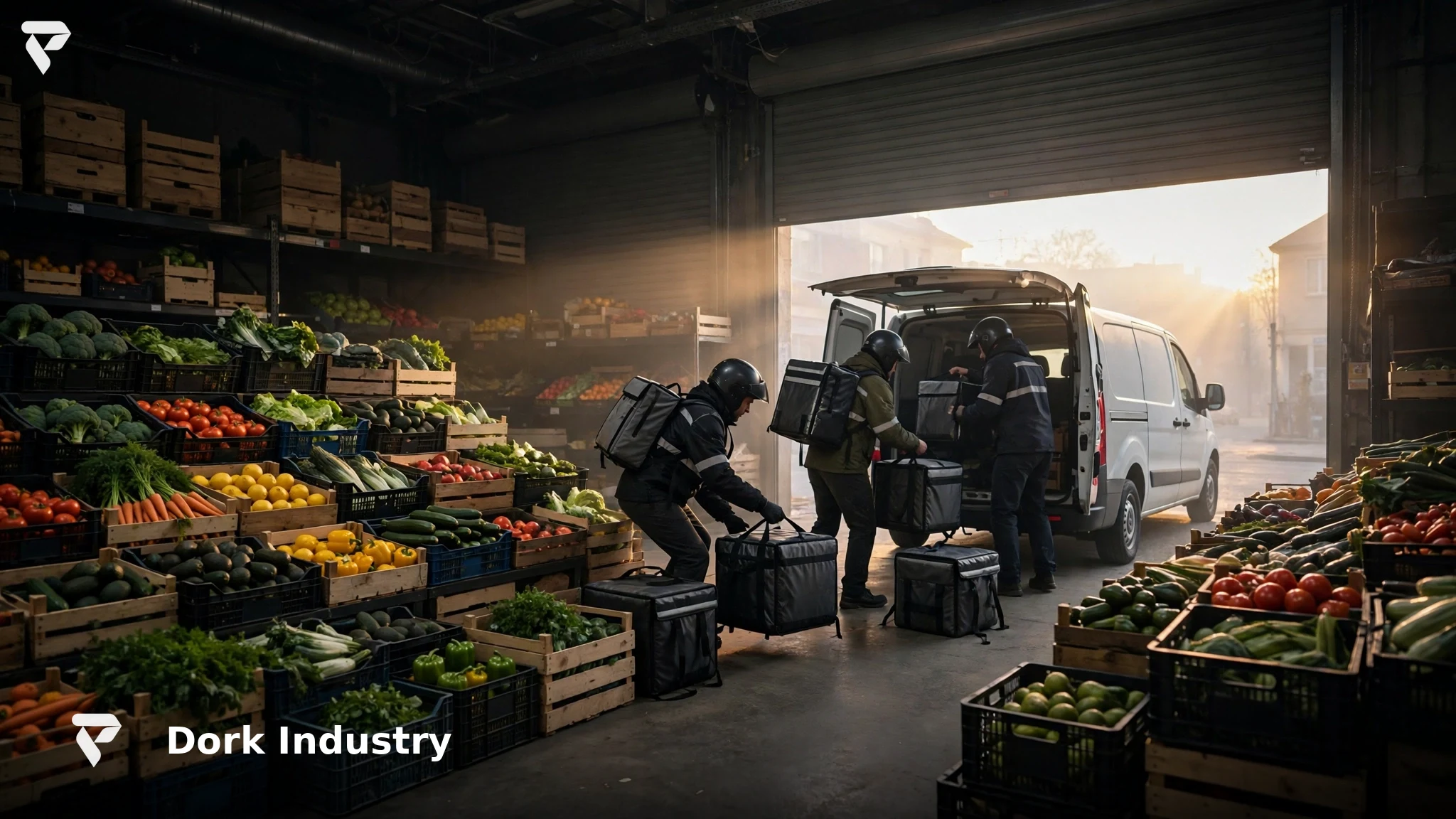
Where does a grocery delivery business actually lose money?
Before discussing technology, it is worth naming the specific leaks. In grocery delivery, margins are thin and the expensive problems hide in everyday operations.
Why do bad substitutions drive customers away?
Substitution is the highest-churn moment in grocery delivery. The picker cannot find the item, grabs a “similar” product, and the customer receives something they would never have chosen. One bad swap erodes the trust built by ten perfect orders. Without substitution rules — what may replace what, per category, approved by the customer in the app — every out-of-stock item becomes a gamble with your repeat rate.
Why do riders cross into the wrong zones?
When delivery zones exist only in the dispatcher’s head, riders take orders they cannot fulfil on time. Orders arrive late, cold-chain windows break on dairy and frozen items, and the business pays refunds that a digital zone boundary would have prevented. Zones must be drawn on the map, enforced by the app, and tied to rider assignment — not remembered by whoever is on shift.
Why does the app sell what the shelf no longer has?
Inventory that syncs once a day is inventory that lies all day. The app takes orders for stock that sold out at noon; the picker discovers this at 6 PM; the customer gets a cancellation or a late, awkward substitution. Every post-order cancellation burns trust and wastes picking time. Real-time sync between the store shelf (or dark-store bins) and the app catalogue is the single most valuable data pipeline in the whole system.
Why can’t the owner see real profit per order?
App orders and POS records live in separate worlds. Discounts, refunds, delivery fees, and rider payouts never reconcile automatically. The owner knows revenue but cannot say which zone, which store, or which item category is actually profitable — until a month-end spreadsheet, weeks too late to act.

What must mobile app development deliver for a grocery delivery business?
A catalogue with a checkout button is not the answer. An app that gives an owner control needs to cover five operational areas.
What should the owner see every morning?
- Yesterday’s orders, revenue, refunds, and cancellations per store and per zone
- Substitution acceptance rate and the items most often out of stock
- On-time delivery rate per rider and per zone
- Inventory mismatches: items the app sold that the shelf did not have
- Per-order margin after delivery cost, refunds, and rider payout
- Live rider positions and pending order queue
How should inventory sync with the shelf?
The catalogue must reflect the shelf. That means a live feed from the POS or the store’s inventory system into the app — when stock hits zero, the item goes unavailable instantly. For dark stores, bin-level scanning on receiving and picking keeps the digital stock honest. The design principle is simple: the picker should never be the first to discover an item is missing.
How do substitutions stop being a gamble?
According to Google’s Maps Platform Routes API documentation, delivery apps can compute routes with real-time traffic and get travel times between multiple locations — useful for zone planning. But the substitution problem is a workflow problem, not a maps problem. The app needs:
- Category-level substitution rules defined by the store, not the picker
- Customer pre-approval in the app: “if unavailable, replace with…” or “call me first”
- Audit trail of every swap, so repeat offenders (items, categories, stores) are visible
- Refund logic for refused substitutions that does not need a support ticket
How are zones and riders managed?
- Delivery zones drawn on the map with per-zone delivery fees and time windows
- Automatic rider assignment within the zone — no cross-zone dispatches without an override
- GPS tracking with customer ETA computed from real traffic, not straight-line distance
- Cold-chain windows: dairy and frozen items flagged with hard delivery deadlines
How does the app reconcile with the POS?
Every app order should land in the POS as a real sale with the same item codes, discounts, and tax treatment. Refunds issued in the app must reverse in the POS. According to Stripe’s payment documentation, businesses can accept online payments through a payment form or a prebuilt payment page — and that payment record should flow into the same reconciliation as cash and UPI from the counter, so the owner sees one revenue number, not three.

What data do you already have — and what is it missing?
Most grocery businesses already generate the raw material: POS sales records, supplier invoices, delivery rider logs, and customer complaints on WhatsApp. What is missing is connection. The POS knows what sold; the app knows what was ordered; neither knows what was substituted, why the rider was late, or which zone loses money.
An app does not create new work for staff — and that principle should guide any mobile app development for grocery delivery: it captures the work they already do — receiving, picking, dispatching, delivering — in a form the owner can actually use. The most common implementation failure is designing for the customer’s checkout flow while making the picker’s and dispatcher’s screens slow and confusing. If the people doing the physical work do not benefit from the app, the data will be incomplete within weeks.
What does the math look like? An illustrative example
Consider a single dark store fulfilling 300 orders a day at an average order value of ₹800 — roughly ₹2.4 lakh in daily order volume. Suppose 8% of orders contain at least one substitution and 15% of those substitutions are refused or trigger a complaint — about 3–4 dissatisfied customers a day. If each dissatisfied customer stops ordering for a month (30 days × ₹800), the store loses roughly ₹72,000–₹96,000 in monthly order volume from substitution friction alone. These are illustrative figures with stated assumptions, not industry benchmarks. But they show why substitution logic usually pays for the app before anything else: even a modest improvement in substitution acceptance directly protects repeat revenue.
Late refunds carry similar leverage. If 5% of orders (15 a day) arrive late enough to trigger refunds averaging ₹100, that is ₹1,500 a day — ₹45,000 a month — in refunds that zone discipline and real-time ETAs can largely prevent. Combined with cancellation losses from inventory mismatch, the operational leaks on 300 orders a day can easily exceed ₹1 lakh a month. A 30-day pilot that measures these three numbers — substitution acceptance, on-time rate, and per-order margin — tells you exactly what the app is worth to your business.
Should you build or buy? An honest breakdown
Not every grocery business needs custom mobile app development. The honest options, in order of investment:
| Approach | Best for | Relative investment | Where it breaks |
|---|---|---|---|
| WhatsApp ordering + manual dispatch | A single kirana testing delivery with a handful of daily orders | Minimal | Breaks past a few dozen orders a day; no inventory honesty |
| Aggregator listing (Swiggy/Zomato) | Instant demand without building anything | Commission per order | You rent the customer; high commissions; no substitution control |
| White-label grocery app | Standard catalogue + delivery without building | Medium | You inherit their roadmap; limited POS and zone customization |
| Custom mobile app development | Dark stores, multi-store chains, unique workflows | Highest | Overkill for a single store with simple operations |
At Dork Industry, we regularly advise grocery businesses against custom builds when aggregators or white-label apps fit. A credible technology partner should be willing to tell you that you do not need custom development. If every consultation ends with a quotation for a custom app, get a second opinion.
What should the app never do?
Technology boundaries in mobile app development matter as much as features — especially where automation touches food and trust.
- Never auto-substitute without customer consent. The app may suggest, never decide. A substitution without approval is a refund waiting to happen.
- Never show fake inventory. If the sync is uncertain, the item must show as unavailable rather than sell a lie.
- Never let pricing drift between the app and the POS. One price list, one source of truth — the app and the counter must agree.
- Never assign a rider a zone they cannot physically serve in the time window. The system should refuse impossible dispatches, not leave them to the rider to fail.
- Never lock your customer list into a format you cannot export. Your customers are a business asset. Any platform must offer full data export.
- AI should prioritize substitutions for human review, not finalize them. “These 12 items need a substitution decision” is useful. An AI silently swapping brands is not.
How do you test it in 30 days before full investment?
The lowest-risk path is a single-store pilot with a fixed scope and measurable outcomes:
- One store, one delivery zone, one product category for substitution rules
- Live POS inventory feed, substitution engine, zone-based rider assignment, owner dashboard
- Run for 30 days
- Measure: substitution acceptance rate, on-time delivery rate, per-order margin, refund volume — against the pre-pilot baseline
If substitutions and on-time delivery do not measurably improve in the pilot, a bigger mobile app development investment will not fix it either. The pilot validates the workflow, not just the software. This is the assessment Dork Industry runs before quoting any grocery delivery project: map the current process, name the leaks, then decide what software earns its cost.

What actually drives the cost of grocery mobile app development?
Grocery app pricing varies widely because scope does. The real cost drivers are:
- Stores and zones: one dark store vs multi-store with zone-level fees and time windows changes the data model significantly
- POS and inventory integration: live sync with the store’s POS or ERP — this is the hardest and most valuable integration
- Substitution engine: rule definitions per category, customer pre-approval flows, audit trails
- Rider app and dispatch: zone enforcement, GPS tracking, traffic-aware ETAs, proof of delivery
- Payments: UPI, cards, COD reconciliation, and refund flows that reverse in the POS
- Platforms: Android only vs Android + iOS vs Flutter cross-platform
Anyone quoting a fixed price without asking about stores, POS integration, and delivery zones is guessing.
Frequently asked questions
Does a grocery delivery business need a custom app, or are aggregators enough?
Aggregators deliver instant demand but take a commission on every order and give you no control over substitutions, zones, or the customer relationship. A custom app earns its cost when you have your own stores or dark stores, want direct customer ownership, and lose meaningful money to substitution and refund problems.
How long does grocery mobile app development take?
A focused pilot (one store, core workflows) can be live in 4–6 weeks. A full multi-store platform with POS sync, substitution engine, rider app, and payments typically runs 3–6 months depending on scope.
Can the app fix substitution problems?
Yes — and this is the highest-leverage outcome. Category-level substitution rules plus customer pre-approval in the app turn the worst churn moment into a controlled workflow. But the rules must come from your business knowledge; no software invents good substitution policy on its own.
What does a grocery delivery app pilot cost?
A single-store pilot with core workflows (POS inventory sync, substitution rules, zone dispatch, owner dashboard) is a fraction of a full build. The pilot’s job is to prove measurable improvement in substitution acceptance and on-time delivery before larger investment. Request a pilot scoping call for a concrete estimate.
Will customers and staff actually use the app?
Adoption follows value: if the customer app gives accurate stock, honest ETAs, and one-tap substitution approval, they use it. If pickers and dispatchers get faster screens than their current WhatsApp-and-paper chaos, they use it. Design each side around its users’ incentives, not the owner’s reporting needs.
About Dork Industry
Dork Industry (dorkindustry.com) is a custom software development company building mobile apps, AI automation, and IoT systems for businesses across India. Our team designs grocery delivery platforms, gym management apps, field-service apps, and industrial IoT — from 30-day pilots to full multi-store rollouts.
The bottom line
The question is not whether a grocery business needs mobile app development. It is whether the owner can see — from one screen — which substitutions are losing customers, which zones are late, which items the app is selling that the shelf does not have, and which store is actually making money. If the answer is no, the technology decision is really an operations decision wearing a software costume.
Start with the workflow, pilot it in one store for 30 days, and only then scale the mobile app development — and let measured substitution, on-time, and margin numbers — not feature lists — decide whether to build further.
Before you sign a quote, see our comparison of best AI automation companies in India.
Running a grocery delivery operation and want to know what an app would change in your specific business?
We map your current ordering, substitution, and dispatch process and show you exactly what software would (and would not) fix, before any development is discussed.
Request a grocery delivery workflow and investment assessment WhatsApp +91 8210792477
For a related read, see how we approached operational control for multi-location gyms.