
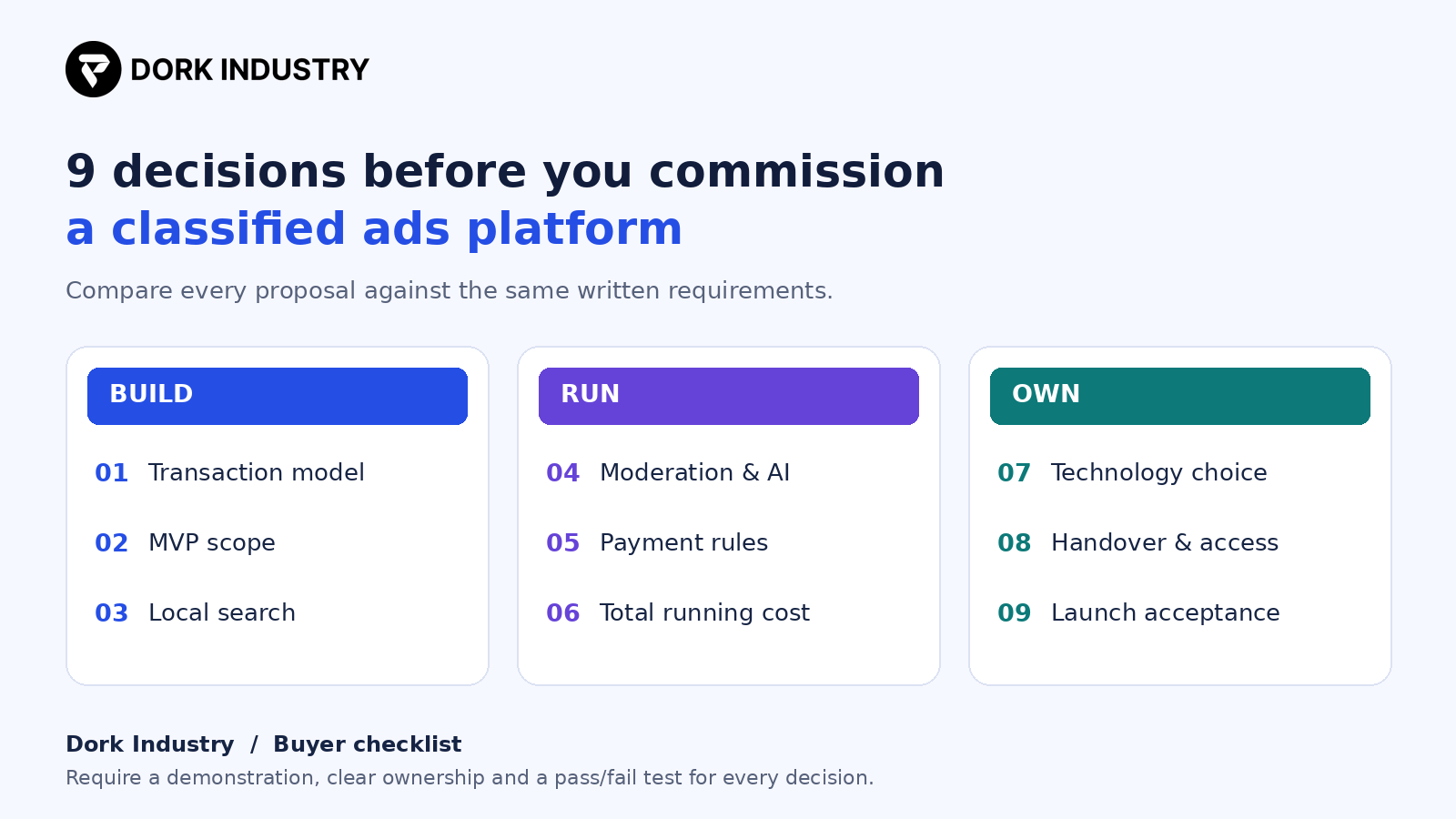
A classified ads platform connects buyers with independent sellers through searchable listings, enquiries and optional paid promotions. To commission one, agree on nine things before comparing quotes: the transaction model, launch scope, search behaviour, moderation, payments, operating costs, technology, ownership and acceptance tests. This guide turns those decisions into a practical brief for Delhi businesses.
A proposal that promises “an app like OLX” can hide very different deliverables. One team may quote for a website with contact forms; another may include mobile apps, live messaging, seller subscriptions and payment reconciliation. Comparing only the final number can leave you paying for features you do not need while missing the controls your team will use every day.
For founders and business owners in Delhi, the useful first question is: what must a buyer, seller and administrator be able to finish without help? Answer that before choosing a technology stack or signing a development contract.
1. What will your classified ads platform actually handle?
Start by drawing the boundary of the transaction. In a contact-led model, a seller publishes an item and an interested buyer sends an enquiry. The parties arrange the sale themselves. In a transaction-led model, the platform also handles an order, payment status, refunds or seller payouts. Those are different software projects, with different operating responsibilities.
Write down what happens after an enquiry. Who confirms that the item is still available? Can the seller mark it sold? Does the operator mediate disputes? Will your team ever collect a buyer’s payment on behalf of a seller? Do not let an attractive checkout mockup answer those questions by accident.
| Model | Core workflow | Decision to settle before quoting |
|---|---|---|
| Enquiry marketplace | Publish listing → buyer enquiry → seller response | Contact privacy, response tracking and sold-listing rules |
| Paid-promotion marketplace | Seller purchases visibility for an eligible listing | Placement duration, payment failure and refund handling |
| Transaction marketplace | Buyer orders → payment → fulfilment → possible refund | Provider eligibility, money movement and operational ownership |
What to request: a one-page workflow with named owners for every step. If the commercial model changes later, revisit the scope instead of assuming the original quote included it.
2. Which classified ads platform features belong in the first release?
A useful MVP is a small complete service. It should let a real seller publish an accurate listing, let a buyer find and contact that seller, and let an administrator correct or remove problematic content. A large feature list is less valuable than these journeys working reliably.
For the initial scope, describe both normal and failed actions. “Photo upload” should say how many images are allowed, which file types are supported and what happens when the connection drops. “Seller dashboard” should specify editing, pausing, renewing and marking an item sold.
| Launch requirement | Evidence to ask for in a demonstration |
|---|---|
| Accounts and permissions | A seller can edit only their own listings; an administrator can review reports |
| Structured listings | Required attributes change with category; incomplete entries cannot be published |
| Search and enquiries | Filters return relevant active listings and enquiries reach the correct seller |
| Moderation | A reported listing can be reviewed, removed and traced to a decision |
| Listing lifecycle | Expired and sold items stop appearing as available |
| Basic measurement | The team can count completed listings and useful enquiries |
Defer recommendations, video listings, elaborate loyalty schemes and multiple mobile apps unless they solve a proven launch requirement. Keep deferred work in a separately priced backlog. That makes later changes visible and prevents a low opening quote from becoming an unclear sequence of extras.
3. How should local search work for Delhi users?
The location field in a classified ads platform should help people decide whether an item is practical to inspect or collect. Offer a city or locality selector and an explicit distance option where appropriate. Explain how approximate locations are displayed; publishing a seller’s exact address should be a deliberate choice.
Consider a hypothetical used-equipment marketplace serving Mayapuri, Naraina and Bawana, or a furniture listings pilot around Kirti Nagar. These are example markets, not claims about measured search demand or existing Dork clients. A buyer might care about machine type, condition, capacity, collection arrangements and distance more than a generic “popular items” feed.
Prepare a small search test set before development. Include abbreviations, spelling variations, missing optional fields and searches with no results. Agree on what a useful result looks like. For example, an exact model match should not disappear below a promoted but unrelated listing.
Also decide which pages deserve search-engine indexing. Public listing and curated category pages need useful content and stable URLs. Filter combinations can create many near-duplicate URLs: Google’s faceted-navigation guidance explains why their crawl behaviour needs explicit planning. Do not create hundreds of thin locality pages simply by replacing a place name.
What to request: a demonstration using your sample listings, including a sold item, a misspelt search, a locality filter and an empty result. Test on an ordinary phone connection as well as a developer’s laptop.
4. Who reviews listings, and where can AI help?
A classified ads platform needs an operating process for reports and corrections. The administrator should see the listing, seller history, reason for the report, decision and timestamp together. Sellers need a clear way to understand a rejection and submit a correction.
Define the review states: submitted, under review, published, rejected, expired and removed. Decide which edits require a fresh review. A seller should not be able to gain approval for an ordinary listing and then silently replace its contents with a prohibited offer.
AI can assist with category suggestions, incomplete descriptions or prioritising suspicious listings. Treat these as aids with measurable error rates. For an initial pilot, let a person approve consequential actions and record overrides. Do not advertise an AI model as a guarantee that every seller or listing is genuine.
Ask how the service behaves if its AI provider is unavailable. A reasonable fallback could queue listings for review rather than publish unreviewed content. Keep the original seller submission so that staff can distinguish seller-provided facts from suggested wording.
For public user content, Google recommends measures against user-generated spam, including appropriate treatment of untrusted outbound links. Product moderation and search visibility therefore belong in the same launch discussion.
What to request: a review-queue demo, a rejected-listing correction flow and a written allocation of moderation work. The software can support decisions; it cannot supply an unbudgeted operations team.
5. Are you selling promotions or processing marketplace transactions?
Charging a seller to promote a listing is different from collecting the sale price and paying the seller later. Document the distinction in the classified ads platform specification. Provider onboarding, refunds, reconciliation and support must fit the actual flow.
For a paid listing boost, define the eligible listing, duration, placement rules and start time. What happens if payment completes while the listing is awaiting review? What if an administrator removes the listing halfway through the promotion? The answer should appear in both the product behaviour and the seller terms.
Payment notifications also need careful handling. A repeated event must not activate two promotions or extend an entitlement twice. Razorpay’s webhook documentation covers signature validation, duplicate events and event ordering. Ask the developer to demonstrate those cases in test mode and show how the records reconcile.
Use provider-confirmed payment states rather than trusting a browser’s “success” screen alone. Maintain a connection between the payment, purchased entitlement and affected listing. Give support staff a way to investigate a mismatch without editing production database rows.
What to request: a written payment-state table covering pending, successful, failed and refunded purchases. If buyer–seller settlement is in scope, confirm provider support and the applicable commercial requirements before promising it to users.
6. How much does a classified ads platform cost to build and run?
There is no reliable single price without a feature scope. Public vendor estimates illustrate the difference: TotalX quotes ₹8–18 lakh for its described web MVP, while Sigosoft lists US$8,000–18,000 for its basic single-platform app tier. These are the vendors’ own published estimates, reviewed on 9 October 2026—not Dork Industry quotes, a market average or equivalent packages.
Obtain an itemised proposal for the same requirements from each provider. Request separate prices for discovery, design, implementation, testing, deployment, migration and optional features. Confirm exclusions and how changes are approved. A fixed amount without a written boundary is difficult to compare.
Calculate first-year cost as build + setup + 12 months of operations + usage charges + agreed change allowance. Identify taxes separately where applicable. Avoid assuming that every supplier includes the same support period or that “hosting included” covers storage, backups and traffic growth.
| Cost category | What drives it | Question for the proposal |
|---|---|---|
| Development | Workflows, roles, integrations and platform coverage | Which acceptance tests and revisions are included? |
| Infrastructure | Images, traffic, backups and search requirements | What usage assumptions support the estimate? |
| External services | Messaging, maps, verification and payment events | Who owns each account and pays each bill? |
| Operations | Moderation, support and reconciliation workload | Which tasks remain with our staff? |
| Maintenance | Updates, incidents and platform changes | What response coverage and exclusions apply? |
Use your own numbers for the classified ads platform business case. For illustration only, assume monthly fixed operations of ₹30,000 and contribution of ₹250 from each paid promotion after its variable costs. Covering that fixed cost requires 120 promotions per month. This is arithmetic, not a revenue forecast; it excludes acquisition costs and recovery of the build investment.
Test whether sellers will pay before treating that model as viable. A successful payment integration proves that money can move, not that buyers and sellers find the service valuable.
7. Should you choose a ready-made product or custom development?
A ready-made product can suit a standard classified ads platform when its permissions, listing fields and commercial model already match your requirements. A custom application becomes more useful when distinctive workflows or integrations justify the extra design and maintenance work. Ask both routes to pass the same scenario tests.
| Route | Potential fit | What to verify |
|---|---|---|
| Hosted product | A short pilot with standard workflows | Data export, usage limits, integrations and exit process |
| Self-hosted script or CMS | Familiar listing behaviour with limited customisation | Licence terms, update responsibility and extension compatibility |
| Custom web application | Distinct operations, permissions or business-system connections | Scope discipline, maintainability and source-code handover |
Do not choose a framework because it appears most often in competitors’ articles. Ask the team to explain its choice against search needs, expected data, staff skills and support arrangements. A proposal should not require several databases or complex distributed services without a clear reason.
A responsive web release may be sufficient for an initial pilot; native apps should follow from actual device or user requirements. Likewise, CRM integration should have an owner, defined fields and duplicate-handling rules rather than simply appear as a ticked box.
Dork Industry’s web application development services and technology solutions provide starting points for discussing the required implementation. The chosen architecture should support the approved workflow and budget.
8. What should you own and receive at handover?
Set ownership and access expectations before work begins. For a custom classified ads platform, clarify the source repository, domain, cloud environment, database, design files and third-party accounts. Distinguish custom project code from licensed components; “source included” does not automatically give unlimited rights to every dependency.
Request a handover pack that another competent developer could use. It should explain deployment, environment settings, routine backups, restoration, background jobs and support procedures. Sensitive credentials should be transferred securely through the agreed process rather than copied into a public document.
Make data portability concrete. Ask for an export containing users, listings, category fields, images or image references, moderation records and paid entitlements, subject to the retention rules you adopt. Check what remains readable after you stop paying for a hosted service.
For support, agree on coverage hours, incident severity, escalation contacts and which changes are billable. A promise of “lifetime support” is less useful than a clearly defined service. Also specify who can approve spending increases on infrastructure or external APIs.
What to request: a handover rehearsal in staging. Have the team restore a backup and explain how a replacement operator would deploy the next update. Record any missing instructions before final acceptance.
9. Which tests should a classified ads platform pass before launch?
Attach an acceptance sheet to the scope, with a test owner and expected outcome for each scenario. Run it with representative listings and non-production payment data. Screenshots of finished pages are useful, but they do not demonstrate the failed actions your support staff will encounter.
- Interrupted posting: disconnect during image upload. The seller sees a clear recovery option, and retrying does not create duplicate listings.
- Permissions: one seller cannot edit another seller’s listing or access private conversations.
- Search quality: agreed sample queries return relevant active listings; sold and expired items follow the documented rule.
- Moderation: a reported listing reaches the queue, a decision is recorded and a consequential edit follows the re-review policy.
- Payment retry: replay a test payment notification. Only one entitlement is created and its audit history remains readable.
- Notification failure: a failed email or message creates a visible retry or follow-up task instead of silently losing an enquiry.
- Recovery: restore a backup in a separate environment and check listings, images and account permissions.
- Measurement: verify that a completed listing and a genuine seller enquiry are counted once, with test traffic identifiable.
- Handover: confirm the agreed accounts, exports, instructions and support contacts are available to the owner.
Define performance targets using an agreed dataset and load rather than a vague “fast and scalable” promise. Measure the slow paths too: image-heavy listings, combined filters and bulk moderation. Document the test conditions so that later comparisons remain meaningful.
After launch, watch listing completion, enquiries per active listing, seller response times, unresolved reports and operating cost per useful enquiry. Set targets from your pilot baseline. These measures help you decide what to improve before adding more categories or geographic coverage.
Frequently asked questions
Can a classified ads platform launch without Android and iOS apps?
Yes, if a mobile-friendly website supports the essential seller, buyer and admin journeys. Decide whether native apps add necessary device capabilities or repeat usage benefits before including them. A web pilot can test demand while keeping the initial scope smaller.
Does a classified ads platform need AI from day one?
No. Start with clear listing fields, search, review rules and accountable staff. Add AI where you can measure a specific improvement, such as faster categorisation or review prioritisation. Keep correction paths and a fallback for unavailable or inaccurate model outputs.
How long does development take?
Request a schedule against the agreed scope, staffing and dependencies. Discovery, design approval, implementation, testing, provider onboarding and handover all take time. A website-only enquiry service and a web-plus-mobile transaction marketplace should not be compared using the same promised launch date.
How should Delhi businesses compare developer quotations?
Give each team the same workflow, MVP feature list and acceptance tests. Compare the first-year total, exclusions, ownership, support coverage and recurring usage assumptions. Ask for a relevant demonstration rather than selecting only the lowest opening price.
Can Dork Industry show relevant marketplace work?
Dork Industry publishes a Yottaf classified ads platform case study. Use it as a starting point for a discussion about relevant capabilities and request a walkthrough of the parts that match your proposed project. This guide does not claim measured outcomes beyond that published material.
Bring a clear brief to your development discussion
Before requesting a classified ads platform proposal, prepare your buyer and seller journeys, launch geography, sample listings, payment model, integrations and first-release priorities. Include the nine acceptance scenarios above and name who will run the service after launch.
Discuss your marketplace requirements with Dork Industry and ask for an itemised scope, implementation approach and handover plan. That gives both sides a concrete basis for deciding what to build first.
Research checked: 9 October 2026. External prices are attributed examples, not a Dork Industry rate card. Product decisions and illustrative calculations in this guide should be adapted to the agreed project scope.
Discuss this for your business?
Book a free consultation — we scope the problem, outline the approach, and give you an honest verdict before any development is discussed.

[…] Theme code rarely controls the core hosted payment-method list, but custom carts, checkout extensions, payment customizations and apps can influence the journey or eligibility. If the cart itself is broken, use the Shopify Add to Cart repair guide. If a promotion changes the outcome, compare the Shopify discount diagnosis. […]