COD order verification automation should hold a new cash-on-delivery order, request confirmation through an approved channel, validate the response and release only an eligible order to dispatch. A sent WhatsApp message, SMS or voice call is not confirmation. The workflow needs explicit states, duplicate-event protection, deadlines, an exception queue and a human override with an audit trail.

Contents
Why do COD orders still reach dispatch without a reliable confirmation?
Many teams copy a new order into a messaging tool, wait for a reply and manually add a tag. The gaps appear when a message fails, a customer replies after the cut-off, two webhooks arrive, an address change is typed into free text or an operator releases an order without recording why. The storefront, support inbox and fulfilment queue then show different versions of the same order.
Current Shopify App Store and WordPress.org listings specifically offer COD verification through WhatsApp, voice, SMS, confirmation buttons and order tags. That is evidence that merchants seek this workflow; it is not evidence that any one plugin fits a store’s dispatch rules or delivers a guaranteed result. See a Shopify App Store example and a WordPress.org example.
Which nine controls should COD order verification automation include?
| Control | Business question | Proof before launch |
|---|---|---|
| 1. State map | What does pending, confirmed, cancelled or review mean? | approved transition table |
| 2. Reliable trigger | Is the order stored before verification starts? | event and retry test |
| 3. Approved message | Which channel, template and consent rule apply? | delivery-status test |
| 4. Valid response | How is a callback authenticated and deduplicated? | signature and idempotency test |
| 5. Deadline | When does no response become an exception? | timer and reminder rule |
| 6. Safe edits | How are address or quantity changes verified? | controlled edit path |
| 7. Exception queue | Who handles failed or ambiguous cases? | owner and resolution reason |
| 8. Reconciliation | Do storefront, OMS and shipping agree? | status comparison report |
| 9. Audit and test | Can every dispatch release be explained? | event history and acceptance tests |
1. Which verification states should be defined first?
Use a small, explicit state model such as awaiting verification, confirmed, cancelled, expired and manual review. Keep payment status, fulfilment status and verification status separate. A tag can display the result, but it should not be the only evidence of the decision.
2. When should the verification trigger start?
Trigger from a reliable order-created event after the platform has stored the order. Queue the work, retry transient failures and use the order ID as part of an idempotency key. This prevents a slow provider or duplicate webhook from creating duplicate messages or conflicting tags.
3. Why must delivery and confirmation remain separate?
Use an approved template and channel policy, then record queued, sent, delivered, failed and customer response as different events. “Sent” must never unlock dispatch. Keep a fallback or manual path for a failed delivery instead of silently treating it as rejection.
4. How should callbacks be validated and deduplicated?
Verify the provider’s signature or other supported authentication, match the callback to the expected order and reject replayed events. Make the handler idempotent so repeated delivery of the same confirmation produces one state change.
5. Set a clear deadline and reminder policy
Define how long the store waits, whether one reminder is allowed and what happens after the cut-off. A late confirmation should follow an agreed rule: manual review, reopening the order or a polite expired-response message. Do not let separate automation jobs race to cancel and release the same order.
Are unconfirmed COD orders still entering your dispatch queue?
Share your storefront, daily dispatch cut-off, current confirmation channel, order states, shipping integration and exception rules. Dork Industry can map the workflow and scope a focused proof of concept or integration repair.
6. Move address and quantity changes to a controlled path
A free-text reply is not a safe order-edit instruction. Send the customer to an authenticated edit route or place the request in a staffed queue. Recalculate availability, price, tax, delivery eligibility and shipping labels before the updated order becomes dispatchable.
7. Give exceptions an owner
No response, failed delivery, conflicting reply, high-value review and invalid address need a visible queue with an owner, deadline and resolution reason. Automation should make exceptions easier to handle, not hide them behind a generic “pending” label.
8. Reconcile every connected system
The storefront, order-management system, warehouse or shipping tool and support view should receive compatible states. Before label creation, confirm that the current order version is still eligible. Compare systems periodically so a missed webhook does not become an unexplained shipment.
9. Keep an audit trail and test failure cases
Record the source event, request ID, provider response, customer action, state transition, operator override and dispatch release. Protect personal data and limit access by role. The log should support operations and debugging without becoming an unrestricted copy of message content.
What should the complete COD verification workflow look like?
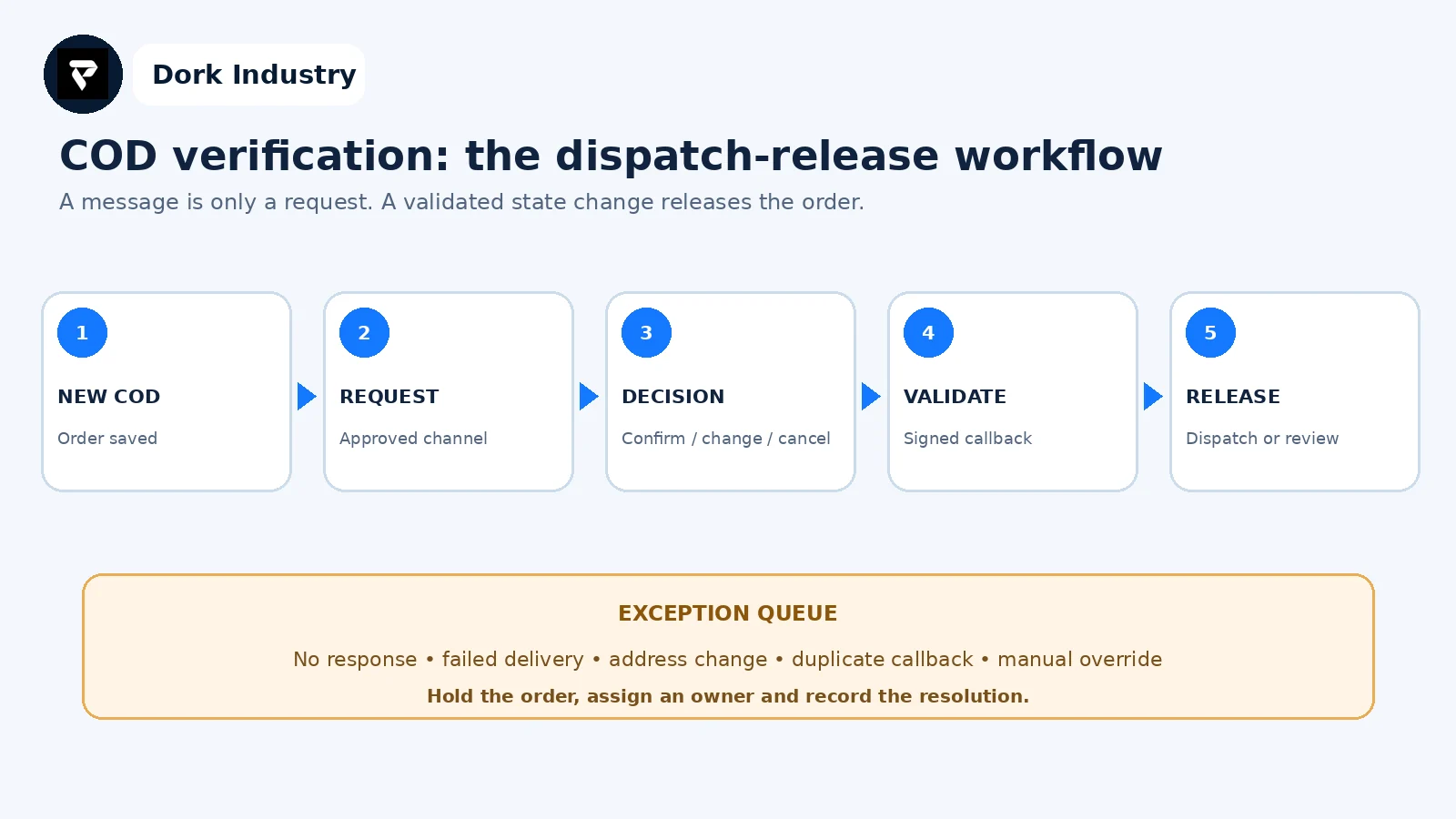
Typical integrations include Shopify or WooCommerce order events, an approved WhatsApp Business provider, SMS or IVR fallback, an OMS or WMS, shipping software and an authorised payment-link path for customers who choose prepaid. Automate the trigger, reminders, tags, queue entries and notifications; keep ambiguous address changes, policy exceptions and manual overrides under human control.
How can a store test COD automation before connecting it to dispatch?
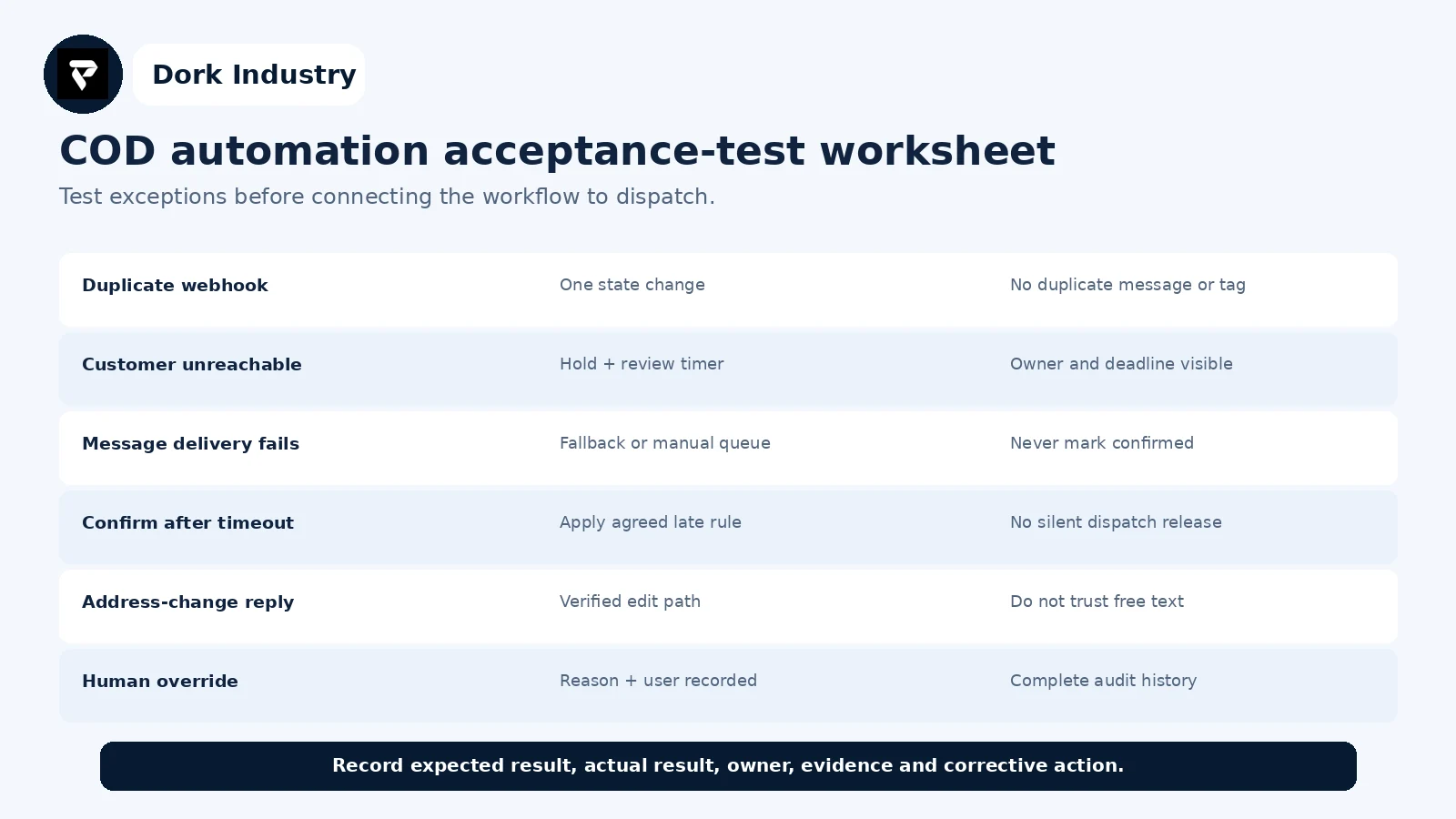
Run these cases with test orders in a safe environment. Record the expected result, actual result, evidence, owner and corrective action. Re-test after changes to webhook authentication, message templates, app permissions, order-status logic or the shipping integration.
Should a merchant install an app, integrate existing tools or build a custom workflow?
| Option | Best fit | Watch for |
|---|---|---|
| Marketplace app | standard confirmation and tagging | provider limits, data handling and dispatch fit |
| Custom integration | existing tools work but states are disconnected | API access, retries and upgrade compatibility |
| Custom application | multiple stores, complex rules or unique exception handling | maintenance, monitoring and operating ownership |
| Phased proof of concept | prove one channel and one dispatch path first | clear acceptance tests and rollback |
A useful proof of concept should process one new COD order through confirmation, one no-response timeout, one failed delivery, one duplicate callback and one manual override—then show that only an eligible order reaches the dispatch queue.
What can Dork Industry implement?
Dork Industry can map the current order-to-dispatch process, repair a Shopify or WooCommerce integration, connect approved messaging and shipping APIs, build an exception dashboard, add audit-ready workflow events or develop a custom order-management component. Technology choices should follow the storefront, volume pattern, existing systems and operating rules—not drive the purchase decision.
Review Dork Industry’s automation solutions, its guide to preventing duplicate Shopify integration orders, the WooCommerce payment-state repair guide and the ecommerce order-status automation guide.
Turn COD verification into a controlled dispatch gate
Send an anonymised order-state sample, current app or message flow, dispatch cut-off, exception rules and integration list. Dork Industry can propose a repair, proof of concept or custom automation with explicit acceptance tests.
Frequently asked questions
Should a sent WhatsApp message mark a COD order as confirmed?
No. Sent, delivered and customer-confirmed are different events. A sent status proves only that the request left the messaging system. Dispatch release should require a validated customer action or an authorised human override recorded with a reason.
Should an unanswered COD order be cancelled automatically?
Only if that policy is explicitly approved and tested against failed delivery and late-response cases. Many stores need an expiry state or manual queue because channel failure, customer timing and order value can require different handling.
Can customers change an address through a reply?
Use the reply to start a verified edit path, not to overwrite the order directly. Recheck customer identity, serviceability, price, tax, inventory and any generated shipping label before the updated order becomes eligible for release.
What should a COD verification proof of concept include?
Include one complete confirmation, failed delivery, no-response timeout, duplicate callback, controlled order edit and human override. Record expected and actual results, then confirm that each case leaves a traceable state and only eligible orders enter dispatch.
Want this automated for your business?
Book a free assessment — we map the workflow, check data readiness, and outline a pilot you can measure.