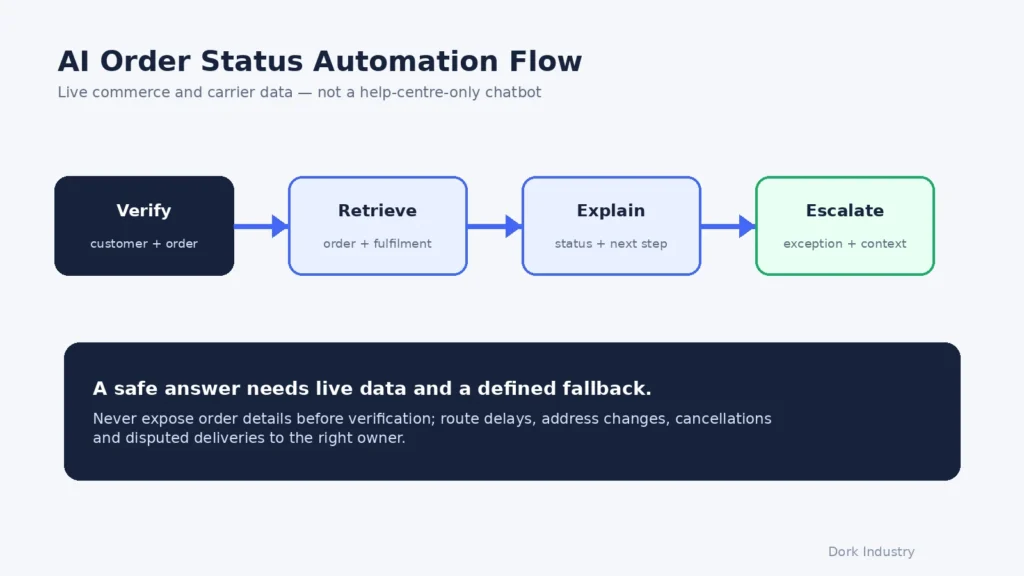
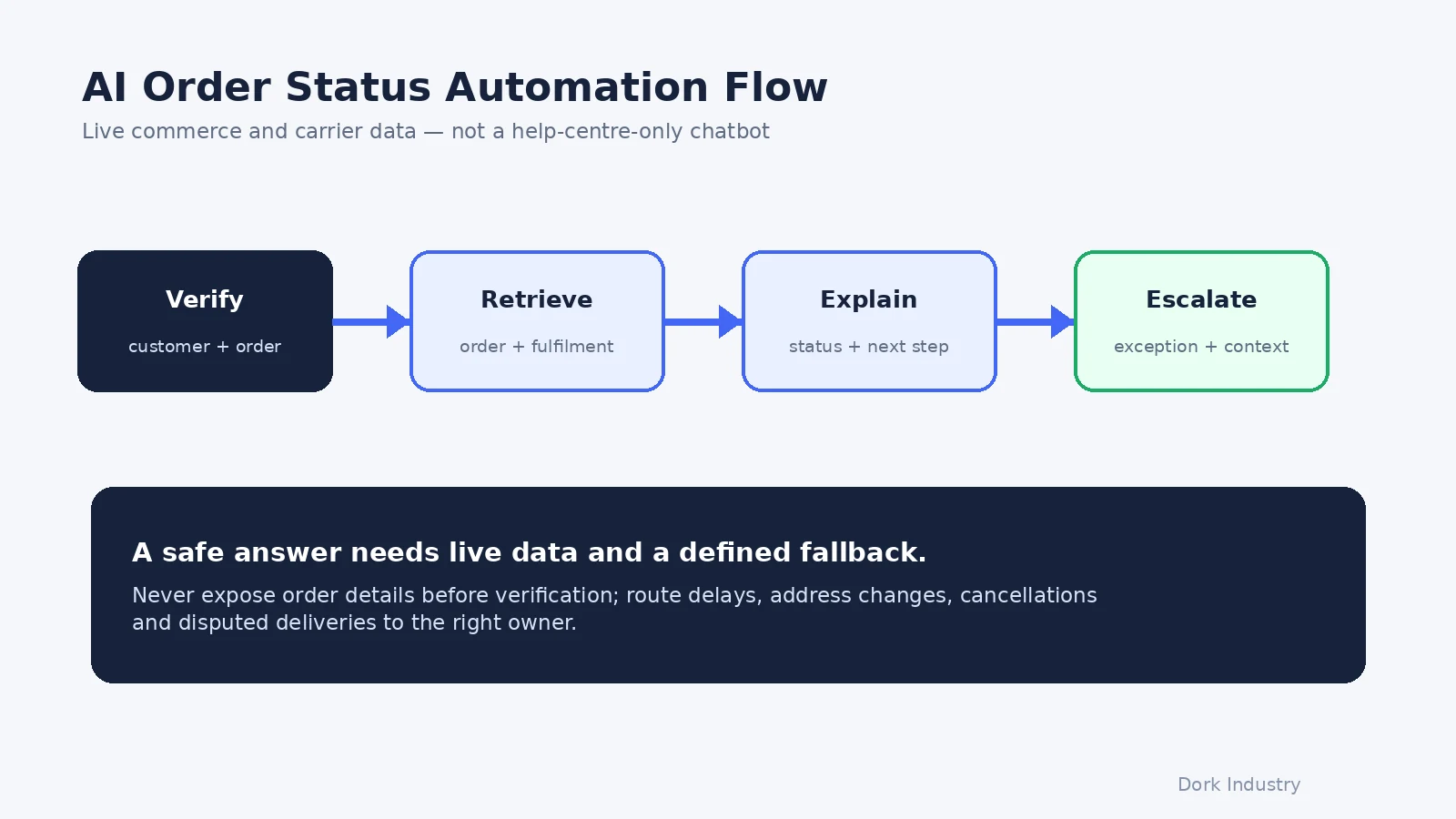
AI order status automation for ecommerce is a connected support workflow that verifies the shopper, retrieves current order and fulfilment data, explains the next valid step, and transfers exceptions to a person with the conversation context attached. A policy-only chatbot cannot safely answer customer-specific questions because it lacks live operational facts.
On this page
Which business problem should AI order status automation solve?
The commercial problem is not that support agents type slowly. It is that customers ask through chat, email or messaging while order, warehouse and carrier facts sit in separate systems. A vague reply creates another contact. An incorrect reply can create a cancellation, refund dispute or avoidable escalation.
The project should therefore target a defined set of post-purchase intents: “Has my order shipped?”, “Why is tracking unchanged?”, “Can I change the address?”, “Can I cancel?”, or “The carrier says delivered, but I do not have it.” Each intent needs an owner, permitted action and source of truth. This is where a paid integration project has more value than installing an unconnected chat widget.
Current competitor pages commonly sell automated “where is my order” answers. The implementation gap is data governance: the system must distinguish a normal status enquiry from an exception that affects money, inventory or delivery liability. Dork Industry approaches this as a workflow and integration problem, not as a prompt-writing exercise.
What live data does AI order status automation for ecommerce need?
The answer should be assembled from current system records, not generated from memory. Shopify documents order lifecycle webhooks for changes such as fulfilment progress, refunds, returns, edits and cancellations. It also recommends on-demand order reads for reconciliation. WooCommerce documents REST API access, while its developer documentation describes webhooks for event delivery.
According to Shopify’s fulfilment documentation, tracking events can appear on the customer’s order status page. That makes the platform and carrier timeline important inputs, but neither should be treated as infallible. Delayed carrier scans, split fulfilments and edited orders require explicit logic.
| Required source | What it answers | Failure to handle |
|---|---|---|
| Shopify or WooCommerce order | Items, payment and order state | Wrong or stale order answer |
| Fulfilment or warehouse system | Pick, pack, hold and ship state | “Shipped” before handover |
| Carrier tracking | Transit events and delivery | Missed delay or exception |
| Helpdesk or CRM | Open cases and prior promises | Repeated questions and conflicting replies |
| Identity verification | Whether the requester may see the order | Customer data exposure |
What should and should not be automated?
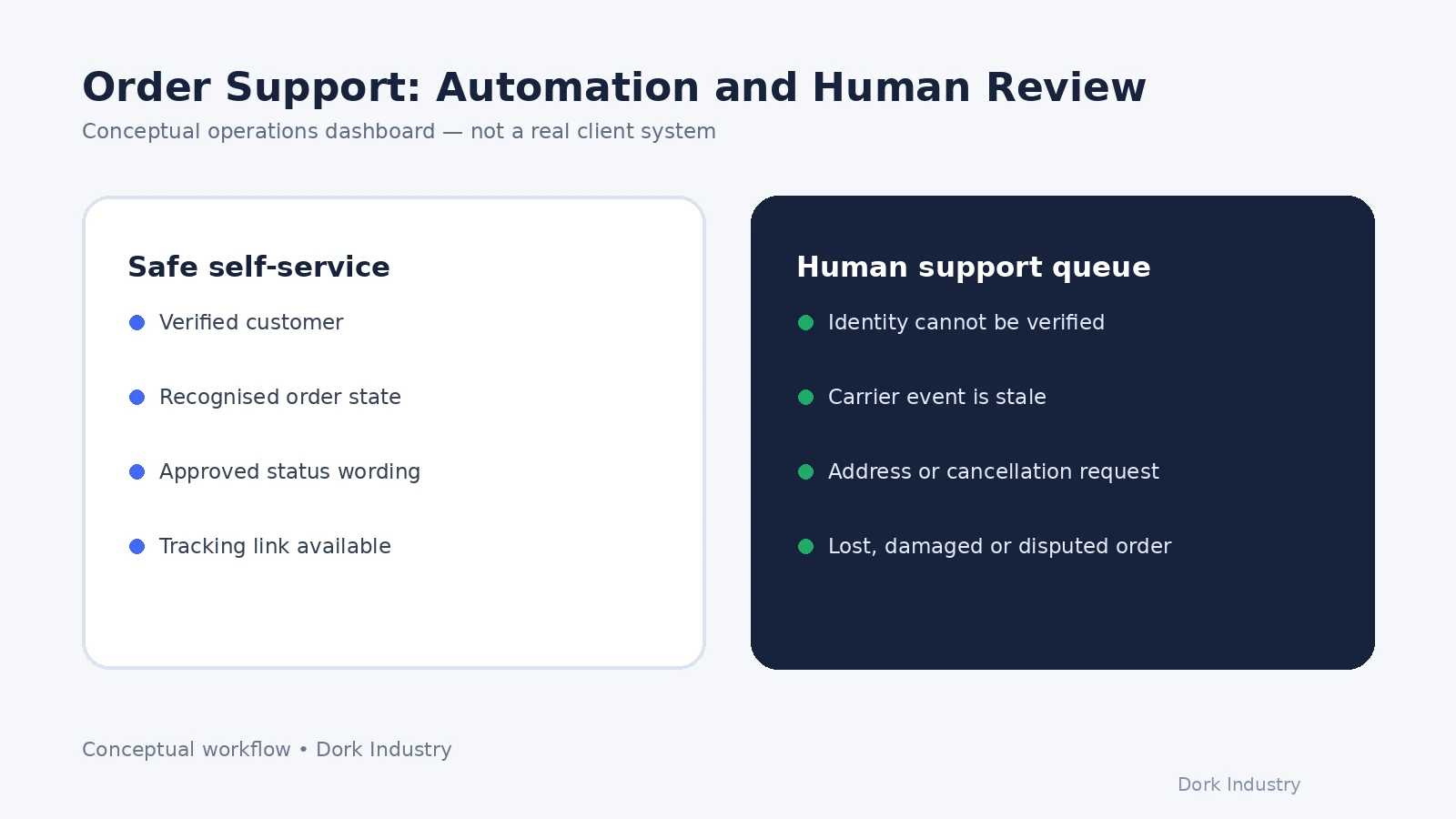
Automate only the cases where identity, order state and permitted response are clear. For example, a verified shopper can receive the tracking link for an in-transit order. The automation can also create a structured support case when a carrier event is stale, provided it does not invent a delivery promise.
Keep address changes, cancellations after fulfilment, high-value refunds, damaged parcels, missing delivered orders and identity failures under human control. The AI can gather evidence and summarise the case. A deterministic policy or authorised employee should decide the action.
How should the workflow be designed?
- Classify the request. Separate a status question from cancellation, address change, return, damage or non-delivery.
- Verify access. Use an authenticated account or an approved combination of order information. Do not reveal details based only on a guessed order number.
- Retrieve live facts. Query the commerce platform, fulfilment source and carrier. Store timestamps so the reply can state when the record last changed.
- Apply rules. Translate raw events into approved customer language. Rules should cover split shipments, partial refunds, holds and stale carrier events.
- Respond or escalate. Give a precise status and next step when safe. Otherwise create or update a ticket with the evidence already collected.
- Log the decision. Retain the source events, policy version and handoff outcome so the team can audit failures and improve the workflow.
This architecture may use AI for intent detection and summarisation, while identity checks, permissions and high-risk actions remain deterministic. A custom software integration may be justified when the store has multiple fulfilment providers, marketplaces, an ERP, or special customer-service rules.
Should you buy, configure or build the solution?
Use an existing support application when one store, one carrier stack and standard policies cover the workflow. Configuration is usually the first option to test. Consider a custom layer when the business needs cross-store identity, marketplace orders, B2B account rules, warehouse events, multilingual policies or a single service history across channels.
A hybrid approach is often practical: retain Shopify or WooCommerce as the commerce system, keep the existing helpdesk, and build the secure orchestration between them. Dork Industry can assess that integration through its AI and ML implementation service, web development capability, and software integration work. If the immediate problem is a storefront defect rather than automation, see the related guide on a Shopify header not updating.
How should an ecommerce team test a pilot?
Start with real but controlled test cases. Include normal orders, split shipments, cancelled items, stale tracking, an unauthorised requester, an address-change request and a “delivered but missing” report. Agree expected responses with support and operations before connecting a customer channel.
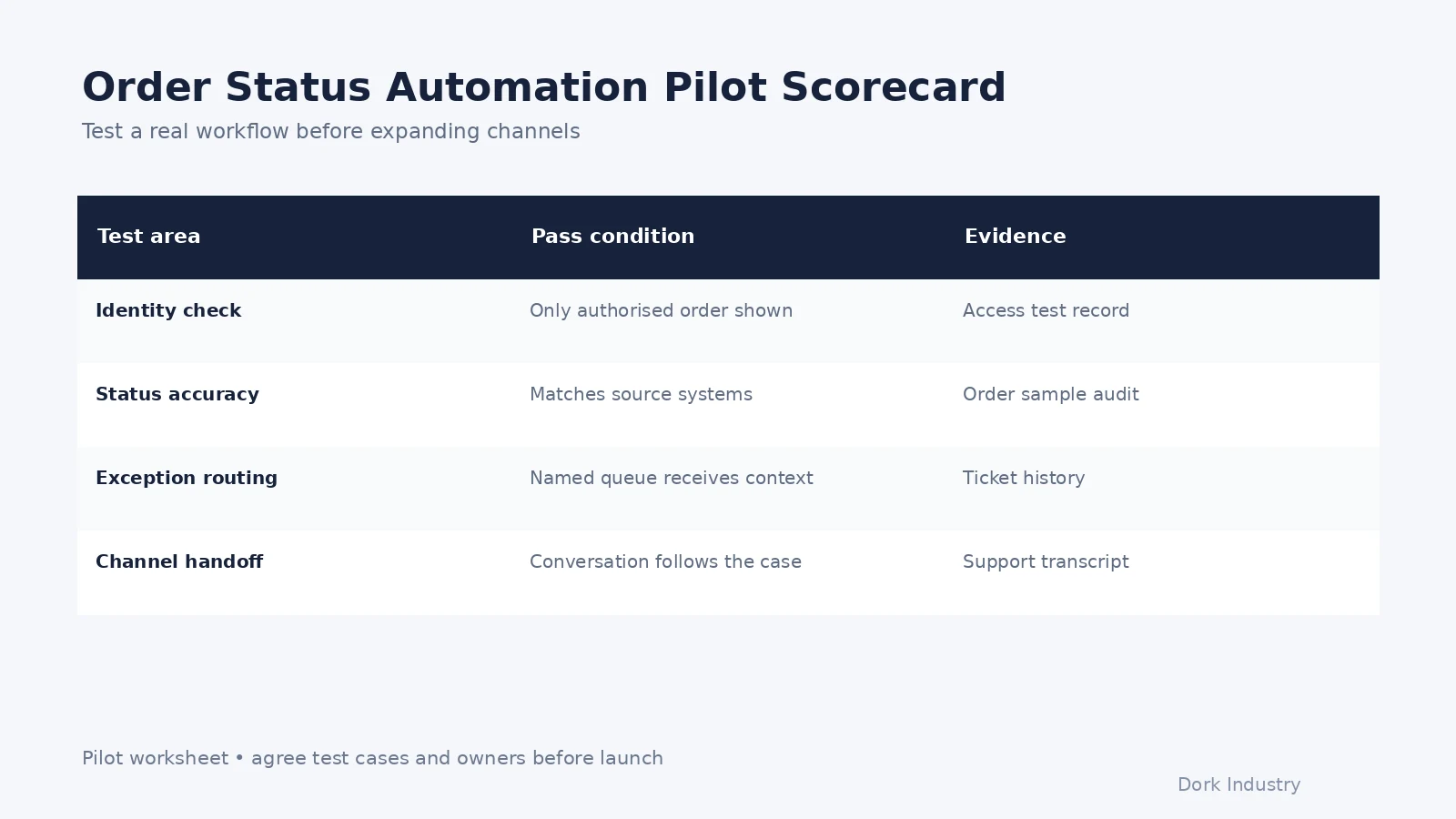
Record accuracy by test case rather than publishing an invented productivity or ROI claim. Review every unsafe answer, missing event and failed handoff. The pilot should prove that the workflow works with the company’s own order mix and policies. It should not rely on a vendor’s generic demo.
Where can Dork Industry help with implementation?
Dork Industry can scope the current customer-support workflow, map Shopify or WooCommerce data, define escalation rules, and build a proof of concept before a wider rollout. The delivery can include API integration, a custom operations panel, helpdesk handoff, AI-assisted classification and monitoring for failed events.
If your team already has the architecture but needs implementation capacity, review Dork Industry’s developer and technical resource hiring options. For a complete workflow, request an assessment covering current channels, order sources, carriers, exception volume and the systems your agents use.
Need an order-support automation assessment?
Bring one normal order, one delayed order and one disputed case. Dork Industry can map the data path, identify the safe automation boundary and propose a focused proof of concept.
Frequently asked questions
Can a chatbot answer order-status questions without an ecommerce integration?
It can explain general shipping policies, but it cannot reliably answer a customer-specific status question without current order and fulfilment data. A safe implementation needs verified access, a live platform lookup and a defined escalation when the data is missing or contradictory.
Does AI order status automation replace customer-support agents?
No. It is best used for verified, repeatable enquiries and for collecting context before a handoff. Agents remain necessary for identity failures, cancellations, address changes, refunds, damaged goods, missing deliveries and any situation where policy or judgement affects the outcome.
Can this work with both Shopify and WooCommerce?
Yes, provided the implementation uses the supported APIs and event mechanisms for the selected platform. The surrounding design must also account for warehouse, carrier, helpdesk and identity systems. The exact integration scope depends on installed apps, checkout flows and fulfilment ownership.
Should the system automatically cancel or refund an order?
Not by default. Those actions affect money and inventory and may become irreversible. Start with evidence collection and human approval. Automate an action only after the business has documented permissions, timing rules, exceptions, audit logs and recovery procedures for failed or duplicate requests.
What is a sensible first proof of concept?
Choose one storefront, one support channel and a small set of read-only intents, such as verified order status and tracking retrieval. Test normal, delayed, split and disputed cases. Add write actions only after the team has reviewed access controls and exception handling.
What should a development proposal include?
It should name the systems, supported customer intents, identity method, source-of-truth fields, channel integrations, escalation owners, test cases, logging, deployment responsibilities and ongoing monitoring. It should also state exclusions clearly so a generic chatbot is not mistaken for an operational integration.