
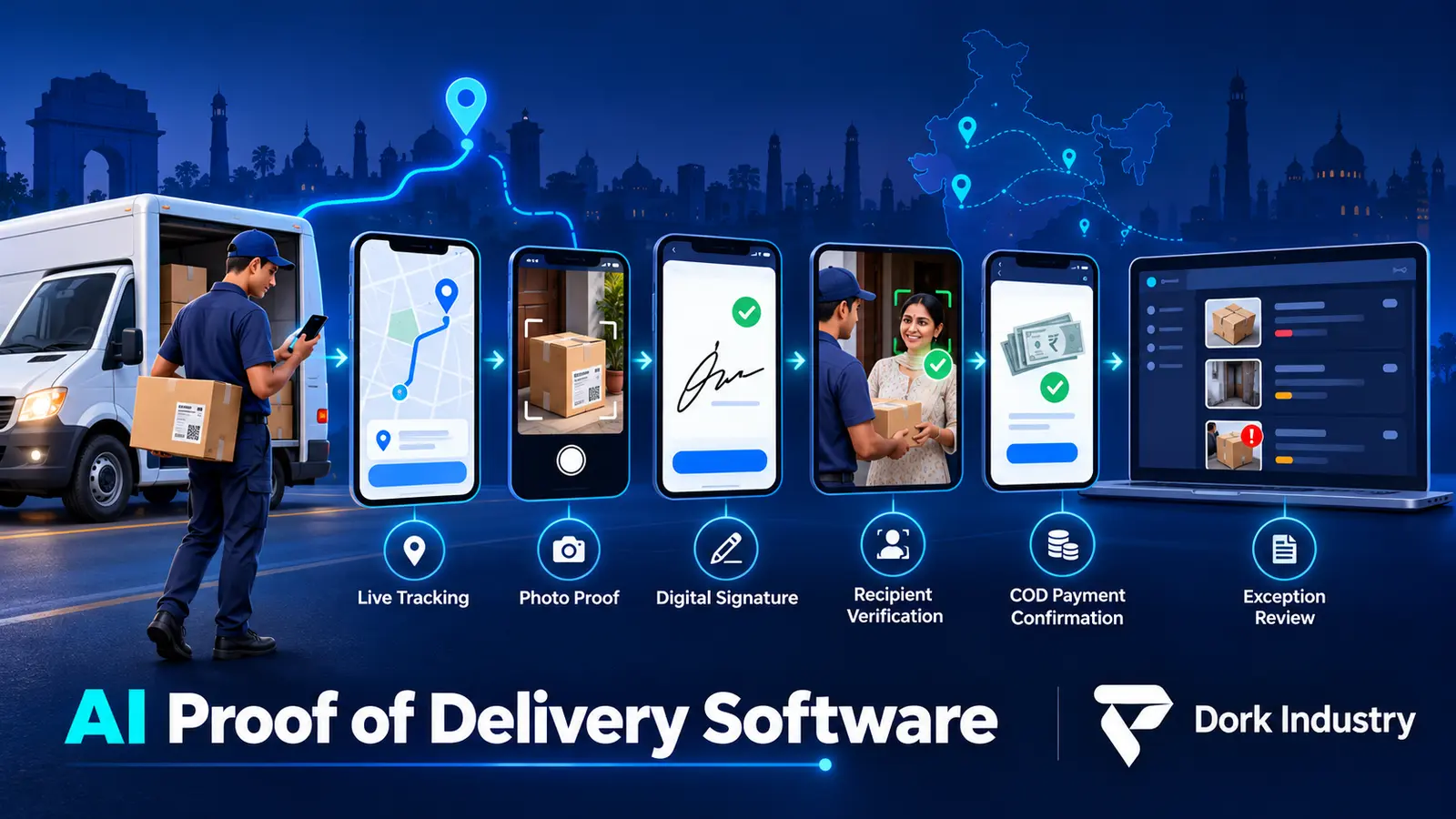
Quick answer: AI proof of delivery software combines mobile evidence capture with automated validation so distributors can confirm who received an order, where and when it arrived, what condition it was in, and whether cash-on-delivery payment matched the invoice. AI should flag suspicious or incomplete records; a responsible employee should decide disputes and financial exceptions.
Reviewed 10 October 2026 by Nishant Singh for Dork Industry.
What should a delivery team verify?
- Order, invoice and route identity match.
- Location and timestamp fall within an acceptable delivery window.
- Recipient name, signature, OTP or authorized-receiver evidence is complete.
- Parcel photos show the correct package and visible condition.
- COD amount and payment method reconcile with finance records.
- Exceptions go to a named human reviewer instead of being silently accepted.
Why do delivery disputes become expensive for distributors?
A delivery dispute is rarely caused by one missing signature. The deeper problem is fragmented evidence. The driver may have a photo in a personal gallery, the route system may hold a GPS point, the ERP may show an invoice, finance may have a COD entry, and customer service may receive a complaint on WhatsApp. When these records cannot be joined by order ID and timestamp, teams spend hours reconstructing one delivery.
For Delhi distributors serving dense markets, gated societies, warehouses and multi-stop commercial routes, the cost appears as delayed COD reconciliation, repeat trips, credit-note leakage, false non-delivery claims, damaged-goods disagreements and slower customer support. A basic signature app digitizes one step; it does not automatically create reliable evidence.
How can you diagnose your proof-of-delivery problem?
Review 30 recent deliveries: ten successful orders, ten customer complaints and ten operational exceptions. For each order, check whether a reviewer can retrieve the following within five minutes.
| Evidence | Pass condition | Typical failure |
|---|---|---|
| Order identity | ERP order and invoice match the stop | Driver selects the wrong customer |
| Time and location | Server timestamp and permitted location are recorded | Device time is edited or GPS is unavailable |
| Recipient | Authorized name, OTP or signature is present | Security guard accepts without authority |
| Condition | Required parcel photos are clear | Image is dark, old or unrelated |
| Payment | COD amount and mode reconcile | Cash entry differs from invoice |
| Exception | Reason, owner and resolution are auditable | Free-text note has no follow-up |
Original diagnostic metric: calculate evidence completeness as completed required fields divided by total required fields. If a 30-order sample requires six evidence groups per order, it contains 180 expected evidence groups. For example, 150 complete groups out of 180 equals 83.3% evidence completeness. This is a hypothetical worksheet calculation, not an industry benchmark. Use your own baseline before setting a target.
Need a delivery-evidence assessment?
Dork Industry can map your dispatch, driver, customer-service and COD reconciliation workflow before recommending software.
How should AI proof of delivery software work?
- Prepare the stop: Sync the order, invoice, customer, route and permitted receiver rules from the ERP or OMS.
- Capture evidence: The driver app records server time, location, photos, recipient evidence, quantities, condition and payment status.
- Validate deterministically: Required fields, order IDs, totals and permissions are checked with fixed rules.
- Assist with AI: OCR reads labels or handwritten references; computer vision can check image quality or package presence; anomaly models compare location, timing and repeated evidence.
- Route exceptions: Low-confidence or high-value cases go to a human queue with the original evidence.
- Reconcile: Approved status and COD data return to ERP, finance and customer-service systems through idempotent APIs.
- Retain and delete: Records follow documented retention, access and deletion rules.
The system should remain usable when connectivity fails. An offline-first mobile app can encrypt queued records, preserve a device event time, attach a server time after synchronization and prevent the same delivery from being posted twice. A correlation ID should follow the record through mobile capture, validation, ERP updates and dispute review.
What can—and cannot—be automated?
AI can assist with blurry-photo detection, duplicate-image detection, label OCR, signature-presence checks, address normalization, suspicious GPS patterns and prioritizing exceptions. These functions reduce manual sorting.
AI should not independently decide whether a customer committed fraud, whether money must be recovered from a driver, whether a credit note is legally valid, or whether sensitive evidence should be shared. Those decisions require policy, context and accountable human approval. Model confidence is not proof.
Which evidence should be mandatory for each delivery type?
| Delivery type | Minimum evidence | Additional control |
|---|---|---|
| Prepaid parcel | Order ID, time, location, recipient confirmation | Photo when contract permits |
| COD | All prepaid evidence plus amount and payment mode | Finance reconciliation reference |
| High-value B2B | Named receiver, quantity and condition | Authorized-receiver list or OTP |
| Partial delivery | Accepted and rejected quantities | Reason code and customer acknowledgement |
| Damaged goods | Multiple condition photos | Supervisor review before closure |
| Failed attempt | Reason, time and location | Customer-contact and reattempt policy |
Should you buy, configure or build the system?
Buy a standard product when
Your workflow follows common parcel-delivery patterns, integrations are available, evidence rules are simple and vendor data terms are acceptable. Validate export, API, pricing and retention before purchase.
Configure a platform when
You need custom fields, approval rules, branded mobile screens and normal ERP connectors, but not a unique optimization engine. This often provides a faster pilot while preserving some workflow fit.
Build custom AI proof of delivery software when
Your organization has unusual COD rules, distributor hierarchies, legacy ERP constraints, sector-specific evidence, offline requirements or high-volume exception logic. A custom build should still reuse proven identity, maps, storage and monitoring components rather than reinventing them.
What should integrate with the proof-of-delivery platform?
- ERP or OMS: orders, invoices, customer master and delivery status.
- Warehouse system: dispatch scan, package identity and loading confirmation.
- Route system: assigned stop, sequence and driver.
- Finance: COD receivable, settlement and unmatched payment queue.
- CRM or support desk: customer notification, complaint and evidence access.
- Identity system: employee roles, device registration and reviewer permissions.
CBIC guidance explains that an e-way bill supports movement of goods and that relevant records must be maintained. It should not be treated as interchangeable with recipient-level proof of delivery. Link the records where useful, but keep each document’s purpose clear.
How should privacy and security be handled?
Delivery records may contain names, phone numbers, addresses, signatures, photographs, location and payment information. The Digital Personal Data Protection Act, 2023 establishes requirements around processing digital personal data for lawful purposes. Obtain legal advice for your exact role and use case; a software feature is not compliance by itself.
- Collect only evidence required by a documented purpose.
- Display a clear notice and avoid capturing unrelated people or documents.
- Encrypt device storage, network traffic and server-side records.
- Separate driver, dispatcher, finance and administrator permissions.
- Log viewing, exporting, changing and deleting sensitive evidence.
- Set retention by contract, dispute window and legal obligation.
- Test the mobile app against the OWASP Mobile Application Security Verification Standard.
What is a practical 30-day pilot?
| Period | Work | Decision evidence |
|---|---|---|
| Days 1–5 | Map delivery types, disputes, evidence and integrations | Baseline sample and approved scope |
| Days 6–10 | Configure capture rules and sandbox integrations | Field map and permission matrix |
| Days 11–18 | Build mobile flow, offline queue and review dashboard | Testable workflow |
| Days 19–23 | Test duplicates, GPS gaps, damaged goods and COD mismatch | Exception results and fixes |
| Days 24–28 | Run shadow deliveries with selected drivers | Completeness, review time and user feedback |
| Days 29–30 | Review privacy, cost, support and rollout decision | Go, revise or stop record |
Agree pilot measures before development: evidence completeness, time to retrieve a delivery record, unresolved COD mismatches, duplicate-post rate, offline synchronization success, reviewer workload and driver completion time. Do not claim savings until the pilot compares these against a real baseline.
AI proof of delivery software buyer worksheet
- List delivery types and the evidence required for each.
- Identify who may receive, capture, review and export evidence.
- Sample 30 historical deliveries and calculate completeness.
- Document offline and device-loss scenarios.
- Map ERP, warehouse, finance and support integrations.
- Define AI assistance and decisions that always remain human.
- Write retention, deletion and dispute-access rules.
- Set pilot thresholds and a stop condition.
- Compare product configuration with custom development.
- Assign an operational owner after launch.
Turn delivery evidence into an auditable workflow
Dork Industry provides workflow assessment, mobile and web application development, AI-assisted validation, ERP integration, cloud deployment and developer hiring for logistics systems.
Frequently asked questions
What is AI proof of delivery software?
AI proof of delivery software records delivery evidence and uses automated analysis to identify incomplete, inconsistent or suspicious records. It should combine fixed validation rules, human review and AI assistance rather than treating an AI prediction as final proof.
Does ePOD replace an e-way bill or invoice?
No. These records serve different operational and compliance purposes. An ePOD record documents delivery events and acceptance; invoices and e-way bills support separate tax and movement requirements. Confirm obligations with qualified advisers.
Can it work without internet access?
Yes, if the mobile application is designed for offline capture, encrypted local queues, conflict handling and idempotent synchronization. Offline behavior must be tested under real route conditions.
Can AI verify a recipient automatically?
AI may assist with image quality, document extraction or anomaly flags. Organizations should avoid unnecessary biometric processing and should keep consequential identity or fraud decisions under explicit policy and human review.
How long does a first pilot take?
A bounded workflow can often be tested in about 30 days when owners, sample data, devices and sandbox integrations are available. Complex legacy systems or regulated approvals may extend the schedule.
Sources and research method
- Government of India: Digital Personal Data Protection Act, 2023
- CBIC Circular 61/35/2018-GST on e-way bills and transporter godowns
- OWASP Mobile Application Security Verification Standard
Dork Industry inspected the five leading organic results for “AI proof of delivery software” on 9 October 2026. Existing results commonly explained signatures, photos, GPS and product features. This guide differentiates through a buyer diagnostic, deterministic-versus-AI decision boundary, COD reconciliation, offline failure handling, privacy controls, integration design and a reproducible 30-day pilot worksheet.

[…] Theme code rarely controls the core hosted payment-method list, but custom carts, checkout extensions, payment customizations and apps can influence the journey or eligibility. If the cart itself is broken, use the Shopify Add to Cart repair guide. If a promotion changes the outcome, compare the Shopify discount diagnosis. […]