Attar batch traceability software should do two jobs that spreadsheets struggle to combine: preserve a defensible chain from each botanical lot to every dispatched container, while preventing the master formula from being exposed to people who only need production, quality, sales, or export data. For a Kannauj distillery, that means connecting traditional craft with controlled digital records—not replacing the perfumer’s judgement.
By Dork Industry Editorial Team · Reviewed for process design, traceability, security and implementation practicality · Updated October 2026

What is attar batch traceability software?
Attar batch traceability software is a controlled record system for following aromatic materials and their transformations through receiving, distillation, fraction collection, blending, ageing, quality approval, packing and dispatch. Unlike a simple inventory program, it keeps the relationships between input lots, intermediate materials and finished lots. Unlike a formula spreadsheet, it can limit who sees the commercial recipe.
This distinction matters because process manufacturing does not behave like assembling fixed parts. One distillation charge can create multiple fractions; natural material characteristics can vary; a blend can use intermediate lots from several runs; yield and loss require explanation; and a customer may receive only part of a finished lot.
Why do attar distilleries lose the batch trail?
The trail usually breaks at handoffs, not at the copper still. Purchase staff record a supplier invoice, production writes a run in a register, the master perfumer keeps a formula separately, QC stores results in a spreadsheet, and dispatch creates an invoice from another system. Every record may be individually correct, yet nobody can reliably join them after a complaint or document request.
- A botanical receipt has a supplier lot but the production register uses only a material name.
- A distillation run is identified, but the collected fractions are combined later without preserving their source.
- A blend sheet shows a product name, not the approved formula version.
- An ageing vessel contains material from more than one lot, but its additions and withdrawals are not versioned.
- A COA is copied from a previous document and no longer points to the tested sample or released lot.
- A sales invoice identifies the product and quantity, but not the dispatched batch or container.
What is the financial and operational consequence?
Weak genealogy turns a narrow question into a broad investigation. A team may hold extra stock because release status is unclear, repeat tests because the original sample cannot be identified, or contact more customers than necessary because the affected dispatches cannot be isolated. Formula leakage creates a different risk: a staff member may need a weighing instruction but receive the complete commercial composition and costing.
The objective is not “digitise every notebook.” It is to reduce the time, scope and uncertainty of a trace request while keeping human approval at the points where sensory and technical judgement matter.
Can you diagnose the problem in 15 minutes?
Select one recently dispatched lot and ask the following questions. Do not allow the team to prepare the answer in advance; the retrieval process is the test.
- Which finished lot and containers were shipped, and to which customer?
- Which released QC sample and COA version support that shipment?
- Which blend version and ageing-vessel transactions created the finished lot?
- Which distillation fractions and raw botanical lots entered that blend?
- Where else did each source lot go?
- Can production answer these questions without seeing formula percentages it does not need?
If the answer depends on one person’s memory, duplicate filenames, handwritten arrows or unrestricted spreadsheets, the business has a record-design problem before it has a software problem.
What should attar batch traceability software record?
A practical data model records events and relationships. GS1 describes traceability around critical tracking events and the key data elements that describe them. Its global standard also recognises identification at class, batch/lot and instance levels. A distillery can apply the principle without adopting every GS1 identifier on day one.
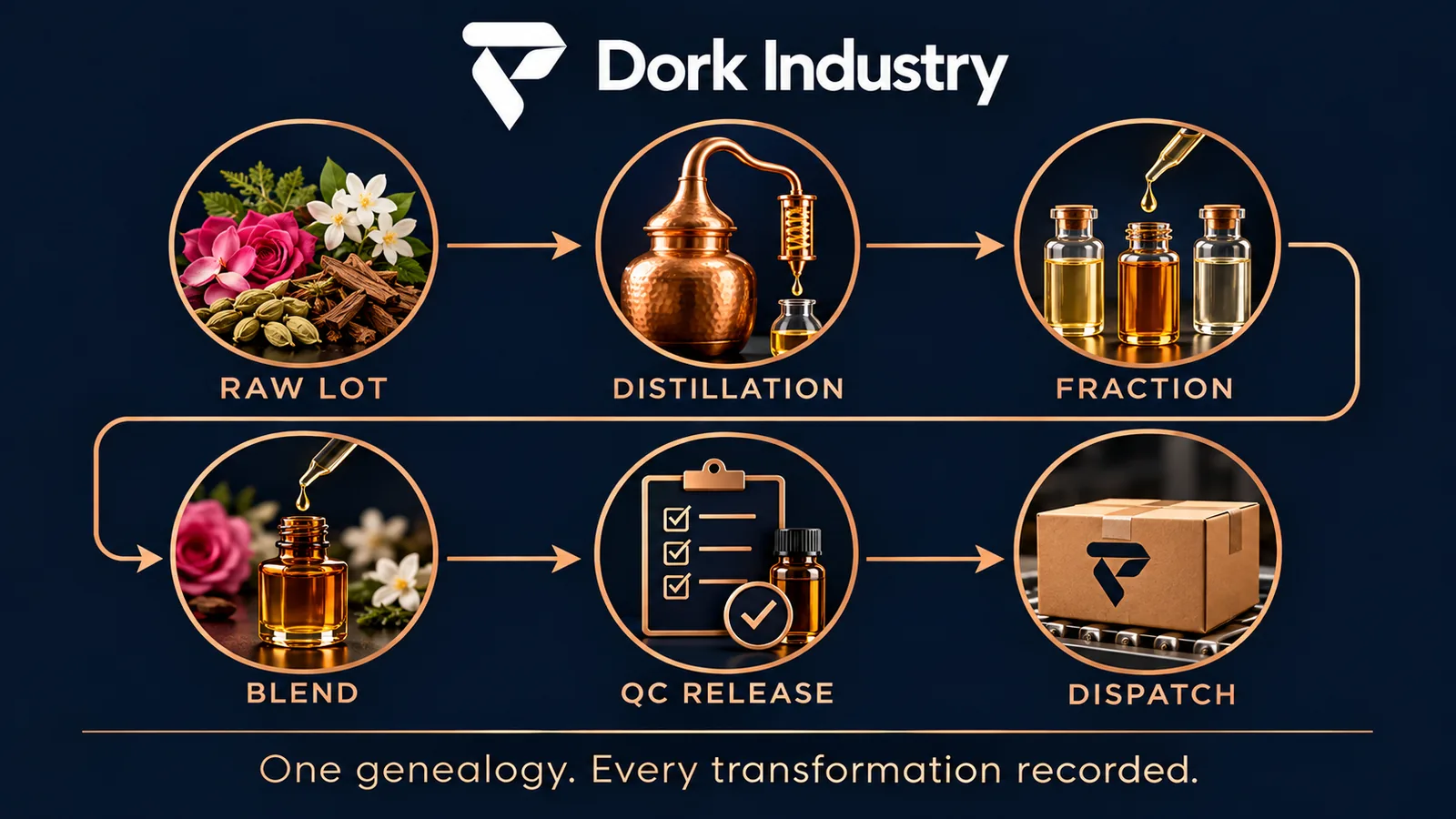
| Stage | Minimum useful record | Control question |
|---|---|---|
| Raw receipt | Internal lot, supplier lot, material identity, quantity, date, supplier, storage location and acceptance status | Can this lot be distinguished from another delivery of the same material? |
| Distillation | Run ID, charged lots and quantities, equipment, operator, times, key observations, fractions, yield and loss | Can each output be traced to every charged input? |
| Intermediate | Fraction or base lot, container, location, quantity, status and parent run | Can the system prevent unapproved material from entering a blend? |
| Blend | Batch ID, approved formula version, input lots, planned and actual quantity, additions, deviations and approver | Can production execute the batch without browsing the master formula? |
| Ageing | Vessel ID, fill and withdrawal events, dates, quantities, conditions, sample events and status | Does every movement preserve the lot relationship? |
| QC release | Sample ID, specification version, results, decision, approver, time and linked COA | Is the release tied to the tested sample and exact lot? |
| Dispatch | Customer, order, finished lot, container, quantity, invoice, shipment and COA version | Can affected customers be isolated without guessing? |
How can the secret formula be protected?
Traceability does not require every user to see the whole formula. Separate the master formulation, production instruction, batch record and customer document into different views. This is the principle of least privilege: each role receives only the information needed for its work.
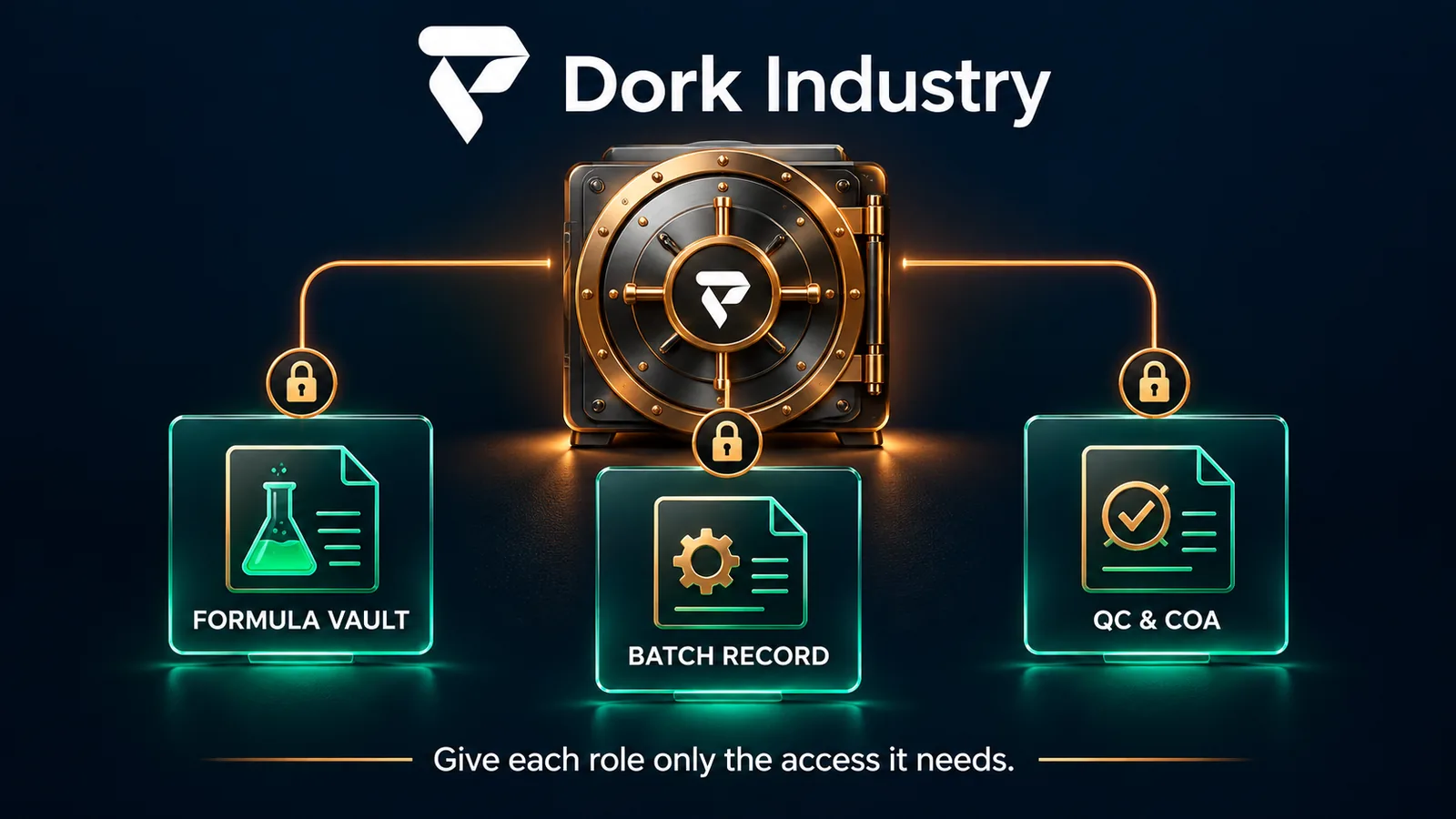
Use four controlled views
- Formula vault: master percentages, costing logic, substitutions, development notes, approval history and effective dates. Access is limited to named owners.
- Production instruction: authorised quantities for a specific batch, sequence, tolerances and safety notes. It need not reveal the entire commercial model.
- Batch record: what was actually charged, by whom, when, from which lots, with deviations and approvals.
- QC and customer record: specification, test results, release decision and the approved COA fields. It should not reveal confidential formula detail.
Security also needs practical controls: named accounts, multi-factor authentication where appropriate, access logs, download restrictions, periodic access review, encrypted backups and a tested recovery process. A system that hides a menu but sends the full formula to the browser is not a secure design.
Map your formula risk before buying software
Dork Industry can map who creates, approves, executes and audits each formulation, then design the minimum permissions and batch links needed for a pilot.
Request a formula-security assessment support@dorkindustry.com
What can and cannot be automated?
| Good automation candidates | Keep human judgement or approval |
|---|---|
| Generating internal lot and batch IDs | Accepting or rejecting natural material based on sensory assessment |
| Checking whether required records are complete | Approving a formula change or substitution |
| Calculating planned quantities from an approved version | Investigating an unusual odour, colour or process observation |
| Blocking unapproved lots from issue | Deciding whether a deviation affects product suitability |
| Building genealogy and forward/backward trace reports | Authorising final release and customer communication |
| Creating a COA from approved test data | Determining which tests and limits are appropriate |
AI may help classify documents, flag missing fields or summarise deviations, but it should not invent specifications, approve batches or silently change formulas. Keep the source record visible, require a human decision and log the final action.
How should quality records and COAs connect?
The COA should be an output of a controlled release record, not a free-floating document. The system should know which sample was tested, which specification version applied, who approved the result, which lot was released and which document revision was sent. If a corrected COA is issued, the original should remain in the audit history.
For fragrance applications, IFRA says its Standards form a globally recognised risk-management system for the safe use of fragrance ingredients. IFRA also notes that application of its Standards may not by itself satisfy every applicable law. Therefore software should store the relevant standard or customer requirement, its version, the calculation inputs and the reviewer’s decision—not display a vague “compliant” badge.
ISO 9235:2021 provides vocabulary for aromatic natural raw materials. Consistent terms and material identities reduce the risk that two teams use different names for the same input or the same name for different grades.
How should inventory, sales and export workflows integrate?
Do not rebuild accounting inside the traceability system if a reliable ERP already owns purchasing, invoices and financial stock. Define one system of record for each object and exchange only the fields required.
- ERP or accounting: supplier, purchase order, customer, sales order, invoice and financial valuation.
- Traceability application: lot identity, transformations, vessel movements, batch genealogy and status.
- QC or LIMS: sample, method, result, specification, review and release where a laboratory system already exists.
- Warehouse: container, location, quantity, issue, transfer, reservation and dispatch scan.
- Document service: approved COA template, version and recipient copy.
Every integration needs an owner, retry rule and reconciliation report. A successful API response is not proof that the receiving system posted the correct lot. Compare daily counts and surface exceptions for human resolution.
Should you buy, configure or build?
| Approach | Best fit | Watch for |
|---|---|---|
| Buy a specialist formulation tool | Small lab or brand with standard formula, weighing and batch needs | Limited support for traditional distillation, fractions, ageing vessels, local documents or ERP integration |
| Configure process-manufacturing ERP | Business needing purchasing, inventory, production, quality and finance in one platform | Implementation complexity, licensing, formula confidentiality and whether variable yields are handled naturally |
| Build a focused application | Distinctive workflow, legacy ERP, proprietary controls or phased digitisation | Product ownership, validation, support, backups and integration responsibility |
| Hybrid | ERP remains commercial system while a secure traceability layer handles distillery-specific events | Duplicate master data and unclear ownership unless interfaces are explicitly designed |
Competitor products demonstrate useful capabilities. Aroma Forge connects formula versions with production sheets; Mix Lab AI links formula, inventory, production and QC context; Tapputi Lab records actual weights and deviations; BatchMaster describes extraction, blending, ageing and bidirectional traceability; Orris Bench connects formulas, compliance documents and raw-material lots. The missing buying question is whether the product models your real distillery transformations and confidentiality boundaries, not whether its feature page contains the word “traceability.”
What should a 30-day pilot include?
- Days 1–5: map one product family. Choose one attar or essential-oil line, document actual handoffs and name the record owner at each step.
- Days 6–10: define identifiers. Agree rules for raw lots, runs, fractions, intermediates, blends, vessels, samples, finished lots and containers.
- Days 11–15: configure the minimum workflow. Create role-controlled screens for receipt, run, blend, movement, QC release and dispatch.
- Days 16–20: enter real records. Run at least one live batch in parallel with the current process. Record actual quantities and deviations.
- Days 21–25: test failure cases. Try a wrong lot, missing approval, corrected COA, partial dispatch, offline period, user departure and backup restore.
- Days 26–30: run trace exercises. Trace one shipment backward and one raw lot forward. Measure retrieval time, missing links, manual corrections and unauthorised exposure.
Copy this pilot scorecard
| Test | Target evidence | Pass? |
|---|---|---|
| Backward trace | Shipment reaches QC, blend, fractions, runs and raw lots without manual reconstruction | Yes / No |
| Forward trace | One raw lot reaches every intermediate, finished lot and customer dispatch | Yes / No |
| Formula access | Operator completes authorised batch without viewing the master composition | Yes / No |
| Release control | Unreleased material cannot be dispatched without an explicit exception | Yes / No |
| COA control | Document shows the approved result set and revision history | Yes / No |
| Recovery | Backup restoration and offline reconciliation are demonstrated | Yes / No |
Why is Kannauj the right place to start?
The District Kannauj government describes the region as famous for essence, flavour, fragrance and perfume. The Fragrance and Flavour Development Centre in Kannauj is an autonomous body under India’s Ministry of MSME and supports research, training and innovation. “Kannauj Perfume” also appears in India’s Geographical Indications registry. These signals make formula stewardship, material identity and batch history commercially relevant local capabilities—not artificial location keywords.
A well-designed pilot in Kannauj can later connect Delhi NCR sales, export, warehouse or customer-service workflows without creating separate location pages that repeat the same advice.
Need a traceability proof of concept?
Dork Industry designs custom web applications, ERP integrations, IoT workflows and secure process records. We can assess one product family, model your lot genealogy, define formula permissions and build a measurable pilot before a full rollout.
Discuss the pilot on WhatsApp Email support@dorkindustry.com
Explore our custom web application development service.
Frequently asked questions
Can a small attar distillery start without a full ERP?
Yes. Start with controlled identifiers, receipt, production, QC and dispatch records for one product family. Integrate accounting later. The pilot should prove genealogy and access control before expanding into planning, costing or every warehouse process.
Does batch traceability reveal the secret formula?
No. Genealogy needs identifiers, quantities, transformations and approvals, but different users can receive different views. The master formula can remain in a restricted vault while production receives an authorised batch instruction and QC receives the relevant specification.
Can barcodes or QR codes solve the problem?
Codes speed identification, but they do not create missing relationships. Define the lot, container, movement and transformation records first. Add scanning where it reduces selection errors or manual entry; keep a readable fallback for damaged labels or device failure.
How is a COA linked to a batch?
The COA should be generated from an approved QC record tied to a sample, specification version and finished lot. The dispatched copy should preserve its revision and recipient history so a corrected document cannot silently replace the original.
What is the first success metric?
Measure whether the team can trace one dispatched lot backward and one raw lot forward within an agreed time, with no missing transformations and no unauthorised formula exposure. This tests business value more directly than counting screens or features.
Sources and methodology
This article combines Dork Industry’s workflow analysis with current product research and primary standards references. Product capabilities were reviewed from Aroma Forge, Mix Lab AI, Tapputi Lab, BatchMaster and Orris Bench. Standards and regional facts were checked against GS1, IFRA, ISO, the District Kannauj government, FFDC and India’s Geographical Indications registry.
- GS1 Global Traceability Standard
- IFRA Standards documentation
- ISO 9235:2021 — Aromatic natural raw materials vocabulary
- Fragrance and Flavour Development Centre, Kannauj
- District Kannauj economy profile
- Aroma Forge formulation and production workflow
- Mix Lab AI fragrance batch workflow
- Tapputi Lab formulation and batch records
- BatchMaster ERP for fragrance manufacturers
- Orris Bench formulation and traceability
Important: This is operational and technology guidance, not legal, safety or regulatory advice. Applicable requirements depend on product, use, customer, destination and business role. Validate them with qualified quality, safety, export and legal professionals.
If you are shortlisting a partner for this kind of system, see our comparison of best AI automation companies in India, which covers eight providers on delivery, integrations and governance.
Discuss this for your business?
Book a free consultation — we scope the problem, outline the approach, and give you an honest verdict before any development is discussed.