Jewellery inventory management software should give a multi-showroom business one defensible record for every piece: identity, weight, purity, HUID, ownership, physical location, custody, movement and commercial status. The buying decision should begin with stock-control failures—not a vendor feature list—because barcode, RFID, ERP and custom integrations only work when the underlying workflow is clear.
Written by Nishant Singh for Dork Industry · Updated 7 October 2026 · For jewellery-chain owners, operations heads, inventory managers, finance controllers and IT teams.
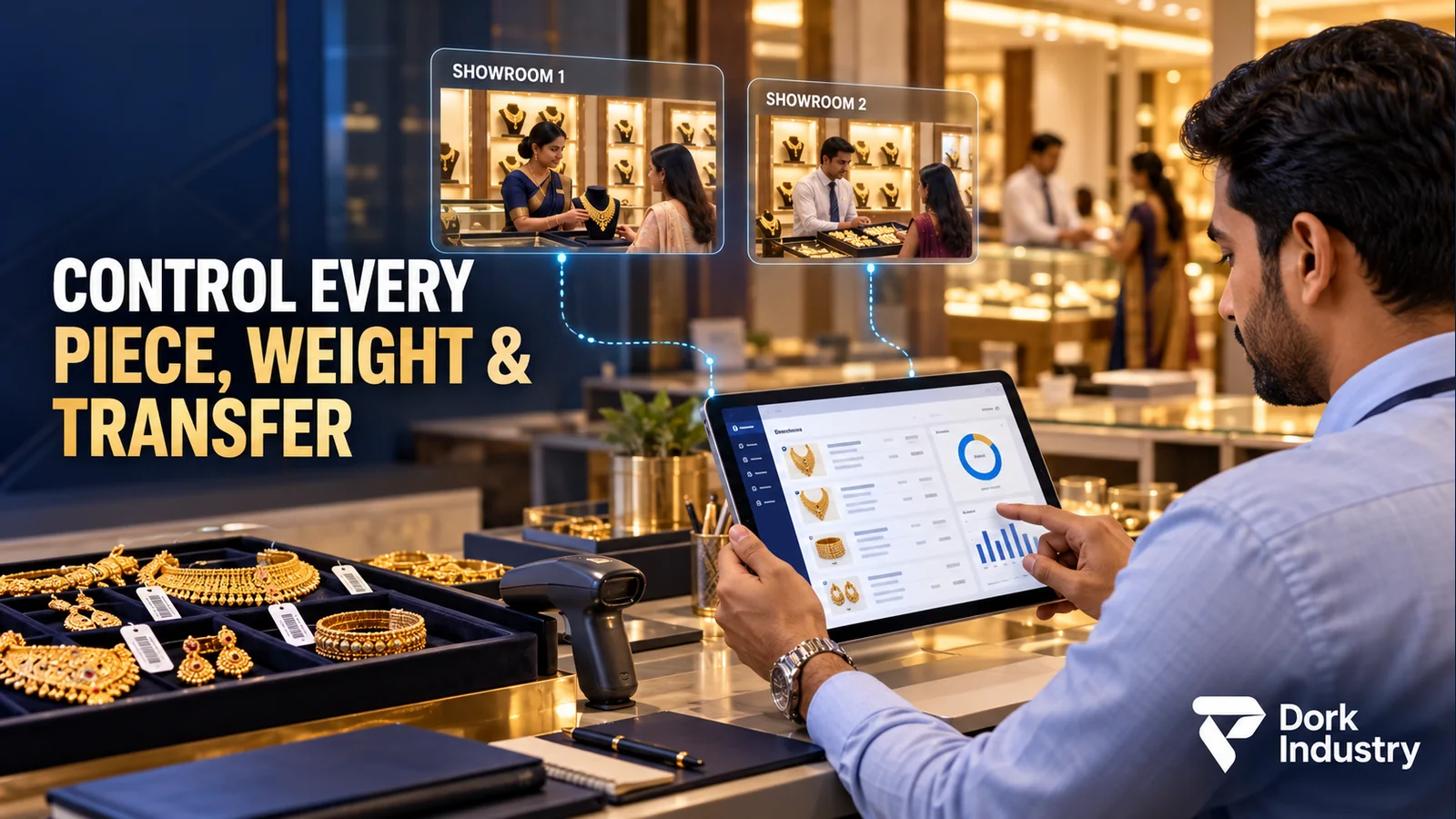
Why do multi-showroom jewellery records stop matching physical stock?
A mismatch rarely starts as a software problem. It starts when a piece can move without a controlled event. A salesperson carries a tray to another counter, an item goes to a photographer, a stone is removed for repair, a branch transfer leaves without receipt confirmation, an approval memo remains open, or an online order reserves stock that the showroom still considers available.
Generic inventory systems usually treat ten rings as ten equivalent units. Jewellery operations may need to distinguish each ring by gross weight, net metal weight, purity, stone details, certificate, HUID, making charges, vendor or karigar, image, ownership and current custodian. When those fields live in spreadsheets, paper packets, POS notes and messaging threads, a single “stock on hand” number conceals several different questions.
Five-minute diagnostic
Pick one high-value item and ask the team to prove, without calling another branch: where it is, who last handled it, which identity fields were verified, whether it is available to sell, and which document explains its last movement. If the answers come from different systems—or depend on memory—fix the workflow before buying more hardware.
What financial and operating consequences should the business measure?
Do not justify a project with a vague promise to “improve efficiency.” Establish a baseline that management can verify: time required for a case or branch count; count of unresolved differences; age of open transfers and approval memos; number of items shown online but unavailable; frequency of manual price corrections; delayed certificates; and staff time spent reconciling records.
A discrepancy does not automatically prove theft, and an RFID read does not automatically prove correct custody. A tag may be unreadable, duplicated, detached, incorrectly associated or detected in an adjacent zone. The system should classify exceptions and preserve evidence so a responsible person can investigate. Human review remains necessary for purity disputes, damaged items, stone changes, weight variances and commercial disposition.
What should jewellery inventory management software control?
A practical control model separates five concepts that weak implementations combine:
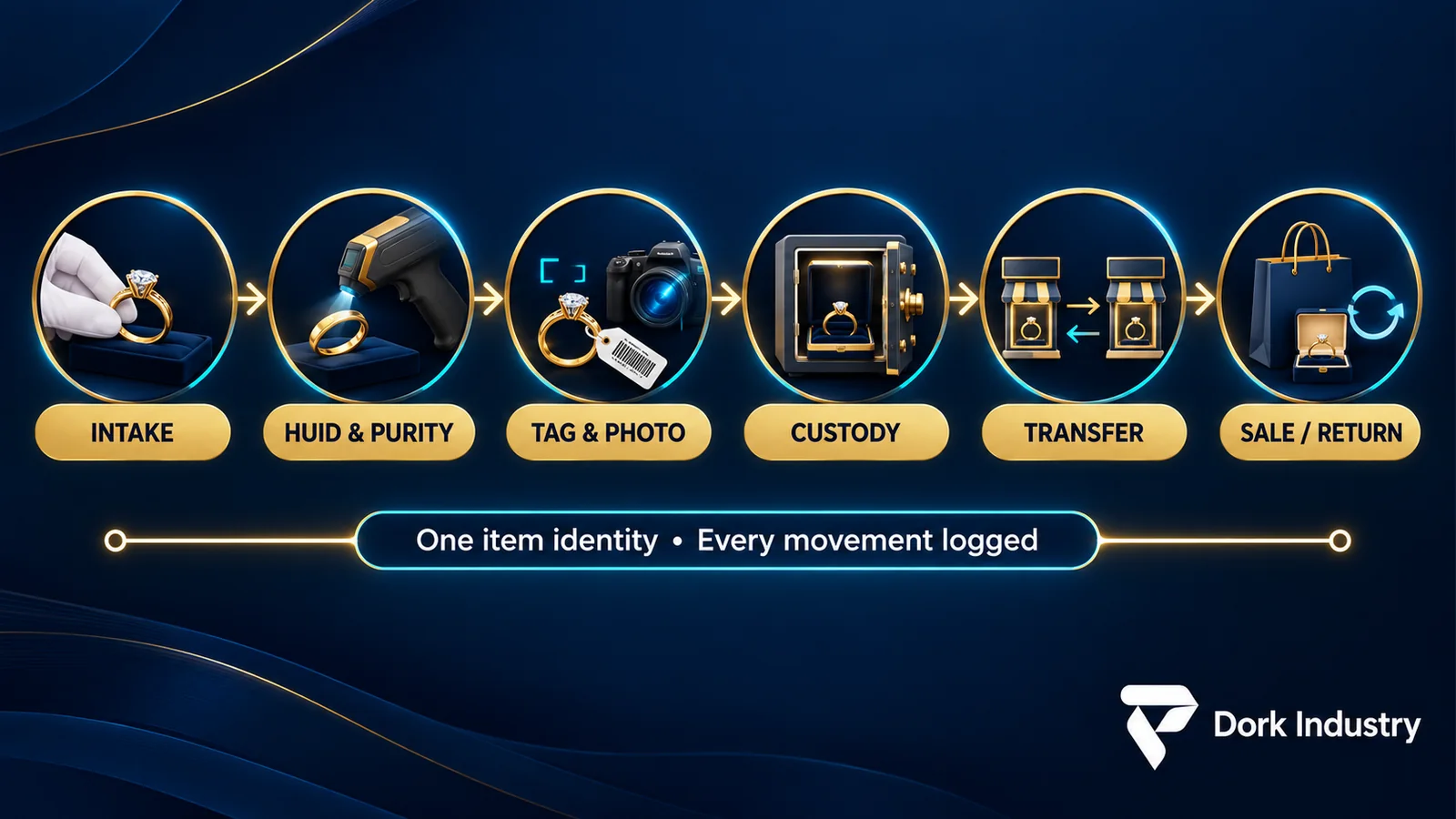
- Identity: which physical piece or defined lot the record represents.
- Attributes: metal, purity, weights, stones, certificates, HUID, photographs and commercial fields.
- Location: branch, vault, counter, tray, workshop, photographer, exhibition or transit.
- Custody: the person or external party responsible at that moment.
- Status: available, reserved, on approval, in transfer, under repair, quarantined, sold, returned or retired.
Every material change should be an event containing the previous state, new state, actor, timestamp, reason and supporting document. Editing the current location without retaining the history weakens accountability. Stock counts should produce a reconciliation record: expected items, observed items, unexpected items, unread items, approved adjustments and unresolved exceptions.
Which fields belong in the item master?
The item record should be designed from actual operations and reporting needs. More fields are not automatically better. A field that nobody verifies becomes decorative data; a required field that staff cannot know at intake creates workarounds.
| Data group | Typical fields | Control question |
|---|---|---|
| Identity | Internal item ID, SKU or serial, tag ID, design/style | Can two records point to the same physical piece? |
| Metal | Metal type, purity, gross weight, stone weight, net metal weight | Which measurement is authoritative and when was it captured? |
| Compliance | HUID, hallmarking status, certificate number, responsible entity | Can the invoice and item record be traced to the marked article? |
| Commercial | Cost components, making charge rule, tax classification, price version | Can users change a price without approval and history? |
| Movement | From/to location, sender, receiver, dispatch and receipt timestamps | Who owns an unreceived transfer exception? |
| Media | Images, video, certificate scan, condition notes | Are files protected, current and linked to the correct item? |
The Bureau of Indian Standards explains that HUID is a unique six-digit alphanumeric identifier for each hallmarked item and that customers can verify it through the BIS Care app. BIS also states that invoices should contain details of hallmarked articles. Those requirements make HUID and invoice linkage operational fields, not marketing decorations. The system should not claim to replace BIS verification or assaying.
Should a jewellery chain use barcodes or RFID?
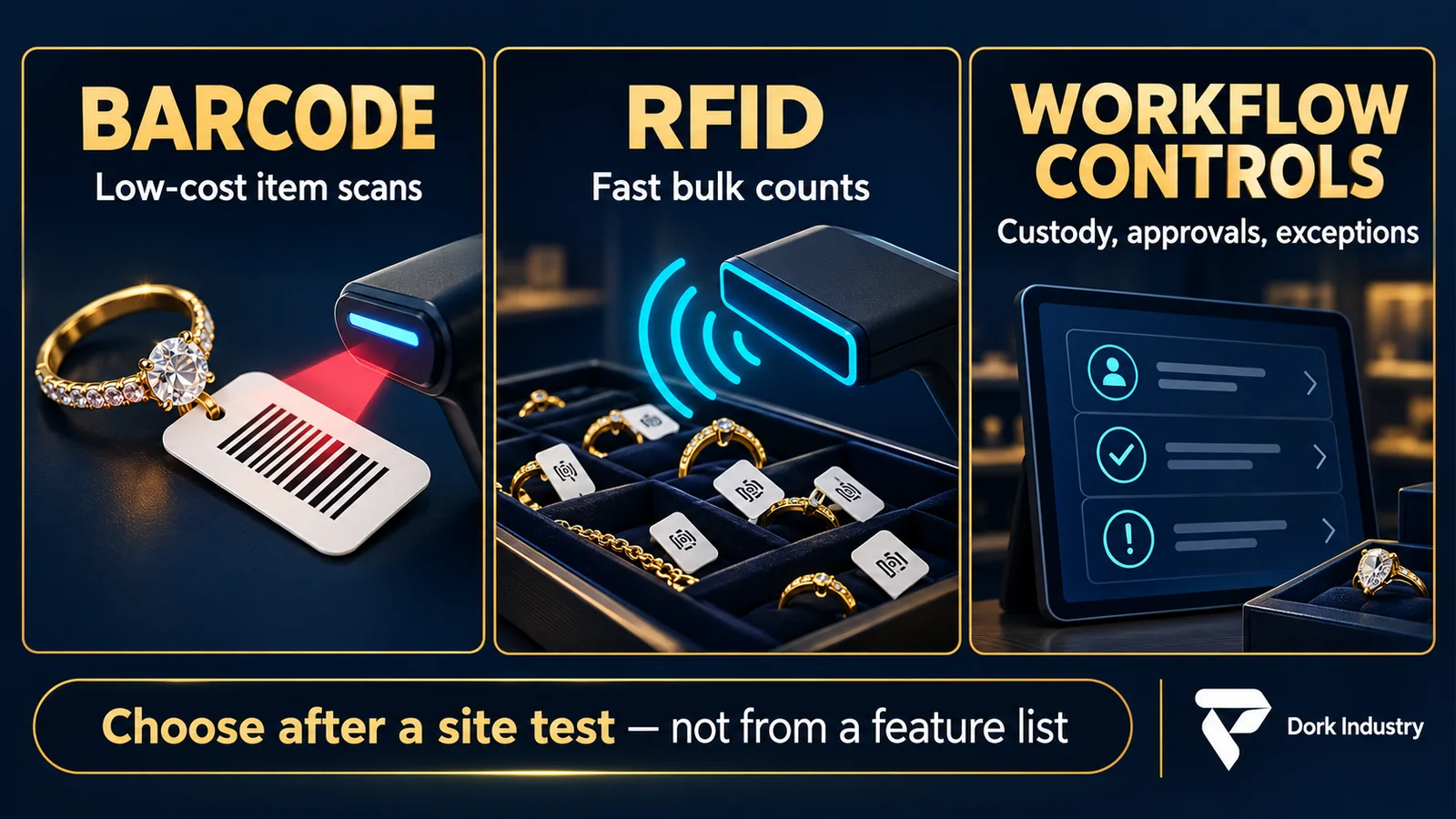
Barcode is usually easier to test because each item is deliberately scanned. RFID can accelerate bulk observations, but performance depends on tag selection, placement, reader configuration, jewellery presentation, shielding, nearby zones and operating discipline. Neither method fixes an incorrect item master or an uncontrolled handover.
| Decision factor | Barcode-first approach | RFID-assisted approach |
|---|---|---|
| Interaction | Line-of-sight, deliberate item scan | Multiple tags may be observed in a reader zone |
| Best early use | Intake, billing, transfers, small controlled counts | Case or tray counts after site validation |
| Primary failure to test | Missed or wrong-label scan | Missed, stray, duplicate or mis-associated read |
| Workflow requirement | User confirms each event | Software converts observations into reviewed business events |
| Purchase test | Scan speed, label durability and exception handling | Read accuracy by item type, zone and real showroom conditions |
Zebra describes RFID uses that include inventory counts and product movement, but that is a capability statement—not proof for a specific showroom. Run a site test with representative rings, chains, bangles, trays, counters and staff routines. Measure false observations and missed items, not only scan speed.
What can—and cannot—be automated?
Software can validate required fields, calculate derived weights under approved rules, block an incomplete transfer, reserve stock, create count tasks, record acknowledgements, flag stale memos, compare expected and observed items, synchronize approved availability and preserve an audit trail. It can also route exceptions to named roles and show which branch has not completed receipt.
It should not silently decide that a missing piece was stolen, that a weight variance is harmless, that a returned item is saleable, or that a certificate belongs to an item merely because filenames look similar. Those decisions require defined authority and evidence. AI may help classify images, suggest attribute matches or prioritize anomalies, but a person should approve high-impact changes and the original evidence should remain available.
How should POS, ecommerce, accounts and workshops connect?
Define a system of record for each data domain. The inventory platform may own item identity, physical state and availability; POS may own the retail transaction; accounting may own financial postings; ecommerce may publish an approved catalogue; and a workshop module may own job steps. “Two-way sync” is not a design until ownership and conflict rules are explicit.
- Sale: reserve before payment, finalize on approved transaction, and release safely after failure or cancellation.
- Return: receive into inspection status rather than immediately available stock.
- Transfer: distinguish dispatch, in-transit, receipt, partial receipt and disputed receipt.
- Online catalogue: publish only eligible items and withdraw availability after reservation according to an agreed latency.
- Workshop: record custody and component consumption without losing the parent item history.
- Accounts: post approved summaries with stable references; do not let accounting imports overwrite physical truth.
Design idempotency so a retried API message does not create a second sale or transfer. Keep integration logs understandable to operations staff, not only developers. When connectivity fails, define which actions may continue offline, how they are queued and how conflicts are resolved after recovery.
Need a workflow map before choosing software?
Dork Industry can assess item identity, custody, transfers, stock counts, POS/ecommerce integration and reporting across your showrooms. The output is a practical control map and pilot scope—not a forced platform recommendation.
What security and privacy controls are required?
Jewellery records can reveal valuable stock, branch locations, pricing, customer preferences, staff activity and security routines. Apply least-privilege access by role and location. Require stronger authentication for exports, price overrides, adjustments and administrative changes. Separate approval from execution for sensitive movements, and alert on unusual downloads or repeated failed access.
Encrypt data in transit and at rest, maintain tested backups, document retention, and keep tamper-evident audit logs. Vendor support access should be time-bound and recorded. Device loss procedures matter when managers use phones or tablets. Exported spreadsheets need controls too; a secure application cannot protect an unrestricted copy sent through personal messaging.
Customer KYC, contact information, purchase history, preferences and employee identifiers are personal data. India’s Ministry of Electronics and Information Technology published the Digital Personal Data Protection Rules, 2025 and an enforcement timeline. Obtain current legal advice for applicability and implementation; the software specification should support purpose limitation, appropriate notices, access control, retention and accountable deletion rather than assuming a generic consent checkbox is sufficient.
Which reports help management act instead of merely observe?
Dashboards should lead to an owner and action. Useful views include unreceived transfers by age, items without complete identity, stock not observed in the latest count, open approval memos, reserved items without active orders, returns awaiting inspection, slow-moving stock by defined period, integration failures and overrides awaiting review.
A branch ranking based only on discrepancies can encourage hiding problems. Pair outcomes with process measures: count completion, exception closure time, transfer acknowledgement, data completeness and approved-adjustment cycle time. Document definitions so finance, operations and showroom teams do not interpret the same metric differently.
Should you buy, configure or build jewellery inventory management software?
| Option | Best fit | Important caution |
|---|---|---|
| Buy a jewellery ERP | Core workflows match the product and the team can adopt its operating model | Verify migration, exports, support, security, integrations and exception depth |
| Configure a platform | Most capabilities exist but roles, fields, approvals and reports need tailoring | Avoid customization that makes upgrades impractical |
| Build an integration layer | Existing systems must remain while stock, ecommerce, RFID or reporting is unified | Define system ownership and recovery before writing connectors |
| Build custom software | The workflow is differentiating, complex and unsupported by viable products | Budget for discovery, security, testing, support and continuous change |
Shortlist vendors using real scenarios, not a generic demonstration. Ask each system to process a partial branch receipt, a returned item pending inspection, an item sent on approval, a tag replacement, a weight correction requiring approval, an offline sale recovery and a catalogue reservation conflict. Confirm how data can be exported if the relationship ends.
How can a jewellery chain run a 30-day pilot?
- Days 1–5: map and baseline. Select one showroom, one secure stock area and representative product categories. Record current count time, discrepancies, open transfers and data gaps.
- Days 6–10: clean identity. Establish item IDs, required attributes, HUID and certificate rules, tag association and duplicate detection. Do not migrate unreviewed spreadsheets blindly.
- Days 11–17: test controlled movements. Run intake, counter handover, vault return, branch dispatch, partial receipt, approval memo, repair and return-inspection scenarios.
- Days 18–23: test failures. Simulate a lost tag, duplicate scan, network outage, API retry, cancelled payment, unauthorized adjustment and unread RFID item without risking live stock.
- Days 24–27: reconcile. Perform observed-versus-expected counts by case and branch. Investigate every exception using the audit trail.
- Days 28–30: decide. Compare baseline and pilot measures, document unresolved risks, training effort and integration defects, then approve, revise or stop expansion.
What should the pilot worksheet record?
| Field | Record |
|---|---|
| Scenario | Normal or exception workflow being tested |
| Item | Internal ID, category, purity, weights, HUID/certificate status and tag ID |
| Event | Previous state, new state, actor, time, reason and document |
| Expected control | Validation, approval, notification or block |
| Observed result | Pass, fail, ambiguity, delay or manual workaround |
| Owner and deadline | Person responsible for resolving the issue before scale-up |
How should Delhi NCR and Jaipur operators adapt the plan?
Geography matters only where it changes the workflow. A Delhi NCR chain may have showrooms, a central vault, repair partners and ecommerce operations spread across several jurisdictions and traffic corridors. A Jaipur operator may connect gemstone procurement, manufacturing or job work, wholesale approval and retail showrooms. Do not create different systems merely because cities differ; standardize identity and event definitions while configuring legitimate operational variations.
Map every external custody point: karigar, assaying or hallmarking process, photographer, exhibition, courier and repair partner. Confirm connectivity, device support and service availability at real locations. Start with one high-control route between two locations before attempting chain-wide rollout.
Frequently asked questions
What is jewellery inventory management software?
Jewellery inventory management software records each piece or controlled lot by identity, attributes, location, custody and status. A suitable system also logs transfers, approvals, returns, counts and exceptions. It differs from generic stock software because jewellery may require weight, purity, stones, certificates, HUID and per-piece traceability.
Does RFID prevent jewellery theft?
No technology should be described as preventing theft by itself. RFID can support faster observations and movement controls, but tags can be missed, detached or read in the wrong zone. Physical security, separation of duties, controlled custody, investigation procedures and reconciled records remain necessary.
Can a jewellery ERP verify HUID authenticity?
An ERP can store HUID and link it to an item, invoice and movement history. Official authenticity verification should follow the Bureau of Indian Standards process, including the BIS Care app where applicable. Software should not represent its own database match as an official BIS verification.
How long should implementation take?
Duration depends on data quality, locations, integrations, hardware and workflow change. Use a time-boxed pilot before estimating chain-wide deployment. A short installation can still fail operationally if identity fields, transfer rules, migration checks, staff training and exception ownership are unresolved.
When is custom development justified?
Custom development is justified when important workflows or integrations create genuine differentiation and viable products cannot support them safely. First determine whether configuration or an integration layer solves the gap. Custom software also requires ongoing security, testing, support, documentation and change management.
What should you bring to a jewellery inventory assessment?
Bring a location map, sample item master, tag formats, count sheets, three recent discrepancy cases, branch-transfer documents, approval-memo process, POS/ecommerce architecture and the roles allowed to adjust stock. Redact customer and commercially sensitive information. Dork Industry can map the workflow, evaluate barcode or RFID, design integrations and deliver a controlled proof of concept.
Email support@dorkindustry.com or start an enquiry on WhatsApp. For implementation options, review Dork Industry’s custom web application development service.
Turn one difficult stock route into a measurable pilot
We will help you define the item record, custody events, exception rules, integrations and acceptance tests before scale-up.
Sources and technical references
- Bureau of Indian Standards: Hallmarking FAQs
- Bureau of Indian Standards: Mandatory Hallmarking Order and amendments
- MeitY: Digital Personal Data Protection Rules, 2025
- GSTN-authorized IRP: e-invoice web portal and integration overview
- Zebra: RFID inventory and movement use cases
Editorial note: This article provides operational and technology-planning information, not legal, tax, security or hallmarking advice. Validate current obligations with qualified advisers and official authorities.
If you are shortlisting a partner for this kind of system, see our comparison of the best AI automation company in India, which covers eight providers on delivery, integrations and governance.
Discuss this for your business?
Book a free consultation — we scope the problem, outline the approach, and give you an honest verdict before any development is discussed.