
Marketing agency lead routing automation should create one accountable CRM record from every valid enquiry, preserve its source and consent evidence, assign it to an eligible owner and escalate it when nobody responds. The goal is not simply an instant WhatsApp reply. It is a traceable path from website forms, Meta lead ads, calls, email and WhatsApp to a human who can qualify and progress the opportunity.

Contents
Why do agencies miss leads even when every channel sends notifications?
Notifications do not create ownership. A website form may reach email, a Meta lead may sit in an ad account, a WhatsApp enquiry may remain on one employee’s phone and a referral may be written in a spreadsheet. Duplicate people receive separate follow-ups, campaign source is overwritten, account managers are assigned while unavailable and nobody owns the exception. The agency then cannot distinguish a low-intent enquiry from an operationally missed one.
Current Indian CRM pages specifically promote capture from web forms, Meta ads, WhatsApp and calls into a shared pipeline. According to official HubSpot, Salesforce and Zoho documentation, their platforms provide rotation, queues or rule-based assignment options. This validates commercial intent without proving search volume or guaranteed results. One Indian market example shows the multi-source requirement.
Which nine controls should marketing agency lead routing automation include?
| Control | Business question | Proof before launch |
|---|---|---|
| 1. Source capture | Did every approved channel create an event? | source-by-source test |
| 2. Identity matching | Is this new or an existing contact? | deduplication rules |
| 3. Consent evidence | Which follow-up is permitted? | notice and preference fields |
| 4. Qualification | What is known versus inferred? | required-field matrix |
| 5. Eligibility | Which team can handle this service? | skills and territory rules |
| 6. Capacity | Is the proposed owner available? | load and absence rule |
| 7. Acknowledgement | What should the lead receive immediately? | approved template |
| 8. Escalation | What happens when no one acts? | timer and backup queue |
| 9. Audit | Can the agency explain assignment and outcome? | event history |
1. How should enquiries enter the system?
Use supported APIs, webhooks or connectors for each approved source. Store the source event ID, campaign identifiers, timestamp, submitted fields and consent context before routing. Queue temporary failures and make ingestion idempotent so a provider retry does not create a second lead.
2. How should duplicate leads be handled?
Match conservatively using verified email, normalized phone number and channel identifiers. Keep the new source event attached to the existing contact instead of discarding it. Ambiguous matches should enter human review; automation must not merge two people merely because names look similar.
3. What consent information should be preserved?
Store the notice or form version, timestamp, source and relevant preference. An enquiry permits the response necessary to handle that enquiry; it should not silently become unlimited marketing permission. Provide an operational opt-out path and obtain appropriate legal review for the actual workflow.
4. Should AI qualify the lead automatically?
AI may extract a requested service, budget phrase, deadline or location from submitted text, but it should label uncertain fields and preserve the original message. Do not invent company size, purchasing authority or intent. High-value, sensitive or unclear enquiries belong in a human review queue.
5. How should an owner be selected?
Start with eligibility—service expertise, client conflict, language, territory and account ownership—then apply capacity or rotation. According to the official platform documentation, Salesforce processes ordered assignment-rule entries and queues; HubSpot supports owner rotation, including round-robin and load-balanced options for supported records; and Zoho supports rule-based assignment. Salesforce guidance, HubSpot guidance and Zoho guidance show why the exact platform matters.
Are paid campaign leads still being assigned manually?
Share your lead sources, CRM, service lines, owner rules, business hours, escalation expectations and approved response channels. Dork Industry can map a focused routing proof of concept or repair a broken integration.
6. What happens when the preferred owner is unavailable?
Check working hours, leave, current capacity and required skills before assignment. Route to an eligible backup or visible queue rather than an inactive user. Preserve the original routing decision so the agency can diagnose coverage gaps.
7. What should be automated immediately?
Automate acknowledgement, not a fabricated sales conversation. Confirm receipt, state when a human response is expected and provide a safe route for correction or opt-out. Do not promise a proposal, audit or result before the responsible person reviews the request.
8. How should escalation work?
Start a timer when the lead becomes actionable. Escalate when no owner accepts, the first task expires, required information remains missing or a high-priority lead has no response. Keep the record open until a person records the outcome.
9. Which integrations are usually required?
Common connections include website forms, Meta or Google lead sources, WhatsApp Business providers, telephony, email, CRM, calendars, proposal tools and reporting. Use one contact identity and one ownership field as the source of truth, then retain raw source events for reconciliation.
What should and should not be automated?
| Automate | Keep human-controlled |
|---|---|
| source capture and retries | ambiguous identity merges |
| approved field mapping | uncertain qualification claims |
| eligibility and capacity checks | client conflicts and exceptions |
| receipt acknowledgements | proposal promises and pricing |
| timers, queues and alerts | opt-out disputes and sensitive cases |
A packaged CRM fits standard sources and routing. Custom integration is useful when the agency already owns suitable tools but field mapping or ownership breaks. A custom application is warranted for multi-brand operations, client-specific routing, unusual reporting or proprietary qualification workflows.
What does a complete lead-routing workflow look like?
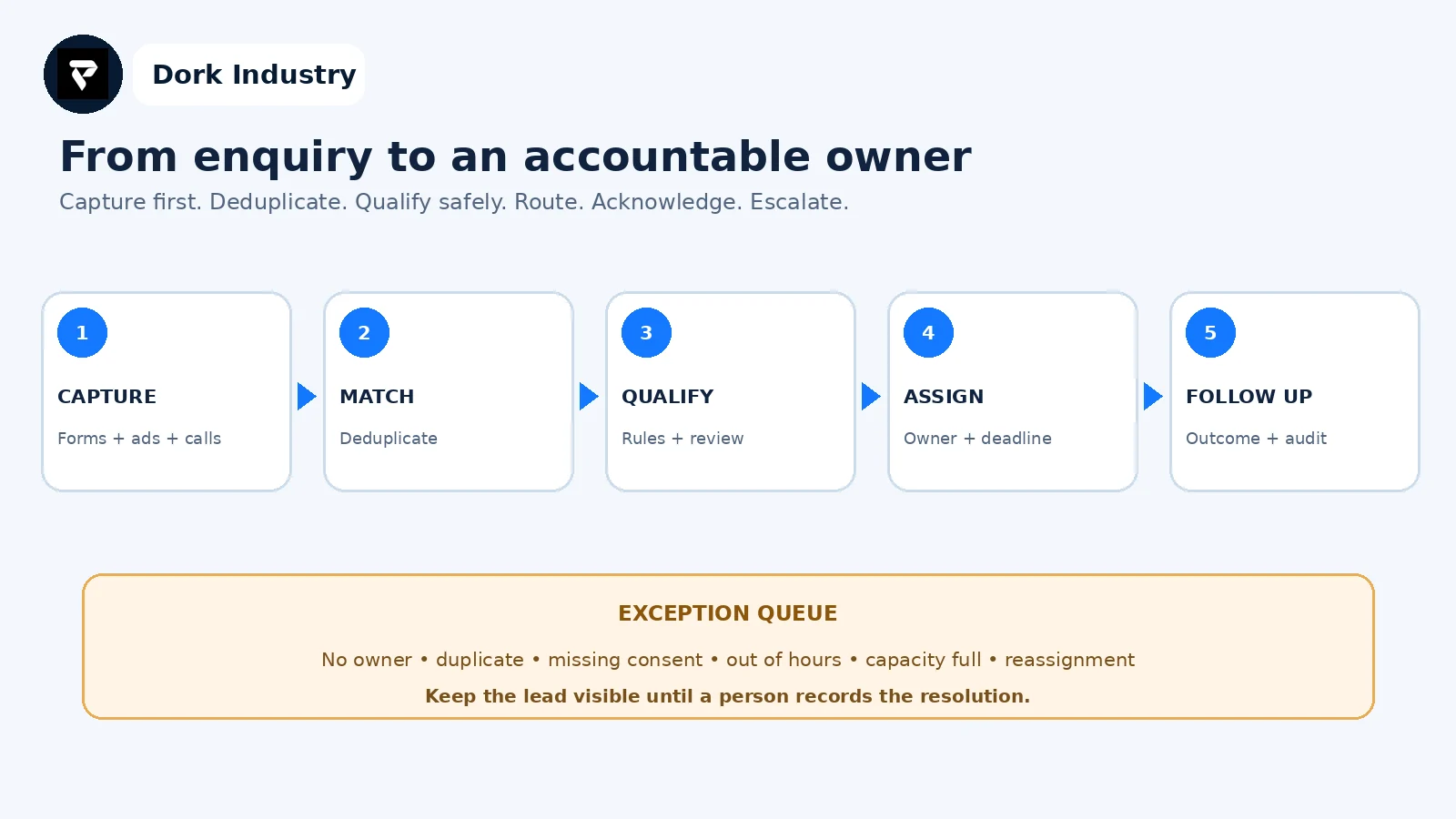
How should an agency test routing before the next campaign?
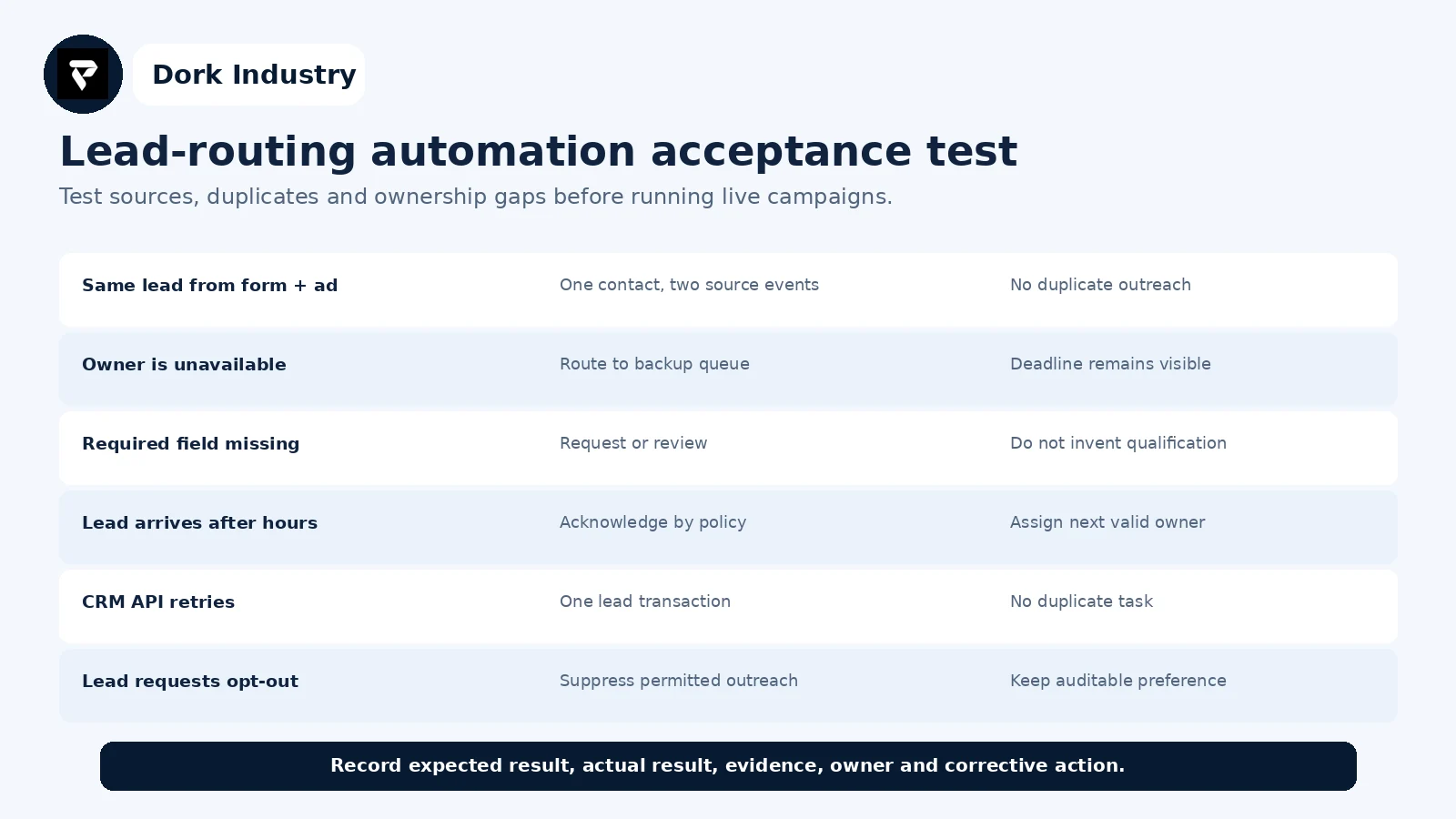
Run test enquiries through every channel in a safe environment. Record expected and actual owner, source fields, acknowledgement, task deadline, retry behaviour and audit history. Repeat after CRM, form, ad-platform or messaging-provider changes.
What can Dork Industry implement?
Dork Industry can audit the current lead path, repair form or CRM integrations, connect supported APIs, build assignment and escalation workflows, create an exception dashboard or develop a custom lead-operations application. The stack—PHP, Laravel, Node, MERN, .NET, Salesforce, Python or cloud services—should follow the operating problem and existing systems.
Review Dork Industry’s automation solutions, enterprise software development, web development and industries served.
Give every valid enquiry a visible owner and deadline
Send an anonymised source map, sample lead fields, routing rules, escalation timings and integration list. Dork Industry can propose a repair, proof of concept or custom lead-routing system with explicit acceptance tests.
Frequently asked questions
Is round-robin assignment enough for an agency?
Not always. Round robin distributes records, but it does not automatically account for service expertise, client conflicts, working hours, language, territory or capacity. Apply eligibility first and rotation second.
Can AI decide whether a lead is qualified?
AI can extract and suggest fields, but uncertain or consequential decisions need human review. Preserve the original enquiry, label inferred values and never fabricate budget, authority or purchasing intent.
Should every lead receive an instant WhatsApp message?
No. The channel and template must match the enquiry source, consent context and business policy. An acknowledgement should confirm receipt without making unsupported promises or beginning unrelated promotional messaging.
What belongs in a routing proof of concept?
Include at least two lead sources, duplicate detection, one eligible assignment, one unavailable-owner case, an after-hours enquiry, a retry, an opt-out and reconciliation with the CRM audit history.
Want this automated for your business?
Book a free assessment — we map the workflow, check data readiness, and outline a pilot you can measure.
[…] Theme code rarely controls the core hosted payment-method list, but custom carts, checkout extensions, payment customizations and apps can influence the journey or eligibility. If the cart itself is broken, use the Shopify Add to Cart repair guide. If a promotion changes the outcome, compare the Shopify discount diagnosis. […]