AI automation can syndicate a property listing from one master record to every portal your agency publishes on — so a price change, a status change, or a new photo set is entered once and appears everywhere, instead of being re-typed portal by portal until the copies disagree. The direct answer to the question in the title is yes, provided one record is declared the source of truth, each portal’s rules are respected, and a human still approves the changes that move money or mislead buyers. Without those three conditions, syndication just spreads the same stale listing faster.
Every estate agency knows the symptom. A buyer calls about a home that sold three weeks ago. Another quotes a price from a portal that was superseded on your own website last Tuesday. None of this is caused by lazy agents. It is caused by a system in which the same listing exists as five or six separate copies, each maintained by hand, each drifting at its own speed.
Why do property listings go stale on some portals but not others?
Because there is no single listing — there are copies. Your CRM holds one version, your website another, each portal its own. A change made in one place reaches the others only if a person remembers to carry it there, in that portal’s format, before the next enquiry arrives. The portals updated promptly look fresh; the ones at the end of the list go stale. Staleness follows the order in which a busy team gets around to re-typing.
Why does re-entering the same listing create errors?
Re-entry is not copying; it is re-deciding. Each portal asks for fields in a different order, with different labels and required fields. An agent under time pressure abbreviates a description on one portal, rounds a price on another, and uploads photos in a different order on a third. According to Auben Realty’s rental listing syndication FAQ, the biggest reason syndicated listings stop showing up correctly is incomplete or mismatched required fields, followed by duplicate feeds pushing the same listing twice on one platform.
Why do sold listings linger on different portals?
A listing disappears from a portal only when a signal tells that portal it has changed. If the status change is entered in the CRM but nobody carries the “sold” or “let” update to every portal, the old copy simply stays up — and aggregators and cached pages can keep showing it longer still. Buyers then call about a home that is gone, and blame the agency, not the portal. The cost is not the wasted call. It is the trust that leaves with it.
Why does each portal show a different price?
Price changes are the most dangerous drift, because they are the field buyers act on. A price reduction agreed with a seller on Monday, entered on the agency website on Monday, and carried to the remaining portals on Thursday, spends three days as two different prices in public. A buyer who offers on the old price has been misled through no fault of their own, and the agent must explain a discrepancy the agency created.
What data does your agency already hold that could fix this?
Almost all of it. The master record for a listing already exists in most agencies — in the CRM, the property management system, or even a disciplined spreadsheet. It holds the address, price, status, bedrooms, area, photos in an agreed order, the agent’s contact details, and the viewing instructions. What is missing is not data; it is discipline about which copy is authoritative for each field, and a mechanism that carries changes from that copy to everywhere else.
That distinction matters for cost. A project that begins with “let us gather all your listing data” is rebuilding something you own. A project that begins with “show us your master record and your portal list” is connecting something you own — and the pilot below starts with the second question.

How does AI automation syndicate listings from one record?
The technology is deliberately unglamorous, and that is a compliment. At its centre is a canonical listing record: one agreed set of fields, with a named owner for each field, so price belongs to the negotiator, status belongs to the contract stage, and photos belong to the marketing owner. When a field changes in the master record, the system validates the change, translates it into each portal’s format and image sizes, and pushes it through that portal’s feed or API. When a portal cannot accept a change, it lands in an exception queue with the reason attached, for a named person to resolve.
According to Reallyo’s rental listing syndication guide, the way to avoid duplicate listings across rental sites is to use one system as the source of truth for each rental and to switch off extra sources so portals see one clear publisher. That is the whole architecture in one sentence. The AI layer sits on top of it and does three things a plain feed cannot: it catches errors before they publish, reconciles what each portal actually displays against the master record, and flags drift instead of waiting for a buyer to report it.
Concretely, a working syndication pipeline has five parts. First, connectors for each portal: feeds, APIs, or managed uploads, chosen per portal. Second, field mapping: each portal’s fields mapped to the canonical record, including required fields and image rules. Third, validation: price floors agreed with the seller, status values matching the contract stage, viewing times not in the past. Fourth, reconciliation: a regular check that reads back what each portal shows and reports mismatches. Fifth, an exception queue: every failure visible, owned, and ageing — never buried in a log file nobody reads.
What is the difference between IDX and MLS syndication?
Buyers and agents often use these terms interchangeably, and they should not. According to the ARAB MLS guide to MLS syndication strategy, MLS syndication is the process through which a Multiple Listing Service distributes listing data to third-party websites and platforms when an agent submits a listing. IDX, by contrast, is the display side: it lets a brokerage show MLS listings on its own website. Syndication pushes your listing out; IDX pulls other listings in for display. According to reAlpha’s real estate listing syndication guide, syndication increases online exposure, attracts more leads, and shortens time on market — but only when the distributed data stays accurate and consistent.
What does the math look like? An illustrative example
Illustrative example — stated assumptions, not statistics. Replace every number below with your own ledger before making a decision. Consider an agency with 40 active listings publishing to 5 portals, where each hand re-entry takes 12 minutes, the agency runs two price or status change rounds a month, and it receives 200 enquiries a month, of which 15% chase a sold, let, or wrongly priced home, each taking 20 minutes of agent time to handle.
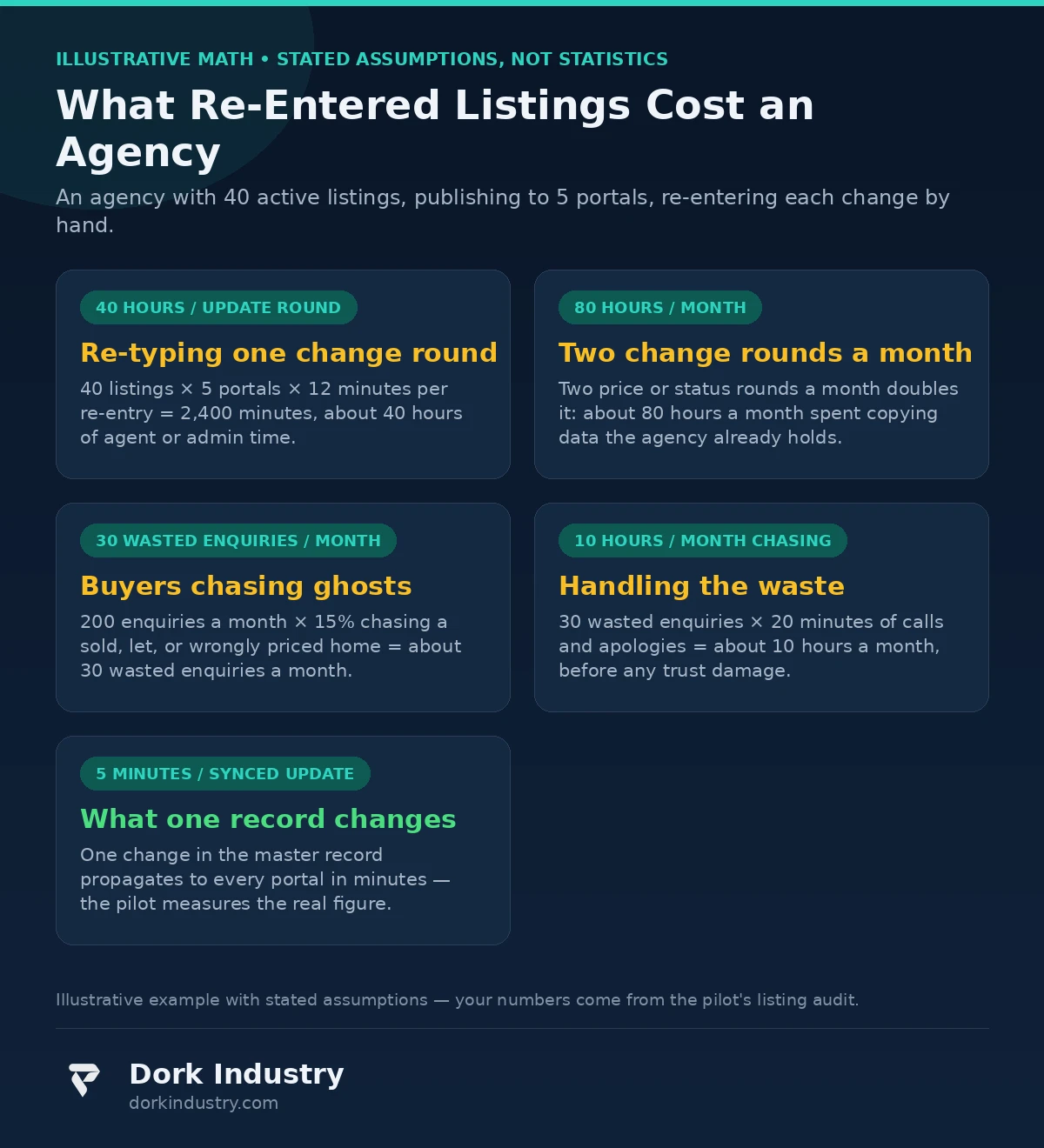
One change round costs about 40 hours of re-typing; two rounds a month cost about 80 hours. Wasted enquiries add about 10 hours of handling a month, before any trust damage. None of these figures proves what your agency loses — a 10-listing agency loses far less, a 200-listing agency far more — but they show where to look: count your portals, time one re-entry, and multiply.
Should you build, buy, or use portal-native syndication?
There are three honest routes, and the right one depends on how many portals you publish to and how unusual your data is.
| Route | Update speed | Error control | Best for |
|---|---|---|---|
| Manual re-entry | Hours to days, portal by portal | None — drift is the default | Under 10 listings on 1–2 portals |
| Portal-native syndication | Minutes to a day, per portal rules | Portal-side validation only | Agencies happy inside one portal’s ecosystem |
| One-record syndication (bought) | Minutes across all portals | Validation, reconciliation, exception queue | Multi-portal agencies with a real master record |
| Custom-built syndication | Minutes, tuned to your workflows | Full — your rules, your checks | Agencies with unusual data, many portals, or CRM quirks |
Build custom only when bought tools cannot cover your portals, model your field ownership, or enforce your validation rules. Do not build custom because syndication sounds strategic; the strategic part is the single source of truth, and a bought tool delivers that for most agencies. Conversely, do not buy a tool that only pushes data one way and never reads back what portals display — a feed without reconciliation is a faster way to publish errors. For agencies whose wider operations also need custom work, custom software development is the route when the bought options genuinely fall short.
What should the system never do alone?
Syndication must never change a price, a status, or an availability window without a human decision behind it. The system may carry a human’s approved change to every portal in seconds; it must not invent the change. Five boundaries are non-negotiable. First, price changes below the seller’s agreed floor stop for approval, every time. Second, a status change that contradicts the contract stage — “available” on a property under contract — stops for approval. Third, a listing must never be withdrawn from all portals automatically on a single failed sync; a failed sync is an alert, not a deletion. Fourth, photos and descriptions that identify a seller’s home must never be altered by an automated rewrite without review. Fifth, no enquiry from a buyer may ever receive an automated answer that states availability or price — the system updates listings; humans answer buyers.
These boundaries are not inefficiency. They are the reason sellers trust an agency with their largest asset. An automation vendor who proposes removing them to save minutes is selling speed at the price of the agency’s reputation.
How do you test it in 30 days before full investment?
Run one branch, two portals, four weeks — and judge it on reconciliation, not enthusiasm. Week one audits the mess: list every portal, sample 20 listings per portal, and count price, status, and photo mismatches against the master record. Week two puts one branch’s listings live from a single master record to two portals only, with a named owner for each field. Week three switches on exception alerts: a failed sync, a price below the agreed floor, or a status contradicting the contract stage alerts a named person within the hour. Week four re-checks the same 20 listings on every portal and renders a verdict on three gates: zero unexplained mismatches, re-entry hours measurably down, and no ghost enquiries from the pilot branch.
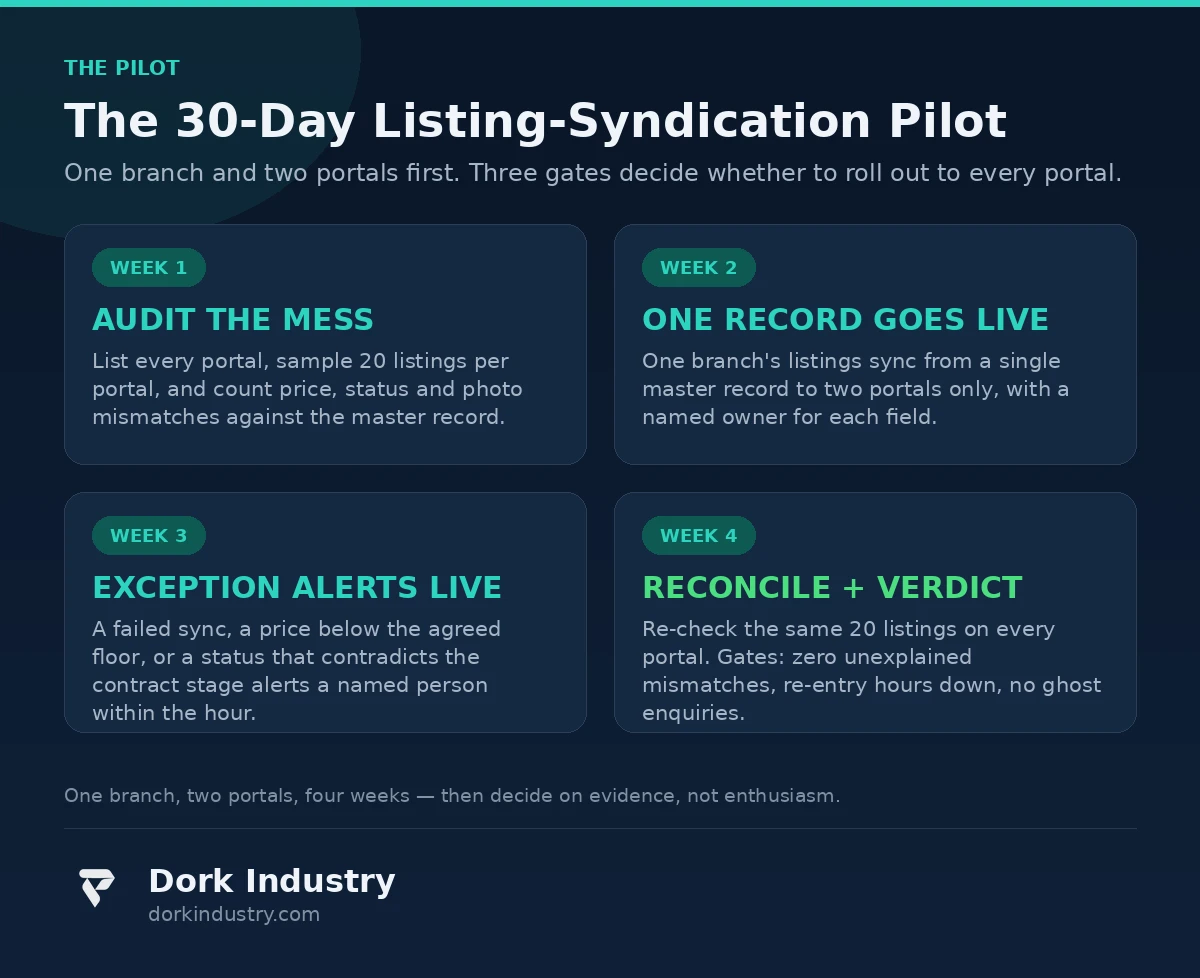
If any gate fails, you have learned something cheap: either the master record needs cleaning, the portal connectors need work, or field ownership was never agreed. All three are far cheaper to discover on two portals than on ten. If all three gates pass, rollout is a scheduling decision, not a leap of faith.
What actually drives the cost of listing-syndication automation?
Four drivers dominate. First, portal count and connector type: API-connected portals are cheaper to maintain than portals accepting only scheduled file feeds. Second, data cleanliness: a master record with duplicate properties or unowned fields needs cleanup before automation is honest. Third, validation and reconciliation depth: a push-only feed is cheap and blind; a reconciled pipeline with an exception queue costs more and is the version worth buying. Fourth, change volume: agencies that reprice weekly care more about sync speed than agencies that reprice quarterly. A quotation that does not ask about all four is guessing.
Frequently asked questions
What is real estate listing syndication?
Listing syndication means creating one master listing and distributing it automatically to multiple websites, instead of posting to each site by hand. One record is published to the portals, the agency website, and other channels from a single source, so a change made once appears everywhere the listing is shown.
How do I syndicate real estate listings?
You can syndicate through your MLS, through a syndication service, or directly with platforms that accept feeds or API connections. The practical first step is the same in every route: settle on one master record, confirm which portals each route actually covers, and switch off duplicate sources so each portal receives the listing from one publisher only.
How long does it take for a syndicated listing to appear on partner sites?
It varies by platform. Some portals update within hours, while others take a day or two because of moderation, identity verification, or feed processing schedules. Updates to price, photos, and availability can also take different amounts of time on each partner site, which is why reconciliation matters more than the initial publish speed.
How do I avoid duplicate listings across rental sites?
Use one system as the source of truth for each rental or sale listing. If your property management system, MLS, or another tool is already publishing the same address or unit, turn off the extra sources so portals see one clear publisher. Duplicates almost always trace back to two systems both believing they own the same listing.
What is the difference between IDX and MLS syndication?
MLS syndication distributes a listing outward from the MLS to third-party websites and platforms under the MLS’s agreements. IDX works in the other direction: it allows a brokerage to display MLS listings on its own website. Syndication pushes your listing out to buyers; IDX pulls listings in for display on your site.
The bottom line
Stale listings are not a marketing problem. They are a record-keeping problem with marketing consequences: wrong prices, ghost enquiries, and sellers who stop believing the agency’s numbers. AI automation fixes it only when one record becomes the truth, every portal is reconciled against that truth, and humans keep every decision that moves money. Start with the audit, prove it on one branch and two portals, and let the reconciliation report decide whether to roll out.
Are your listings still different on every portal?
Dork Industry will audit a sample of your listings across every portal you publish on, map them to a single master record, and show you exactly where price, status, and photos disagree — before you commit to any build.
Request a free listing-syndication assessment WhatsApp +91 8210792477
About Dork Industry
Dork Industry (dorkindustry.com) is a custom software development company building mobile apps, AI automation, and IoT systems for businesses across India. Our team designs workflow automation, listing and operations platforms — from 30-day pilots to full multi-branch rollouts — including custom software development and AI automation work such as AI automation that assembles files under human review. Talk to us through our contact page.
Outbound sources: According to Auben Realty’s rental listing syndication FAQ, incomplete or mismatched required fields are the biggest reason syndicated listings display incorrectly. According to Reallyo’s rental listing syndication guide, one source of truth per rental prevents duplicate listings. According to the ARAB MLS guide to MLS syndication strategy, MLS syndication distributes listing data to third-party platforms under the MLS’s agreements.