Travel agency CRM software is a shared system for enquiries, quote versions, bookings and follow-ups. For a growing Delhi agency, its most valuable job is connecting the customer’s accepted price to supplier commitments, payments and booking contribution. Evaluate it with a changed-cost booking and a cancellation, not only a polished itinerary demo.
What do clients say about working with Dork Industry?
Published client testimonials from Dork Industry’s service pages:
“Working with Dork Industry was one of the best technical decisions we made. The team doesn’t just develop software — they understand business problems, system architecture, scalability, and execution at a serious level. From communication to delivery, everything was handled aggressively fast, professionally, and with complete ownership. What impressed us most was their ability to take complex requirements and turn them into stable, production-ready solutions without excuses or unnecessary delays. If you’re looking for a tech partner that actually delivers instead of just talking, Dork Industry is the team to trust.”
Vikas Kumar, Director
“We recently connected for project as we got referal of this company. After taking services i can say the team delivered our project on time as they committed very time centric. Thanks to Nishant & team Dork”
Sandeep Sreedhar, MD, Proofbind IT Solution, Dubai
This guide is for agency owners, operations heads and finance managers evaluating a new platform, replacing disconnected tools or integrating CRM with accounting. It addresses a commercial question: can your team accept more bookings without losing control of the money behind each trip?
By admin · Dork Industry · Updated 1 October 2026. Examples and interface graphics are illustrative, not client results. No supplier availability or software performance is implied.
When does a Delhi travel agency need enterprise CRM software?
The investment becomes meaningful when bookings require coordinated work across sales, operations, suppliers and finance. A simple contact list can manage callbacks. It cannot reliably explain which quote was accepted, which supplier rate applies or why a confirmed trip’s contribution changed.
Consider a Delhi-based agency selling a customised family holiday. The consultant revises the hotel option, operations books the transfer, and finance receives an advance. If each team edits a separate file, the accepted itinerary can diverge from the cost sheet. The buyer needs one booking identity linking those records.
For an agency serving corporate customers in Okhla or Naraina, include the customer organisation, traveller, bill-to entity and purchase-order reference as separate fields when those distinctions apply. These areas are relevant as client locations, not as labels to attach to every travel keyword. A Rohini office coordinating suppliers elsewhere needs the same record discipline.
- Growth trigger: another branch or sales team needs shared booking visibility.
- Margin trigger: accepted quotes and revised supplier costs live in different places.
- Capacity trigger: staff repeatedly re-enter the same booking into multiple tools.
- Cash trigger: customer balances and supplier payment obligations are difficult to reconcile.
- Control trigger: discounts or amendments need accountable approval.
Before buying, collect your own baseline: booking counts, quote turnaround, rework, unresolved balances and manual finance effort. A feature list alone does not establish return on investment. If volumes are small and hand-offs are simple, improving the current process may be enough.
What must travel agency CRM software connect?
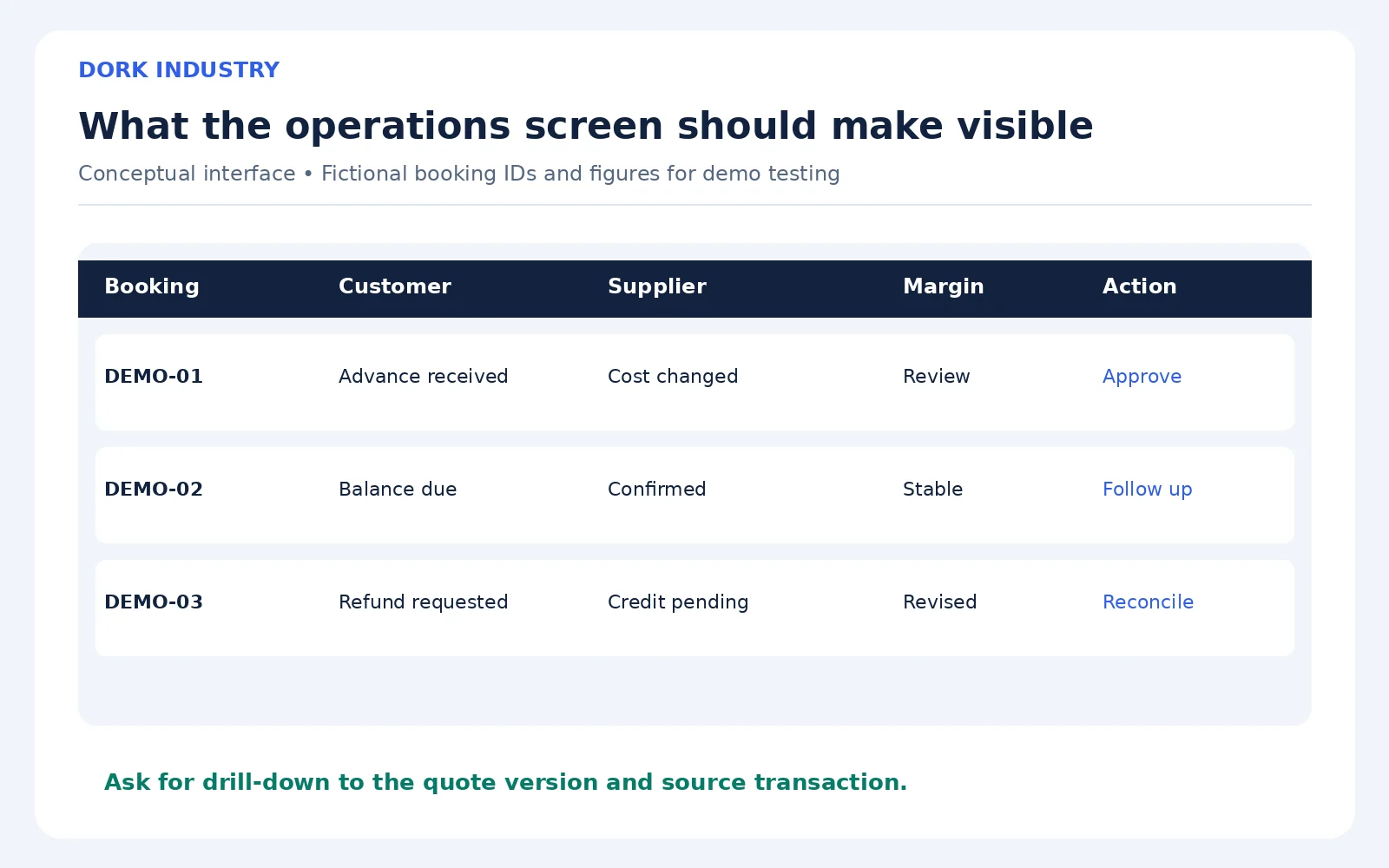
The system should connect the enquiry, quote, booking, supplier commitment and payment record through stable identifiers. Treat a customer payment, a supplier obligation and a profit estimate as different facts. A paid advance does not prove that the booking is profitable or that suppliers are confirmed.
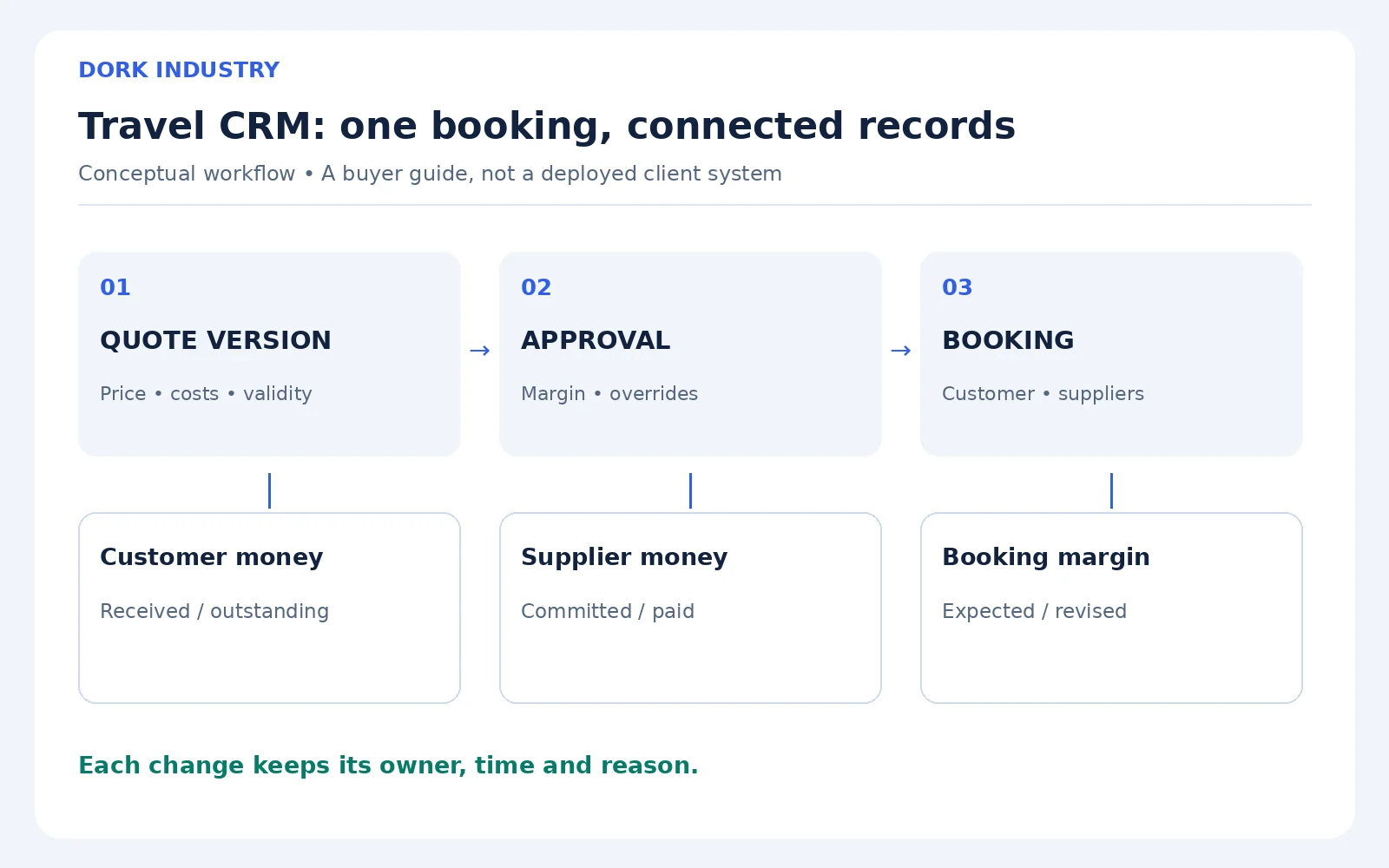
| Record | Required information | Control to demonstrate |
|---|---|---|
| Enquiry | Customer, dates, traveller count, source, owner, next action | Ownership transfer preserves history |
| Quote version | Price, inclusions, direct costs, currency, validity and terms | Accepted version remains recoverable |
| Booking | Accepted quote reference, status, travellers and responsible team | Changes create an amendment trail |
| Supplier commitment | Service, confirmed cost, payment deadline and confirmation reference | Cost changes require review |
| Customer payment | Amount, payment reference, booking allocation and verification status | Duplicate notifications do not duplicate receipts |
| Finance hand-off | Approved invoice data, credits, supplier bills and reconciliation references | Accounting totals can be traced to source records |
Specify how the system handles missing information. A quote may use an estimated supplier cost, but the interface should label it as estimated. Operations should be able to distinguish requested, held and confirmed services. The system must not present those stages as interchangeable.
The technology can be a configurable CRM linked to an ERP, a travel management platform or a custom application. The business rules matter more than the framework name. Microsoft’s ERP overview describes ERP as integrating core business processes. Use that principle to define the finance boundary rather than assume CRM replaces the accounting ledger.
How can a supplier change reduce booking contribution?
Compare the accepted selling price with the latest approved direct costs. Preserve the original estimate so leadership can see the change. For this example, contribution means selling price minus direct booking costs; it is not net company profit.
Illustrative worked example: a fictional booking sells for ₹150,000. Estimated direct costs total ₹120,000. The initial contribution is ₹30,000, or 20% of the selling price. A supplier revision raises costs by ₹9,000. At the same selling price, contribution falls to ₹21,000, or 14%.
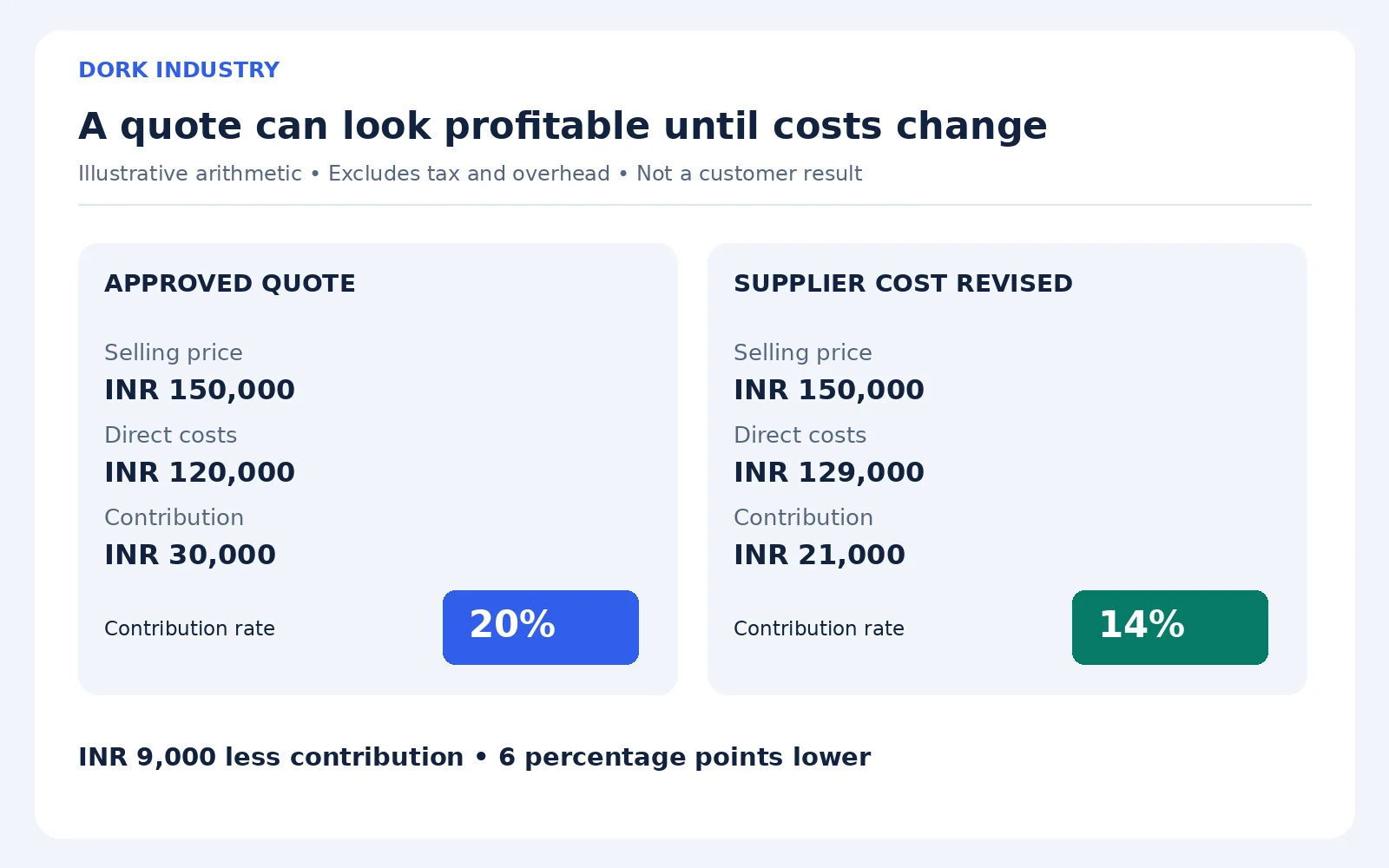
| Measure | Accepted estimate | Revised cost |
|---|---|---|
| Selling price | ₹150,000 | ₹150,000 |
| Direct booking costs | ₹120,000 | ₹129,000 |
| Contribution | ₹30,000 | ₹21,000 |
| Contribution / selling price | 20% | 14% |
| Markup on cost | 25% | Approximately 16.28% |
The reduction is ₹9,000 and six percentage points of contribution rate. Margin on selling price and markup on cost use different denominators. Your software should label the formula so staff do not approve a quote using the wrong percentage.
For multi-currency bookings, store the source currency, rate used, rate date and approved converted value. Keep estimated exposure separate from posted accounting values. Have finance define the treatment of tax, commissions, refunds and exchange differences before development. This article does not prescribe tax rates or revenue-recognition policy.
What should you test before selecting a travel CRM?
Ask each supplier to run the same fictional booking through the following tests. Record evidence from the demonstration, the gap, its owner and the agreed fix. A screenshot of a dashboard is weaker evidence than a transaction you can trace from start to finish.
- Revise a quote. Change the hotel and retain both versions. Pass when the booking references the accepted version and the customer-facing document matches it.
- Change a supplier cost. Use the ₹9,000 revision above. Pass when contribution updates, the original estimate survives and the change owner is visible.
- Apply an approval rule. Set a fictional contribution threshold with the buyer. Pass when an unauthorised user cannot approve an exception and the approver’s reason is retained.
- Record a partial payment. Allocate an advance to the booking. Pass when received money and remaining customer balance remain separate from supplier dues.
- Replay a payment event. Deliver the same test notification twice. Pass when it creates one receipt and a traceable duplicate-handling record.
- Amend after confirmation. Remove one service. Pass when sales, operations and finance can see the amended scope and financial difference.
- Cancel with a pending supplier credit. Pass when customer refund status and supplier recovery status remain separate, with an outstanding exception.
- Transfer the booking to another branch. Pass when ownership changes without losing history or revealing records beyond the agreed role.
- Export and reconcile. Compare the system export with the source quote, supplier bill and payment references. Pass when unexplained differences are listed rather than silently discarded.
Razorpay’s webhook documentation says duplicate events can occur and event order is not guaranteed. Accordingly, payment integrations need duplicate handling and a reconciliation path. The correct design depends on the provider you actually use; this is not a claim that every travel CRM supports Razorpay.
Razorpay’s refund documentation also distinguishes refund states and explains an important processed-state confirmation nuance. Keep the gateway reference and status in your workflow. A customer refund and a supplier credit are separate transactions, even when they arise from the same cancellation.
How should you record the demo evidence?
Copy this worksheet for each candidate. Choose mandatory controls before seeing the product. A failed mandatory control remains unresolved until the supplier demonstrates the fix; a good average should not hide it.
| Scenario | Expected result | Observed evidence | Owner / decision |
|---|---|---|---|
| Changed supplier cost | ₹21,000 contribution; estimate retained | Record during demo | Finance: accept or remediate |
| Duplicate payment event | One allocated receipt | Record during demo | Integration owner |
| Cancellation | Customer refund and supplier credit separate | Record during demo | Operations and finance |
| Data export | Booking-level references and totals recoverable | Record during demo | Implementation owner |
Should you buy a platform, integrate existing tools or build custom software?
Buy a platform when it fits your mandatory workflows with manageable configuration. Integrate when your existing tools are useful but their hand-offs fail. Consider custom development when important rules cannot be configured or reliable integration is unavailable. Compare ownership costs and implementation risks, not only licence prices.
| Route | Useful when | Main question |
|---|---|---|
| Configurable travel platform | Your booking and finance workflow fits its model | Can the demo prove your exception cases? |
| CRM plus accounting integration | Current systems are sound but data hand-offs are weak | Who owns retries, mismatches and support? |
| Custom enterprise application | Distinct rules or multi-entity operations need a tailored model | Can you fund maintenance, testing and change control? |
Request a written cost scope covering migration, integrations, testing, training, hosting, support and future changes. Confirm export rights and how attachments, history and relationships leave the platform. A cheap licence can still require expensive manual reconciliation. Custom development also needs continuing ownership; it is not automatically the best option.
How should a growing agency implement the system?
Start with one complete workflow and a representative pilot team. Define the records and acceptance tests before selecting integrations. Expand after sales, operations and finance agree that the same booking produces consistent results.
- Map the current process. Walk through enquiry, quote, confirmation, amendment and cancellation with the people doing the work.
- Agree the data model. Define customer, traveller, branch, quote version, booking, supplier and payment identifiers.
- Write approval rules. Name who can discount, change a confirmed cost, override a warning or approve a refund.
- Clean migration data. Deduplicate customers, identify open bookings and reconcile opening balances. Preserve the original files.
- Test integrations. Cover duplicates, late events, unavailable services and rejected records. Name an exception owner.
- Pilot and reconcile. Compare outputs with controlled source records. Train each role using its actual tasks.
- Plan cutover and recovery. Agree a freeze window, fallback process and sign-off criteria before moving live operations.
Supplier availability should only be described as live where a verified integration supplies it. Do not assume that connecting a CRM to a portal provides bookable inventory. Document each API’s permissions, limitations, update frequency and commercial agreement.
What should owners measure after implementation?
Measure booking contribution, workflow capacity and exceptions alongside sales activity. Use your own baseline and consistent definitions. A rise in enquiries means little if more accepted bookings still carry unreviewed costs.
- Median time from qualified enquiry to usable quote.
- Accepted quotes requiring correction after confirmation.
- Expected versus revised contribution per booking, using the agreed formula.
- Customer balances overdue and supplier obligations approaching due date.
- Unallocated receipts and unresolved reconciliation differences.
- Manual hand-offs and re-entry effort per booking.
- Bookings handled per team, with quality and exception context.
For content-led enquiries, retain the article source, buyer role, industry and intended software investment when the prospect provides them. Follow consultation requests through qualified opportunities and projects. Search clicks and observed AI referrals are acquisition signals; they are not revenue or proof of business impact.
How can Dork Industry help scope the software investment?
Dork Industry’s ERP solutions service and published custom CRM and ERP project establish a relevant enterprise-software connection. The travel-agency technology consulting page describes workflow and portal planning. These pages do not establish that Dork already offers every feature in this guide.
Bring an anonymised quote, a supplier-cost revision, an amendment and your current software list. Ask Dork Industry to map the workflow and recommend whether configuration, integration or custom development fits. Specific integrations, delivery scope, price and support should be confirmed in a proposal.
If you are shortlisting a partner for this kind of system, see our comparison of the best AI automation company in India, which covers eight providers on delivery, integrations and governance.
Discuss your quote-to-booking workflow
Tell us your team size, branches, current tools and the booking-control problem you need to solve.
Request a Dork Industry software consultation WhatsApp +91 8210792477
Or email your requirements with the article reference. Reference: TRAVEL-CRM-MARGIN-20261001.
Agency CRM: what Delhi travel businesses should shortlist
An agency CRM earns its place when it connects the accepted quote to supplier commitments, payments and booking contribution in one record. For a Delhi travel business, that means one booking identity across sales, operations, suppliers and finance — not a contact list with an itinerary attached.
When comparing travel agency CRM software, test it with a changed-cost booking and a cancellation, not only a polished demo. The demo shows the happy path; the changed booking shows whether your margins survive contact with reality.
Frequently asked questions
What is the difference between travel CRM and ERP?
Travel CRM manages customer enquiries, quotes and follow-ups. ERP links broader operational and finance processes. A growing agency may need both, connected through booking and transaction references. Evaluate the division of responsibility so the two systems do not maintain conflicting versions of the same balance.
Can travel CRM software show profit per booking?
It can show an agreed contribution calculation when selling prices and direct costs are reliable. That is different from net company profit, which also depends on overhead and accounting policy. Require visible formulas, estimated-versus-confirmed costs and a revision trail before relying on the number.
Should a Delhi agency replace all its software at once?
Usually the safer decision is based on a mapped workflow and a controlled pilot. Keep useful tools where integration can solve the problem. Replace systems when mandatory requirements, data quality or support cannot be addressed. Define migration, reconciliation and fallback responsibilities before a full cutover.
How much does an enterprise travel CRM cost?
There is no verified universal price for the scope in this guide. The investment depends on users, branches, migration, integrations, approval rules, hosting and support. Ask for a written scope and ownership-cost comparison. Dork Industry should confirm its proposed work and price after discovery.
What should we bring to a software consultation?
Bring anonymised examples of an accepted quote, a changed supplier cost, a partial payment and a cancellation. Add your software list and the people responsible for each stage. These records make it easier to define acceptance tests without exposing customer identities or relying on a generic feature checklist.
What is travel approval software, and does an agency CRM include it?
Travel approval software routes trip requests through manager and finance approval before booking, usually for corporate travel. A good agency CRM covers the booking side — quotes, supplier rates and contribution — and should connect to the client’s approval record through the bill-to entity and purchase-order reference, rather than replacing the approval workflow itself.