

WordPress website development cost in India commonly ranges from ₹30,000 for a controlled small-business build to ₹6 lakh or more for a custom, integrated corporate platform. A WooCommerce or membership project can exceed ₹10 lakh when catalogue, payment, integration and operational requirements are complex. The useful buying number is first-year ownership cost, not the developer’s headline fee.
This 2026 guide is for founders, marketing teams and procurement managers comparing proposals with different assumptions. The ranges are Dork Industry planning estimates—not fixed quotations—and exclude taxes unless a proposal explicitly includes them.
Last reviewed: 18 October 2026 by the Dork Industry Editorial Team.
WordPress budget answer in 60 seconds
- Essential business site: ₹30,000–₹70,000; normally 2–4 weeks.
- Professional marketing site: ₹80,000–₹2 lakh; normally 4–8 weeks.
- Custom corporate or content platform: ₹2.5–₹6 lakh; normally 8–16 weeks.
- WooCommerce or deeply integrated build: ₹3–₹10 lakh+; normally 10–20 weeks.
How much does WordPress website development cost in India?
A realistic professional range is ₹30,000 to ₹6 lakh for most business websites. Price changes with template count, design originality, editorial workflow, content migration, plugin licensing, hosting, integrations, performance, security and post-launch responsibility. “Ten-page WordPress website” is not enough information to estimate safely.
| WordPress project | Indicative build range | Typical timeline | Best fit |
|---|---|---|---|
| Essential business site | ₹10,000–₹30,000 | 2–4 weeks | Small company with prepared content and standard enquiry flow |
| Professional marketing site | ₹30,000–₹1 lakh | 4–8 weeks | Growth company needing custom sections, conversion paths and analytics |
| Custom corporate platform | ₹2.5–₹6 lakh | 8–16 weeks | Multiple templates, roles, content types, migration and integrations |
| WooCommerce / integrated site | ₹3–₹10 lakh+ | 10–20 weeks | Payments, catalogue, subscriptions, ERP/CRM or operational workflows |
WordPress software is released under the GPL and does not require a WordPress core licence fee. That does not make a production website free: design, engineering, hosting, premium components, content, maintenance and business accountability still cost money. WordPress explains the software licence on its official GPL page.
Why do two WordPress quotes differ by 5×?
The cheapest and most expensive proposal may not describe the same product. One supplier may configure a purchased theme with supplied content. Another may include research, original UX, reusable blocks, migration, forms, CRM handoff, accessibility, technical SEO, performance work, security hardening, staging, recovery testing and 90 days of support.
Ask each supplier to state:
- number of unique page templates and reusable blocks;
- whether design is custom, theme-based or a mixture;
- who writes, edits and uploads content;
- which plugins and licences are required;
- hosting specification and traffic assumption;
- migration records and redirect responsibility;
- forms, integrations and failure handling;
- performance, accessibility and browser tests;
- security, backups, restore testing and updates;
- warranty, maintenance and response commitments.
Until those boundaries match, comparing only totals creates a false saving.
What should a first-year WordPress budget include?
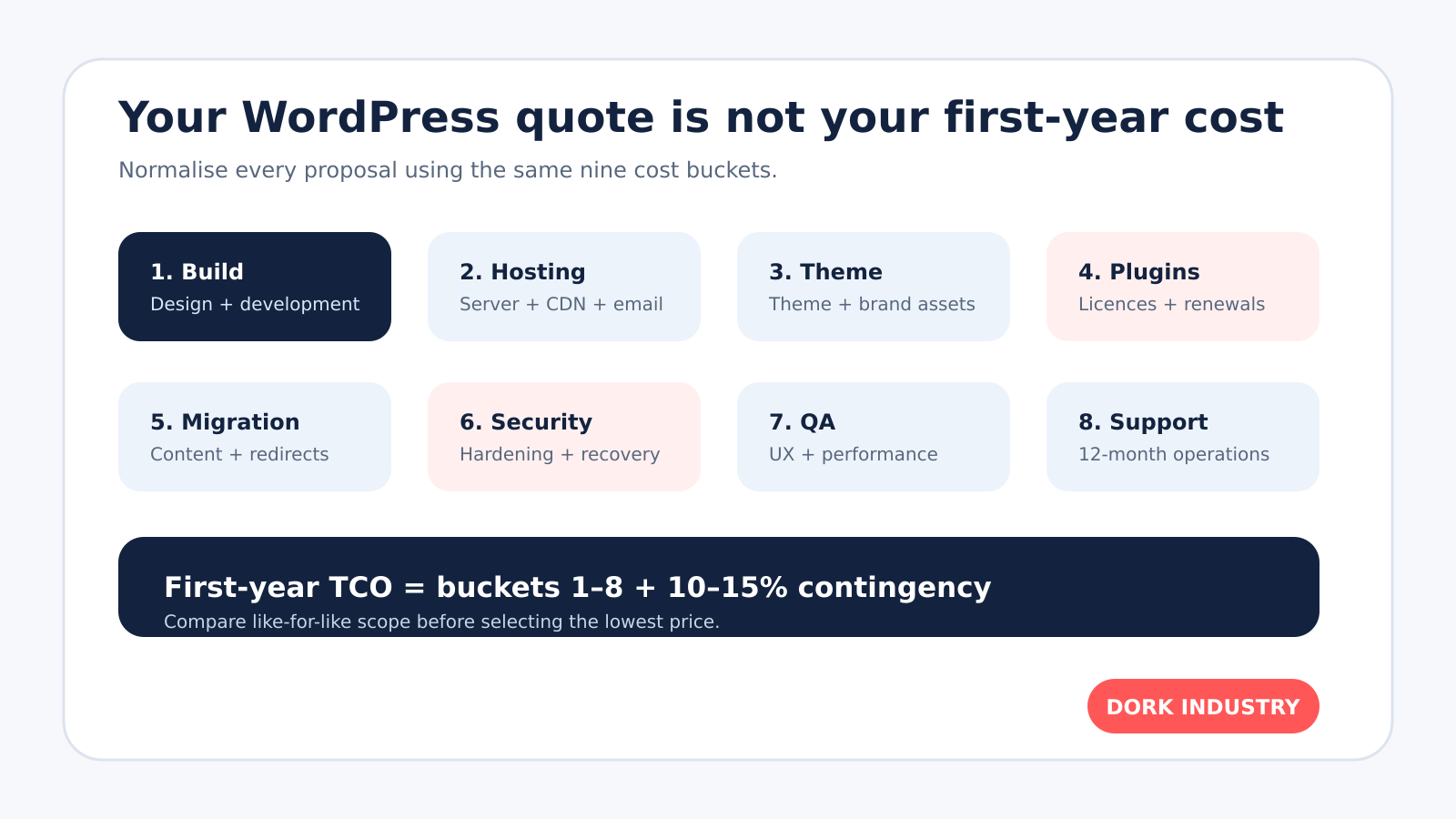
To compare WordPress website development cost in India fairly, use one formula for every proposal:
First-year TCO = build + hosting + theme/assets + plugin licences + migration + security/recovery + QA/training + support + 10–15% contingency.
| Cost bucket | What to verify | Common omission |
|---|---|---|
| Build | Templates, blocks, responsive states and integrations | Mobile variants and revision limits |
| Hosting | Environment, backups, CDN, traffic and support boundary | Renewal price and email delivery |
| Theme and assets | Licence owner, child theme and brand assets | Vendor-controlled licence key |
| Plugins | Annual renewals, purpose, owner and alternatives | Agency licence removed after handover |
| Migration | Pages, media, metadata, redirects and validation | Content cleanup and broken internal links |
| Security and recovery | Access, updates, backups, monitoring and restore test | Backup exists but cannot be restored quickly |
| QA and training | Forms, devices, roles, analytics, SEO and editor training | No written acceptance evidence |
| Support | Warranty, severity, response time and maintenance tasks | Updates treated as unlimited free support |
What recurring WordPress costs should you plan each year?
Annual running cost is part of WordPress website development cost in India because hosting, licences and support continue after launch. The amount depends on traffic, risk and operational complexity. A small service site with standard components may need modest hosting and scheduled maintenance. A revenue-producing WooCommerce or membership platform may need managed infrastructure, active monitoring, staging, premium extensions and a faster incident response.
| Recurring item | Planning question | Decision rule |
|---|---|---|
| Domain and DNS | Who owns renewal and DNS access? | Keep registration in a client-controlled account |
| Hosting | What traffic, storage, backups and support are assumed? | Buy for measured workload and recovery need |
| Premium theme/plugins | Which licences renew and what happens if they lapse? | Retain only components with an owner and clear value |
| Transactional email | Are form and order messages monitored? | Treat delivery as an operational service, not a default assumption |
| Maintenance | Are updates tested, deployed and documented? | Separate planned maintenance from new feature work |
| Monitoring and security | Who receives alerts and responds? | Match response coverage to business impact |
| Content and SEO | Who publishes, reviews quality and measures results? | Fund an internal owner or defined external service |
Do not accept a single “annual maintenance” line without task and response boundaries. One supplier may include only updates; another may include backups, uptime checks, malware response, content hours and performance reviews. These are different services.
Also ask whether licence renewals are billed at the supplier’s cost, marked up, bundled into support or purchased directly by the client. None of those models is automatically wrong, but ownership and exit terms should be visible before signing.
Which requirements increase WordPress website development cost in India?
1. Custom design and template count
Page count is not the main driver. Fifty articles using one template can be simpler than eight pages requiring eight different layouts. Estimate unique templates—home, service, industry, resource, case study, team, archive and contact—then count reusable content blocks and exceptional states.
2. Content preparation and migration
A redesign often exposes weak source content: outdated claims, inconsistent formatting, uncompressed images, missing metadata and broken links. A migration quote should define records, transformation rules, redirects and validation. “Move all content” is not measurable.
For a high-risk migration, require a trial batch and a report showing expected, imported, skipped and failed items. Priority URLs need individual redirect checks; redirecting everything to the home page protects neither users nor search performance.
3. Custom post types and editorial workflow
Case studies, resources, locations, team profiles, products and industry pages should be modelled as structured content when editors need consistency. Custom fields, validation, preview states, permissions and approval workflow cost more initially but reduce long-term publishing errors.
4. Plugin selection and licensing
Plugins shorten delivery when they are well supported and appropriately scoped. They increase risk when five plugins solve one job, a licence belongs to the developer, or updates are never tested. The proposal should list every premium theme and plugin, renewal frequency, account owner and exit path.
WordPress’s own security guidance advises using trusted sources for themes and plugins. Avoid “nulled” commercial components; a low one-time price can create ownership, update and security problems.
5. Hosting and traffic profile
Hosting should match workload, not a generic package label. A brochure site, membership platform, news publisher and WooCommerce store have different database, cache, background-job and traffic patterns. WordPress currently recommends PHP 8.3+, MariaDB 10.11+ or MySQL 8.0+, and HTTPS support in its official hosting requirements.
Ask who owns DNS, SSL, CDN, backups, transactional email, monitoring and incident escalation. A website may be “online” while enquiry emails fail or editors cannot publish reliably.
6. Forms, CRM and third-party integrations
A contact form is inexpensive; a reliable lead workflow is not always. Define spam controls, consent, routing, field validation, notification delivery, CRM acknowledgement, retry behaviour and audit trail. Dork Industry covers that narrower workflow in its guide to WordPress and CRM integration; this article keeps the broader cost decision separate.
7. WooCommerce and transactional workflows
WooCommerce adds catalogue, payment, tax, shipping, inventory, refund and email states. Subscriptions, bookings, marketplaces, memberships and ERP sync add more. The budget should include failure paths—not only the successful checkout demo.
If checkout or payment configuration is the immediate problem, use Dork Industry’s technical guides for missing WooCommerce payment methods and failed subscription renewals rather than treating them as generic design issues.
8. Performance, accessibility and technical SEO
Performance requires choices across hosting, images, fonts, themes, plugins, caching, database and third-party scripts. WordPress documents these layers in its official optimisation handbook. A proposal should define tested page types, devices and target conditions instead of promising a perfect score under unspecified circumstances.
Accessibility and technical SEO should be designed into components. Retrofitting labels, focus states, heading order, structured content and template metadata after launch is slower and less consistent.
What do four realistic WordPress budgets look like?
Scenario A: local professional-services company
The company needs five service pages, team profiles, resources, contact forms and local trust signals. Content and branding are ready.
- Likely tier: essential to lower professional range.
- Main work: information architecture, reusable service template, responsive build, forms, analytics and editor training.
- Main risk: buying a large design package before finalising positioning and proof.
- Cost control: one flexible page system with clear editorial rules.
Scenario B: manufacturer with distributors and technical resources
The manufacturer needs product families, specification downloads, distributor enquiries, case studies and multilingual-ready content. Leads must route by product and region.
- Likely tier: professional to custom corporate.
- Main work: content modelling, filtered resources, role-based routing, CRM handoff and reporting.
- Main risk: treating products as manually designed pages that become impossible to maintain.
- Cost control: structured content types and one validated lead-routing model.
Scenario C: publisher migrating 3,000 articles
The publisher has legacy categories, authors, images, embedded media, search traffic and editorial roles.
- Likely tier: custom corporate platform.
- Main work: data mapping, trial migration, author and taxonomy reconciliation, redirects, search, performance and editorial acceptance.
- Main risk: migration completeness and search loss, not visual design.
- Cost control: prioritise high-value content, automate validation and freeze source changes before cutover.
Scenario D: WooCommerce catalogue with ERP stock sync
The store needs thousands of variants, online payment, COD, warehouse fulfilment and inventory exchange with ERP.
- Likely tier: integrated WooCommerce.
- Main work: catalogue transformation, checkout, payment and shipping rules, idempotent integration, reconciliation and monitoring.
- Main risk: duplicate orders, stale stock and no recovery ownership.
- Cost control: pilot one catalogue segment and define the system of record before coding.
Freelancer, agency or in-house team: which is cheaper?
| Delivery model | Strongest use | Hidden cost | Control to require |
|---|---|---|---|
| Freelancer | Small build or focused specialist task | Single-person dependency | Client-owned hosting, repository, licences and documentation |
| Agency | Coordinated strategy, design, migration, engineering and QA | Change requests after shallow discovery | Deliverable inventory, milestones and acceptance tests |
| In-house | Continuous product and publishing roadmap | Hiring and underused specialist capacity | Clear product owner and release process |
| Hybrid | Internal owner with external specialists | Unclear accountability | One backlog, release owner and support matrix |
Choose for scope, not prestige. A specialist freelancer can outperform an agency on a defined plugin task; a coordinated team is safer for migration, custom content modelling, integrations and launch governance.
How should you compare two WordPress proposals?
The safest way to compare WordPress website development cost in India is to normalise each quote against the same scope, ownership and evidence fields.
| Comparison field | Proposal A | Proposal B | Required evidence |
|---|---|---|---|
| Templates and blocks | Record count | Record count | Annotated sitemap and component inventory |
| Content and migration | Records/rules | Records/rules | Sample migration and redirect map |
| Theme/plugins | ₹ annual | ₹ annual | Licence owner and renewal list |
| Hosting | Specification | Specification | Traffic assumption, backups and support boundary |
| Security/recovery | Controls | Controls | Update, backup and restore procedure |
| Performance | Targets | Targets | Test pages, devices and conditions |
| Ownership | Named owner | Named owner | Domain, hosting, repository and admin handover |
| Support | Days/SLA | Days/SLA | Severity and response matrix |
| First-year TCO | ₹ total | ₹ total | All one-time and recurring costs |
This worksheet prevents a ₹40,000 build with ₹90,000 of excluded work from appearing cheaper than a complete ₹1.1 lakh proposal.
What acceptance tests belong in the price?
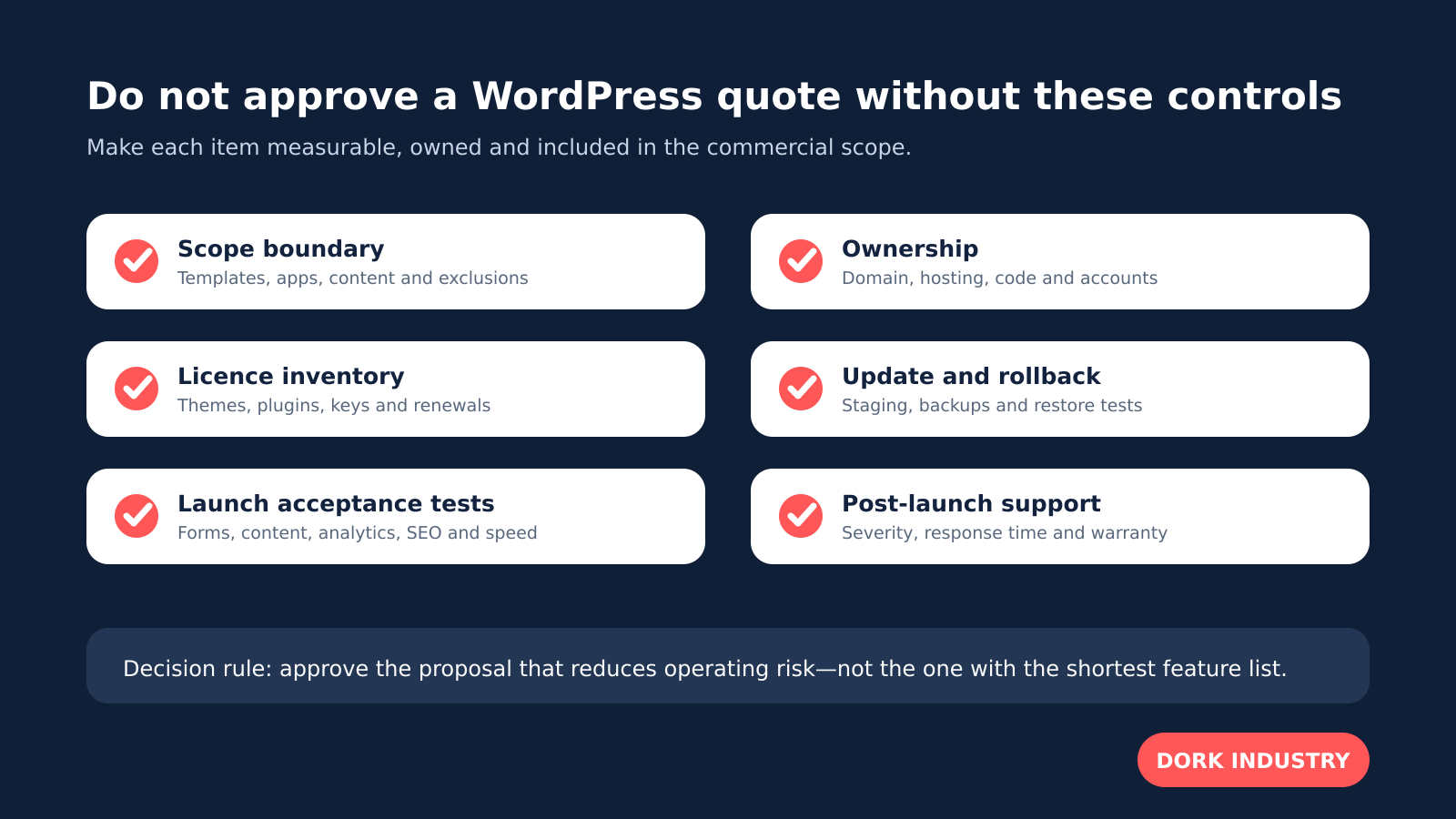
- Ownership: client controls domain, hosting, administrator accounts, repository and licence records.
- Content: approved pages, links, media, metadata and responsive states are complete.
- Forms: successful, invalid, duplicate and spam submissions are tested; delivery is verified.
- Roles: each editor can perform required tasks without unnecessary administrator access.
- SEO: titles, descriptions, canonicals, robots rules, sitemap and redirects are checked.
- Analytics: consent and agreed conversion events appear in the correct property.
- Performance: representative templates are tested on agreed mobile and desktop conditions.
- Updates: theme and plugin changes are tested on staging with a rollback path.
- Recovery: a backup is restored in a controlled test, not merely shown in a dashboard.
- Handover: licences, credentials, documentation, training and support contacts are complete.
Why must security and maintenance be priced?
WordPress maintenance is an operating responsibility, not a one-time plugin installation. The official WordPress hardening handbook describes updates, trusted sources, permissions, backups, monitoring and access controls. It also frames security as risk reduction rather than a perfect permanent state.
A maintenance agreement should name:
- core, theme and plugin update cadence;
- staging and compatibility-test process;
- backup schedule, retention and restore testing;
- uptime, error and security monitoring;
- administrator and vendor access review;
- incident severity and response target;
- content changes included or excluded;
- responsibility when a third-party licence expires.
A backup that has never been restored is only an assumption. An update process without staging can turn routine maintenance into downtime.
How do you judge whether a WordPress website can pay back?
A website investment should connect to measurable commercial or operating outcomes. Page views alone do not prove value. Select a small scorecard before the redesign changes the baseline:
- qualified enquiries and enquiry-to-opportunity rate;
- organic landing-page conversions;
- form completion and form-delivery success;
- sales response time after an enquiry;
- content publishing time and approval effort;
- support questions answered by self-service content;
- revenue or pipeline influenced by website sessions;
- maintenance incidents and recovery time.
A simple financial model is:
Annual net benefit = added contribution from website-generated business + avoided operating cost − annual hosting, licence and maintenance cost.
Payback period = total implementation investment ÷ average monthly net benefit.
Use contribution rather than headline revenue. A lead that never receives a response has no realised value, and an ecommerce sale can lose money after discounts, payment charges, fulfilment and returns. Assign one owner to each metric and define how the website contributes without claiming every sale as an SEO result.
For an enquiry-led business, the fastest improvement may be better proof, clearer service pages and reliable lead routing rather than a large visual rebuild. For a publisher, search retention and editorial speed may matter more. For WooCommerce, checkout completion, stock accuracy and fulfilment time may dominate. The technology scope should follow the economic constraint.
How can you reduce WordPress cost safely?
- Fix the conversion journey first: decide what action each visitor should take.
- Prepare content before development: late copy changes cause layout and approval rework.
- Use reusable blocks: avoid designing every page independently.
- Limit plugins: require one owner, purpose, annual cost and removal path for each.
- Prioritise integrations: launch only those needed for the first measurable business outcome.
- Approve one design system: control inconsistent late-stage styling requests.
- Train internal editors: reduce dependence for routine publishing.
- Fund maintenance: planned care is usually cheaper than emergency recovery.
When should you not start the WordPress build?
Pause when the organisation has not agreed its audience, offer, proof, content owner or enquiry workflow. A new theme cannot resolve unclear positioning. Similarly, do not begin a migration without an inventory of source URLs, content types, integrations and ownership.
If platform choice is still undecided, compare business workflows first. WordPress is strong for content-led sites and extensible business experiences, but a hosted commerce platform or custom application may be more appropriate for some operating models.
What should final budget approval contain?
Final approval for WordPress website development cost in India should show the buying committee exactly what is included now, what renews later and how the finished website will be accepted.
- business goal, audience and baseline metric;
- sitemap, templates, blocks and content responsibilities;
- hosting, theme, plugin and integration decisions;
- migration inventory and redirect plan;
- one-time and recurring first-year costs;
- milestones, dependencies and client approvals;
- acceptance tests and launch rollback;
- ownership, documentation, warranty and maintenance.
Dork Industry provides WordPress development services for business websites, structured content, integrations, migrations and ongoing engineering. Its separate Delhi web-development cost guide covers the broader agency market; this page focuses specifically on the WordPress ownership and operating model.
Need a scope-based WordPress estimate?
Bring your sitemap, content status, current URL, integrations, traffic pattern and target launch date. Dork Industry can map the build, recurring costs, risks and phased delivery options.
Frequently asked questions about WordPress website development cost in India
What is the minimum WordPress website development cost in India?
A controlled professional business site can begin around ₹30,000 when content is ready and requirements are standard. Very small setup work may cost less, but confirm mobile quality, ownership, forms, analytics, backups and support before comparing it with a complete build.
How much does a custom WordPress website cost?
A professional marketing site commonly costs ₹80,000–₹2 lakh. A custom corporate or content platform can range from ₹2.5–₹6 lakh, while WooCommerce and integrated builds often start around ₹3 lakh and can exceed ₹10 lakh.
Is WordPress free?
The WordPress core software is open source under the GPL. A production website still requires domain, hosting, design, development, content, licences where applicable, security, maintenance and support.
Does the development price include hosting?
Not automatically. Some proposals include the first year; others do not. Record the hosting owner, specification, renewal cost, backups, CDN, email delivery and technical-support boundary.
How long does WordPress development take?
An essential business site may take 2–4 weeks. A professional marketing site usually needs 4–8 weeks, while custom platforms, migrations and WooCommerce integrations can require 8–20 weeks or more.
Which hidden WordPress costs are most common?
Frequent omissions include premium plugin renewals, hosting upgrades, content cleanup, migration exceptions, transactional email, accessibility work, performance optimisation, backup recovery, analytics, SEO redirects and post-launch maintenance.
Should the developer own the hosting and licences?
The client should normally control the domain, hosting, administrator accounts and paid licences. Suppliers can receive delegated access. This reduces lock-in and makes support transitions safer.
How do I obtain an accurate WordPress quotation?
Provide the sitemap, template types, content status, migration volume, required forms, integrations, editor roles, traffic expectations and launch date. Ask every supplier to disclose assumptions, exclusions, annual renewals, ownership and measurable acceptance tests.
Pricing note: Dork Industry ranges are planning estimates as of 18 October 2026. A binding quotation requires discovery and confirmed scope. Third-party hosting, theme and plugin prices can change; verify live supplier terms before purchase.
Before you sign a quote, see our comparison of the best AI automation company in India.
Planning a budget for this?
Book a free consultation — we scope the requirements, outline the cost drivers, and give you an honest estimate range before any development is discussed.

[…] Theme code rarely controls the core hosted payment-method list, but custom carts, checkout extensions, payment customizations and apps can influence the journey or eligibility. If the cart itself is broken, use the Shopify Add to Cart repair guide. If a promotion changes the outcome, compare the Shopify discount diagnosis. […]