
IoT development for cold storage works — yes, it can predict a chamber’s temperature drift hours before a compressor failure, but only if it is built around the people who open the doors, not just the sensors on the wall. A cold store does not fail the way other equipment fails. A conveyor belt breaks loudly and stops; a refrigeration chamber fails quietly, degree by degree, while the product sits inside it. The most expensive failures — the overnight excursion that writes off a batch, the compressor that dies on a Sunday — are preceded by weeks of small signals nobody was watching. This article examines whether IoT development can catch those signals: what it must do, what data it needs, what it must never do alone, and how to test the idea in one chamber for 30 days before committing.
The core question is not “can we put sensors in the freezer?” — it is whether IoT development can give you temperature you trust, alerts that reach the right person, and a record that stands up to an audit or a shipment dispute.
Where does a cold store actually lose money?
Before discussing technology, name the specific leaks. In our experience with cold-chain businesses, the expensive problems are rarely the electricity bill. They are the events nobody noticed until it was too late.
Why do temperature excursions destroy product value?
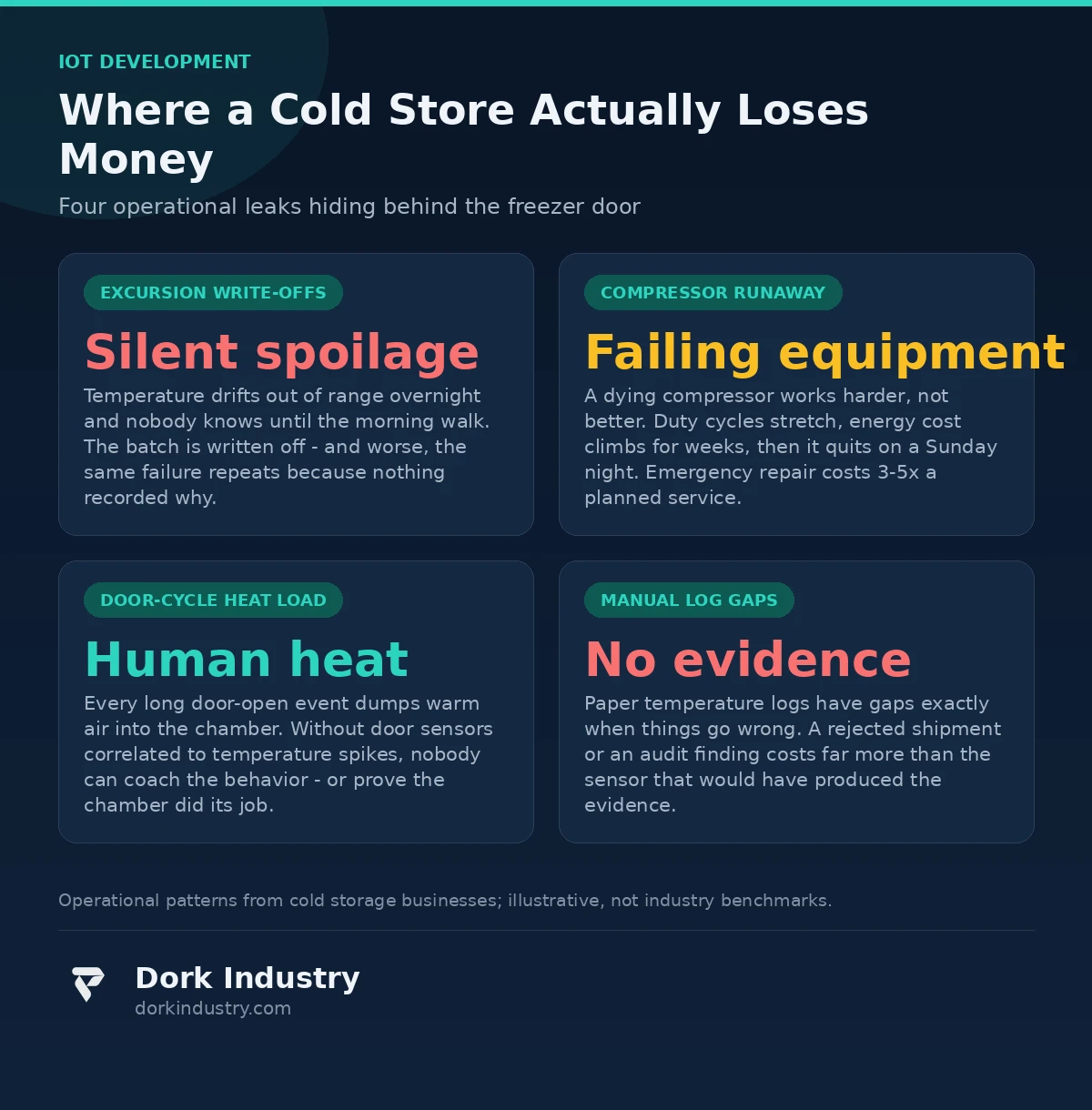
A chamber drifting out of its setpoint range for a few hours — an “excursion” — can degrade or ruin temperature-sensitive goods: dairy, seafood, pharmaceuticals, vaccines. The excursion often happens overnight or between manual checks. By the morning walk-through, the product is already compromised, and the batch gets written off. Worse, nothing recorded why it happened, so the same failure repeats.
Why does a failing compressor cost 3–5x more than a planned service?
A dying compressor does not simply stop; it works harder and less efficiently for weeks. Duty cycles stretch, pull-down times grow, and energy consumption climbs — all invisible without instrumentation. Then it quits at the worst possible moment: a weekend, a full chamber, a loaded shipment scheduled for Monday morning. Emergency callouts, temporary cooling, and the spoiled stock together dwarf the cost of a planned replacement.
Why do door-open events matter more than the thermostat setting?
Every long door-open event dumps warm, humid air into the chamber, and the chamber then works overtime to recover. In busy loading periods this heat load dominates the chamber’s energy use. Without door sensors correlated to temperature spikes, nobody can coach the behavior — and nobody can prove the chamber held temperature during a dispute.
Why are manual temperature logs a liability?
Paper and clipboard logs have gaps precisely when things go wrong — the night shift, the busy afternoon, the holiday weekend. According to the FDA’s final rule on the sanitary transportation of human and animal food, parties across the chain carry defined responsibilities for maintaining adequate temperature control, and records are central to showing it. The pharmaceutical side sets the same expectation: according to the CDC’s vaccine storage and handling guidance, temperature-sensitive products demand continuous monitoring with calibrated devices — clipboard spot-checks do not meet the bar. A rejected shipment or an audit finding costs far more than the sensor that would have produced the evidence.
Why do cold stores fail silently?
Cold stores fail silently because every layer of their monitoring is built for compliance theater, not for early warning. Understanding why the failure is invisible is what separates a useful IoT development project from an expensive gadget.
How does compressor degradation hide in plain sight?
The refrigeration cycle degrades gradually: refrigerant leaks slowly, coils foul, insulation ages. Each change is small, and the thermostat still reaches setpoint — it just runs longer to get there. A human reading a wall display sees “−18°C” and moves on. The trend lives in duty cycles and power draw, which manual logs never capture. This is exactly the signal IoT development is designed to extract: not the temperature reading, but the trajectory of the equipment behind it.
Why is a single wall sensor dangerously misleading?
One sensor near the door reads warm every time the door opens; one near the evaporator reads cold even when the far corner is drifting. A single-point reading cannot represent a 5,000-square-foot chamber. Proper IoT development places sensors where the physics demands: air temperature at product height in multiple zones, evaporator return air, door contacts, and compressor power or pressure where it matters.
Why does the data your store already collects never reach the decision-maker?
Most cold stores already generate raw material: thermostat displays, energy bills showing unexplained spikes, the morning walk’s handwritten readings, maintenance invoices. The data exists but is fragmented, un-timestamped, and owned by no single record. When the compressor finally dies, nobody can reconstruct the three weeks of warning signs.
What data does your cold store already have — and what is it missing?
Your store is already instrumented, just not connected. The energy meter shows the compressor’s growing appetite. The logbook shows when excursions were noticed — not when they started. What is missing is continuity: a timestamped, tamper-resistant record that ties temperature, door events, and equipment behavior together. IoT development does not ask your staff to do new work; it captures the work the equipment already does, in a form the owner can act on.

Where sensor programs fail is familiar from our work on facility and operations software: the dashboard is designed for the owner while data collection is painful for the shift staff. Alerts that fire to a group chat at 2 AM get muted within a week. If the people who must act on the data do not trust it and cannot reach it easily, the system degrades into decoration. The same lesson applies to multi-location operations more broadly — see our breakdown of how centralized visibility changes owner control across locations.
What must IoT development deliver for a cold store?
A temperature-monitoring “app” with a chart is not the answer. An IoT development program that actually prevents spoilage needs five capabilities, each concrete:
How should the chamber be sensed?
- Calibrated air-temperature sensors at product height in at least two zones per chamber — never a single wall point
- Door contacts on every chamber door, time-stamping every open/close event
- Compressor duty-cycle and power-draw sensing, so degradation shows up as a trend, not a surprise
- Humidity sensing where condensation or frost buildup is the failure mode, and defrost-cycle logging tied to it
- Battery-backed or locally buffered loggers, so a network outage does not create a blind gap in the record
How should alerts work?
- Threshold alerts on temperature with product-specific bands — dairy, pharma, and frozen foods have different excursion tolerances
- Rate-of-change alerts: a chamber climbing 1.5°C per hour is failing, even before it crosses the threshold
- Door-open-duration alerts that distinguish a loading event from a door left ajar overnight
- Escalation routing: the alert reaches the shift lead by name, then escalates after N minutes of silence — never a muted group chat
What counts as predictive maintenance?
- Compressor duty-cycle trending: a compressor running 70% duty today that ran 45% three months ago is degrading
- Pull-down time after door events: slowing recovery is an early sign of fouling or refrigerant loss
- Energy-per-degree-day analysis: separating “the weather got hotter” from “the equipment got worse”
- Maintenance ticketing tied to the trend: the system books the service visit before the breakdown, not after
How is compliance evidence produced?
- Continuous, tamper-resistant temperature records exportable for audits and customer disputes
- Excursion reports with start, duration, peak deviation, probable cause, and corrective action — aligned with requirements such as the FDA’s sanitary transportation rule
- According to the Global Cold Chain Alliance, the industry’s trade body, documented best practices across the cold chain increasingly expect exactly this kind of continuous evidence — not clipboard spot-checks
What does the owner see every morning?
- Every chamber’s status: in range, in warning, in excursion — in one view
- Overnight events: excursions, long door-opens, compressor anomalies, with who responded and how fast
- Energy trend per chamber against the same period last month
What does the math look like? An illustrative example
Consider a mid-size cold store: 4 chambers holding frozen seafood with a combined inventory value of ₹4 crore. Assume one temperature excursion per quarter that goes unnoticed for 6 hours, and that roughly one-third of each affected batch must be written off — an illustrative loss of about ₹25 lakh per year in direct write-offs. These are stated assumptions, not industry benchmarks.
Now add the compressor side. An emergency compressor replacement with temporary cooling and overtime typically runs 3–5x a planned service. If one unplanned failure every two years costs ₹12 lakh all-in versus a ₹3 lakh planned replacement, the avoidable premium is about ₹9 lakh every two years — ₹4.5 lakh annualized — before counting spoiled product in the failed chamber.
Against that, a chamber-level sensor program with alerting and analytics typically costs a fraction of one year’s write-off losses. The break-even question is not “can we afford the sensors?” — it is “can we afford one more year of blind chambers?”
Should you build or buy? An honest breakdown
Not every cold store needs custom IoT development. The honest options, in order of investment:
| Approach | Best for | Relative investment | Where it breaks |
|---|---|---|---|
| Standalone data loggers | Audit evidence and excursion records only | Minimal | No alerts, no prediction, nobody is told while it is happening |
| SaaS cold-chain platform | Standard alerting and reporting across chambers | Low subscription | Cannot model unusual chamber layouts or integrate legacy BMS |
| BMS/SCADA integration | Sites with existing building automation | Medium | Built for control, not for spoilage analytics; alert routing is weak |
| Custom IoT development | Predictive maintenance, multi-site evidence, ERP integration | Highest | Overkill for a single standard chamber with simple alerting needs |
At Dork Industry, we regularly advise cold stores against custom builds when a packaged platform covers their needs — including pointing businesses to established approaches like the ones surveyed in our guide to cold storage temperature monitoring with IoT controls. A credible IoT development partner should be willing to tell you that you do not need custom development.
What should the system never do alone?
IoT boundaries matter as much as sensors — especially where automation starts making decisions about product and people.
- Never auto-adjust chamber setpoints. A system that “optimizes” the setpoint without human sign-off can push product out of its safe band. Recommend; never act.
- Never auto-shut or restart the compressor. Control logic belongs in the refrigeration controller and the hands of a technician. The monitoring system watches and alerts; it does not touch the equipment.
- Never silence or auto-resolve alerts. An alert that clears itself because the temperature recovered erases the excursion record. Every excursion gets a human acknowledgment and a logged corrective action.
- Never auto-reject or auto-approve a shipment. The system can assemble the temperature evidence for a disputed load, but the accept/reject call is a human commercial decision.
- Never use staff-tracking to punish. Door-open analytics are for coaching workflows and fixing procedures — not for penalizing the loader who took 40 seconds longer. Surveillance destroys the trust the alerting system depends on.
How do you test it in 30 days before full investment?
The lowest-risk path is a single-chamber pilot with fixed scope and measurable outcomes:
- One chamber, one product type, one shift pattern
- Calibrated sensors (two air points, door contact, compressor power tap) alongside the existing manual log
- Alerts routed to the shift lead by name; escalation after 15 unacknowledged minutes
- Run for 30 days
- Measure: excursions caught vs the manual log, median alert-to-response time, compressor duty-cycle trend, energy per degree-day
If the pilot does not catch at least one event the manual log missed, a bigger investment will not fix it either. The pilot validates the workflow, not just the hardware.

What actually drives the cost of cold-chain IoT development?
IoT development pricing varies widely because scope does. The real cost drivers are:
- Chambers and zones: a single walk-in vs a 12-chamber distribution facility changes the sensor count and the data model significantly
- Sensor types and calibration: consumer-grade probes vs calibrated food-safety-grade sensors with traceable certificates — audits accept the latter
- Alerting and escalation logic: simple threshold SMS vs multi-level escalation with on-call rotation and acknowledgment tracking
- Integration: standalone monitoring vs ties into ERP, maintenance ticketing, and customer shipment-evidence portals
- Connectivity: existing Wi-Fi vs LoRaWAN or cellular gateways for sites where the freezer kills radio signal
- Analytics depth: excursion reports vs duty-cycle trend modeling and predictive maintenance
Frequently asked questions
Can IoT development really predict a compressor failure?
It can predict the conditions that precede failure: lengthening duty cycles, slowing pull-down after door events, and rising energy per degree of cooling. These trends develop over weeks. What no system can do is name the exact day a compressor seizes — treat the output as a maintenance signal, not a prophecy.
How many sensors does a cold chamber need?
A practical minimum: two air-temperature points at product height in different zones, one door contact, and a compressor power or duty-cycle tap. The physics of airflow decides the count, not the sensor vendor.
Will the system work if the internet goes down?
It must. A cold store’s most dangerous hours are exactly when infrastructure fails. Loggers should buffer readings locally and forward them when connectivity returns. Ask any vendor what happens to the record during a 6-hour outage — if the answer is vague, walk away.
Can sensors replace manual temperature logs?
Yes, for evidence purposes — a calibrated, continuous, tamper-resistant record is stronger evidence than spot checks. But run the manual log alongside the sensors for the first 30 days. The comparison period is what builds staff trust and catches sensor misplacement before it matters.
What does a cold-chain IoT pilot cost?
A single-chamber pilot — sensors, gateway, alerting, and a 30-day evidence report — is a fraction of a full rollout and of one year’s excursion losses. The pilot’s job is to prove the workflow catches failures before you scale it. Request a cold-chain monitoring assessment for a concrete estimate scoped to your chamber count.
About Dork Industry
Dork Industry (dorkindustry.com) is a custom software development company building mobile apps, AI automation, and IoT systems for businesses across India. Our team designs cold-chain monitoring, gym management platforms, and industrial IoT — from 30-day pilots to multi-site rollouts.
The bottom line
The question is not whether a cold store needs IoT development. It is whether the owner can see — from one screen — which chamber drifted overnight, which compressor is working too hard, which door is open too long, and who responded.
Running a cold store and want to know what continuous monitoring would change in your specific operation?
We map your chambers, product types, and current logging process and show you what IoT development would — and would not — fix.
Request a cold-chain monitoring assessment WhatsApp +91 8210792477