
A cold storage temperature monitoring system should detect a meaningful excursion, preserve readings during an internet outage and route an actionable alert to a named person. A sensor plus a mobile dashboard is not enough. The business needs defined thresholds, device-health monitoring, escalation, an evidence trail and a tested human response.

Contents
Why can a cold room record data but still miss an excursion?
Common gaps sit between the measurement and the response: one sensor does not represent every zone, a gateway goes offline silently, a threshold creates repeated noise, the first recipient is unavailable, or nobody records what happened after acknowledgement. The result is an incomplete operational record and a late decision about affected stock.
The National Centre for Cold-chain Development’s engineering guidelines describe strategically placed IoT sensors, remote monitoring of temperature and humidity, and alerts when parameters cross predefined thresholds. The same guidance makes the implementation lesson clear: sensors, connectivity and response logic must work together. Read the NCCD engineering guidelines.
Which nine controls should a cold storage temperature monitoring system include?
| Control | Question to answer | Evidence before go-live |
|---|---|---|
| 1. Approved thresholds | Who sets limits and delay per room or product? | signed configuration sheet |
| 2. Sensor placement | Which warm, cold and airflow zones are represented? | placement map and mapping rationale |
| 3. Sensor identity | Can each reading be tied to a device and calibration record? | asset register |
| 4. Offline continuity | What happens when internet or cloud access fails? | buffer-and-replay test |
| 5. Context signals | Are door, power and refrigeration events visible? | correlated event timeline |
| 6. Escalation | Who receives, acknowledges and owns the alert? | route and response matrix |
| 7. Noise control | How are delay, hysteresis and duplicate alerts handled? | approved alert rules |
| 8. Audit trail | Are changes, acknowledgements and actions recorded? | exportable incident history |
| 9. Failure testing | Has each credible failure been simulated? | signed acceptance test |
1. Set thresholds from the operating requirement—not from a generic template
Record the approved upper and lower limits, the permitted duration outside them, the responsible approver and the action expected. Requirements may differ by room, product and process. Technology should enforce the approved rule; it should not invent a storage specification.
2. Map zones before choosing sensor count
Doorways, evaporators, high racks and restricted airflow can behave differently. Create a room map, identify the operational zones that matter and document why each sensor is placed where it is. A single convenient wall location may create a tidy dashboard without representing the stored product environment.
3. Treat every sensor as a managed asset
Store the device ID, room, position, installation date, calibration status, battery or power state and maintenance owner. If a sensor disconnects, the system must report missing evidence rather than display the last value as if it were current.
4. Design for an internet outage
The edge gateway should timestamp and buffer readings locally, report connectivity state and replay data after service returns. Define how operators receive an on-site warning when the cloud route is unavailable. Test the exact behaviour instead of assuming a mobile network or Wi-Fi connection will always exist.
5. Add the context needed to investigate
Temperature alone may not explain the event. Door-open, power, compressor or refrigeration-controller signals can create a usable timeline. Integrate only signals that support a defined operational decision; collecting every available point increases complexity without automatically improving response.
6. Escalate until a responsible person acknowledges
Define the first recipient, acknowledgement window, backup contact and final escalation. A delivery receipt is not the same as an operational response. Keep the incident open until a person records the inspection and next action.
Planning a pilot for one cold room or warehouse?
Share the room layout, approved operating limits, current sensors/controllers, connectivity constraints, alert recipients and systems that need data. Dork Industry can scope an IoT proof of concept covering device integration, edge buffering, dashboards, alerts and authorised integrations.
7. Reduce noise without hiding a real incident
Use an approved delay, hysteresis, deduplication and maintenance mode. Document every suppression rule. Operators who receive repetitive non-actionable messages may miss the one that matters, but overly broad suppression can hide a genuine excursion.
8. Keep an evidence trail that other systems can use
Preserve raw readings, device-health events, configuration changes, alert delivery, acknowledgement and operator notes with consistent timestamps. Where appropriate, integrate incident data with an ERP, warehouse system, maintenance workflow or reporting tool instead of forcing duplicate manual entry.
9. Test failures before production
Run controlled tests for threshold breach, door open, sensor disconnect, gateway offline, power loss, acknowledgement and non-response. Do not test by risking stored goods. Use a safe pilot environment or a controlled simulation and record expected versus actual behaviour.
What should happen between a sensor reading and human action?
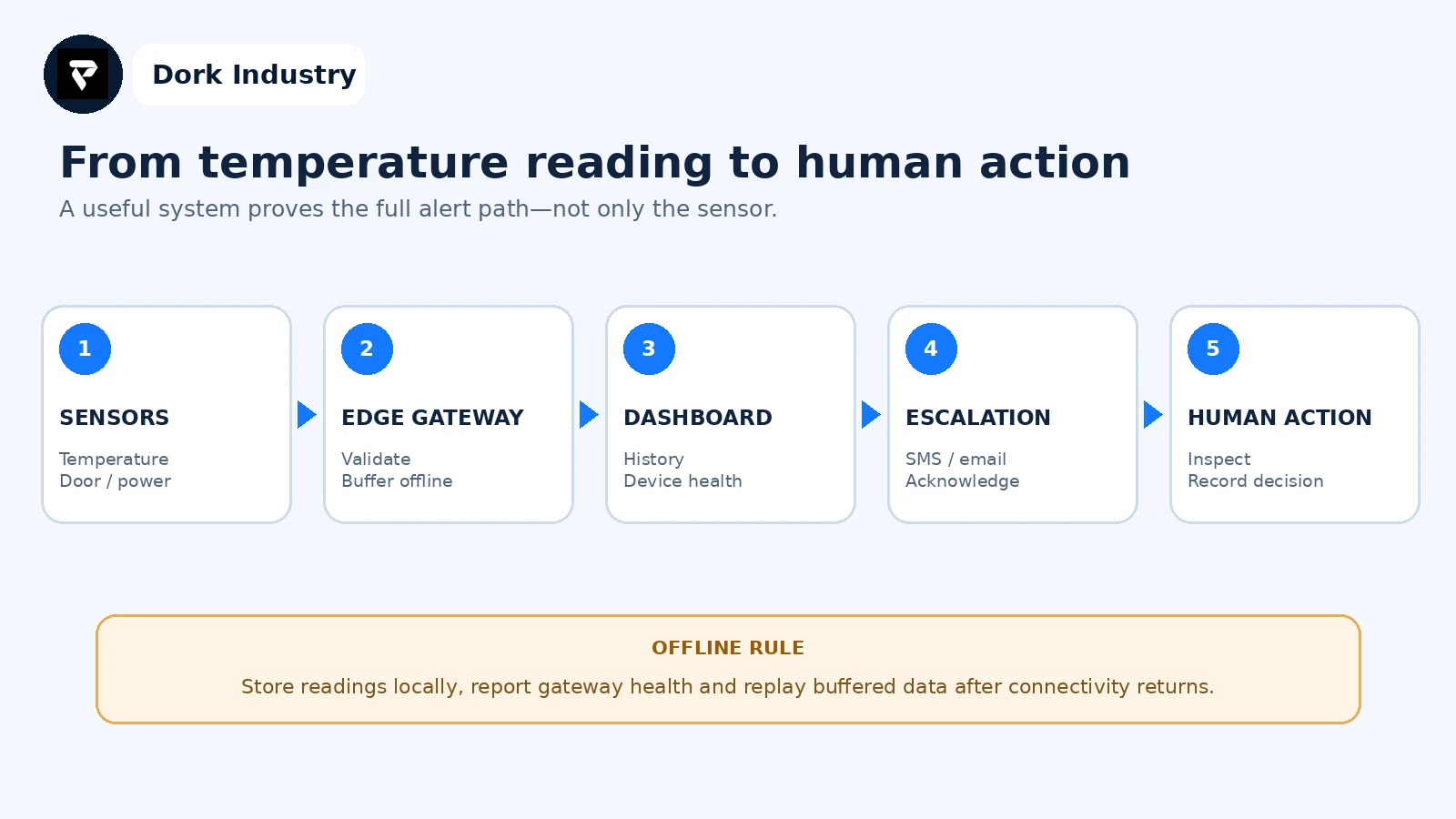
The system may automate collection, validation, threshold evaluation, notification, escalation and report generation. It should not automatically decide whether stock is safe, change approved limits, conceal a missing sensor or close an incident without a human record. Product disposition and regulatory decisions remain with authorised people following the applicable SOP.
How can a business test the monitoring system before relying on it?
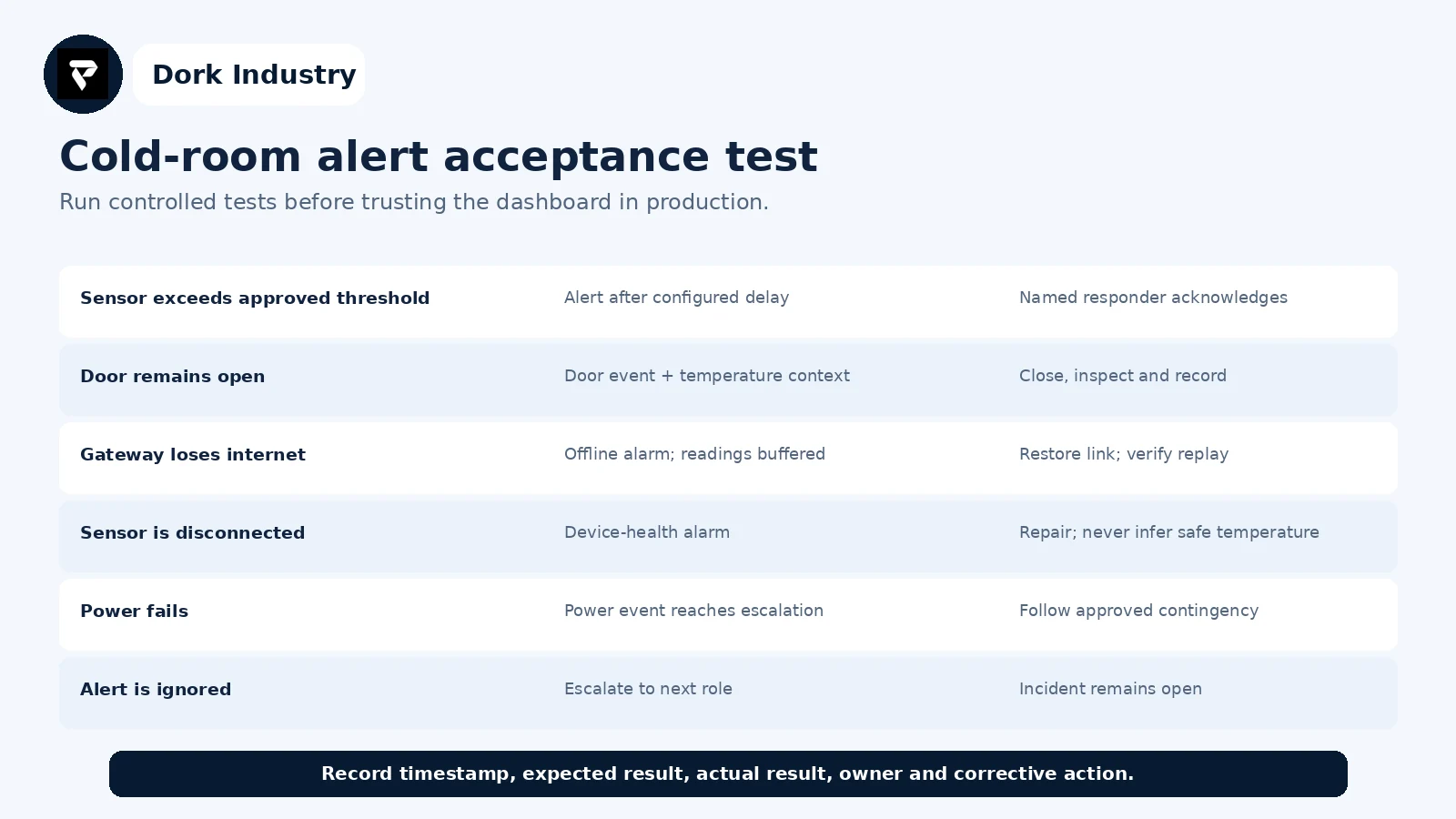
For each scenario, record the timestamp, expected signal, expected notification, recipient, acknowledgement window, actual result and corrective action. Repeat tests after material firmware, connectivity, gateway or escalation changes.
Should the business buy a tool, integrate existing devices or build a custom system?
| Option | Best fit | Watch for |
|---|---|---|
| Packaged monitoring tool | standard rooms and standard alert flow | device lock-in, exports, offline behaviour |
| Integration layer | existing sensors/controllers must feed one dashboard | protocol access, timestamps, ownership |
| Custom IoT application | multiple sites, special workflow or ERP/WMS integration | testing, maintenance and device lifecycle |
| Phased hybrid | pilot first, then connect proven components | clear interfaces and upgrade plan |
A useful pilot proves one complete business path: sensing, offline continuity, alert delivery, acknowledgement, human response and evidence export. It should not be a dashboard-only demonstration.
What can Dork Industry implement?
Dork Industry’s verified IoT and automation service covers sensor and device integration, connectivity options, edge/cloud processing, remote monitoring, dashboards, alerts and integrations with systems such as ERP, SCADA and CRM. Scope depends on the existing equipment, authorised interfaces, operating requirements and pilot findings.
Explore Dork Industry’s industry solutions, the related guide on testing asset-maintenance software, and the guide on testing proof-of-delivery automation.
Turn the cold-room alert gap into a testable pilot
Send the room map, current devices, controller details, approved alert rules, connectivity constraints and the people who must respond. Dork Industry can propose a proof of concept, integration plan or custom monitoring application without treating the dashboard as the whole solution.
Frequently asked questions
Is a data logger the same as a complete monitoring system?
No. A logger records measurements. A complete operational system also handles device health, connectivity failure, alert routing, escalation, acknowledgements, incident notes and evidence export.
Should the system automatically control refrigeration?
Only after a separate control-engineering and safety assessment. Monitoring and alerting can be implemented without granting a cloud application direct control over refrigeration equipment.
What happens when the internet is down?
The design should specify local buffering, local warning, gateway-health reporting and later data replay. The exact behaviour must be tested during acceptance.
Can existing sensors be reused?
Possibly. First verify their protocol, accuracy needs, calibration status, ownership, timestamp behaviour and whether authorised data access is available. An integration pilot can confirm compatibility.
Want this automated for your business?
Book a free assessment — we map the workflow, check data readiness, and outline a pilot you can measure.

[…] Theme code rarely controls the core hosted payment-method list, but custom carts, checkout extensions, payment customizations and apps can influence the journey or eligibility. If the cart itself is broken, use the Shopify Add to Cart repair guide. If a promotion changes the outcome, compare the Shopify discount diagnosis. […]