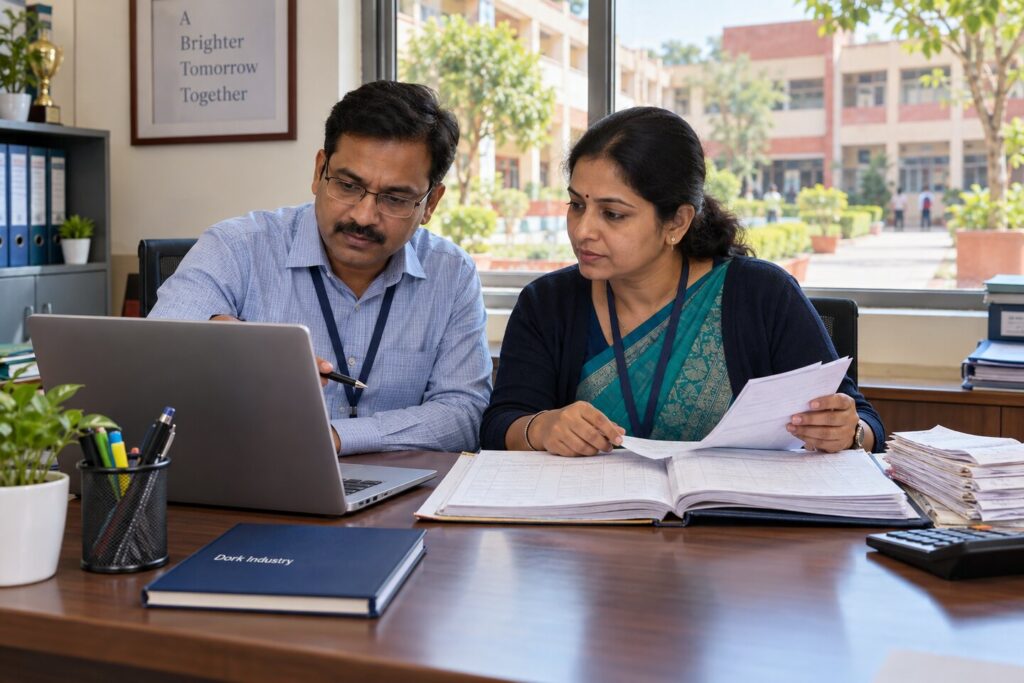
Job work tracking software records material sent to an external processor, links each return to the original job and shows the quantity still awaiting reconciliation. For a Delhi manufacturer, the useful starting point is a reliable challan-level ledger, rather than a dashboard that combines every vendor into one total.
Quick answer: Track each outward job by item, batch, unit, vendor and reference. Link partial receipts, unused material, scrap and approved process loss to that reference. Keep outstanding stock visible until it is reconciled. Test these events with representative transactions before buying software or commissioning a custom integration.
Prepared by Dork Industry · 30 September 2026. This is an operational guide. Numerical examples are illustrative and are not customer results or savings promises.
Material leaves your factory for coating, machining or another operation. Some returns today, another batch comes next week, and your team cannot tell which consignment remains outstanding. That problem needs a material movement workflow with evidence at each handover. It may be solved through configuration, a focused application or integration with an existing ERP.

What should job work tracking software record?
Keep one reference for the job and separate records for its individual movements. Record ownership, item, batch, unit, quantity, vendor, process, issue date and expected return date. Every receipt needs its own timestamp and source document. A single editable “pending quantity” field cannot explain why a balance changed.
| Record | What to capture | Why it matters |
|---|---|---|
| Job identity | Job reference, order, vendor and process | Connects movements to the intended operation |
| Material identity | Item code, batch, owner and unit | Prevents unlike material being combined |
| Issue event | Quantity, dispatch time and reference document | Establishes what left the factory |
| Receipt event | Quantity, condition, time and original job link | Supports multiple returns against one issue |
| Exception | Scrap, loss, rejection or difference with evidence | Separates approved outcomes from unexplained gaps |
| Closure | Final balance, reviewer and supporting records | Prevents an incomplete job being silently closed |
Separate company-owned material with a processor from usable material in your stores. Likewise, customer-owned material received for processing needs an ownership field. Physical location and ownership answer different questions. Your accounting team should validate how these operational states connect to valuation and financial records.
How do you reconcile partial returns from a job worker?
Reconcile against the original issue using comparable quantities and documented outcomes. Keep partial receipts separate, preserve the outstanding balance and distinguish expected process loss from an unexplained shortage. When the process changes material form, use a validated conversion or yield model instead of subtracting finished pieces from input kilograms.
Illustrative same-unit example: A factory sends 1,000 kg for an operation where input and returned quantities can meaningfully be compared in kilograms. It receives 600 kg, then 250 kg. There is also 20 kg of separately documented scrap and 10 kg of approved process loss.
| Event | Quantity | Record treatment |
|---|---|---|
| Issued | 1,000 kg | Original job issue |
| First receipt | 600 kg | Linked receipt event |
| Second receipt | 250 kg | Separate linked receipt event |
| Documented scrap | 20 kg | Evidence and disposition recorded |
| Approved process loss | 10 kg | Reviewer and reason recorded |
| Unresolved balance | 120 kg | Remains open for investigation |
The example balance is 1,000 − 600 − 250 − 20 − 10 = 120 kg. It does not prove the 120 kg is lost: it might still be with the processor or in transit. Confirm its location and state. Avoid deducting scrap twice when it is already included in a receipt quantity; define your event categories before calculating totals.
Do not treat 10 kg as a standard allowable loss. Process tolerances depend on the material, operation and agreed measurement method. Document the approved basis and retain exceptions outside that basis. A system that automatically labels every difference as wastage hides the problem rather than resolving it.

What workflow should job work tracking software follow?
- Create the job. Select vendor, process, material owner and expected outcome.
- Record dispatch. Capture the outward reference, quantities, batch and destination.
- Confirm the handover. Retain acknowledgement and investigate differences between dispatched and received quantities.
- Record progress. Keep vendor updates distinct from confirmed inventory receipts.
- Receive in parts. Link each return to its job and batch; capture inspection status.
- Resolve exceptions. Assign an owner to rejects, scrap, unused material and unexplained differences.
- Close with approval. Verify the remaining balance and preserve history.
A return awaiting inspection should not automatically become available for dispatch. Rejected material may need another operation or return to the processor. Represent those states explicitly. Accounts, stores and production should agree which event triggers a stock movement and which is simply a progress update.
For implementation context, ERPNext’s official subcontracting documentation describes a workflow for outsourced processing and supplied materials. Treat this as an implementation reference, not a promise that every ERP configuration fits your factory. Demonstrate your own transactions and confirm the required controls.
What should a job work software demo prove?
Ask the vendor to execute one complete representative job, including partial returns and a correction. Inspect the ledger and documents after each step. The demonstration should show where the balance comes from, who changed it and what remains outstanding. A polished vendor dashboard is insufficient evidence of reliable transaction control.
- Issue one material batch and receive it in two separate deliveries.
- Reject part of a receipt and keep it outside usable stock.
- Record unused material separately from processed output.
- Account for scrap without deducting it twice.
- Attempt a duplicate receipt and show prevention or a reviewable exception.
- Correct an incorrect quantity while retaining the original event and approval.
- Export the movement ledger with timestamps and references.
- Show overdue jobs using an operational expected-return date.
Acceptance test: independently recalculate the balance for each demonstrated item, batch and job. Compare it with the software report. Every included quantity must point to an identifiable event; every unexplained balance must stay visible. Test access permissions with actual operator and reviewer roles, not only an administrator login.
For a process that converts weight into pieces, add a second test using the agreed conversion model. Require input material, finished output and residual material to be reported in their own units. Approve the conversion basis with production before using it for reconciliation or costing.
Should you use a spreadsheet, ERP module or custom software?
| Option | Suitable starting point | Decision test |
|---|---|---|
| Controlled spreadsheet | Limited jobs and one accountable editor | Can you preserve events, access control and versions? |
| Existing ERP module | Your purchasing and production already use an ERP | Can configuration cover partial returns and material states? |
| Focused job work application | Multiple processors and frequent handovers | Can it integrate approved movements with current systems? |
| Custom integration or workflow | Specific processes or fragmented tools | Is the gap documented and measurable in a scoped pilot? |
Retain a useful accounting tool when a dependable integration is practical. Agree which system owns item codes, job references and approved quantities. If both systems independently create the same movement, your team may introduce new duplication. Test retries, corrections and failed synchronization before rollout.
Costs depend on vendors, locations, users, process complexity, devices, migration, integrations and support. Request a scoped proposal using representative jobs. This guide does not claim a fixed project price or implementation duration without discovery.
How should a Delhi factory pilot job work tracking?
Start with one process, one material group and a small number of processors. For operations involving Bawana, Narela, Okhla or Naraina, map your actual dispatch and receipt handovers. Location names alone do not change the software design; separate sites, transport steps and responsibility for entry do.
Reconcile open jobs before migration. Record uncertain opening balances as unresolved cases instead of importing them as trusted figures. Train stores staff on issue and receipt events, production staff on output and rejection states, and supervisors on exception approval. Run the old and new calculations against a defined sample until the results agree.
- Posting delay: time between a physical handover and its recorded event.
- Open exception age: time an unresolved discrepancy has remained open.
- Traceable receipt rate: receipts linked to valid job references divided by receipts reviewed.
- Overdue jobs: jobs beyond their agreed operational expected-return date.
- Repeated causes: recurring validated reasons for reconciliation differences.
State the scope and baseline when comparing results. Fewer exceptions may mean better records, but may also reflect fewer jobs or narrower checking. Validate the cause before claiming improvement. Operational due dates do not replace statutory deadlines; have your accounts or tax adviser verify compliance requirements separately.
How can Dork Industry help?
Dork Industry’s manufacturing technology offering includes software, ERP integration and operational reporting. Use a discovery discussion to determine whether a focused workflow, configuration change or integration best fits your job work process. For broader inventory issues, read our stock mismatch guide for Delhi factories.

Discuss job work tracking with Dork Industry. Bring a representative outward record, two partial receipts, an open reconciliation case and the names of your existing systems. Ask for a written scope and a demonstrable acceptance test.
Frequently asked questions
What is job work tracking software?
It records externally processed material, individual dispatches and returns, process status and unresolved balances against a job reference. Useful software preserves an event history instead of relying on an overwritten pending total.
Can it handle several returns against one challan?
It should support separately dated receipts linked to the original reference. Test partial deliveries, rejected quantities and corrections before selection; do not assume a general inventory module handles your workflow automatically.
Can we continue using our accounting software?
Possibly. Verify supported integrations, system ownership of records, duplicate prevention and correction handling. Retaining accounting software can be practical when the operational movement workflow can exchange reliable data.
Does barcode scanning solve job work tracking by itself?
No. Scanning can help identify the item or job, but material ownership, units, movement rules, approvals and exception handling still need to be defined.
Does this guide provide GST compliance advice?
No. Its focus is operational traceability. Ask your accounts or tax adviser to confirm documentation, deadlines and applicable reporting obligations before configuring compliance fields.
Sources and research notes
The technical reference is ERPNext’s subcontracting documentation. Competitor research on 30 September 2026 reviewed simpliRP’s job work workflow, ERPDrive’s vendor and challan tracking page and TICK’s Delhi manufacturing ERP offering. These establish commercial topic relevance, not measured search volume or proven competitor performance. The worked example and demo acceptance test are original editorial tools. Images are reused Dork Industry AI illustrations, not photographs of a client project.