A home healthcare caregiver tracking app should identify a visit at risk before a family has to call the agency. It needs more than GPS attendance: skill-based assignment, an offline check-in, late-visit escalation, replacement handling, restricted care notes, family updates and a reliable hand-off to billing or payroll.

Contents
Why do home-care visits get missed even when a roster exists?
A spreadsheet can show the intended assignment but not whether the caregiver accepted it, reached the right visit, lost network connectivity, reported an exception or handed the work to a replacement. Phone and WhatsApp follow-up then becomes the real operating system, leaving coordinators, families and finance teams with different versions of the day.
Current Indian home-care software pages repeatedly address the same buyer problem through attendance, scheduling, visit tracking, family visibility and mobile workflows. That validates the commercial intent without proving that one standard product fits every agency. The correct choice depends on visit types, field connectivity, existing billing and the information families are allowed to see.
Which nine controls should a home healthcare caregiver tracking app include?
| Control | Business question | Proof before launch |
|---|---|---|
| 1. Visit definition | What counts as scheduled, accepted, started and completed? | agreed status map |
| 2. Skill-based assignment | Can only suitable staff receive the visit? | role and skill matrix |
| 3. Offline check-in | Can field work continue without reliable data? | queue-and-sync test |
| 4. Location boundaries | When and why is location captured? | consent and fallback rule |
| 5. Late/missed exception | Who acts before the family calls? | escalation timer |
| 6. Reassignment | Can a backup take over without duplicate visits? | replacement workflow |
| 7. Care record | Which tasks and notes are required? | role-based field list |
| 8. Family update | Which approved facts can relatives view? | visibility matrix |
| 9. Audit and integration | Can operations, billing and payroll reconcile? | event history and export |
1. What should each visit status mean?
Define scheduled, offered, accepted, en route, checked in, completed, cancelled, missed and reassigned. Every transition needs an owner and timestamp. A coloured calendar is useful only when coordinators agree what each colour means and which states require action.
2. How should caregivers be matched to visits?
Filter by required skill, availability, service area, language or other approved operating criteria. Keep a human coordinator in control of exceptions. Automated matching can prepare options, but it should not silently assign a person who lacks the required role or confirmed availability.
3. How should the app work when mobile data is unreliable?
Store the authorised schedule locally, allow essential check-in and care-note actions offline, show the caregiver what is waiting to sync and prevent duplicate submission after reconnection. According to Google’s Android guidance, an offline-first app should remain usable without reliable network access and provide data from a local source. Review Android’s official offline-first guidance.
4. Should the agency continuously track caregiver location?
Not by default. Capture only the location evidence needed for the declared visit workflow, during an appropriate time window, with a clear explanation and a safe fallback for denied permission or GPS failure. Continuous surveillance can create privacy, trust and battery problems without improving the actual exception workflow.
5. What should happen when a visit is late?
Start a configurable timer, notify the coordinator, contact the assigned caregiver, offer an authorised replacement and inform the family according to policy. Keep the case open until someone records the resolution. A push notification alone is not proof that the exception was handled.
Still discovering missed visits through family calls?
Share your roster format, visit types, caregiver roles, current attendance method, escalation contacts, billing workflow and common network conditions. Dork Industry can scope a focused prototype for scheduling, offline check-in, exception handling and family-visible updates.
6. How can reassignment avoid duplicate visits?
Lock ownership through a clear offer-and-accept process. When a replacement accepts, close or revoke the previous assignment and retain both events in the audit history. If two devices update while offline, send the conflict to a coordinator instead of silently choosing the latest phone timestamp.
7. Which information belongs in the care record?
Use the minimum fields needed for the approved service: completed tasks, observations, exceptions, authorised measurements and a hand-off note. Separate operational attendance from sensitive clinical content. A caregiver, coordinator, clinician, finance user and family member should not automatically see the same fields.
8. What should families see?
A family portal may show the scheduled window, arrival/completion state, approved visit summary, next visit and agency contact route. Private staff notes, unrelated records and unrestricted live location should remain hidden. Design the view from the agency’s consent and access policy, not from a generic feature checklist.
9. Which systems should the app integrate with?
Prioritise one source of truth for clients, staff, visits and invoices. Common integration points include CRM or referral intake, HR/onboarding, payroll inputs, billing, notifications and a hospital or clinic system where authorised. According to MeitY’s official DPDP Act information, India’s data-protection framework is relevant whenever the workflow processes digital personal data; obtain appropriate legal and compliance review for the actual implementation. Review MeitY’s DPDP Act information.
What does a complete caregiver-visit workflow look like?
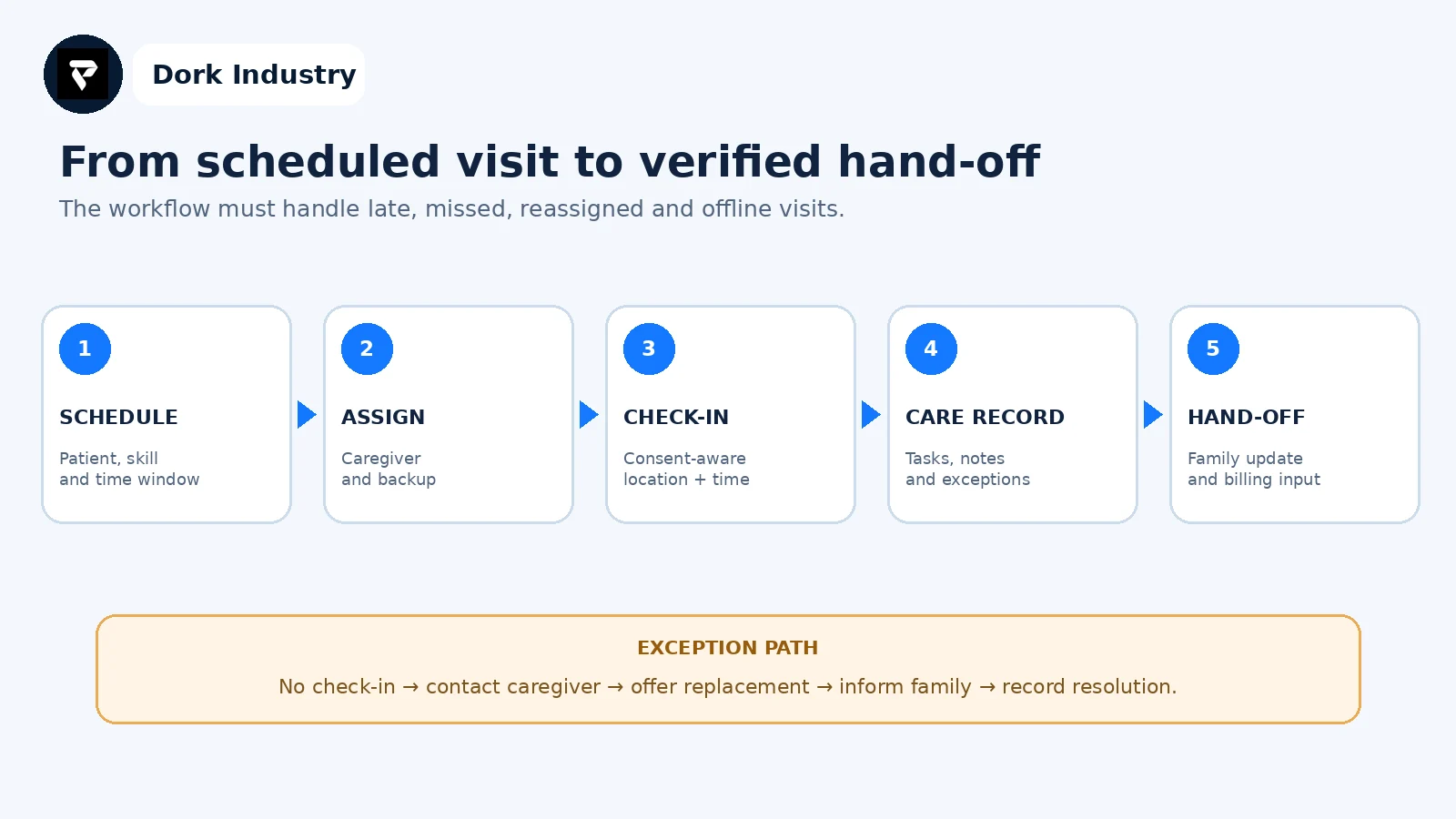
The app can automate reminders, status timers, notifications, approved family updates and structured exports. It should not diagnose patients, decide clinical action, fabricate a check-in when GPS fails, replace consent or close a missed visit without human review.
How can an agency test the app before field rollout?
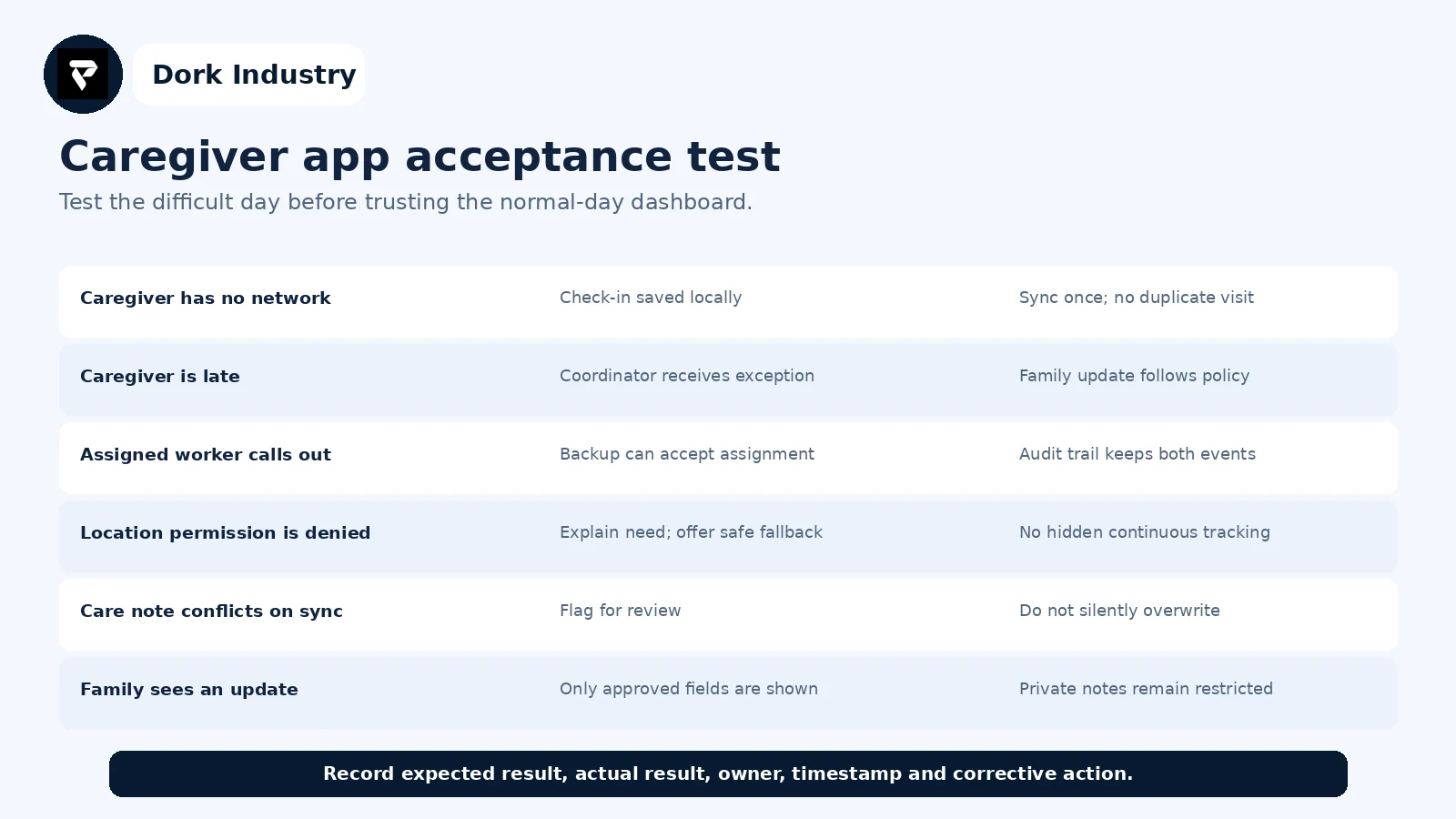
Run each scenario in a safe pilot with test records: no network, late arrival, last-minute absence, denied location permission, sync conflict and restricted family access. Record the expected result, actual result, owner, timestamp and corrective action. Re-test after changes to authentication, sync, assignment or notification logic.
Should the agency buy a tool, customise one or build a dedicated app?
| Option | Best fit | Watch for |
|---|---|---|
| Packaged software | standard scheduling, attendance and billing | workflow fit, exports and data ownership |
| Customisation/integration | existing system is close but disconnected | API access and upgrade compatibility |
| Custom application | distinct visit models, family portal or multi-system workflow | maintenance, testing and rollout support |
| Phased hybrid | prove one exception path before wider investment | clear success criteria and interfaces |
A credible proof of concept should demonstrate one complete visit—including offline check-in, late-visit exception, reassignment, restricted family update and an export that operations can reconcile.
What can Dork Industry build for a home healthcare agency?
Dork Industry can scope and develop a caregiver mobile app, coordinator dashboard, family portal, offline synchronization, notifications, role-based workflows and authorised integrations. Technology selection—such as Flutter, Kotlin, Swift, web dashboards or an existing backend stack—should follow the workflow, device estate and integration requirements rather than drive the article or the purchase decision.
Review Dork Industry’s verified app development service, healthcare industry capabilities, offline mobile app testing guide and clinic appointment automation guide.
Turn the missed-visit problem into a testable pilot
Send one week of anonymised roster structure, visit statuses, exception rules, user roles, network constraints and required integrations. Dork Industry can propose a proof of concept, integration plan or dedicated caregiver application with clear acceptance tests.
Frequently asked questions
Is GPS attendance enough to prevent missed visits?
No. The workflow also needs assignment acceptance, a late-visit timer, backup handling, offline evidence, acknowledgement and a recorded resolution. GPS can support a check-in but cannot prove that every required task or hand-off occurred.
Can the caregiver app work without internet?
Yes, if the architecture deliberately stores authorised schedules and essential actions locally, displays pending sync clearly and resolves conflicts safely after reconnection. Offline behaviour must be acceptance-tested on the actual devices and network conditions.
Should families see the caregiver’s live location?
Usually they need an approved arrival status or time window, not unrestricted live tracking. The agency should define the purpose, time window, consent, fallback and access rules with appropriate privacy and legal review.
What should be included in a proof of concept?
Include scheduling, assignment acceptance, one online and one offline check-in, a late or missed-visit exception, reassignment, restricted family visibility and one downstream billing or payroll export. Test failure cases, not only the happy path.
Planning an app for this?
Book a free consultation — we scope the requirements, outline the approach, and give you an honest verdict before any development is discussed.