


Predictive maintenance for manufacturing is worth funding only when a pilot proves that a specific failure creates a detectable signal early enough for the maintenance team to act. Before buying sensors at scale, test asset criticality, data quality, warning time, false-alert load, workflow adoption and avoided-loss economics on one bounded production problem.
By Dork Industry Editorial Team · Last reviewed: 18 October 2026 · For Indian manufacturing leaders, plant heads, reliability teams and operations buyers
The decision in one minute
Do not approve a plant-wide platform because a dashboard can display vibration. Approve a 90-day pilot only when the team can name the failure mode, the operational decision it should trigger, the minimum useful warning window and the financial consequence of acting—or failing to act. Scale only after blind validation.
What are the key predictive maintenance for manufacturing takeaways?
- Start with one costly, defined and potentially detectable failure mode—not a catalogue of sensors.
- Set the minimum warning time from the real inspection, parts and maintenance workflow.
- Measure confirmed findings, missed failures and false-alert workload instead of relying on a headline accuracy score.
- Require each actionable alert to become an owned CMMS or ERP work order with a recorded outcome.
- Scale only after a locked, blind validation period passes technical, operational and financial evidence gates.
Why do evidence gates matter now for Indian manufacturers?
According to Rockwell Automation’s 2026 Asia-Pacific manufacturing report, 95% of APAC manufacturers consider digital transformation essential to competitiveness, and 71% plan to increase AI and machine-learning use in the next 12 months. The underlying global survey included 1,560 respondents across 17 countries. These figures show investment momentum; they do not prove that any individual predictive-maintenance use case will work.
Rockwell Automation reports that broader implementation is replacing pilot-only activity. That makes disciplined acceptance gates more important, not less: a weak signal scaled across a plant creates more alerts, integration cost and mistrust. Indian manufacturers should use the pilot to decide which asset and failure mode deserve production funding.
What this guide helps you decide
- Whether you need monitoring, preventive maintenance or prediction
- The nine tests a predictive-maintenance pilot must pass
- How to run a 90-day pilot without creating a permanent proof of concept
- How to calculate value without invented ROI percentages
- What to put in a vendor RFP and acceptance sheet
- Answers to common buyer questions
What does predictive maintenance for manufacturing mean—and what is it not?
A condition-monitoring system tells you what an asset is doing now. Preventive maintenance schedules work at fixed intervals. Predictive maintenance estimates whether a defined failure is emerging and gives the team enough lead time to intervene. These are related capabilities, but they are not interchangeable.
| Approach | Question answered | Typical trigger | Best fit |
|---|---|---|---|
| Run to failure | Can we afford to replace it after failure? | Breakdown | Low-criticality, inexpensive and redundant assets |
| Preventive maintenance | Is scheduled service due? | Time, cycles or production count | Known wear patterns and regulated intervals |
| Condition monitoring | Is the machine outside a known operating range? | Threshold or operator observation | Immediate visibility and rule-based escalation |
| Predictive maintenance | Is a specific failure developing, and when must we act? | Trend, anomaly or remaining-useful-life estimate | Critical assets with detectable degradation and costly downtime |
If your plant does not yet have dependable telemetry, production context and downtime codes, begin with the foundational layer described in our industrial IoT machine-downtime tracking guide. Prediction built on missing timestamps, changing operating modes or inconsistent failure labels produces confident-looking noise.
The important distinction is the decision. “Bearing temperature is 78°C” is an observation. “Inspect the drive-end bearing during tomorrow’s planned changeover because the combined vibration and temperature pattern is consistent with lubrication failure” is an actionable maintenance hypothesis. The second statement still needs human verification and a recorded outcome.
Nine predictive maintenance for manufacturing tests before you buy sensors
1. Is the downtime problem economically material?
Start with loss, not technology. Select an asset where unplanned failure affects throughput, quality, safety, energy use, secondary equipment or an expensive maintenance response. Establish a baseline from production records, CMMS work orders, shift logs and operator knowledge. If the plant cannot distinguish planned stops, starvation, blockage, quality holds and equipment failure, the first project is better event classification—not machine learning.
Record at least: failure frequency, median and worst-case duration, lost contribution per hour, scrap or rework, emergency labour, expedited parts, downstream damage and the current inspection cost. Avoid using headline “downtime cost” figures from unrelated factories. Your business case must be based on your constraint, margins and recovery process.
2. Can one defined failure mode be detected before failure?
“Predict this machine’s failure” is too broad. A motor can fail through bearing damage, winding insulation breakdown, misalignment, overload or cooling failure; each produces different evidence. Create a failure-mode statement that names the component, mechanism, observable precursor and desired intervention.
| Failure hypothesis | Potential evidence | What can invalidate it |
|---|---|---|
| Rolling-element bearing degradation | Frequency-band vibration, acoustic emission, temperature trend | Signal cannot be separated from speed/load changes |
| Pump cavitation | Vibration signature, suction/discharge pressure, flow, acoustic pattern | Process conditions are not captured with the sensor signal |
| Motor electrical fault | Current signature, voltage imbalance, temperature and load | Sampling rate or electrical access cannot reveal the fault |
| Heat-exchanger fouling | Pressure drop, inlet/outlet temperature, flow and energy consumption | Instrumentation is uncalibrated or cleaning history is missing |
Some failures are sudden, random or hidden from practical sensors. A good pilot is allowed to conclude that a failure mode is not predictably detectable. That finding prevents a much larger bad investment.
3. Does the asset combine criticality with learning value?
The most expensive asset is not automatically the best pilot. Choose one that matters financially, fails often enough to generate evidence, has a known failure mode, is safe to instrument and has a maintenance team ready to act. A single unique machine may be critical but produce too few events for validation; a small family of similar pumps or motors can provide faster learning.
| Selection factor | Favourable pilot condition | Warning sign |
|---|---|---|
| Business consequence | Failure affects a constraint or creates measurable loss | Impact is inconvenient but immaterial |
| Event frequency | Enough degradation or confirmed faults within the test window | No likely event for years |
| Repeatability | Comparable assets or operating cycles exist | Every cycle is unique and undocumented |
| Actionability | Inspection, parts and planned windows can be arranged | No owner or maintenance capacity exists |
| Instrumentation | Safe mounting, power, connectivity and data access | Hazardous access or approvals make the pilot impractical |
4. Is the operating and maintenance data ready?
Predictive maintenance for manufacturing needs more than sensor readings. It needs time-aligned context: asset ID, operating state, speed, load, product, recipe, environmental conditions, alarms, maintenance actions and confirmed outcomes. A vibration increase during a high-load product run may be normal; the same increase at steady load may be meaningful.
Run a data-readiness audit covering timestamp accuracy, sampling frequency, missingness, calibration, tag naming, historian retention, PLC access, maintenance-code consistency and OT security boundaries. Where existing data is adequate, use it. Add sensors only to close a defined evidence gap. Industrial connectivity should use documented interfaces and a reviewed operational-technology architecture; the Modbus specifications and NIST operational-technology security guidance are useful reference points.
5. Do the sensor and sampling plan match the failure physics?
Do not select a sensor because it is common or inexpensive. Select measurement type, placement, axis, range, frequency and sampling method from the expected failure signature. Slow temperature polling may reveal thermal drift but miss high-frequency bearing behaviour. A wireless sensor may simplify installation but still be unsuitable if battery life, metal structures, hazardous-area certification or network policy conflict with the use case.
The pilot plan should document why each signal exists, what normal looks like across operating modes, how calibration is checked and what happens when data is missing. Edge processing may be appropriate for low-latency rules or limited connectivity; cloud processing may be useful for fleet comparison and model operations. The architecture follows the decision requirement—not a preferred platform.
6. Does the warning arrive early enough to act?
An accurate alert delivered ten minutes before a failure is useless if the inspection requires four hours and the spare part takes two days. Work backwards from the response: time to acknowledge, diagnose, obtain a part, secure permits, plan labour and reach a safe maintenance window. That total becomes the minimum useful warning time.
Measure lead time from the first valid alert to the confirmed maintenance finding or failure—not from a retrospectively selected point on a chart. Separate early but unstable hints from an alert the team could responsibly act on. The acceptance sheet should state a range, because different failure severities may require different responses.
7. Are false alerts and missed failures priced explicitly?
Model accuracy alone hides the operational trade-off. A system can appear accurate by predicting “healthy” most of the time when failures are rare. Track confirmed detections, missed failures, false alerts and alerts that cannot be verified. Then attach a consequence to each.
A false alert may consume inspection hours, interrupt production or erode technician trust. A missed failure may create a far larger loss. Set thresholds by asset and consequence, and require an escalation policy for uncertain cases. There is no universal “95% accuracy” that makes a predictive-maintenance system production-ready.
8. Does every actionable alert enter a maintenance workflow?
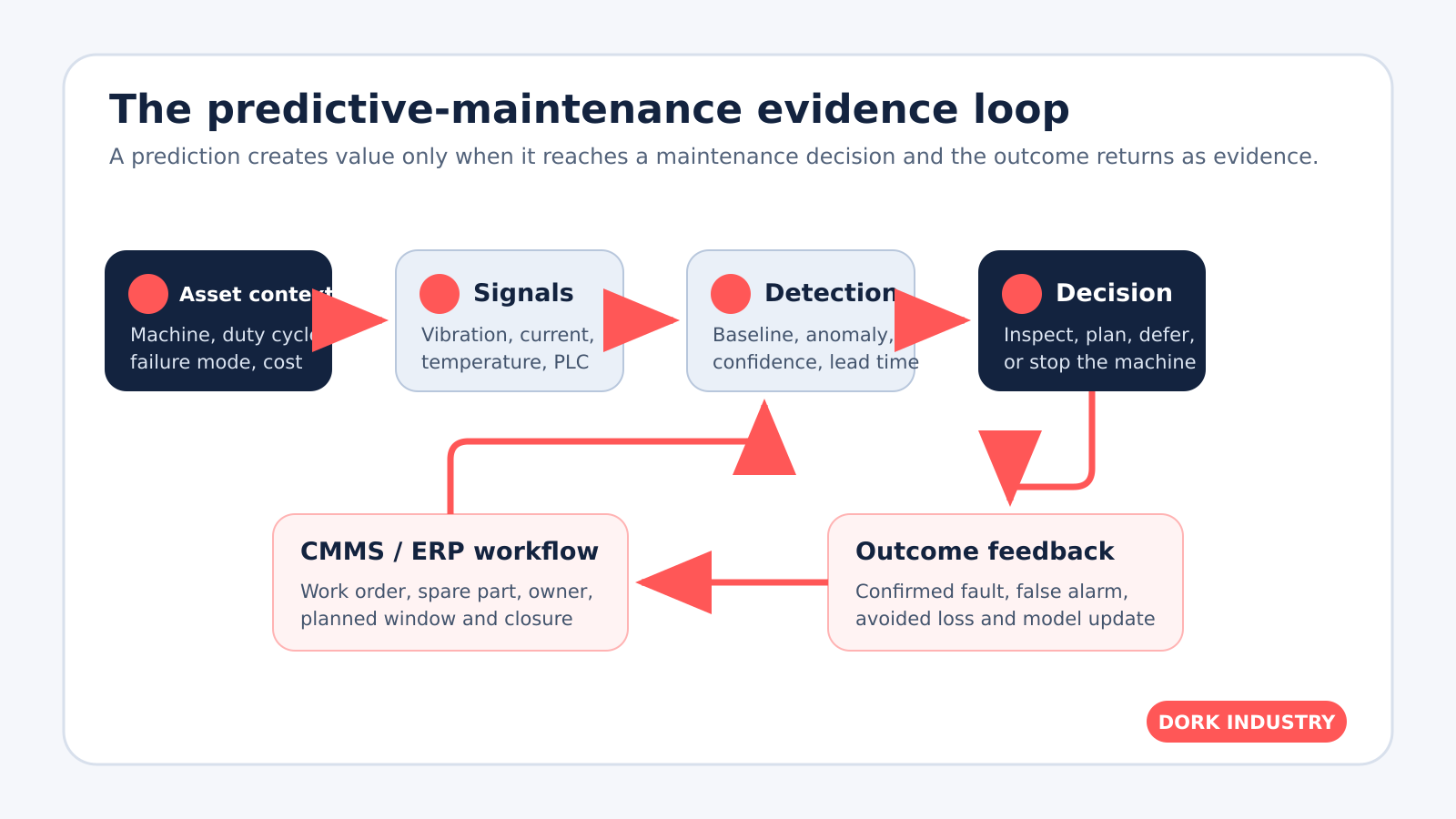
A dashboard nobody owns is not an operating system. Decide who receives the alert, what evidence they see, how they acknowledge it, who inspects the asset, what work order is created, how parts are reserved and how the result is closed. Integrate only the fields needed to support that loop into the CMMS or ERP.
Capture the technician’s outcome: confirmed defect, no fault found, sensor issue, process-related anomaly, deferred action or completed repair. Without that feedback, the model cannot be governed and the finance team cannot validate avoided loss. If ERP and maintenance processes still depend on disconnected spreadsheets, use our guide to scope ERP implementation before replacing spreadsheets.
9. Are scale, redesign and stop rules agreed before kickoff?
Every pilot needs an exit. Define evidence gates before data collection so enthusiasm cannot move the goalposts. A scale decision should require failure detectability, adequate warning time, tolerable alert load, usable data, workflow adoption and financial evidence. A redesign decision should identify one correctable constraint. A stop decision is appropriate when physics, event frequency or economics do not support the case.
A successful pilot can therefore end in “do not scale.” That is disciplined capital allocation, not failure.
How should predictive maintenance for manufacturing run as a 90-day pilot?
Days 1–15: baseline the decision
- Name the asset family, failure mode and operational owner.
- Map the present detection and maintenance process.
- Calculate the loss baseline and minimum useful warning time.
- Review OT security, access, safety and instrumentation constraints.
- Freeze acceptance criteria and stop conditions.
Days 16–30: instrument and verify context
- Connect approved existing tags before installing new hardware.
- Verify timestamps, operating modes, asset identity and sensor placement.
- Test missing-data, connectivity-loss and calibration procedures.
- Create the alert-to-work-order path in a controlled environment.
Days 31–60: tune with labelled evidence
- Build normal baselines for relevant load and production states.
- Review anomalies with maintenance and process specialists.
- Record inspection findings instead of assuming every anomaly is a fault.
- Tune thresholds while preserving a change log and untouched validation period.
Days 61–90: run blind validation
- Lock the alert rules or model version before validation.
- Let the operating team handle alerts through the agreed workflow.
- Measure warning time, alert burden, confirmed findings and user response.
- Present scale, redesign or stop evidence to operations and finance together.
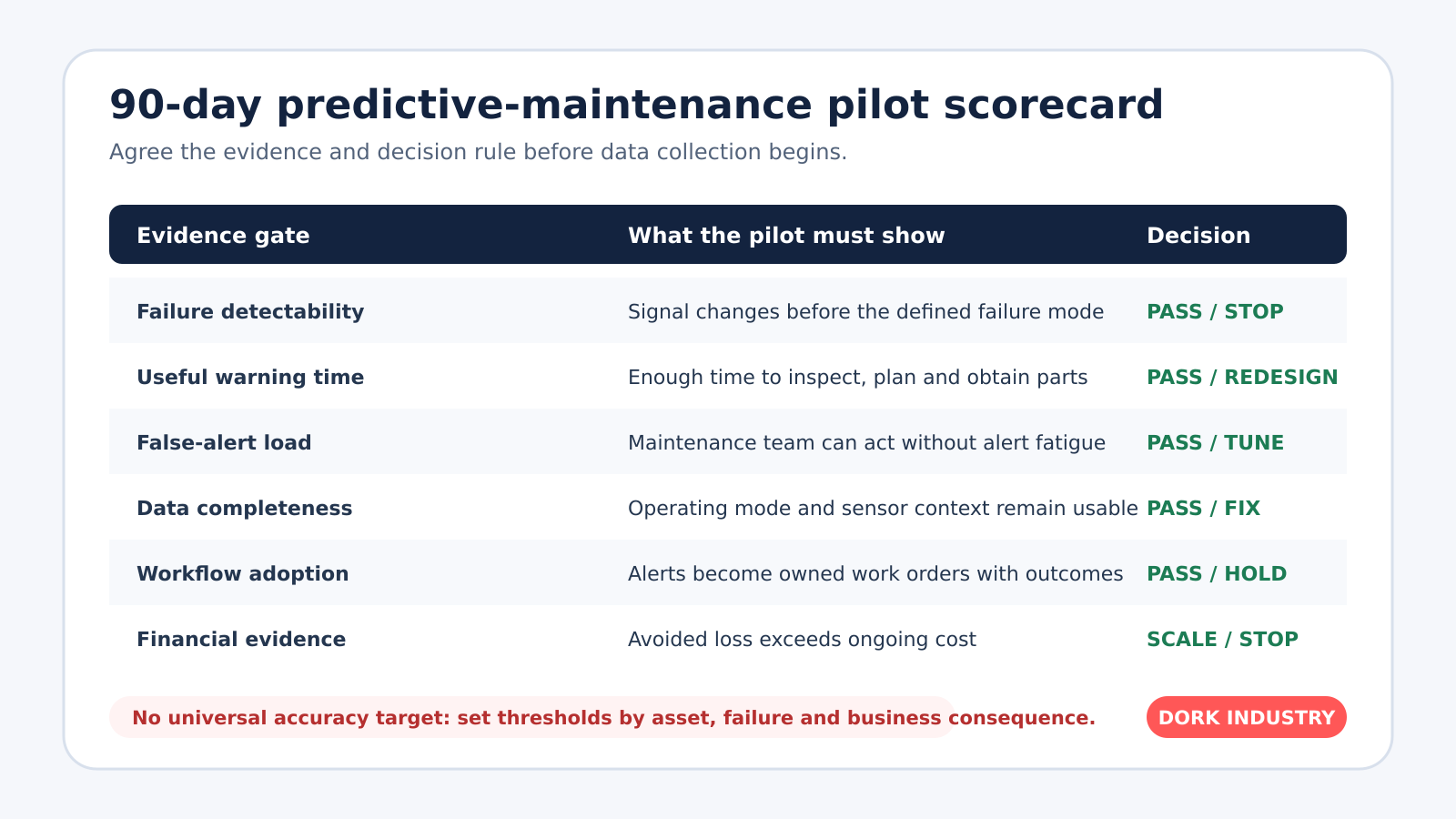
Ninety days is a governance framework, not a promise that every plant will observe enough faults in one quarter. For low-frequency failures, extend the observation window, use a fleet of comparable assets or begin with a condition-monitoring threshold while evidence accumulates. Never manufacture labels or claim validation from simulated anomalies alone.
A predictive maintenance for manufacturing pilot is decision-ready only when its evidence survives this locked validation period and the operating team can repeat the response without vendor supervision.
How do you calculate predictive maintenance value without fictional ROI?
Use a transparent value equation:
Avoided-loss value = prevented downtime contribution + avoided scrap/secondary damage + avoided emergency labour and freight − pilot and operating cost.
Keep cash savings separate from capacity value. If a line already has spare capacity and no demand is lost, an hour of avoided downtime may not create additional revenue. If the protected asset is the plant constraint and demand exceeds capacity, the same hour can be valuable. Finance should approve the assumptions, probability and attribution.
A useful pilot budget separates one-time and recurring items:
- failure-mode analysis and reliability engineering;
- sensors, gateways, installation and certification;
- historian, connectivity, edge or cloud infrastructure;
- data engineering, model or rule development and integration;
- CMMS/ERP workflow changes and user training;
- security review, support, calibration and model monitoring.
Ask the vendor to price the pilot, the first production deployment and a representative fleet scale separately. This exposes costs that are often hidden during a small proof of concept: licences per asset or tag, data retention, network upgrades, model support, sensor replacement and integration maintenance.
When is predictive maintenance the wrong answer?
Do not force prediction onto every asset. Prefer a simpler control when:
- the component is inexpensive, redundant and safe to run to failure;
- the failure is random and has no observable precursor at a practical cost;
- a fixed preventive interval already controls risk economically;
- the plant lacks a stable operating baseline or reliable asset identity;
- the maintenance team cannot inspect or act within the warning window;
- the real constraint is production planning, quality, operator procedure or spare-parts availability;
- the pilot would need years to observe enough events and no comparable fleet exists.
Predictive maintenance for manufacturing should therefore compete against simpler alternatives on net value, response time and operating effort—not win automatically because it uses AI.
Sometimes the better first investment is OEE and downtime classification, a calibrated process instrument, a revised lubrication route, critical-spares planning or a rules-based alarm. Computer vision may be more appropriate when the observable failure is visual; our computer-vision ROI test guide explains how to evaluate that path.
Predictive maintenance for manufacturing RFP checklist
A serious RFP should request evidence, responsibilities and exit terms—not a generic demo. Include these requirements:
Use the same predictive maintenance for manufacturing acceptance sheet for every shortlisted vendor so that sensor quantity, dashboard polish and model terminology cannot hide different levels of operational evidence.
- Problem definition: named assets, failure modes, historical events and business consequences.
- Detection hypothesis: why the proposed signals should change before each failure.
- Data plan: sampling, context tags, calibration, retention, missing-data treatment and ownership.
- OT architecture: network boundaries, protocols, edge/cloud responsibilities, access control and update process.
- Acceptance measures: warning time, confirmed detections, missed events, false-alert burden and workflow response.
- Validation method: locked rules/model, blind period, human verification and audit trail.
- Integration: the exact CMMS/ERP fields, work-order states and accountable users.
- Commercial model: pilot, production and scale costs; hardware replacement; licences; support; and exit costs.
- Portability: exportable raw data, labelled events, configurations and model outputs.
- Decision gate: who can approve scale, redesign or stop and what evidence they require.
For data pipelines and operational integrations, see Dork Industry’s real-time data engineering services and AI data platform development. The platform should be sized after the pilot clarifies the signal, latency, retention and governance needs.
Need a feasibility decision before a platform purchase?
Dork Industry can help your operations, maintenance, IT and finance teams define the failure case, audit available data, design the evidence loop and scope a vendor-neutral pilot. The output is a scale, redesign or stop decision—not a forced software sale.
What do manufacturing buyers ask about predictive maintenance?
What is predictive maintenance for manufacturing?
It is a maintenance approach that uses asset condition, operating context and historical outcomes to identify a developing failure early enough for a planned response. It differs from basic monitoring because the output must support a specific decision, warning window and verified maintenance action.
Which machines should be selected first?
Start with a critical asset or repeatable asset family where failure has measurable consequences, a precursor is likely observable, events occur often enough to learn and the maintenance team can act. Pumps, motors, fans, compressors and gearboxes are common candidates, but selection must follow local failure history.
How much historical data is required?
There is no universal duration. The requirement depends on operating variation, event frequency, failure labels and the proposed method. Months of unlabelled data may be less useful than a shorter period with verified operating modes and inspection outcomes. The pilot should state what evidence is adequate and what uncertainty remains.
Does predictive maintenance always require AI?
No. A well-designed threshold, trend rule or engineering calculation may solve the problem more transparently. Machine learning becomes useful when patterns, operating modes or multiple signals make fixed rules inadequate and when enough trustworthy evidence exists to validate the model.
How should false alerts be measured?
Count alerts that trigger inspection but produce no relevant finding, then measure the labour, interruption and trust cost. Also record unverifiable alerts separately. Review false alerts by asset, operating state and severity because one plant-wide percentage can hide an unusable workflow.
Can existing PLC and historian data be used?
Often, yes. Existing current, pressure, temperature, speed, load and alarm tags may be sufficient for an initial hypothesis. Verify sampling, calibration, timestamps and context first. Add external sensors only when the current data cannot reveal the defined failure mode with useful warning time.
How do we connect predictions to SAP, Dynamics or another ERP?
Begin with the maintenance decision and minimum fields: asset, alert severity, evidence, recommended inspection, owner, due time and outcome. Use an approved integration layer or API to create or enrich a notification or work order. Avoid copying every sensor reading into the ERP.
What should make us stop the pilot?
Stop when the targeted failure has no practical precursor, warning arrives too late, data quality cannot be corrected economically, alert burden exceeds the team’s capacity or credible avoided loss cannot exceed ongoing cost. Documenting that decision preserves the learning for future asset selection.
Method and sources
This guide combines failure-mode-first reliability practice with data, workflow and financial acceptance gates. Technical reference points include the IBM overview of predictive analytics, AWS explanation of IoT systems, ISO 22400 manufacturing KPI framework, Modbus protocol specifications and NIST guidance for operational-technology security. Product claims and universal ROI percentages were deliberately excluded. Plant-specific engineering, safety and OT security review remains necessary.
Want this automated for your business?
Book a free assessment — we map the workflow, check data readiness, and outline a pilot you can measure.

[…] Theme code rarely controls the core hosted payment-method list, but custom carts, checkout extensions, payment customizations and apps can influence the journey or eligibility. If the cart itself is broken, use the Shopify Add to Cart repair guide. If a promotion changes the outcome, compare the Shopify discount diagnosis. […]