
Custom software development for rental equipment businesses is rarely about the software — it is about knowing where every machine is, who is responsible for it, and which days are billable. Yes: a purpose-built rental operations system can stop equipment from going missing on customer sites, provided it tracks custody the way rental businesses actually move assets — a dispatch scan, a named custodian, and a timestamped photo at every handoff — and is piloted on one yard before a full rollout. The expensive problem is not that equipment gets stolen; it is that scaffolding, mixers, generators, and compactors drift between customer sites with nobody recording who has them, while billing runs on whatever the register says.
This article examines whether custom software development can give a rental equipment owner real control: where the money leaks, what the system must do, what data you already have, what the math looks like, what it must never do alone, and how to test the idea in 30 days before committing to a full build.
Where do rental equipment businesses actually lose money?
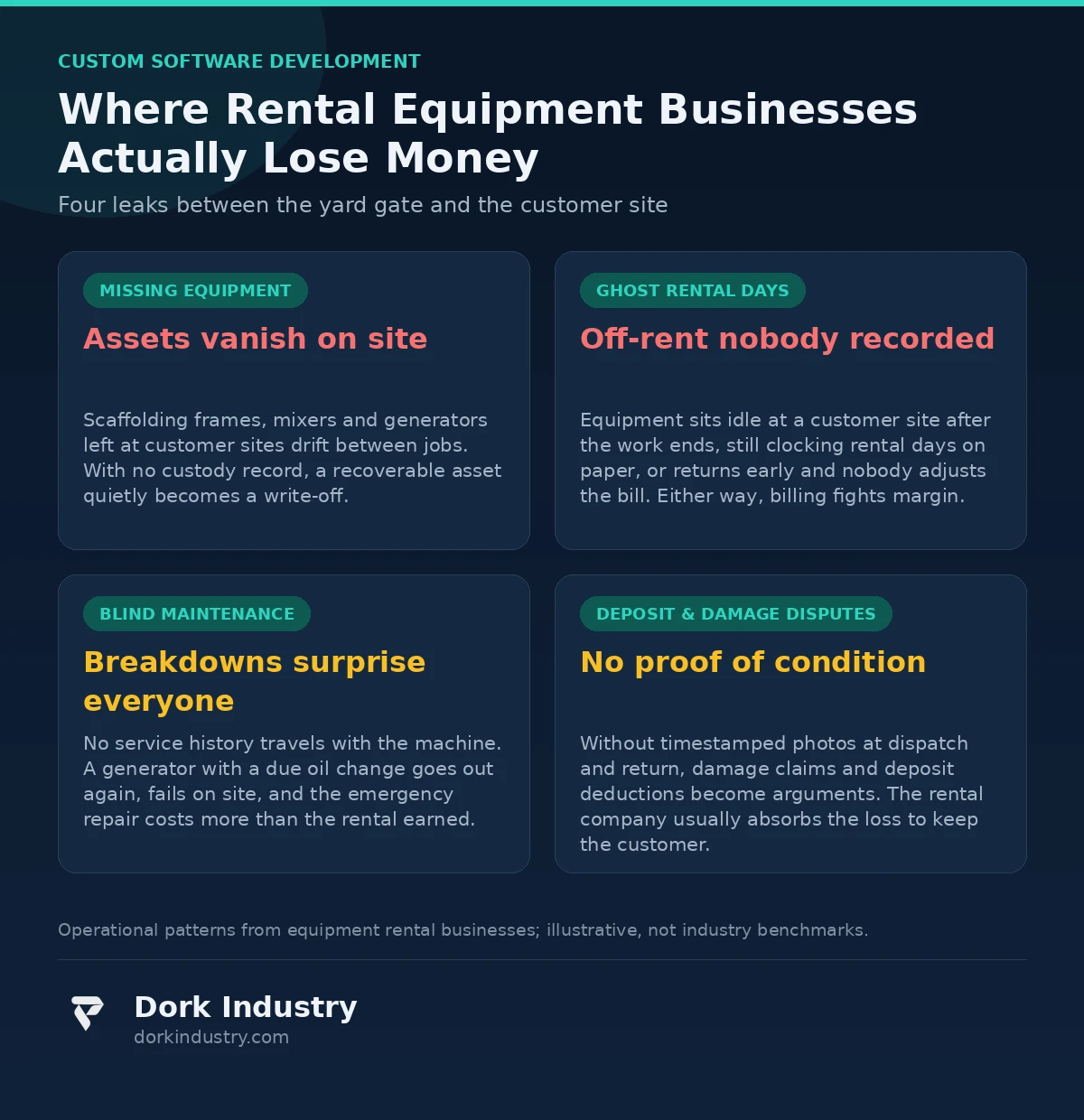
Before discussing technology, it is worth naming the specific leaks. In our experience working with equipment rental businesses, the expensive problems are not about fleet size or rental rates. They are about information that never gets recorded.
Why does equipment go missing at customer sites?
A rental register knows the machine went out on a date. It rarely knows which sub-contractor is holding it today, which of the customer’s three sites it is sitting at, or who signed for it. Steel scaffolding frames, props, plates, and couplers move between floors and sites within days of arrival. Without a custody record — a named person, a named site, a scan — a recoverable asset quietly becomes a write-off. When the yard finally reconciles, the shortfall is discovered months after anyone could have acted on it.
Why are rental days billed wrong?
Two failures collide. First, equipment often sits idle at a customer site after the work ends, still clocking rental days on paper while the customer refuses to pay for days they did not use. Second, returns come back early or in parts and nobody adjusts the bill. Without timestamped dispatch and return events, off-rent requests become phone-call arguments. The rental company either eats the disputed days or spends weeks chasing them.
Why does maintenance turn into emergency repair?
No service history travels with the machine. A generator with a due oil change or a compactor with a worn belt goes out on rent again because the yard register cannot tell the dispatcher it needs attention. It fails on the customer’s site, the customer demands a replacement, and the emergency repair plus the downtime costs far more than the rental earned. Preventive maintenance fails in rental businesses not from neglect but from invisibility.
Why are deposit and damage claims lost?
At dispatch, nobody photographs the condition. At return, a dent, a burnt winding, or a missing accessory is discovered with no evidence of when it happened. The customer disputes it, the deposit deduction becomes a relationship fight, and the rental company usually absorbs the loss to keep the account. Every undocumented handoff is a future write-off.
What must custom software development deliver for a rental operation?
A generic “asset tracking app” with a logo is not the answer. A rental operations system needs to cover five areas that map exactly to how rental businesses move equipment.
What should the owner see every morning?
- Every asset out on rent, with the customer, site, custodian, and days running
- Assets idle on customer sites past the work-end date — the recoverable-days list
- Overdue returns and assets that have not moved in N days
- Pending off-rent requests and disputed rental days awaiting resolution
- Machines due for service or blocked from dispatch until repaired
- Revenue earned per asset class and per customer, not just total billing
How does a real custody chain work?
Every movement is an event with four fields: which asset, from whom, to whom, and when — plus a photo. Dispatch scans the asset out to the customer; the customer (or their site supervisor) acknowledges receipt; site-to-site transfers within the customer’s operation get their own custody events; return scans it back to the yard. The register stops being a daily summary and becomes a provable chain of custody. When a mixer goes missing, the owner can see the last person who held it.
Why do QR tags beat spreadsheets at the yard?
According to the QR code standard, a single printed tag can carry an asset identifier readable by any phone camera — no special hardware, no pairing, no batteries. A weatherproof QR sticker costs almost nothing, survives yard conditions reasonably well, and lets any staff member scan a dispatch or return in seconds. For high-value powered assets like generators and compactors, RFID tags read at range without line of sight — according to the RFID overview, passive tags carry the asset identity without their own power source. The practical pattern: QR for consumable steel and small tools, RFID for powered machines, GPS trackers reserved for the highest-value fleet.
How should billing and off-rent work?
- Rental days accrue from timestamped custody events, not from the register date
- Off-rent requests are raised from the customer side with a photo, acknowledged by the yard
- Part returns split the rental cycle per asset, not per order
- Deposit holds and deductions link to the dispatch/return condition photos
- GST-compliant invoicing with per-asset rental lines for Indian rental businesses
How is maintenance tracked per machine?
Each powered asset carries its own service profile: operating hours, service intervals, last service date, and common failure parts. The system blocks dispatch of machines overdue for service, schedules the maintenance slot, and logs the repair with photos and parts. Breakdown-on-site becomes a measured metric instead of a surprise.
What data does your rental business already have — and what is it missing?
Most rental businesses already generate the raw material: dispatch registers, challans, delivery notes, customer ledgers, mechanics’ notebooks, and thousands of WhatsApp photos from sites. What is missing is structure — who has it now, when they got it, what condition it was in.
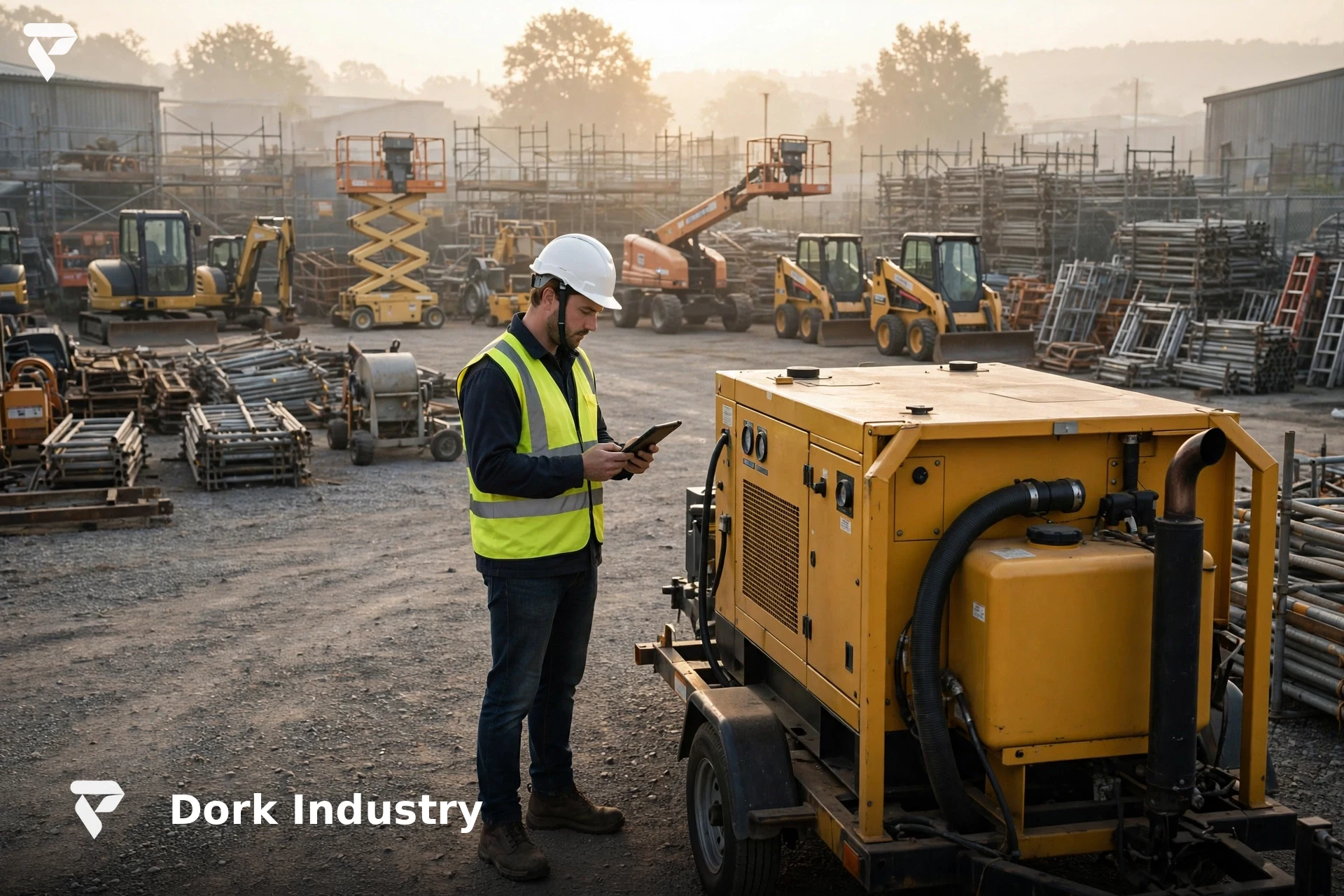
A rental operations system does not create new work for yard staff, and that principle should guide any custom software development for this industry: it captures the work they already do — dispatch, handover, return, repair — in a form the owner can actually use. Scanning a QR tag during a dispatch they are already making adds seconds. The most common implementation failure is designing for the owner’s dashboard while making data capture painful for yard staff. If the people scanning the tags do not benefit — faster dispute resolution, fewer arguments with customers — the data will be incomplete within weeks.
What does the math look like? An illustrative example
This section is illustrative: it uses round, stated assumptions to show where the leverage sits. It is not an industry benchmark.
Consider a mid-size rental yard with 200 assets. At any given time, roughly 120 are out on rent at an average of ₹800 per asset per day. That is about ₹28.8 lakh in monthly rental capacity. Now apply three realistic, illustrative assumptions: 5% of high-movement consumable assets (scaffolding, props, mixers) go missing or get written off each year at an average replacement value of ₹15,000 each — that is roughly ₹7.5 lakh in annual write-offs. Assume another 6% of billable rental days are disputed and written off — about ₹20.7 lakh a year at full utilization. Assume one emergency breakdown on a customer site per month at ₹25,000 all-in (repair, replacement machine, transport) — ₹3 lakh a year.
Cutting missing-asset write-offs by half recovers ₹3.75 lakh. Resolving half the disputed days through timestamped custody evidence recovers ₹10.4 lakh. Preventive service scheduling that halves on-site breakdowns saves ₹1.5 lakh. Together that is over ₹15 lakh a year for this illustrative yard — which is why the custody chain, not the dashboard, is the highest-leverage feature. The software does not need to be sophisticated to earn its cost; it needs to record four facts at every movement: which asset, to whom, when, and what condition.
Should you build or buy? An honest breakdown
Not every rental business needs custom software development. The honest options, in order of investment:
| Approach | Best for | Relative investment | Where it breaks |
|---|---|---|---|
| Registers + WhatsApp | A small single-yard operation with under 50 assets | Minimal | Breaks the moment assets sit on multiple customer sites |
| Off-the-shelf rental software | Standard dispatch, billing, and basic maintenance tracking | Low subscription | Cannot model custody chains, part returns, or site-to-site transfers |
| Rental ERP module | Businesses already running an ERP for accounts | Medium | Depot-centric design; yard scanning and custody photos are usually bolted on |
| Custom software development | Multi-site rental operations with custody disputes and billing leakage | Highest | Overkill if your real problem is just late invoicing |
At Dork Industry, we regularly advise rental businesses against custom builds when packaged software fits. If your billing leakage is really an invoicing-discipline problem, a configured off-the-shelf tool plus a 30-day process pilot will tell you that before you spend on development. A credible technology partner should be willing to tell you that you do not need custom development. If every consultation ends with a quotation for a custom platform, get a second opinion.
What should the system never do?
Technology boundaries matter as much as features in custom software development — especially where tracking and automation meet people.
- Never track people with the equipment tracker. GPS trackers go on the machine, not as a surveillance tool on your staff or the customer’s workers. Custody events name people for handoffs, not minute-by-minute location trails of individuals.
- Never auto-penalize customers. Flag idle-on-site equipment and disputed days for human review. Do not let software auto-deduct deposits or blacklist customers.
- Never send automated accusations. A reminder that equipment is still on site should read like a helpful check-in from the yard, with a human to reply to — not an automated demand.
- Never lock your asset register into a format you cannot export. Your equipment list and movement history are a business asset. Any platform must offer full data export.
- Never let the system decide fault in damage disputes. Condition photos are evidence for humans to decide on. AI can surface the before/after pair; it should not adjudicate who pays.
How do you test it in 30 days before full investment?
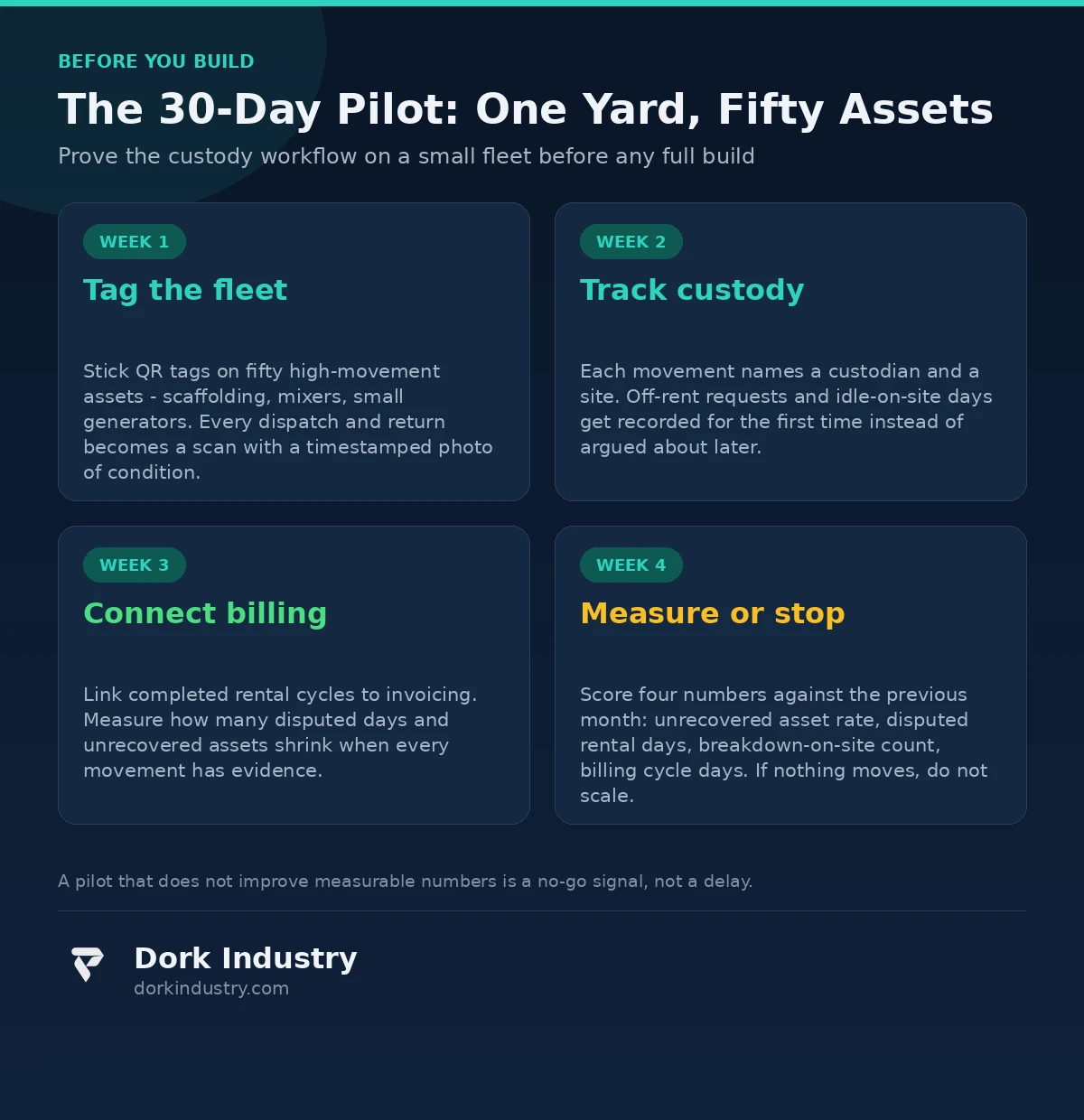
The lowest-risk path is a single-yard pilot with a fixed scope and measurable outcomes:
- One yard, fifty high-movement assets (scaffolding, mixers, small generators)
- Weatherproof QR tags on every asset; dispatch and return scans with condition photos
- Custody events for every movement, off-rent requests with photo evidence
- Run for 30 days
- Measure: unrecovered asset rate vs the previous month, disputed rental days, breakdown-on-site count, billing cycle days
If unrecovered assets and disputed days do not measurably improve in the pilot, a bigger custom software development investment will not fix it either. The pilot validates the custody workflow, not just the software. This is the assessment Dork Industry runs before quoting any rental project: map the current movement process, name the leaks, then decide what software earns its cost.
What actually drives the cost of custom software development for rental tracking?
Rental tracking pricing varies widely because scope does. The real cost drivers are:
- Yards and roles: single yard vs multi-yard with custodian hierarchies changes the data model significantly
- Tagging mix: QR-only is nearly free per asset; RFID readers for yard gates add hardware cost; GPS trackers add recurring SIM and battery logistics
- Field hardware: rugged phones for yard staff, or consumer phones — Android Enterprise rugged devices are standard for dust-and-drop yard conditions
- Billing integration: per-asset rental lines, part returns, off-rent adjustments, GST invoicing, and existing accounting software integration
- Platforms: Android only vs Android + iOS vs cross-platform web for the owner dashboard
- Maintenance module depth: service reminders vs full preventive-maintenance scheduling with parts inventory
Anyone quoting a fixed price without asking about yards, tagging mix, and how off-rent currently works is guessing.
Frequently asked questions
Does a rental equipment business need custom software development, or is rental software enough?
For a single yard with standard dispatch and billing, configured rental software is usually enough and far cheaper. Custom development earns its cost at multi-site scale, with custody disputes, part returns, and site-to-site transfers that packaged software cannot model.
How long does custom software development for rental tracking take?
A focused pilot (one yard, QR tagging, dispatch/return scans, owner dashboard) can be live in 4–6 weeks. A full multi-yard platform with RFID, billing integration, and maintenance scheduling typically runs 3–6 months depending on scope.
Will yard staff actually scan the QR tags?
Adoption follows value: if the system settles custody arguments in the yard’s favor and makes returns faster, staff scan it. If it is a surveillance tool imposed from above, tags get skipped. Design scanning into the dispatch they already do, not as an extra step.
Can QR tags survive construction sites and yards?
Yes — weatherproof adhesive tags rated for outdoor industrial use survive dust, rain, and rough handling for years at negligible cost per tag. Reserve RFID for powered machines where no-line-of-sight reading at the yard gate matters.
What does a rental tracking pilot cost?
A single-yard pilot with core workflows (tagging, dispatch/return scans, custody records, owner dashboard) is a fraction of a full build. The pilot’s job is to prove measurable improvement in unrecovered assets and disputed days before larger investment. Request a pilot scoping call for a concrete estimate.
About Dork Industry
Dork Industry (dorkindustry.com) is a custom software development company building mobile apps, AI automation, and IoT systems for businesses across India. Our team designs custom software development platforms — from rental equipment custody tracking and field-service mobile app development to industrial IoT — scoped from 30-day pilots to full multi-yard rollouts.
The bottom line
The question is not whether your rental business needs custom software development. It is whether you can answer four questions every morning: which assets are out, who holds them, which days are billable, and which machines are due for service. If the answer is no, the technology decision is really an operations decision wearing a software costume.
Start with the custody workflow, pilot it in one yard for 30 days, and let measured numbers on unrecovered assets and disputed days — not feature lists — decide whether to build further.
Running a rental yard and want to know what custody tracking would change in your specific operation?
We map your current dispatch, return, and billing process and show you exactly what software would (and would not) fix, before any development is discussed.
Request a rental operations assessment WhatsApp +91 8210792477
[…] A hybrid approach is often practical: retain Shopify or WooCommerce as the commerce system, keep the existing helpdesk, and build the secure orchestration between them. Dork Industry can assess that integration through its AI and ML implementation service, web development capability, and software integration work. If the immediate problem is a storefront defect rather than automation, see the related guide on a Shopify header not updating. […]
[…] web development, custom software and AI/ML implementation capabilities. The existing guide to a Shopify header that is not updating addresses theme repair; catalog enrichment is a separate product-data and integration […]
Comments are closed.