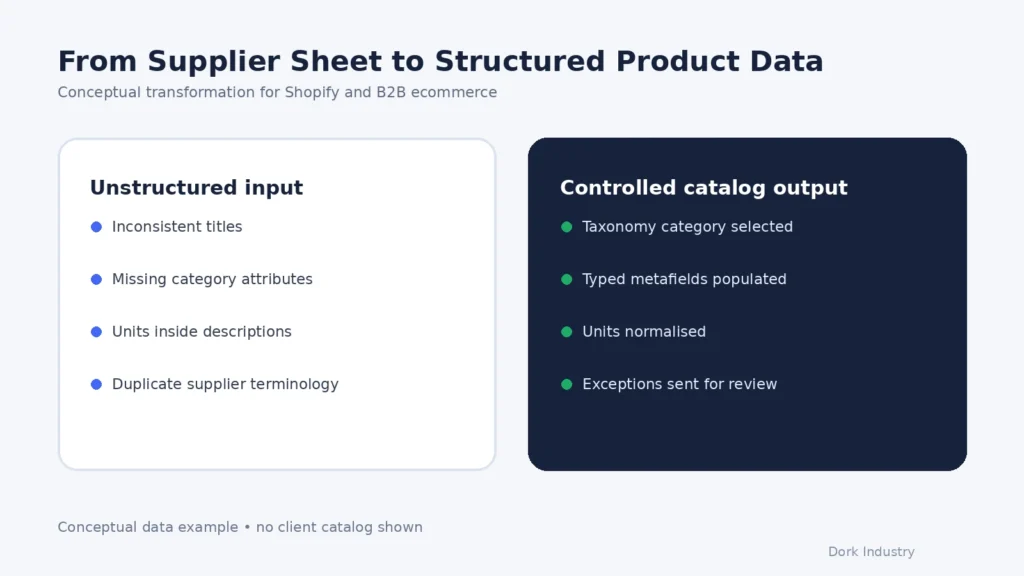
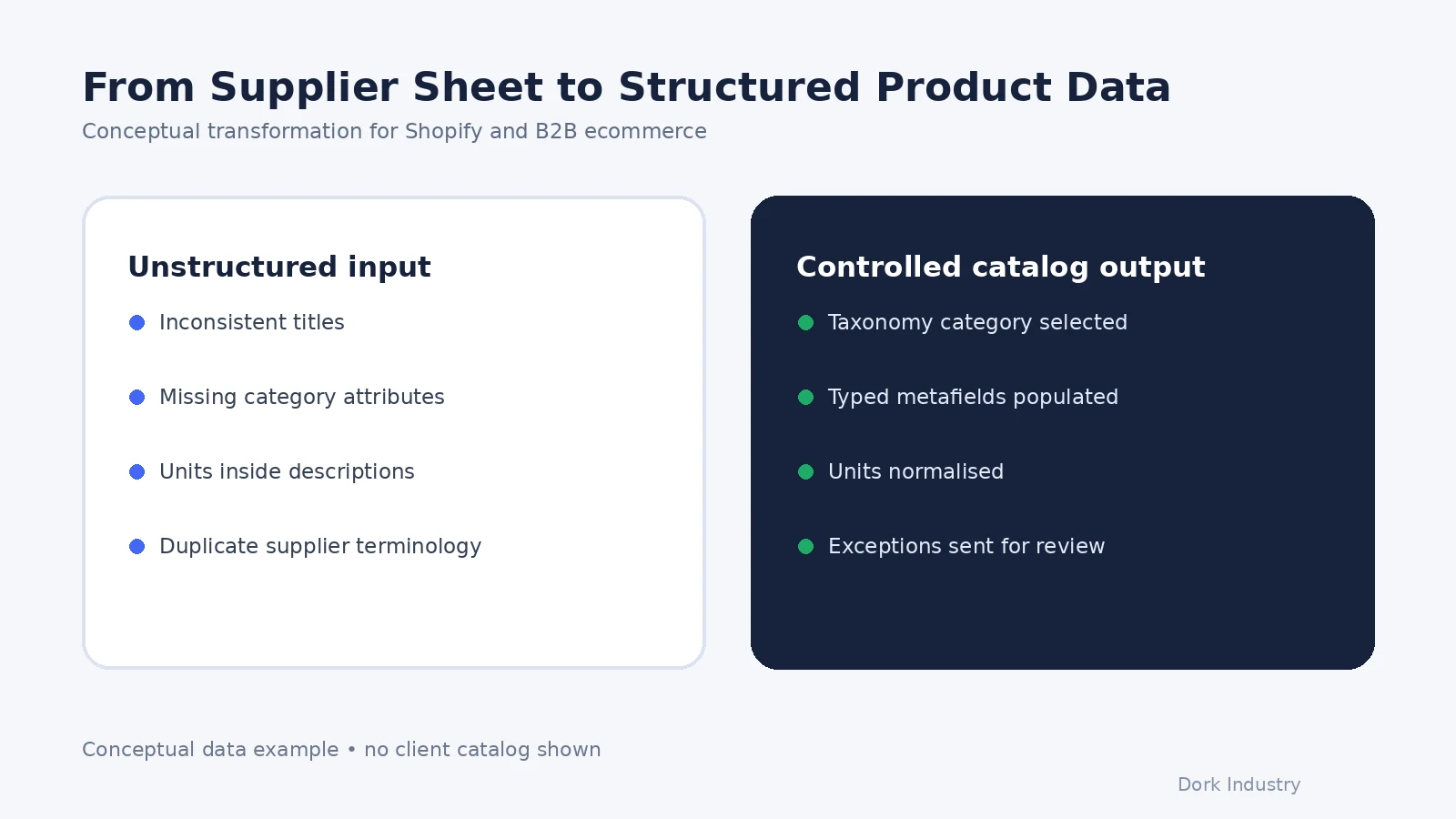
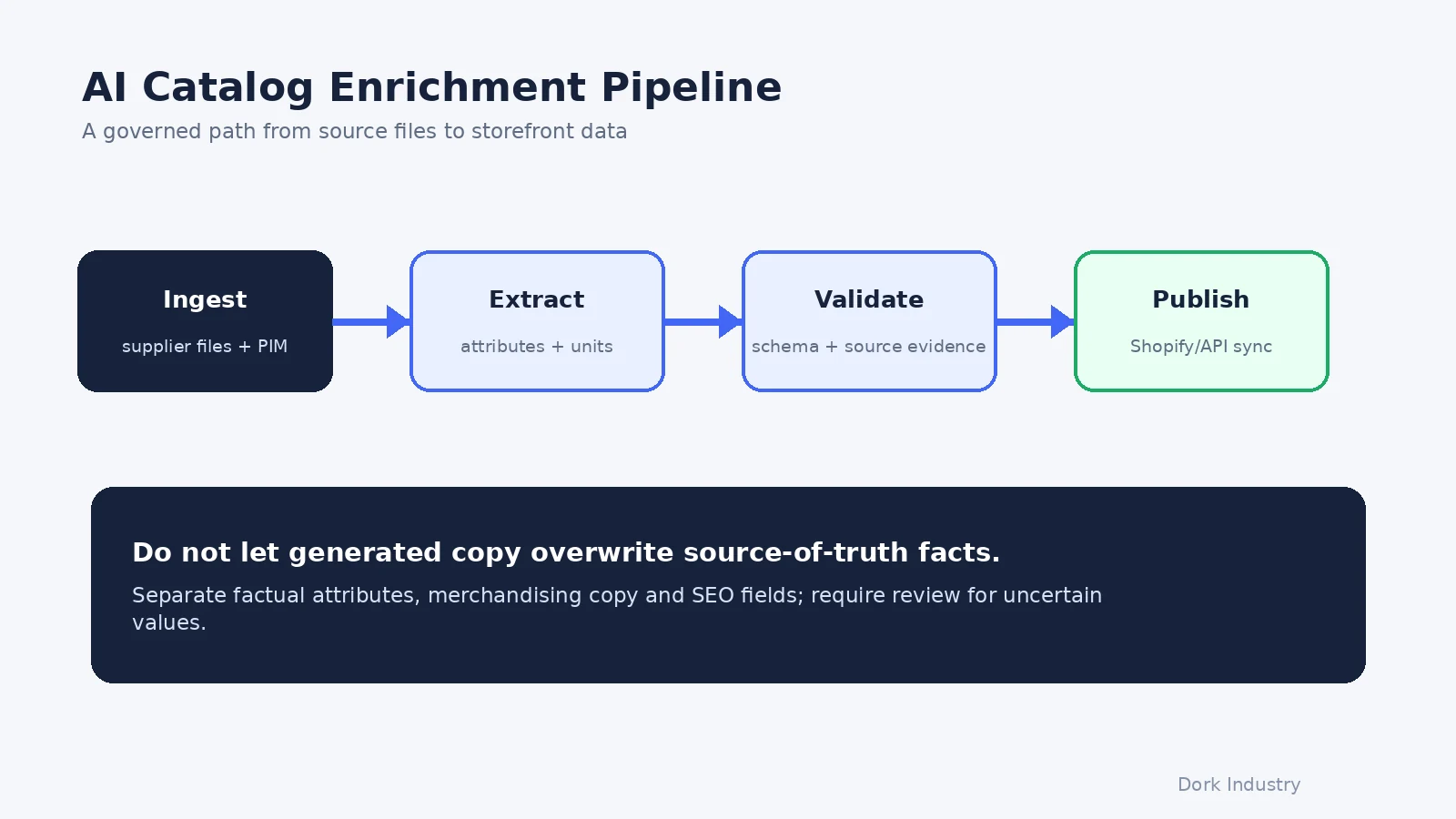
AI product catalog enrichment for Shopify should turn supplier files and unstructured descriptions into proposed categories, attributes and merchandising fields without overwriting verified product facts. The safe design separates extraction, generation, validation and publishing, and sends missing, conflicting or unsupported values to a human review queue.
This is a sales and operations problem as much as a content problem. Dork Industry can scope catalog enrichment as a Shopify integration, structured-data project, custom application or ongoing development-resource engagement.
Why does inconsistent product data block ecommerce growth?
Supplier spreadsheets often describe the same attribute in different columns, units or sentences. Teams then copy titles, specifications, variants and category information into Shopify manually. The visible symptom may be a weak product page, but the underlying problem is a missing product-data model and an unreliable publishing workflow.
Google describes product data as attributes such as title, description, color, price and availability, and explains that structured product data can help it understand and verify merchant information. Shopify’s developer documentation uses taxonomy categories and typed metafields to store structured product information. These sources support a structured-data approach; they do not justify generating unsupported claims. See Google’s product-data guidance and Shopify’s taxonomy-linked metafield documentation.
What should AI product catalog enrichment for Shopify handle?
AI can propose normalized titles, identify likely category attributes, extract specifications from source text, map supplier terminology, draft descriptions and flag duplicate or incomplete products. Each field needs a defined source and publication policy.
| Field type | Acceptable automation | Required control |
|---|---|---|
| Dimensions/specifications | Extract from supplied evidence | Do not infer missing facts |
| Category and metafields | Suggest from controlled taxonomy | Validate type and allowed values |
| Merchandising copy | Generate from approved facts | Reject unsupported claims |
| Price/availability | Sync from system of record | Never generate |
How should an AI catalog enrichment pipeline work?
- Ingest supplier sheets, PIM exports or ERP product records without losing source references.
- Map every category to an approved schema and required attributes.
- Extract factual fields with confidence and source evidence.
- Generate only permitted merchandising fields from approved facts.
- Validate units, types, variants, duplicate identifiers and required fields.
- Route uncertain values to a reviewer with the original evidence visible.
- Publish through controlled Shopify APIs and keep an audit history.
What belongs in the human review queue?
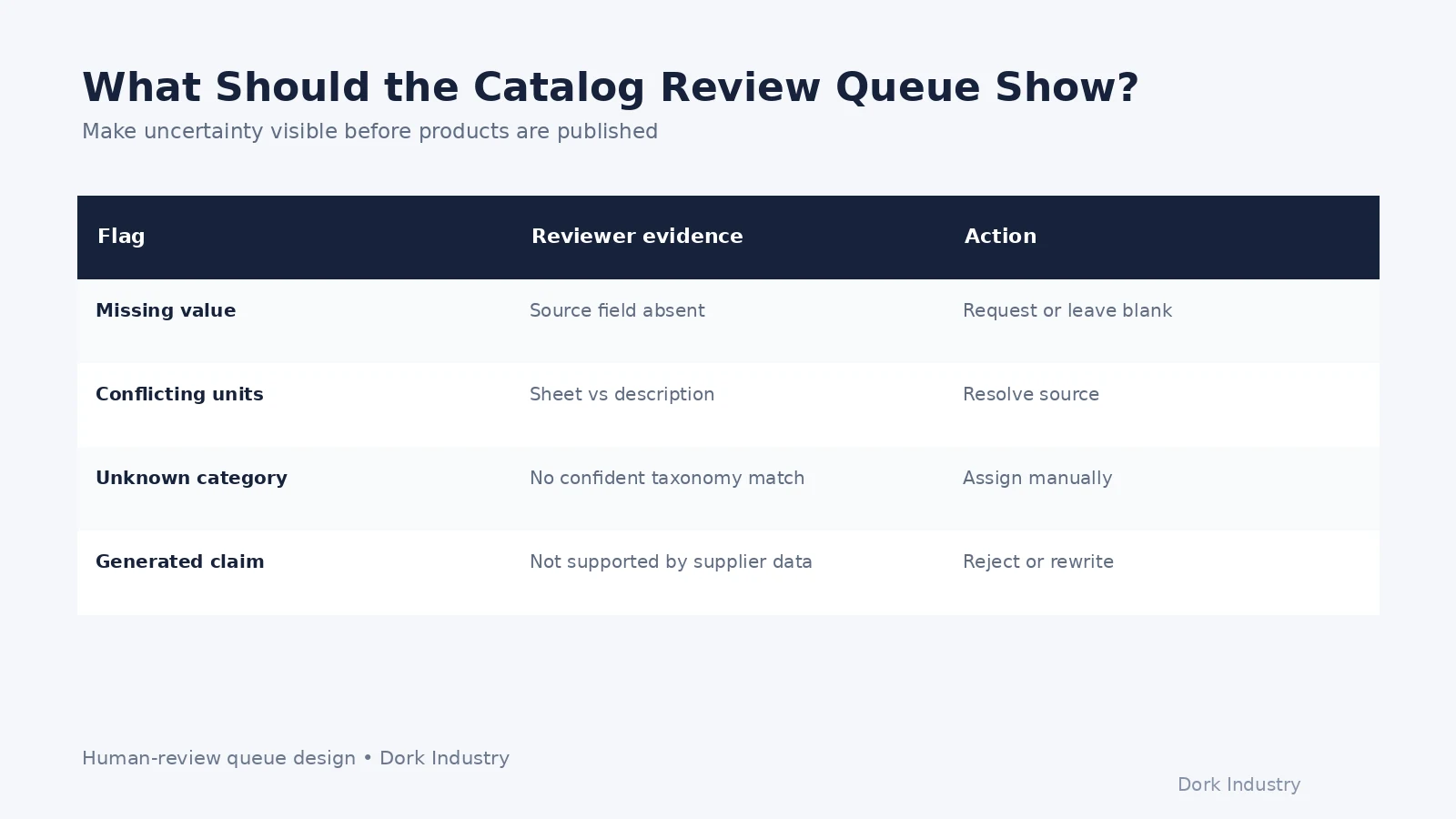
Review is required when the source omits a required value, uses conflicting units, contains several possible categories, disagrees with the existing product record, or when generated copy makes a claim not supported by supplier evidence. The queue should show the proposed value, confidence, source fragment, rule that failed and permitted actions.
Dork Industry can connect this workflow to its verified web development, custom software and AI/ML implementation capabilities. The existing guide to a Shopify header that is not updating addresses theme repair; catalog enrichment is a separate product-data and integration project.
How should a Shopify catalog enrichment pilot be evaluated?
Select products from several categories and suppliers, including variants, incomplete records, inconsistent units and duplicate terminology. Define a field-level answer key, then assess extraction, taxonomy mapping, generated-copy compliance and exception routing separately. A pilot is not complete until rollback, reprocessing and API-rate behaviour are tested.
When is custom catalog automation justified?
Custom development is justified when supplier formats change frequently, the store has category-specific attributes, several systems own different fields, or manual publication cannot maintain consistency. A smaller Shopify store with a stable catalog may need configuration and cleanup rather than a new AI application.
Plan a controlled catalog-enrichment pilot
Share a small anonymised supplier file, Shopify product structure, category schema and review rules. Dork Industry can determine whether the right solution is cleanup, app configuration, API integration or custom AI-assisted catalog software.
Frequently asked questions
Can AI write every Shopify product description automatically?
AI can draft descriptions from approved product facts, but automatic publication is unsafe when source data is incomplete or regulated claims are possible. Use templates, prohibited-claim rules and human review for uncertain or high-risk categories.
What is the difference between extraction and generation?
Extraction identifies information already present in supplier evidence. Generation creates new language from approved inputs. Keep them separate so the system cannot present invented specifications as facts.
Should price and inventory be enriched by AI?
No. Price and availability should come from authorised commerce, ERP or inventory systems. AI may help identify anomalies, but it should not generate values that create a commercial commitment.
Can the workflow use Shopify metafields?
Yes. Typed metafields can store structured attributes, while Shopify taxonomy categories can support consistent category-specific data. The implementation should define field ownership, validation and API publishing rules.
What products should be included in a pilot?
Use several categories, suppliers and variant structures. Include clean products and difficult records with missing fields, conflicting units, duplicate terminology and uncertain category matches.
Can Dork Industry build a Shopify catalog automation tool?
Dork Industry can review the catalog, source files, Shopify structure and required integrations before confirming scope. Delivery may involve app configuration, custom APIs, a review application or a broader product-information workflow.