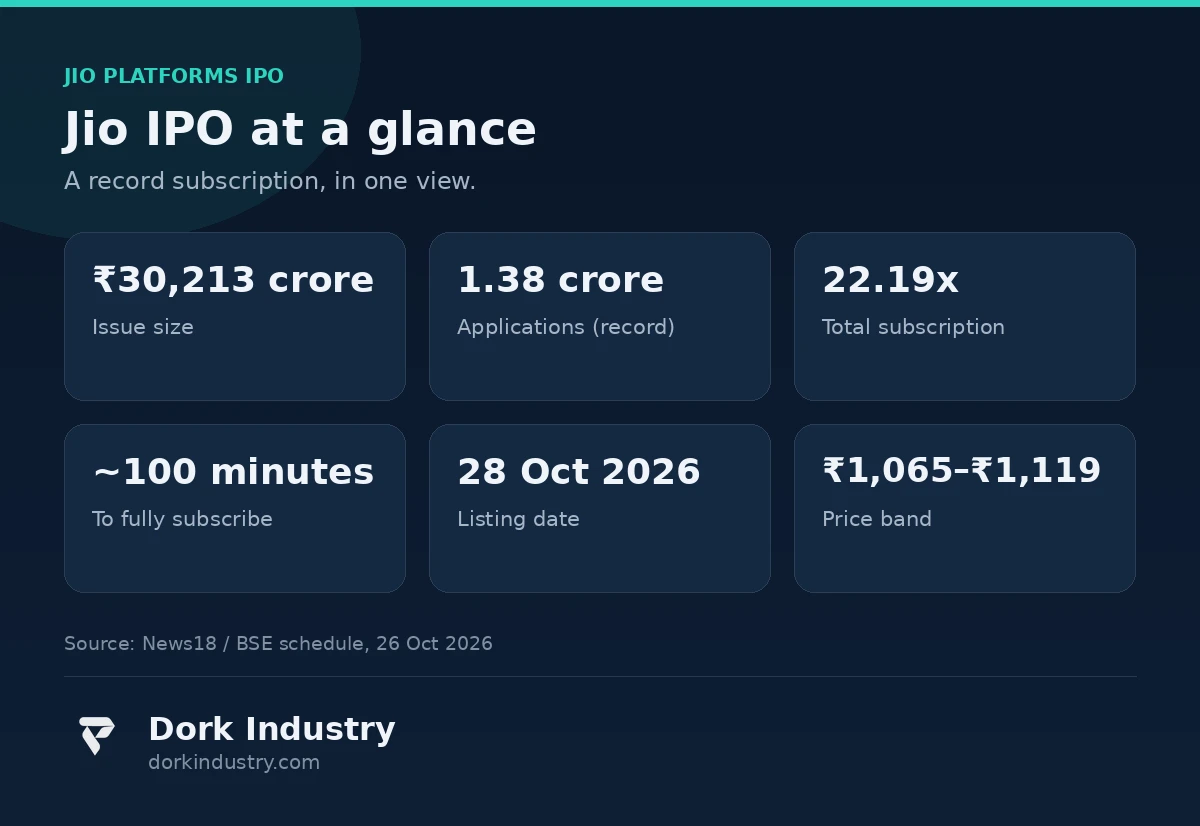
Mobile app development at crore scale is not a bigger server. It is engineering for the burst: queues that absorb the first seconds, backends load-tested beyond the expected peak, and failure modes that degrade gracefully instead of collapsing. Jio Platforms just proved what that burst looks like in India. Its ₹30,213-crore IPO drew a record 1.38 crore applications and was fully subscribed within about 100 minutes of opening on 21 October. Allotment was finalised on 26 October, with listing set for 28 October. For any team building a consumer app in India, that is the new bar: your app will face a crore users one day, and the question is whether it survives the hour they all arrive.
In brief: Jio’s IPO drew 1.38 crore applications in three days, subscribed 22.19 times. Apps break under such spikes from five predictable failures: onboarding queues, payment timeouts, retry storms, database exhaustion, slow cold starts. The fix is scale engineering before the spike: load tests at 2–3x peak, async queues, rate limits, a rehearsed game day.
Key takeaways:
- Mobile app development at crore scale means engineering for traffic spikes before they happen, not reacting during them.
- The five predictable failures are onboarding queues, payment timeouts, retry storms, database exhaustion, and slow cold starts.
- The fix is load testing at 2–3x peak, async queues, rate limits, and a rehearsed scale game day.
- The smallest safe pilot is one game day on staging: simulate 10x traffic, find the top 3 bottlenecks, fix, retest.
The IPO that proved crore scale
According to News18, Jio Platforms’ IPO opened on 21 October and closed on 23 October, receiving bids for about 421.87 crore shares against 19.75 crore shares on offer — subscribed 22.19 times overall. Qualified institutional buyers subscribed their portion 70.55 times, non-institutional investors 14 times, and retail investors 2.72 times. The issue attracted 1.38 crore applications, a record for an Indian IPO. The price band was ₹1,065–₹1,119 per share, with a minimum application of 12 shares (₹13,428 at the upper end). Allotment was finalised on 26 October through registrar KFin Technologies and the BSE and NSE; refunds and demat credits follow on 27 October, and shares list on 28 October.
This is the pattern of Indian consumer demand now. During the festive sales, Flipkart’s Big Billion Days drew 6.3 million concurrent users in its opening hour — six times a regular hour — with new customers up 34%. Meesho’s sale opened with orders up around 75% year-on-year on day one. The platforms that win are not the ones with the most features; they are the ones still standing at the end of the first hour. That is a mobile app development problem, and it is decided months before the spike, in architecture and testing.
Where apps break under a crore users
Apps rarely break from one bug — five predictable failures arrive together.
First, onboarding and KYC queues. A crore users do not arrive evenly; they arrive in the first minutes. Registration, OTP verification, KYC checks, and bank account linking all hit third-party systems at once. If any step is synchronous, the whole funnel stalls behind the slowest dependency.
Second, payment timeouts. Payment gateways and banks have their own limits. When APIs slow down, error, or time out, apps that assume every request will succeed crash or freeze — and each user retry adds load to a struggling system, turning a slowdown into an outage.
Third, retry storms and bots. A buggy app retrying in an endless loop, a bot farm firing hundreds of checkouts per second, scrapers polling prices, and millions of legitimate users refreshing — all at once. Without controls, the system cannot tell a genuine customer from noise, and it drowns in both.
Fourth, database exhaustion. Millions of concurrent requests and databases that cannot absorb spikes: two requests read the same last unit of stock and both sell it. Flash sales are load-shedding problems disguised as inventory problems — if only 1,000 users can succeed, the other 999,000 must fail fast, cheaply, and safely.
Fifth, the cold start. Launching from scratch is the most critical moment for retention: almost 50% of users uninstall after launch performance issues, and a third leave if loading takes more than 6 seconds. An app starting in 3 seconds normally can take 8 during a spike, as every launch network call — remote config, token refresh, feature flags — slows down. That is the moment users give up.
What scale engineering actually means
Scale engineering is a short list of disciplines, applied before the spike, not during it.
Load-test beyond the peak, not at it. Test at 2–3x the expected peak and fix the breaking point — whether it is the database, a queue, or a payment dependency — while there is still time.
Queues with backpressure. Onboarding, payments, and notifications go through async queues so bursts are absorbed, not crashed into. Queues need backpressure and dead-letter handling: when full, the system sheds load gracefully instead of accepting work it cannot finish.
Rate limiting per client. Limit requests per client and reject the excess with a clear 429. Across servers with a shared store, this stops bot farms, scrapers, and retry loops from eating genuine users’ capacity.
Graceful degradation. A spike has three phases: ignition (seconds, volume outruns any reaction), saturation (queues fill, errors climb), and recovery (autoscaling catches up). Most teams defend recovery and neglect ignition and saturation — exactly backwards, since the first two phases are where outages happen. The real defenses: an edge queue, cache stampede protection, and degradation that keeps the critical path alive.
Lazy initialisation. Only initialise what the first frame needs: UI, essential data, cached content. Defer analytics, crash reporting, remote config, feature flags, and push registration. This alone can cut cold start by 40–60% and makes the app far more resilient when every network call is slower.
Observability and explicit failure handling. Define timeouts for every request. Handle 4xx, 5xx, and malformed responses explicitly instead of assuming success. Cap retries. Monitor with crash reporting and analytics so the first sign of trouble is a dashboard alert, not one-star reviews.
| Spike phase | What breaks | The defense that holds |
|---|---|---|
| Ignition (first seconds) | Volume rises faster than autoscaling can react | Edge queue absorbs the burst |
| Saturation (minutes) | Queues fill, errors climb, retries compound load | Rate limits, backpressure, graceful degradation |
| Recovery (later) | Autoscaling catches up, caches warm | Pre-warmed capacity, runbook, staged re-admission |
What technology must never do alone
Four lines never to cross. Autoscaling without load tests is hope, not engineering — it reacts minutes after demand rises, not during the seconds that matter. Queues without backpressure just move the crash to the queue. Caching without invalidation serves stale prices to a crore users at once. More servers without database scaling only reach the same exhausted database faster. Each looks like scaling and behaves like a new failure mode.
Same for retries: a retry without a cap is a denial-of-service attack you run on yourself. Bound retries, back off, fail fast where users can retry safely.
Build in-house, hire an agency, or buy a dedicated team?
Three honest options. Building in-house gives control but needs platform and reliability skills that are slow to hire — and the spike will not wait for hiring. A generic agency ships features, but load testing is often an afterthought line item, not a discipline. Several Indian firms do offer proper load testing, so the shortlist question is whether a firm can show a game day it ran, a breaking point it found, and a fix it shipped before the spike.
The third option is a dedicated team with a scale mandate: architecture assessment, a game day that finds the top bottlenecks, fixes shipped and retested, and a runbook for spike day. That is how mobile app development should be bought when the next spike is a date on the calendar, not a hypothetical. We have covered the website version before — when traffic spikes crash a website — but apps break differently: on launch, in queues, and at payment time, inside an experience users cannot refresh away.
The smallest safe pilot: a scale game day
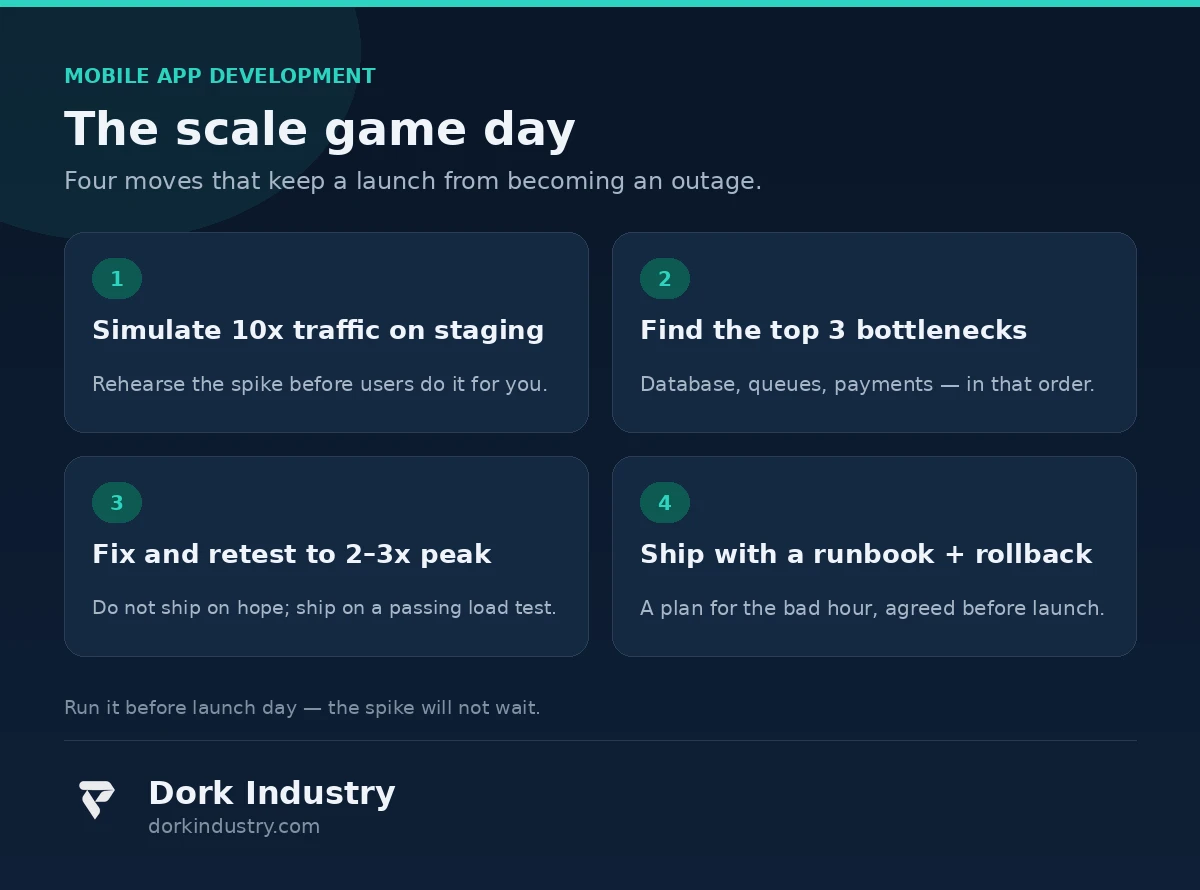
You do not need a six-month rebuild to survive the next spike. You need one game day, run before it:
Step 1 — simulate 10x traffic on staging. Replay a realistic burst: onboarding, KYC, payments, and the critical journey, all at once.
Step 2 — find the top 3 bottlenecks. It is almost always the database, a queue, or a payment dependency. Rank by user impact, not technical interest.
Step 3 — fix and retest to 2–3x expected peak. Ship the fixes, rerun the simulation, and confirm the breaking point moved beyond the expected spike.
Step 4 — write the runbook and the rollback. Rate limits, queue depths, database pool sizes, payment fallback, status page, and support staffing — decided in advance, not improvised during the outage.
The numbers behind this article
Jio IPO figures (₹30,213 crore issue, 1.38 crore applications, 22.19x subscription, ~100 minutes to full subscription, allotment 26 October, listing 28 October, price band ₹1,065–₹1,119) are as reported by News18 on 26 October 2026, consistent with the BSE/NSE schedule. Flipkart’s 6.3 million concurrent users and Meesho’s ~75% day-one order growth are as reported by Bank of America via Fortune India. Cold-start statistics come from a mobile performance engineering guide, not a controlled study. The 40x traffic-jump illustration comes from a published engineering essay about sale-day spikes, used as illustration, not a measured case.
Frequently asked questions
Why does my app keep crashing?
The most common causes are overloaded back-end servers during sudden spikes, unhandled exceptions, memory pressure, and device incompatibility. The fix is cloud infrastructure that scales dynamically, stress testing under peak conditions, and a resilient back-end architecture.
Why do apps crash during flash sales and traffic spikes?
High server load alone rarely crashes an app. The crash happens when the app cannot handle what an overloaded back end sends back — slow APIs, 5xx errors, timeouts, or incomplete responses — and the app assumes every request succeeded. Define timeouts, handle error responses explicitly, bound retries, and cache where stale data is safe.
How do you design a flash sale system that never oversells?
Treat it as a load-shedding problem, not an inventory problem. If only 1,000 users can succeed, the other 999,000 must fail fast, cheaply, and safely. Never check-then-decrement stock in separate steps — concurrent requests will oversell. Use atomic claims and queues so correctness holds under extreme concurrency.
How does rate limiting keep your system alive when everyone shows up at once?
Rate limiting controls how many requests each client can make, rejecting the excess with a 429 response. Across servers with a shared store, it stops bot farms, scrapers, and retry loops from consuming the capacity genuine users need — so the system serves real customers instead of drowning in noise.
The bottom line: Jio’s IPO is the clearest proof that crore scale is now normal in India. The apps that survive it are not the ones with the most features but the ones engineered for the burst: load-tested beyond the peak, queued, rate-limited, rehearsed. If your next spike has a date, the game day belongs before it, not after.
Expecting a traffic spike?
Get a free scale-readiness assessment: we run a game day on your app, find the top 3 bottlenecks, and give you a fix plan before your spike day — not after it.
Request a free scale-readiness assessment WhatsApp +91 8210792477
About Dork Industry: Dork Industry builds custom web, mobile, AI and IoT systems for businesses across India. Our editors and engineers write from production experience — every assessment, pilot framework and cost breakdown here reflects how real apps are scoped, tested, and handed over to the teams that run them. See our IT services for the full range.
Sources: According to News18, Jio’s IPO drew 1.38 crore applications with allotment finalised on 26 October 2026. Live allotment coverage from News18. Festive scale figures from Fortune India.