

Reviewed by Nishant Singh, Founder of Dork Industry. Nishant works across cloud engineering, DevOps, AI automation, data platforms and custom software delivery.
GPU cloud providers are platforms that rent access to graphics processors with the compute, storage and networking needed for AI and other parallel workloads. They should be compared by the cost of completing a useful AI workload, not by the advertised hourly GPU rate alone. For an Indian team buying capacity for model training, inference, computer vision, rendering or a proof of concept, the practical decision includes GPU memory, queue time, storage, data transfer, regional availability, security controls, support and the cost of moving away later.
This buyer guide gives founders, CTOs, CIOs and engineering leaders a repeatable way to shortlist a provider before signing a contract. It is especially relevant to Delhi and NCR teams, where Dork Industry’s target-market research and recent site analytics show the strongest addressable interest among the supplied North India markets.
Dork Industry research note: Google Ads Keyword Planner data retrieved on 16 October 2026 recorded approximately 260 average monthly searches in India for “GPU cloud providers,” 23.1% growth over the preceding three months, medium advertiser competition and a high top-of-page bid of approximately ₹507. Delhi also recorded measurable local demand and led the supplied target markets in recent Dork Industry site engagement. These are planning signals, not guaranteed traffic forecasts.
Need a workload-based GPU cloud assessment?
Dork Industry can profile your model, data path, latency target and security requirements, then design a small provider-neutral pilot before you commit to production capacity.
Which GPU cloud provider is best for an AI workload?
The best provider is the one that meets your workload’s memory, throughput, latency, availability, security and support requirements at the lowest verified cost per completed job or per successful inference. Shortlist two or three providers, run the same representative workload, measure the full bill and recovery behaviour, and only then choose a production platform.
That answer is intentionally different from a generic “top GPU cloud providers” list. One provider may be excellent for short experiments, another for multi-node training, and another for low-latency inference near Indian users. A single ranking cannot represent all four situations.
Why should you define the workload before comparing GPU cloud providers?
A comparison of GPU cloud providers is meaningless until the workload is measurable. Start by documenting what goes into the job, what must come out, and what a successful run looks like. For example, a training workload may be constrained by GPU memory and interconnect bandwidth, while an inference workload may be constrained by response time and cold starts.
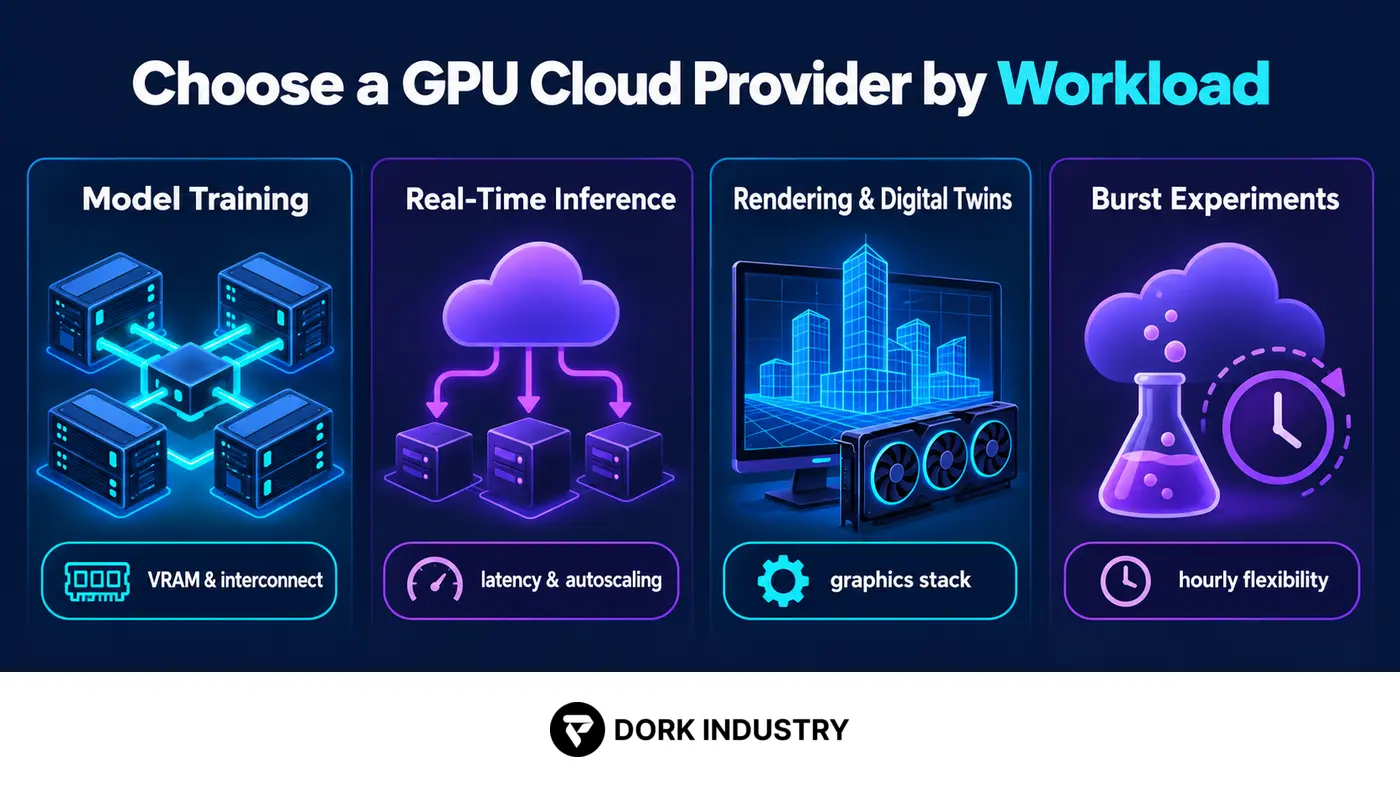
Record these six inputs before requesting quotes:
- Workload: training, fine-tuning, batch inference, real-time inference, computer vision, rendering or simulation.
- Model and framework: model size, precision, PyTorch/TensorFlow version, CUDA requirement and container image.
- Memory need: minimum VRAM per GPU, host RAM and temporary storage.
- Scale pattern: one GPU, multiple GPUs in one node, or distributed nodes with a high-speed interconnect.
- Service level: tolerated queue time, interruption policy, recovery time and production availability.
- Data path: dataset size, upload frequency, output size, retention, user geography and sensitivity.
Official cloud documentation confirms that GPU families differ by accelerator, memory, interconnect and intended workload, so GPU cloud providers must be evaluated against the same workload specification. AWS documents accelerated-computing instance families, Google explains GPU and machine-series mappings, and Microsoft maintains distinct GPU-optimized VM families. Use those specifications as inputs to a benchmark, not as substitutes for one.
GPU cloud providers in India: nine essential buyer checks
1. Is the required GPU actually available in the region?
A catalogue entry from GPU cloud providers does not guarantee immediate capacity. Ask whether the exact GPU, memory configuration and node count are available in the region you plan to use. For multi-GPU training, confirm topology and interconnect rather than assuming that several individual GPUs behave like one tightly connected system.
Request written answers for quota, expected provisioning time, reserved-capacity terms and the process when capacity is unavailable. If your launch depends on one scarce GPU family, define a tested fallback.
2. What is the cost per completed job?
For GPU cloud providers, hourly price is only one line in the bill. Measure wall-clock duration, GPU utilization, CPU and RAM, storage operations, snapshots, public IPs, observability, orchestration and data transfer. A faster but more expensive GPU can cost less per completed training run if it finishes materially sooner.
For inference, use cost per 1,000 successful requests or per million tokens at the required latency. For rendering, use cost per accepted frame. For computer vision, use cost per processed stream-hour. These unit economics let procurement compare different architectures fairly.
3. How quickly can the platform start useful work?
Track three separate delays across GPU cloud providers: account or quota approval, instance provisioning, and application warm-up. A cheap instance with long queues may be unsuitable for interactive experimentation or autoscaled production inference.
Run at least 20 start tests at different times. Record median and slow-case start time. If the provider offers interruptible or spot capacity, also record eviction frequency and the warning period.
4. Can interrupted work recover safely?
Training jobs on GPU cloud providers should checkpoint to durable storage at an interval that matches the interruption risk and checkpoint cost. Verify what happens when a node disappears, a disk detaches, a zone fails or a job exceeds its expected duration.
A production-ready design should include idempotent job submission, checkpoint validation, retry limits, failure alerts and a documented rollback path. This is where many comparison articles stop too early: infrastructure availability is not the same as application recovery.
5. Does the network fit the workload?
Network design is a major differentiator between GPU cloud providers. Multi-node training can be limited by east-west bandwidth and latency. Inference can be limited by distance from users, model-loading time or calls to databases and APIs. Ask for network topology, bandwidth limits, placement options and cross-zone charges.
For Delhi/NCR users, test from the networks and applications that will actually call the service. Do not use a provider’s internal benchmark as a proxy for end-to-end customer latency.
6. What are the data-residency and security controls?
Map personal, confidential and regulated data before choosing among GPU cloud providers or regions. The Digital Personal Data Protection Act, 2023 published by MeitY establishes obligations for processing digital personal data in India; the correct technical design depends on your role, purpose, notices, consent or other lawful use, retention and cross-border arrangements.
Ask about encryption in transit and at rest, customer-managed keys, private networking, identity federation, audit logs, vulnerability management, deletion evidence, incident notification and subcontractors. Legal review is still required for your use case; a cloud region alone does not create compliance.
7. Can you observe utilization, latency and cost?
GPU cloud providers should expose enough telemetry to track GPU utilization, memory utilization, temperature or hardware health where available, queue depth, job duration, request latency, error rate and cost allocation. Confirm that metrics and logs can be exported to your existing monitoring stack.
Set budgets and anomaly alerts before production. A platform that makes cost attribution difficult can turn a successful proof of concept into an uncontrolled operating expense.
8. How portable is the workload?
Container images, infrastructure-as-code, external model registries and standard observability reduce switching cost between GPU cloud providers. Portability does not mean every provider behaves identically; GPU drivers, storage, networking and managed services still create differences.
Document which components are portable and which are provider-specific. Estimate the time and data-transfer cost to move the model, dataset, checkpoints and serving stack. The exit plan should be tested while the environment is small.
9. What support is included when production fails?
Compare GPU cloud providers on support hours, response targets, escalation path, architecture help, quota assistance and responsibility for the GPU host, guest operating system, drivers, containers and application. Ask for a sample incident workflow.
A low-cost provider can still be the right choice for experiments. A customer-facing service may justify stronger support and reserved capacity. Match the contract to the business consequence of downtime.
Turn the checklist into a vendor-neutral pilot
Dork Industry can containerize the workload, automate provisioning, add monitoring and compare two shortlisted GPU cloud providers using the same acceptance criteria.
Request a GPU cloud pilot plan or WhatsApp +91 8210792477.
Which type of GPU cloud provider should you shortlist?
| Provider type | Often suits | Verify carefully |
|---|---|---|
| Hyperscale cloud | Teams that need integrated identity, networking, databases, managed AI services and global regions | Quota, complex billing, egress, idle resources and architecture lock-in |
| GPU-specialist cloud | Training, fine-tuning and experiments where rapid GPU access and simpler pricing matter | Regions, enterprise controls, networking, support depth and long-term capacity |
| Indian cloud or data-centre provider | Workloads that benefit from domestic regions, INR billing or local support | GPU range, orchestration features, portability and audited control evidence |
| Managed AI platform | Teams that value managed notebooks, pipelines, registries and deployment more than raw infrastructure control | Platform fees, supported frameworks, export path and custom networking |
| On-premise or colocation | Stable, highly utilized workloads with strict control or specialized integration needs | Capital cost, power, cooling, staffing, refresh cycle and spare capacity |
Examples of hyperscale GPU infrastructure include Amazon EC2 accelerated-computing instances, Google Compute Engine GPU machine types and Microsoft Azure GPU-optimized VM families. These are examples, not endorsements. Current regions, quotas, prices and terms must be verified directly with each provider.
How do you calculate the true cost of GPU cloud providers?
Use a total-workload model when comparing GPU cloud providers:
Total cost = GPU compute + CPU/RAM + storage + snapshots + data transfer + orchestration + observability + support + engineering time + expected interruption loss.
Then divide by a business unit: completed training run, accepted render, processed video-hour, 1,000 successful inferences, or another unit that reflects value. Include taxes and currency conversion where relevant.
A simple example without invented pricing
Suppose Provider A has a lower hourly rate but completes a benchmark in 10 hours, while Provider B costs more per hour but finishes in six hours. Add the storage, network and engineer time for both. The provider with the lower hourly rate may not have the lower cost per completed run.
Run the same container, dataset sample, precision, batch size and acceptance test. Record unsuccessful jobs separately; a failed run still consumes time and often incurs charges.
What security and integration requirements belong in the contract?
Do not leave security until after benchmarking GPU cloud providers. A provider that performs well but cannot meet identity, audit or data-handling requirements is not a viable finalist.
- Single sign-on, multifactor authentication and role-based access
- Private connectivity and restricted administration paths
- Encryption and key-management responsibilities
- Immutable or protected audit logs and export retention
- Image scanning, patching and driver update ownership
- Dataset, model and checkpoint deletion procedures
- Backup, restore and disaster-recovery objectives
- Incident-response contacts, evidence and notification terms
- Subprocessor visibility and contract exit assistance
Integrations should also be part of the pilot: source control, CI/CD, secrets manager, model registry, data store, observability, billing export and alerting. Dork Industry’s guides to AI agent development and Kubernetes development services explain adjacent application and orchestration decisions.
How can you test GPU cloud providers in 14 days?
- Days 1-2: define acceptance criteria. Choose one representative workload and set thresholds for output quality, completion time, latency, availability, security and budget.
- Days 3-4: package the workload. Create a versioned container, dependency manifest, test dataset and repeatable command. Store secrets outside the image.
- Days 5-7: deploy two finalists. Use infrastructure-as-code where possible. Configure identity, network restrictions, logs, budgets and checkpoint storage.
- Days 8-10: run repeated tests. Measure start time, execution time, utilization, failures, recovery, latency and every billed component.
- Days 11-12: test failure and exit. Interrupt a job, restore from a checkpoint, revoke credentials and export the workload and data.
- Days 13-14: score and decide. Apply the same weighted worksheet to both providers, document exceptions and approve only if the production risks have owners.
A pilot does not need to reproduce full production scale. It must expose the biggest economic and operational unknowns before a larger commitment.
GPU cloud provider procurement worksheet
Score each item from 1 (unacceptable) to 5 (excellent), multiply by the weight, and attach evidence for every shortlisted GPU cloud provider. Change the weights before testing so they cannot be adjusted to favour a preferred vendor afterward.
| Criterion | Suggested weight | Evidence to collect |
|---|---|---|
| Workload performance | 20% | Repeated completion time, throughput and quality |
| Total workload cost | 20% | Itemized bill and cost per accepted unit |
| Capacity and scaling | 15% | Quota, provisioning tests and reservation terms |
| Security and data controls | 15% | Control evidence, architecture and contract terms |
| Reliability and recovery | 10% | Checkpoint restore and failure test |
| Integration and observability | 10% | Working logs, metrics, alerts and CI/CD |
| Support and exit | 10% | Escalation drill and export test |
When should you buy cloud capacity, use a managed platform or build on-premise?
Buy GPU cloud capacity when demand is uncertain, bursty or changing, and speed of access matters. Configure a managed AI platform when the team benefits from integrated notebooks, pipelines, registries and deployment. Consider on-premise or colocation only after utilization is predictable and the organization can operate power, cooling, networking, security, spares and refresh cycles.
A hybrid design can be reasonable, but it adds data movement, identity, observability and operating complexity. Model the whole workflow before calling hybrid “the best of both worlds.”
What should a qualified GPU cloud implementation partner deliver?
A useful partner should deliver an evidence pack, not only a provider recommendation:
- workload and data-flow map;
- provider-neutral requirements and shortlist;
- repeatable benchmark and acceptance criteria;
- security, identity and network design;
- cost model and budget alerts;
- checkpoint, retry and disaster-recovery plan;
- infrastructure-as-code and deployment documentation;
- production handover, monitoring and exit plan.
Dork Industry provides cloud architecture, DevOps, AI integration, data engineering and application-development support. The engagement can begin with a focused proof of concept rather than a long platform commitment.
Get a decision-ready GPU cloud comparison
Send the model name, framework, dataset size, required region and expected workload pattern. Dork Industry will outline the pilot scope and the evidence needed for a purchase decision.
Frequently asked questions about GPU cloud providers
What are GPU cloud providers?
GPU cloud providers rent access to graphics processors and supporting compute, storage and networking. Organizations use them for AI training, inference, computer vision, scientific computing, rendering and other parallel workloads without buying and operating every GPU themselves.
How do I compare GPU cloud providers fairly?
Run the same representative workload with the same container, dataset sample and acceptance criteria. Compare cost per completed job, start time, throughput, latency, failure recovery, security controls, support and exit effort—not only the advertised hourly rate.
Which GPU is best for AI?
There is no universal best GPU. The right choice depends on model size, numerical precision, required VRAM, throughput, latency, interconnect, framework support and budget. Benchmark a suitable current-generation option against a lower-cost alternative using your own workload.
Are Indian GPU cloud providers better for data residency?
An Indian region can simplify some latency, billing or data-location requirements, but it does not automatically create compliance. Review the full data flow, contract, subprocessors, access controls, retention, deletion and applicable legal obligations.
Is a hyperscaler or a GPU-specialist cloud cheaper?
Either can be cheaper depending on utilization and the surrounding services. GPU specialists may offer simpler access or pricing, while hyperscalers may reduce integration work. Compare the full workload bill and engineering effort using the same benchmark.
When should a company buy GPUs instead of renting them?
Buying may be viable when demand is stable and high, hardware will remain useful, and the organization can operate power, cooling, networking, security and spares. Include financing, downtime, staff and refresh costs before comparing ownership with cloud rental.
Can Dork Industry migrate an existing AI workload between providers?
Yes. Dork Industry can assess dependencies, containerize the workload, define infrastructure as code, move model artifacts and data, add observability, test performance and plan cutover and rollback. Scope depends on the current platform, data volume and production requirements.
Sources and further reading
- Amazon EC2 accelerated-computing instance specifications
- Google Cloud: Understand GPUs
- Microsoft Azure virtual-machine size families
- Ministry of Electronics and Information Technology: Digital Personal Data Protection Act, 2023
- NIST AI Risk Management Framework
Last reviewed: October 2026. Cloud capacity, hardware, regions, prices and terms change frequently; verify current provider documentation and obtain legal advice for your specific obligations.
Discuss this for your business?
Book a free consultation — we scope the problem, outline the approach, and give you an honest verdict before any development is discussed.



[…] Theme code rarely controls the core hosted payment-method list, but custom carts, checkout extensions, payment customizations and apps can influence the journey or eligibility. If the cart itself is broken, use the Shopify Add to Cart repair guide. If a promotion changes the outcome, compare the Shopify discount diagnosis. […]