
Custom CRM development cost for a multi-branch distributor should be estimated from the dealer workflow, territory rules, quotation process, data migration, integrations, security and adoption plan—not from the number of screens. As a practical India planning range, a focused CRM MVP may require roughly ₹6–15 lakh, while an integrated multi-branch platform can move into ₹15–40 lakh or more. These are scoping bands, not fixed quotations; the approved requirements and acceptance tests determine the real price.
Quick answer for buyers
Buy a standard CRM when your pipeline and dealer workflow are conventional. Configure an existing platform when most processes are standard but fields, approvals and integrations differ. Build custom only when territory logic, dealer hierarchy, quotation rules, integrations or ownership requirements create measurable business value that standard products cannot deliver safely.
This guide is for distributor owners, sales directors, operations heads, CIOs and finance approvers who are losing enquiries or reporting time across branches, spreadsheets, messaging apps and disconnected accounting tools. It provides a cost model, build-versus-buy test, requirements worksheet and payment gates that can be used before inviting proposals.
What should a distributor know before budgeting a custom CRM?
- Price the complete lead-to-order workflow, not a generic list of CRM features.
- Separate discovery, configuration, custom development, migration and integration in every estimate.
- Do not automate a broken territory or approval rule before management resolves it.
- Include mobile adoption, data ownership and exception handling in the first release.
- Compare three-year total cost of ownership, not only the initial development quote.
- Tie payments to inspectable workflow, reconciliation and handover evidence.
Are dealer enquiries disappearing between branches?
Dork Industry can map your lead, dealer, quotation and follow-up workflow before you pay for CRM development.
Why was this keyword and buyer problem selected?
External Google Ads Keyword Planner research on 18 October 2026 measured approximately 50 monthly searches in India for custom CRM development cost, with a 600% three-month increase. The United States showed approximately 90 monthly searches and 75% three-month growth, alongside high commercial bid values. Search volumes are directional, but the query clearly represents a buyer comparing investment before contacting a development partner.
The distributor angle is deliberate. Dork Industry’s existing content does not own this exact decision. The closest page was a custom API hiring guide at only 46.4% similarity, and the admission gateway approved this topic for drafting. Focusing on multi-branch dealer operations prevents another broad “software company” article while retaining the measured commercial keyword.
What do the five leading CRM cost pages miss?
The current leading results from Ouranos Technologies, Appinventiv, Webisoft, ZTABS and SolGuruz explain complexity, features, team location, development stages, total cost and broad build-versus-buy decisions. Several include detailed price ranges, diagrams and consultation CTAs.
The missing buyer value is operational specificity. A distributor needs to know how a quote changes when the same dealer buys across branches, a field representative changes territory, quotations require margin approval, enquiries arrive through WhatsApp, or ERP stock and credit limits must be checked before an order is promised. This guide turns those situations into scope, acceptance tests and cost controls.
What problem should the CRM solve first?
Start with the revenue leak. Do not begin with “we need leads, contacts and dashboards.” A distributor should document where ownership or information currently breaks:
- A website or WhatsApp enquiry is copied manually into a spreadsheet.
- Two branches contact the same dealer without seeing each other’s activity.
- A quotation waits for price or discount approval without an escalation.
- A salesperson leaves and follow-up history remains on a personal phone.
- The CRM shows a promising deal, but accounting shows overdue credit.
- Management receives pipeline figures days after the review meeting.
A testable requirement is stronger than a feature request. Instead of “add lead assignment,” write: “When a dealer enquiry enters from the website or approved messaging channel, match it against the dealer master, assign it using product and territory rules, notify the owner, start the response timer and escalate if no qualified action is recorded.”
What actually drives custom CRM development cost?
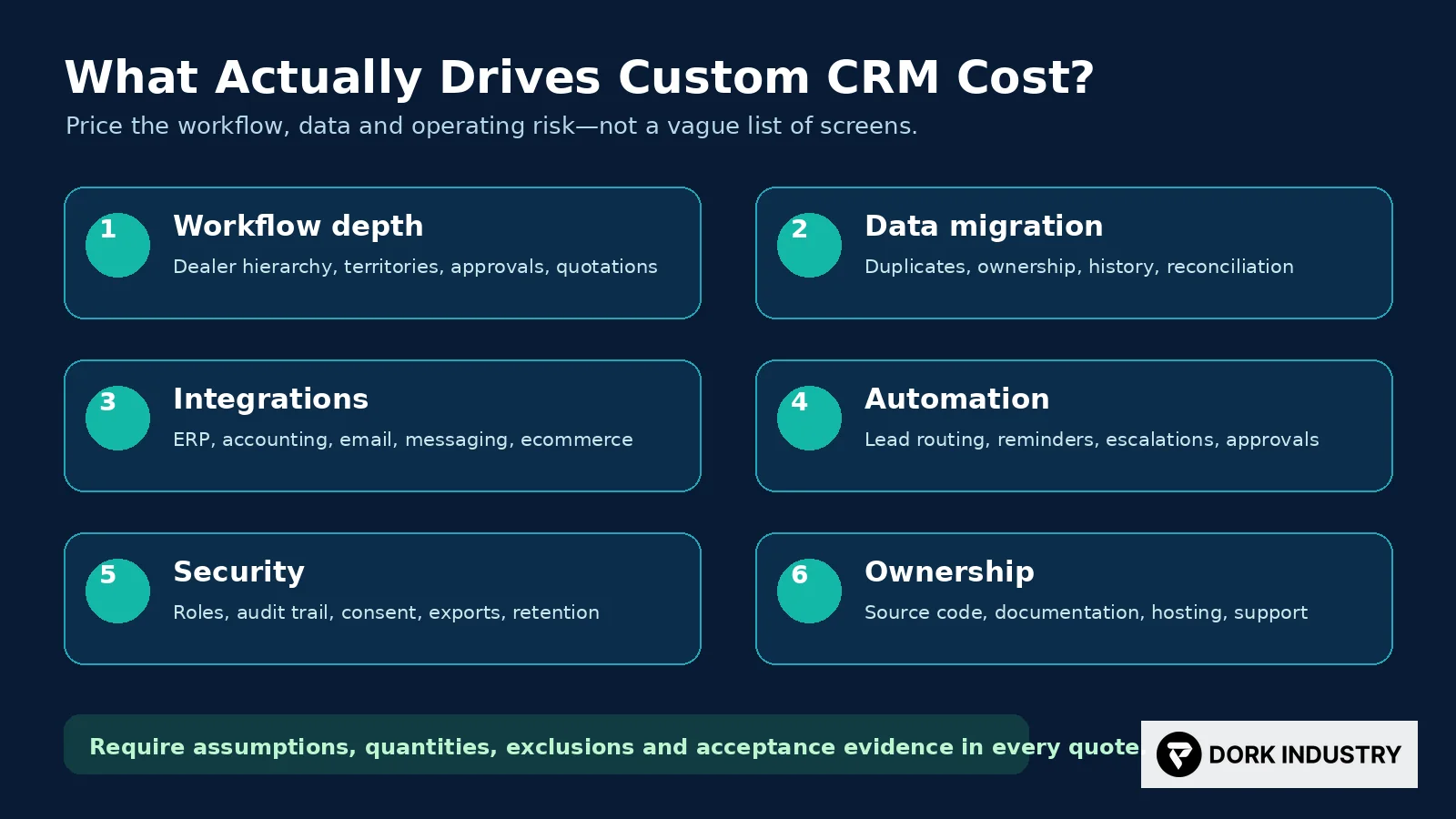
| Cost driver | Distributor questions that change the price |
|---|---|
| Workflow depth | How many branch, dealer, product, territory, approval and quotation variations exist? |
| Data migration | How many spreadsheets and systems contain duplicate dealers, contacts, history and open opportunities? |
| Integrations | Must CRM read stock, pricing, credit, invoices or dispatch status from ERP or accounting? |
| Automation | Which routing, reminders, approvals, escalations and activity summaries are genuinely valuable? |
| Security | Which roles can view margins, export contacts, reassign territories or approve discounts? |
| Ownership | Who owns source code, environments, documentation, backups, monitoring and release access? |
Design polish, mobile applications, offline operation, multilingual support, analytics, AI assistance and complex document generation also add effort. The correct estimate exposes each item instead of hiding everything inside “advanced CRM.”
What planning budget should an Indian distributor use?
The following are Dork Industry planning bands for early discussion, not market guarantees or fixed offers:
| Solution level | Illustrative scope | Planning band |
|---|---|---|
| Discovery blueprint | Workflow mapping, fit-gap, data audit, integration plan, prototype and backlog | ₹1.5–4 lakh |
| Focused CRM MVP | Lead capture, dealer master, pipeline, tasks, basic quotations, roles and reports | ₹6–15 lakh |
| Integrated multi-branch CRM | Territories, approvals, ERP/accounting integration, migration, mobile workflow and analytics | ₹15–40 lakh |
| Enterprise programme | Multiple companies, complex integrations, offline apps, advanced security, AI or extensive automation | ₹40 lakh+ |
A credible partner should replace these bands with a component estimate after discovery. If two quotations differ sharply, compare excluded migration, integration error handling, training, QA, cloud operations and warranty before assuming one team is cheaper.
Should you build, configure or buy the CRM?

Buy a standard CRM when:
- Your lead stages, assignments and reports are conventional.
- The team can adopt the product’s workflow without material revenue or control loss.
- Fast implementation matters more than owning a differentiated process.
Configure an existing platform when:
- Most capabilities are standard, but fields, permissions, automations and integrations differ.
- Supported extensions can close gaps without creating an upgrade trap.
- Subscription and implementation costs remain reasonable over three years.
Build custom when:
- The dealer hierarchy or territory model cannot be represented safely in standard tools.
- Quotation, margin, credit or fulfilment rules create a genuine competitive advantage.
- Deep ERP, ecommerce, messaging or proprietary-data integration is central to the workflow.
- Roadmap control and software ownership justify the operating responsibility.
Do not custom-build email, calendars, authentication or common analytics merely because developers can. Connect dependable services where they fit and reserve custom work for valuable operating differences.
How should CRM integrations be costed?
An integration is not simply an API connection. Each interface needs a system of record, data contract, frequency, authentication method, duplicate rule, retry behavior, error queue, reconciliation report and support owner.
For example, showing ERP inventory inside CRM requires decisions about warehouses, reservations, stale data and failed synchronization. Promising stock from an outdated value can damage a dealer relationship. Our custom API development hiring guide explains the evidence buyers should require for resilient interfaces.
How should old dealer and lead data be migrated?
- Inventory every source: spreadsheets, email exports, accounting tools and existing CRM databases.
- Define the dealer identity and duplicate-matching rules.
- Assign owners for customer, contact, territory, activity and opportunity data.
- Clean invalid, incomplete and conflicting records before loading.
- Run trial migrations and reconcile counts, values and exceptions.
- Approve the final delta load, source freeze and rollback plan.
Migrating every historical note can cost more than the value it provides. Retain information required for active selling, service, compliance and reporting; archive the rest under an approved retention policy.
Which security and privacy requirements belong in the quote?
A distributor CRM may contain contact details, commercial terms, sales activity and credit-related information. Requirements should cover role-based access, least privilege, export control, audit logs, encryption, backup recovery, session security, administrator actions, data retention and incident response.
Use the OWASP Application Security Verification Standard to make application-security expectations testable, and the NIST Secure Software Development Framework to define secure-development practices. Your legal advisor should identify the privacy and sector rules that apply to the organisation and its markets.
What should the first release include?
A practical first release for a multi-branch distributor could include:
- Website, email and approved messaging lead capture.
- Dealer and contact master with duplicate prevention.
- Branch, territory, product and salesperson assignment.
- Opportunity stages, next action, ageing and escalation.
- Quotation creation with price or discount approval.
- Activity history that remains with the business.
- Role-based dashboards for representatives, managers and leadership.
- One critical ERP or accounting integration.
Delay low-value AI, decorative dashboards and unusual automation until clean data and consistent use are proven. AI can summarize activities, suggest next actions or classify enquiries later; it cannot repair unclear sales ownership or unreliable source data.
How do you calculate three-year CRM ownership cost?
Use this worksheet:
Three-year TCO = discovery + configuration/development + integrations + migration + testing/security + training/cutover + licences/cloud + maintenance + internal administration + planned enhancements − retired-tool savings.
| Worksheet item | Your input |
|---|---|
| Number of branches, companies and user roles | __________ |
| Priority workflows and approval variations | __________ |
| Data sources and approximate record counts | __________ |
| Mandatory integrations | __________ |
| Mobile, offline and language requirements | __________ |
| Required launch date and blackout periods | __________ |
| Internal product owner and data owners | __________ |
| Three-year licence, cloud and support estimate | __________ |
Which acceptance gates should control vendor payments?
- Discovery accepted: workflow maps, problems, scope, exclusions and measures approved.
- Blueprint accepted: roles, data model, integrations, migration and release plan approved.
- Working workflow accepted: priority lead-to-quotation scenarios demonstrated with evidence.
- Migration accepted: trial-load counts and exceptions reconciled by business owners.
- UAT accepted: critical scenarios pass, severe defects close and users are trained.
- Handover accepted: code, environments, documentation, monitoring and support ownership transfer.
The software RFP should include these artifacts rather than asking vendors only for “features, timeline and best price.” See Dork Industry’s custom software RFP checklist for a broader procurement structure.
What are the red flags in a custom CRM quotation?
- A fixed price appears before anyone maps the actual distributor workflow.
- Data migration is described as a simple import with no reconciliation.
- Integrations omit failures, duplicates, monitoring and support ownership.
- The proposal includes AI without naming the decision, data or human approval.
- Source code, hosting accounts, documentation and release access are unclear.
- User training and adoption are excluded from the project plan.
- Payments depend only on calendar dates rather than accepted evidence.
What low-risk pilot should you run first?
Select one region, one branch group and one high-value workflow for four to six weeks. Import a controlled dealer sample, capture enquiries from one or two channels, route them through real territory rules, create quotations and measure response time, follow-up completion, duplicate rate and user adoption. The pilot should test assumptions—not pretend to be a miniature final system.
Need a defensible CRM budget before inviting vendors?
Dork Industry can turn your distributor workflow into a fit-gap, phased backlog, integration map and cost range. You can use the blueprint with us or as an independent procurement document.
Frequently asked questions
How much does custom CRM development cost in India?
A focused CRM MVP may fall around ₹6–15 lakh, while an integrated multi-branch solution may require ₹15–40 lakh or more. These are planning bands. Workflow depth, migration, integrations, mobile access, security, QA and handover determine the actual estimate.
Is a custom CRM cheaper than Salesforce, Dynamics 365, Zoho or Odoo?
Not automatically. Compare three-year ownership cost and workflow fit. A standard platform may be cheaper and faster for conventional sales processes; custom development may be justified when unique rules or deep integrations produce measurable value.
How long does custom CRM development take?
A focused MVP can often be delivered in stages, while an integrated multi-branch programme needs longer for discovery, migration, integrations, UAT and rollout. Ask for phase exit criteria rather than accepting an unsupported number of weeks.
Can WhatsApp enquiries be connected to a CRM?
Yes, using an approved business messaging route and a defined consent, identity-matching and ownership workflow. The design should prevent duplicate leads and keep business conversations under organisational control.
Should the CRM include AI in the first release?
Only when the use case, data and human approval are clear. Establish reliable lead ownership, activity capture and reporting first. Add AI where it can measurably improve classification, summaries or next-action support.
What should we own after development?
The contract should clearly state ownership and access for source code, repositories, cloud environments, databases, deployment pipelines, documentation, third-party accounts, backups and operational runbooks.
If you are shortlisting a partner for this kind of system, see our comparison of best AI automation companies in India, which covers eight providers on delivery, integrations and governance.
Planning a budget for this?
Book a free consultation — we scope the requirements, outline the cost drivers, and give you an honest estimate range before any development is discussed.
About the author: The Dork Industry Editorial Team creates implementation-focused guidance with input from CRM, ERP, software, API integration, cloud and automation practitioners. Recommendations are grounded in buyer requirements, current primary technical sources and practical delivery controls.
Research note: Keyword, cannibalization and live competitor research was completed on 18 October 2026. Keyword Planner figures are directional averages and can change by market, date and match behaviour. Budget bands are early planning estimates, not fixed quotations.
[…] Theme code rarely controls the core hosted payment-method list, but custom carts, checkout extensions, payment customizations and apps can influence the journey or eligibility. If the cart itself is broken, use the Shopify Add to Cart repair guide. If a promotion changes the outcome, compare the Shopify discount diagnosis. […]