
healthcare app development for clinics is rarely about the app itself — it is about whether the doctor can see the day before it begins. Yes: a well-designed clinic app can give a doctor and their front-desk staff real control over appointments, no-shows, queues, patient records, and payments — but only if it is built around how a busy OPD actually works and piloted with one doctor before a full rollout. A clinic seeing 50 to 60 patients a day loses money in ways no extra staff member can fix: booked patients never arrive, the waiting room overflows while morning slots sit empty, consultation fees are collected days later (or never), and every repeat visit starts with lost history.
This article examines whether healthcare app development can give a clinic real operational control: what the app must do, what data it needs, where the technology must never cross a line, how to test the idea in 30 days, and when you should not build anything custom at all.
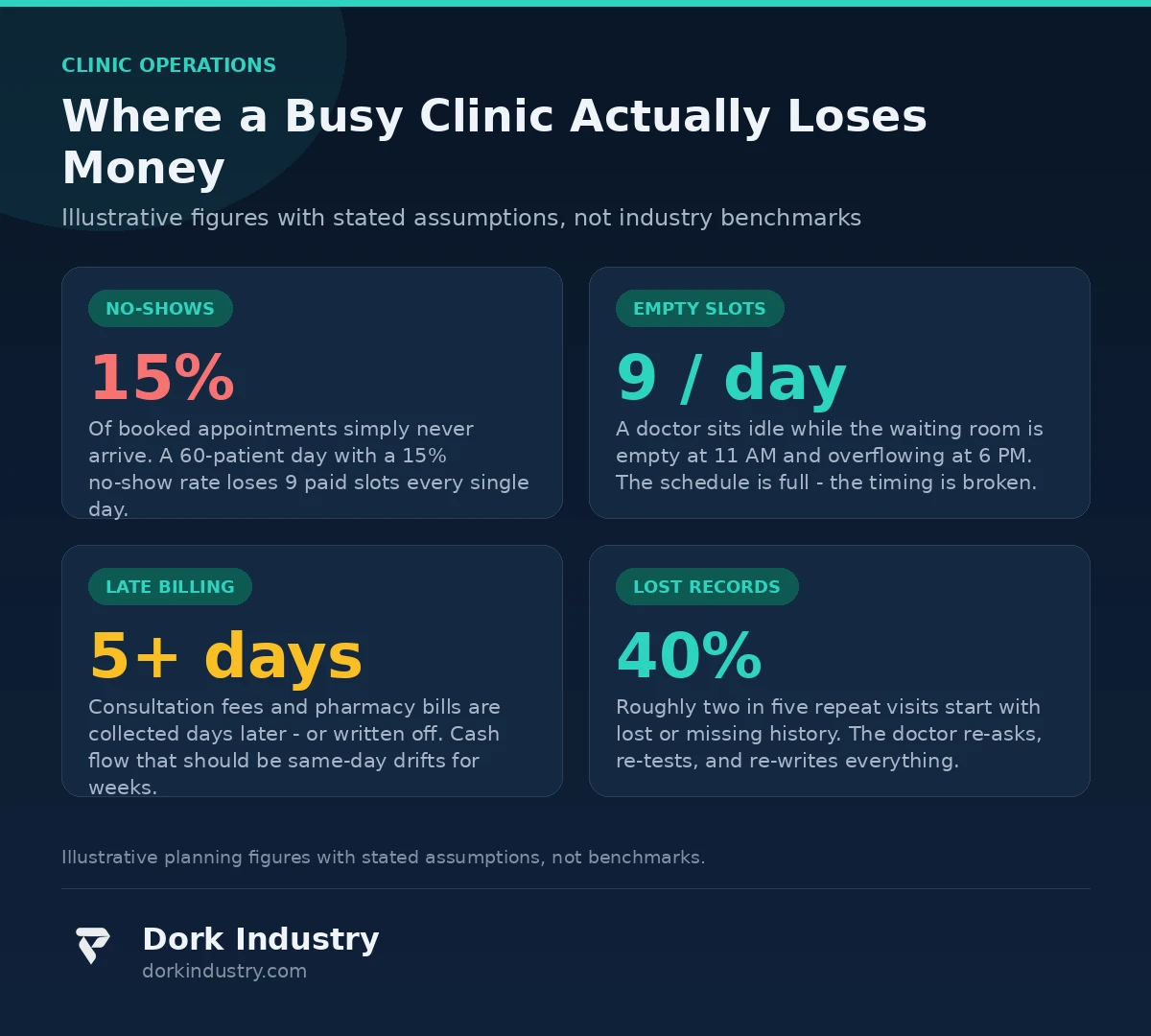
Where does a busy clinic actually lose money?
Before discussing technology, it is worth naming the specific leaks. In our experience working with service businesses, the expensive problems in clinics are rarely about medical competence. They are about operations that run on memory, paper, and phone calls.
Why do no-shows eat clinic revenue?
Booked patients do not arrive, and nobody is alerted in time to offer the slot to someone else.
Why is the waiting room full while the doctor waits?
The schedule looks full on paper, but patients arrive whenever they like and the queue is managed by shouting names. Mornings sit half-empty, evenings overflow, and walk-ins cut the line. The doctor’s working hours are the clinic’s only inventory — and without appointment discipline, that inventory is distributed by luck.
Why is billing collected days late — or never?
Consultation fees, dressing charges, and pharmacy bills are tracked in registers or the receptionist’s memory. Follow-up visits are charged inconsistently. Patients leave with “we will settle it next time,” and next time never quite arrives. Cash that should be collected the same day drifts for weeks or gets written off silently.
Why do repeat patients get asked the same questions every visit?
Paper files are lost, borrowed, or buried. A repeat patient arrives and the doctor starts from zero: same history questions, same prescriptions rewritten, sometimes the same tests repeated. This costs doctor time, patient trust, and — in the worst cases — clinical context that actually matters for the diagnosis.
What must healthcare app development deliver for a clinic?
A generic “clinic app” with a logo and a contact page is not the answer. An app that gives a doctor operational control needs to cover four areas — and each one must remove work from the front desk, not add to it.
How should appointments and reminders work?
Booking must be possible by phone, walk-in, and patient self-booking — three channels feeding one schedule. The critical feature is automated reminders: SMS, WhatsApp, and push notifications sent 24 hours and 2 hours before the appointment. According to Meta’s WhatsApp Business Platform documentation, clinics can send structured appointment-confirmation and reminder templates at scale through the official API — the compliant way to do what receptionists already attempt manually with phone calls they do not have time for. Reminders should include a one-tap confirm or reschedule option, so the slot can be released early enough to refill.
- Doctor-wise, day-wise, and slot-wise scheduling with configurable slot lengths
- Walk-in token generation merged with the booked-appointment queue
- Repeat-visit recall: automatic follow-up reminders based on the doctor’s prescribed review date
- Waiting-list backfill: when a patient reschedules, the next waitlisted patient is offered the slot automatically
What does a digital queue change for patients?
The single highest-visibility improvement: patients see their live token number and estimated wait on their phones instead of camping in a crowded waiting room. The doctor controls the pace — pause, delay, or reorder tokens. Front-desk staff stop being human megaphones.
How do patient records move beyond paper files?
The app must give the doctor the patient’s visit history in seconds: chief complaints, previous prescriptions, test reports, and the doctor’s own notes from the last visit. This is where healthcare app development differs from every other service app — the record is clinical infrastructure, not just operational data. According to the HL7 FHIR specification, modern health systems exchange records in a standardized resource format — designing record storage with FHIR-compatible data models keeps the clinic’s data portable instead of locked into one vendor’s database. For Indian clinics, structuring consent and data flows around the Ayushman Bharat Digital Mission (ABDM) health-data framework is the forward-compatible choice: patients keep control of their health records, and the clinic’s system should be able to issue and accept ABHA-linked records as the ecosystem matures.
- Visit summaries the doctor dictates or types in under a minute per patient
- Prescription templates for common complaints — speed without copy-paste errors
- Test reports attached against the visit, retrievable without hunting through files
- Full data export: the clinic’s patient data must never be held hostage by the software vendor
How do payments stop leaking?
Collect fees at the counter, at the moment of the visit: UPI, cards, and payment links sent to the patient’s phone for pending amounts. Every consultation, procedure, and pharmacy line item should be billable against the visit record, with a daily collection report the doctor can check in one glance. Reconciliation — matching collected money to actual receipts — is the part manual systems never do and software always should.
What data does your clinic already have — and what is it missing?
Most clinics already generate the raw material: appointment registers, the receptionist’s call log, cash receipts, prescription pads, patient files. What is missing is structure. The data is not connected, timestamped, or owned by the clinic — it lives in people’s heads and paper piles.
A clinic app does not create new work for staff, and that principle should guide any healthcare app development for clinics: it captures the work the front desk already does — bookings, token calls, fee collection — in a form the doctor can actually use. The most common implementation failure is designing for the doctor’s dashboard while making data entry painful for the receptionist. If the people entering data do not benefit from the app, the data will be incomplete within weeks.
What does the math look like? An illustrative example
Consider a single-doctor clinic seeing 60 patients a day at an average consultation fee of ₹500. That is ₹30,000 in daily consultation revenue, or roughly ₹7.8 lakh a month across 26 working days. If 15% of booked patients no-show — 9 empty slots a day — the clinic loses roughly ₹4,500 a day, or about ₹1.17 lakh a month in revenue that can never be recovered. These are illustrative figures with stated assumptions, not industry benchmarks.
If automated reminders and a waiting-list backfill cut the no-show rate from 15% to 7% — a conservative improvement consistent with how confirmation-based systems behave — the clinic recovers about 5 slots a day: roughly ₹65,000 a month in revenue that currently evaporates. Now add the record side: if the doctor spends even 5 minutes per repeat visit reconstructing lost history across 30 repeat patients a day, that is 2.5 hours daily — time worth, at the clinic’s revenue rate, far more than any software subscription. The illustrative math is simple: reminders attack the revenue leak, records attack the time leak.
Should you build or buy? An honest breakdown
Not every clinic needs custom healthcare app development. The honest options, in order of investment:
| Approach | Best for | Relative investment | Where it breaks |
|---|---|---|---|
| Paper register + phone | A new single-doctor clinic finding its feet | Minimal | No-shows, queues, and billing all unmanaged |
| Off-the-shelf clinic software | Standard appointment, billing, and records workflows | Low subscription | Cannot model multi-doctor or multi-branch operations your way |
| White-label patient app | Branded booking experience without building | Medium | You inherit their roadmap; records portability is often poor |
| Custom healthcare app development | Multi-doctor clinics, chains, or unusual workflows | Highest | Overkill for a single standard practice |
At Dork Industry, we regularly advise single-doctor clinics against custom builds when configured clinic software fits — the same honesty we apply to multi-location businesses where off-the-shelf software covers standard workflows. A credible technology partner should be willing to tell you that you do not need custom development. If every consultation ends with a quotation for a custom app, get a second opinion.
What should the app never do?
Technology boundaries in healthcare app development matter more than features — this is medicine, and the stakes are clinical.
- AI must never diagnose or change a prescription. An app can surface “this patient has reported this symptom across three visits” — the diagnosis and the treatment decision belong to the doctor, always. Any AI-assisted note-taking is a draft the doctor reviews and signs, never a medical record by itself.
- Never send clinical information through unsecured channels. Appointment reminders are fine on SMS and WhatsApp. Test reports and diagnoses are not — they need authenticated, encrypted access with an audit trail of who viewed what.
- Never auto-cancel or auto-charge patients without clear consent. Flag high-risk no-shows for the front desk. Do not let software penalize a patient who may have had an emergency.
- Never lock patient records into a format you cannot export. The clinic’s records are a clinical and legal asset. Full, machine-readable export — FHIR-compatible where possible — is non-negotiable.
- Patient data access must be consent-based and logged. Who saw which record, when, and why. In India, the ABDM Health Data Management framework sets the direction of travel; in any case, your system should behave as if an audit is always one day away.
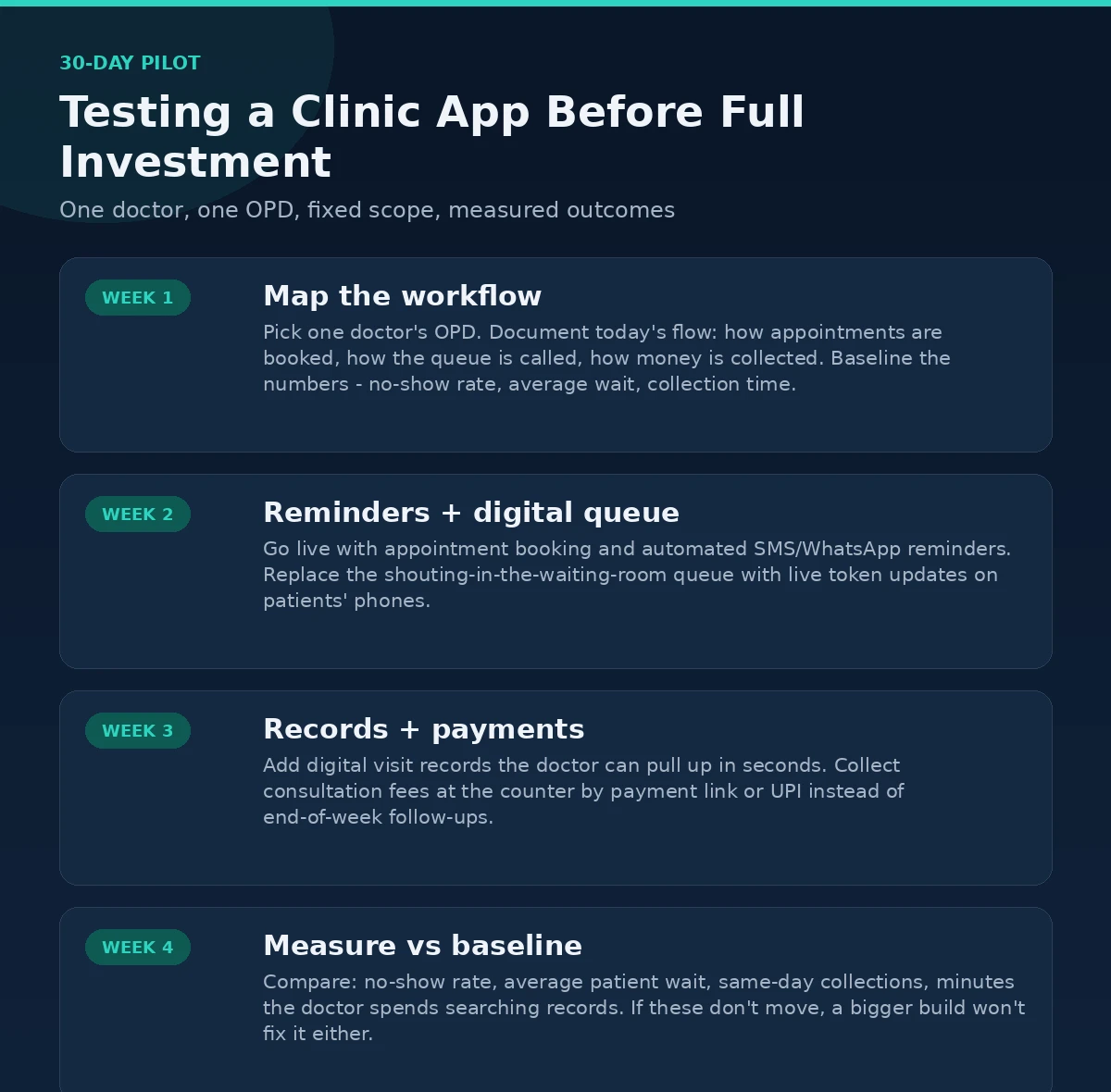
How do you test it in 30 days before full investment?
The lowest-risk path is a single-doctor pilot with a fixed scope and measurable outcomes:
- One doctor, one OPD, 30–50 appointments a day
- Appointment booking, automated reminders, digital queue, payment collection, basic digital records
- Run for 30 days
- Measure: no-show rate vs the previous 30 days, average patient wait time, same-day collections, minutes the doctor spends searching for records
If no-shows, wait times, and collections do not measurably improve in the pilot, a bigger healthcare app development investment will not fix it either. The pilot validates the workflow, not just the software. This is the assessment Dork Industry runs before quoting any clinic project: map the current process, name the leaks, then decide what software earns its cost.
What actually drives the cost of healthcare app development?
Clinic app pricing varies widely because scope does. The real cost drivers are:
- Doctors and locations: single doctor vs multi-doctor schedules vs multi-branch chains changes the data model and permission structure significantly
- Record depth: basic visit summaries vs structured clinical notes, templates, report attachments, and FHIR-compatible data models
- Integrations: lab systems, pharmacy billing, existing accounting software, and ABDM/ABHA connectivity
- Communication channels: SMS, WhatsApp Business API, and push notification setup, templates, and regulatory compliance (DLT registration for SMS in India)
- Payment flows: UPI intent flows, cards, payment links for pending dues, and reconciliation logic
- Platforms: Android only vs Android + iOS vs Flutter cross-platform, plus the staff-side vs patient-side split
- Compliance: consent management, access logging, encrypted storage, and audit readiness add real engineering, not just paperwork
Anyone quoting a fixed price without asking about doctors, branches, record structure, and payment flows is guessing. Similar cost-driver logic applies across the service businesses we build for — see our breakdowns for dairy plant monitoring for a different industry’s version of the same discipline.
Frequently asked questions
Does a clinic need a custom app, or is clinic management software enough?
For a single doctor with standard appointment, billing, and record needs, configured clinic management software is usually enough and far cheaper. Custom healthcare app development earns its cost at multi-doctor scale, with clinic chains, or when specialist workflows do not fit packaged software.
How long does healthcare app development for a clinic take?
A focused pilot — one doctor, appointments, reminders, digital queue, basic records, payments — can be live in 4–6 weeks. A full multi-doctor or multi-branch platform with deep record structures and lab/pharmacy integrations typically runs 3–6 months depending on scope.
Can a clinic app work with ABHA health IDs and digital health records?
Yes — and it should be designed for it from the start. Structuring patient records with FHIR-compatible data models and building consent-based data sharing keeps the clinic aligned with India’s Ayushman Bharat Digital Mission as ABHA-linked records become standard.
What does a clinic app pilot cost?
A single-doctor pilot covering booking, reminders, digital queue, records, and payments is a fraction of a full platform build. Its job is to prove measurable improvement in no-shows, wait times, and collections before larger investment. Request a pilot scoping call for a concrete estimate.
Will patients actually use the app?
Adoption follows value: if patients can book in seconds, see their live token number, and pay from their phones, they use it. If it is just a digital visiting card, they will not. Design the patient side around their incentives — less waiting, clearer communication — not the clinic’s reporting needs.
About Dork Industry
Dork Industry (dorkindustry.com) is a custom software development company building mobile apps, AI automation, and IoT systems for businesses across India. Our team designs clinic and healthcare workflow platforms, field-service apps, and industrial IoT — from 30-day pilots to full multi-branch rollouts.
The bottom line
The question is not whether a clinic needs healthcare app development. It is whether the doctor can see — from one screen — which patients are not coming, how long the queue is, which fees are still uncollected, and what happened at the patient’s last visit. If the answer is no, the technology decision is really an operations decision wearing a software costume.
Start with the workflow, pilot it with one doctor for 30 days, and only then scale the healthcare app development — and let measured no-show, wait-time, and collection numbers, not feature lists, decide whether to build further.
Running a single clinic or a growing chain and want to know what a management app would change in your specific operation?
We map your current appointment, billing, and record process and show you exactly what software would (and would not) fix, before any development is discussed.
Request a clinic workflow assessment WhatsApp +91 8210792477
[…] A hybrid approach is often practical: retain Shopify or WooCommerce as the commerce system, keep the existing helpdesk, and build the secure orchestration between them. Dork Industry can assess that integration through its AI and ML implementation service, web development capability, and software integration work. If the immediate problem is a storefront defect rather than automation, see the related guide on a Shopify header not updating. […]
[…] web development, custom software and AI/ML implementation capabilities. The existing guide to a Shopify header that is not updating addresses theme repair; catalog enrichment is a separate product-data and integration […]
Comments are closed.