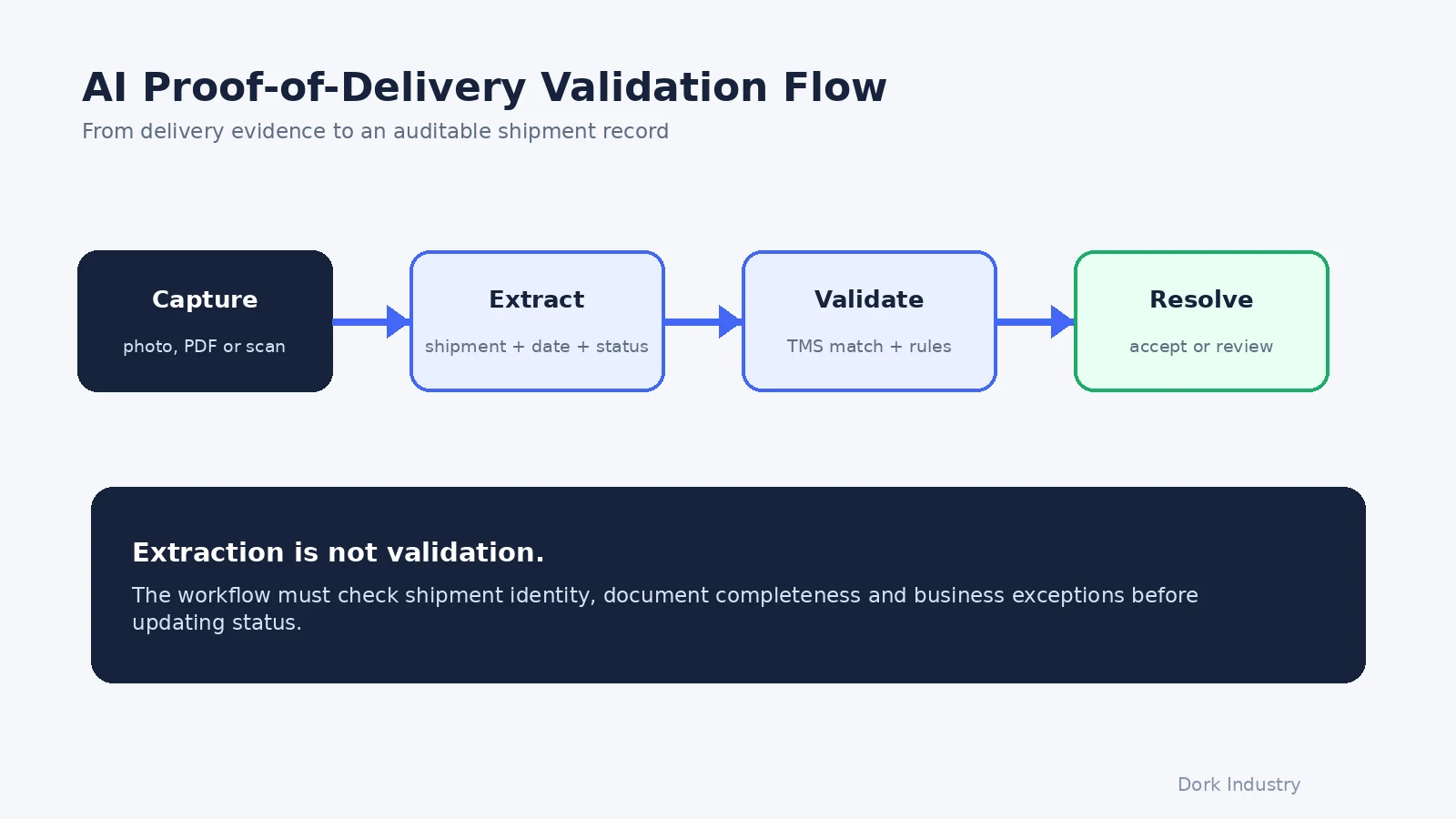
AI proof of delivery automation should capture delivery evidence, extract shipment identifiers and status fields, validate them against the transport system, and route uncertain or incomplete documents to operations staff. Extraction alone is not validation: a readable document can still belong to the wrong shipment or lack required evidence.
The commercial objective is an auditable flow from driver capture to customer, billing or ERP status. Dork Industry can scope it as a mobile application, document-AI service, TMS integration or custom operations platform.
Why does proof-of-delivery processing become an operational bottleneck?
Delivery evidence may arrive as a paper scan, phone image, PDF, messaging attachment or in-app form. Operations teams then match it to a shipment, inspect recipient or status information, check damage or refusal notes, rename the file, update the TMS and release the record to another team. Missing identifiers or unreadable evidence create exceptions that automation must expose rather than hide.
Google Cloud describes Document AI as technology for extracting structured and unstructured data, classifying documents and splitting files. Its logistics customer material also describes proof-of-delivery documents being stored alongside operational applications. These capabilities support document processing, but the shipment match, acceptance policy and downstream status remain business-specific. See Google Cloud Document AI.
According to Google’s documentation for a custom extractor with derived fields, a processor can infer a configured field such as whether a contract is signed from document context. For POD work, any comparable inferred status still needs organisation-specific evidence rules and exception review.
What should AI proof of delivery automation do?
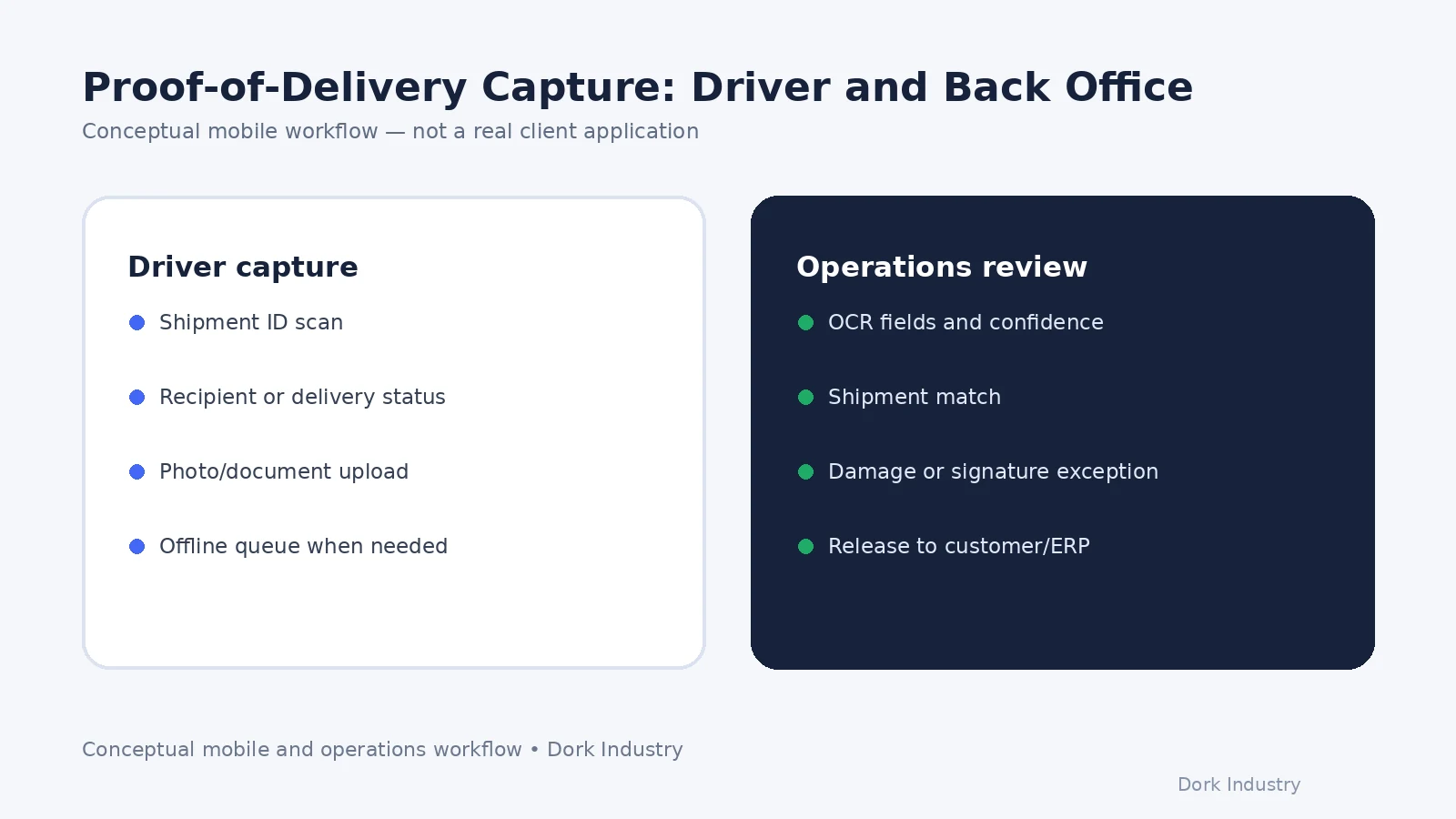
- Capture or receive the delivery evidence with device and event metadata where appropriate.
- Preserve the original file before image enhancement or extraction.
- Extract shipment number, delivery date, recipient/status and configured exception fields.
- Match the evidence to a shipment using more than a filename.
- Validate required evidence against customer, route and shipment rules.
- Send low-confidence, conflicting or incomplete cases to a named queue.
- Write an approved status and document reference back to the TMS, ERP or customer portal.
- Retain an audit trail of automated and human decisions.
What must be validated before a POD updates shipment status?
| Control | Example question | Failure action |
|---|---|---|
| Shipment identity | Does the identifier match an open stop? | Manual match queue |
| Document completeness | Are required pages or fields present? | Request recapture |
| Delivery outcome | Delivered, partial, refused or damaged? | Route to exception owner |
| Duplicate evidence | Was this file or event already processed? | Hold duplicate update |
What should a driver capture application include?
A practical driver workflow may need shipment scanning, delivery outcome, recipient information, document/photo capture, damage notes, offline queuing and safe retry. The app should prevent duplicate submissions and make incomplete evidence obvious before the driver leaves, while respecting the organisation’s privacy and retention policy.
Dork Industry can connect its mobile app development, custom software development and AI/ML implementation capabilities after requirements are verified. For the broader system-selection context, see the existing guide to transport management software for logistics companies.
How should a POD automation pilot be scored?
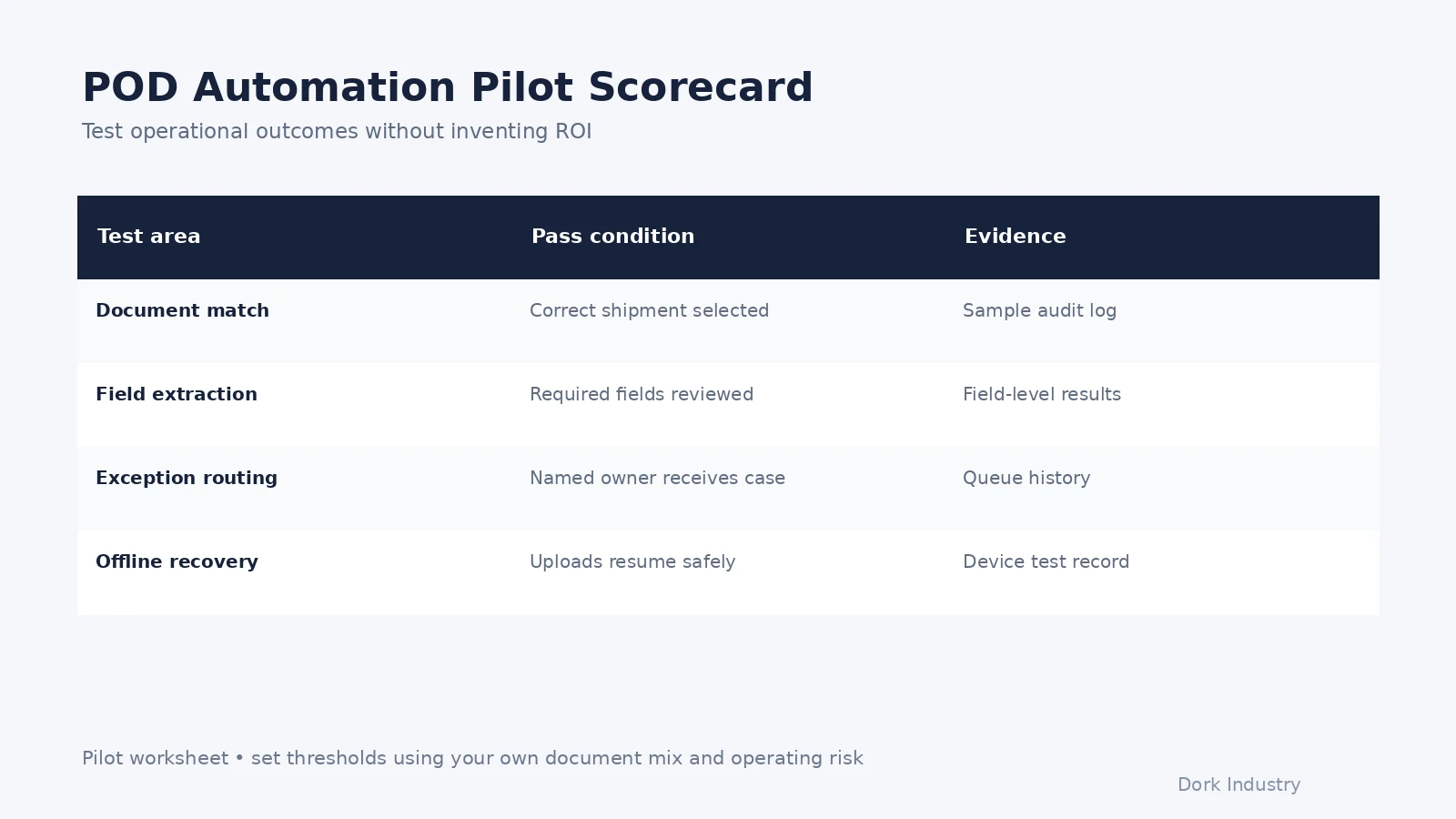
Use a representative, authorised document set containing clean scans, phone photos, multiple layouts, missing fields, handwritten notes, damaged-delivery exceptions and duplicate submissions. Define field-level expected values and business outcomes. Measure extraction, shipment matching, completeness checks and exception routing separately; do not compress them into one impressive-looking accuracy number.
When should logistics teams request an automation consultation?
Request a consultation when document matching delays billing or customer visibility, drivers use disconnected channels, exception ownership is unclear, or manual updates cannot keep up with operational volume. A discovery session should map capture points, TMS ownership, acceptance rules, offline requirements, document retention and downstream consumers before choosing AI components.
Discuss a POD automation pilot
Bring anonymised sample documents, shipment status rules, current capture channels, TMS/ERP details and the exceptions that consume the most operational attention. Dork Industry can scope a controlled mobile, document-AI and integration pilot.
Frequently asked questions
What is AI proof of delivery automation?
It is a workflow that captures delivery evidence, extracts configured fields, matches the evidence to a shipment, validates required conditions and routes exceptions before updating operational systems.
Is OCR enough for POD automation?
No. OCR can read text, but the business workflow must also identify the correct shipment, check completeness, interpret delivery outcomes, detect duplicates and handle uncertain cases.
Can POD capture work without continuous internet?
A mobile application can be designed with an offline queue and controlled retry, but the requirements must cover local storage, duplicate prevention, user feedback, authentication and reconciliation after connectivity returns.
Should every extracted POD be accepted automatically?
No. Low-confidence fields, missing identifiers, conflicting shipment data, damaged-delivery notes and incomplete evidence should enter a human review or recapture workflow according to defined policies.
What systems normally need integration?
The workflow may connect a driver application, document storage, TMS, ERP, customer portal, billing process and notification service. Integration depends on which system owns shipment and status truth.
Can Dork Industry build the mobile and back-office workflow?
Dork Industry can review the capture, document, integration and exception requirements before confirming scope. Delivery may combine mobile development, custom software, document AI and TMS or ERP integration.