Asset maintenance software for energy companies should be tested against real asset, work, inventory and cost controls—not a polished demo. A serious evaluation follows one maintenance event from the asset register through planning, field execution, spare usage, closure evidence and ERP reconciliation. If that chain breaks, management cannot trust backlog, cost or reliability decisions.
Prepared by Dork Industry as a practical enterprise-software decision guide. The examples and thresholds below are illustrative recommendations, not customer results.
In this guide
What problem should asset maintenance software solve?
The buying problem is not simply “digitise maintenance.” Energy and utility operations need a dependable control system for assets, preventive work, corrective work, crews, contractors, spares, permits, readings, failures and cost. The system must answer three commercial questions: which work protects operational capacity, what resources are committed, and whether completed work produced trustworthy evidence.
According to Oracle’s product documentation, utility work and asset management covers asset lifecycle, work orders and preventive or predictive maintenance. According to IBM’s Maximo documentation, enterprise asset management connects asset data, work orders and condition insights. These product descriptions confirm the scope, but buyers still need to prove that their own operating rules survive configuration and integration. Oracle Utilities Work and Asset Cloud and IBM Maximo Application Suite are useful primary references for that category definition.
| Business risk | Software control | Evidence a buyer should demand |
|---|---|---|
| Critical work hidden in a long backlog | Asset criticality, priority rules and escalation | One traceable priority decision with owner and timestamp |
| Preventive work generated too early or too late | Calendar, meter and condition triggers | Trigger value, due date and generated work order agree |
| Field completion without proof | Mobile steps, readings, attachments and sign-off | Mandatory evidence blocks incomplete closure |
| Spare usage disconnected from the job | Reservation, issue, return and substitution | Stock movement and work-order consumption reconcile |
| Maintenance cost differs from finance | Labour, material, contractor and ERP interfaces | Exceptions are visible and recoverable, not silently lost |
What workflow must stay connected?
A capable platform preserves context from the physical or logical asset to the financial record. The minimum chain is: asset register → maintenance trigger → priority and approval → work planning → crew and spare allocation → field execution → technical closure → cost posting → reliability review. Each transition needs an owner, timestamp, evidence and exception path.
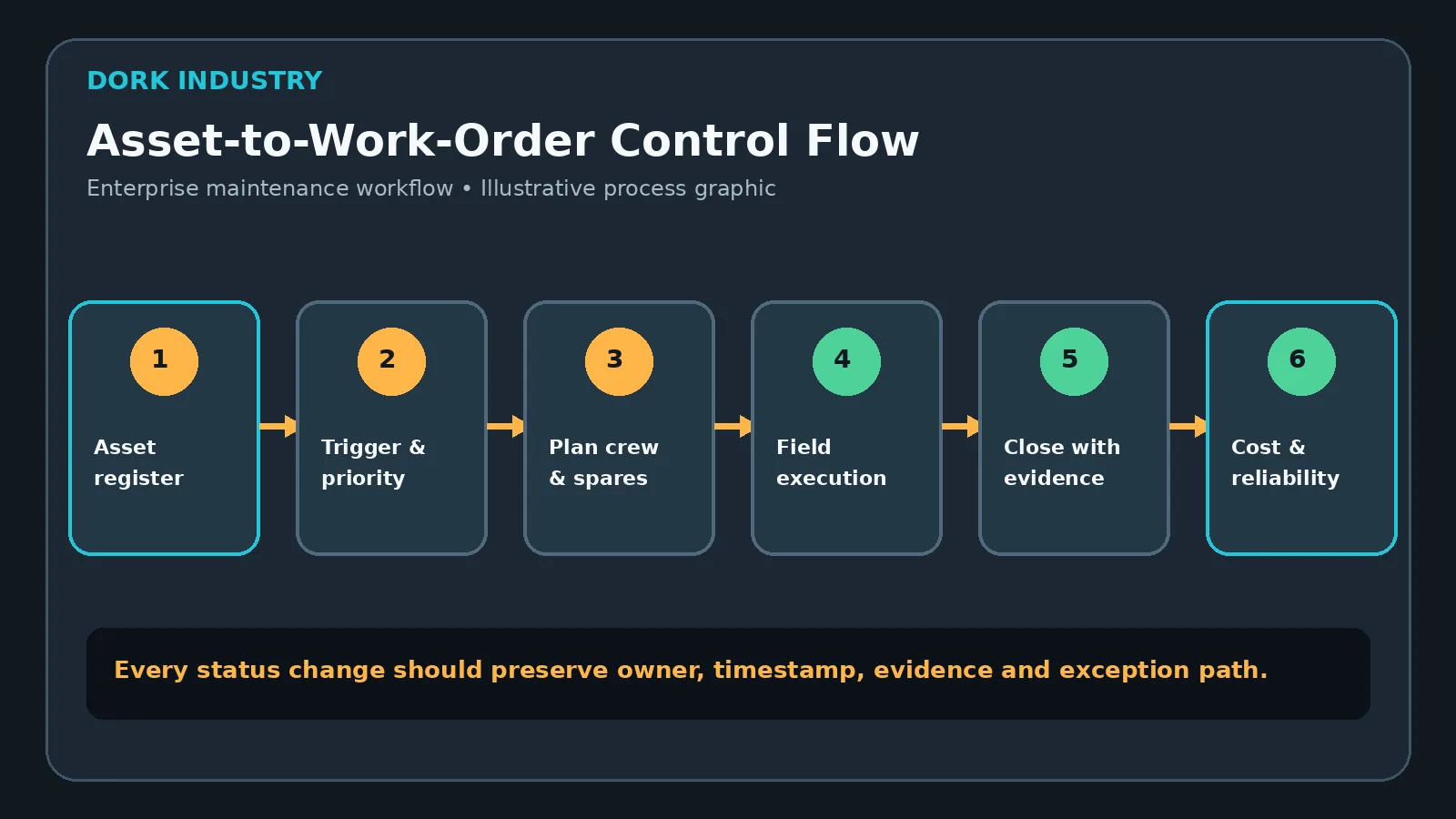
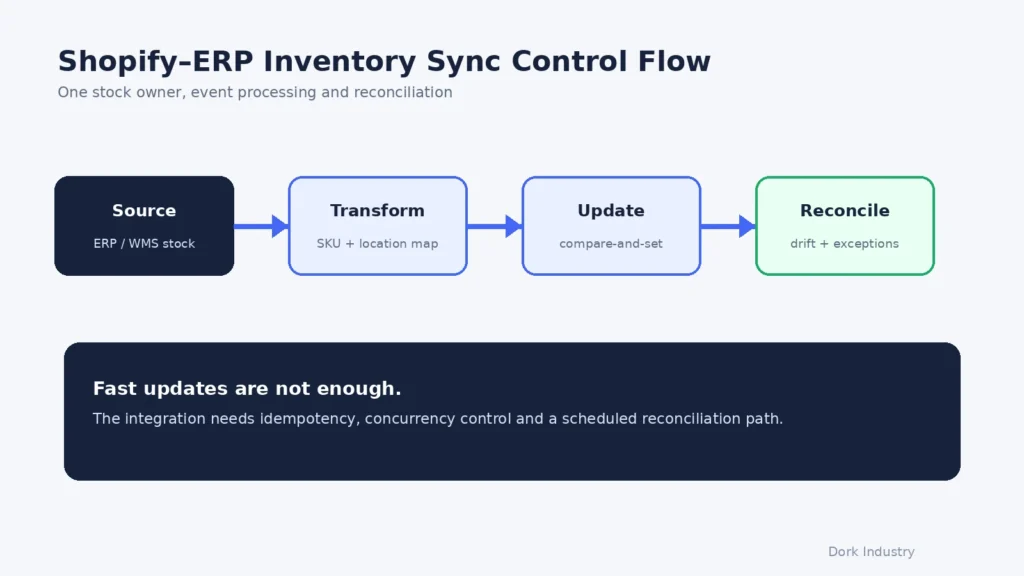
For organisations evaluating ERP integration and enterprise workflows, maintenance should not become a separate island. Asset IDs, stores, cost centres, suppliers, purchase orders and financial postings need controlled ownership. Where equipment or sensors contribute readings, IoT and industrial automation should feed governed events rather than create uncontrolled duplicate work.
Which asset maintenance software for energy companies belongs on the shortlist?
How should the asset model work?
The asset register should support parent-child hierarchy, location, equipment class, criticality, commissioning dates, maintainable components and controlled change history. Moving an asset should not erase its maintenance record. Buyers should also decide which system owns the master record before integration begins.
How should planned and corrective maintenance work?
Preventive plans need calendar, meter or condition triggers, job steps, permits, skills, estimated duration and material lists. Corrective work needs rapid reporting, triage, priority, approval and a path to planned execution. Both should use one auditable work-order lifecycle.
What should field teams be able to do?
Field users should see assigned work, safety steps, asset history, parts and drawings; record readings, labour and failure information; and attach evidence. If sites have unreliable connectivity, offline work and conflict-safe synchronisation are evaluation requirements, not optional conveniences.
How should stores, procurement and finance connect?
Test reservations, issues, returns, substitutions, reorder signals, purchase requests, contractor charges and cost posting. The interface must expose failed transactions to an exception queue with retry and audit history. “Integrated” is not sufficient unless the buyer can observe and recover failures.
Which nine acceptance tests should buyers run?
Run the following tests with anonymised records that represent your asset classes, crews, stores and accounting rules. Record expected result, actual result, evidence link, owner and severity for every test.
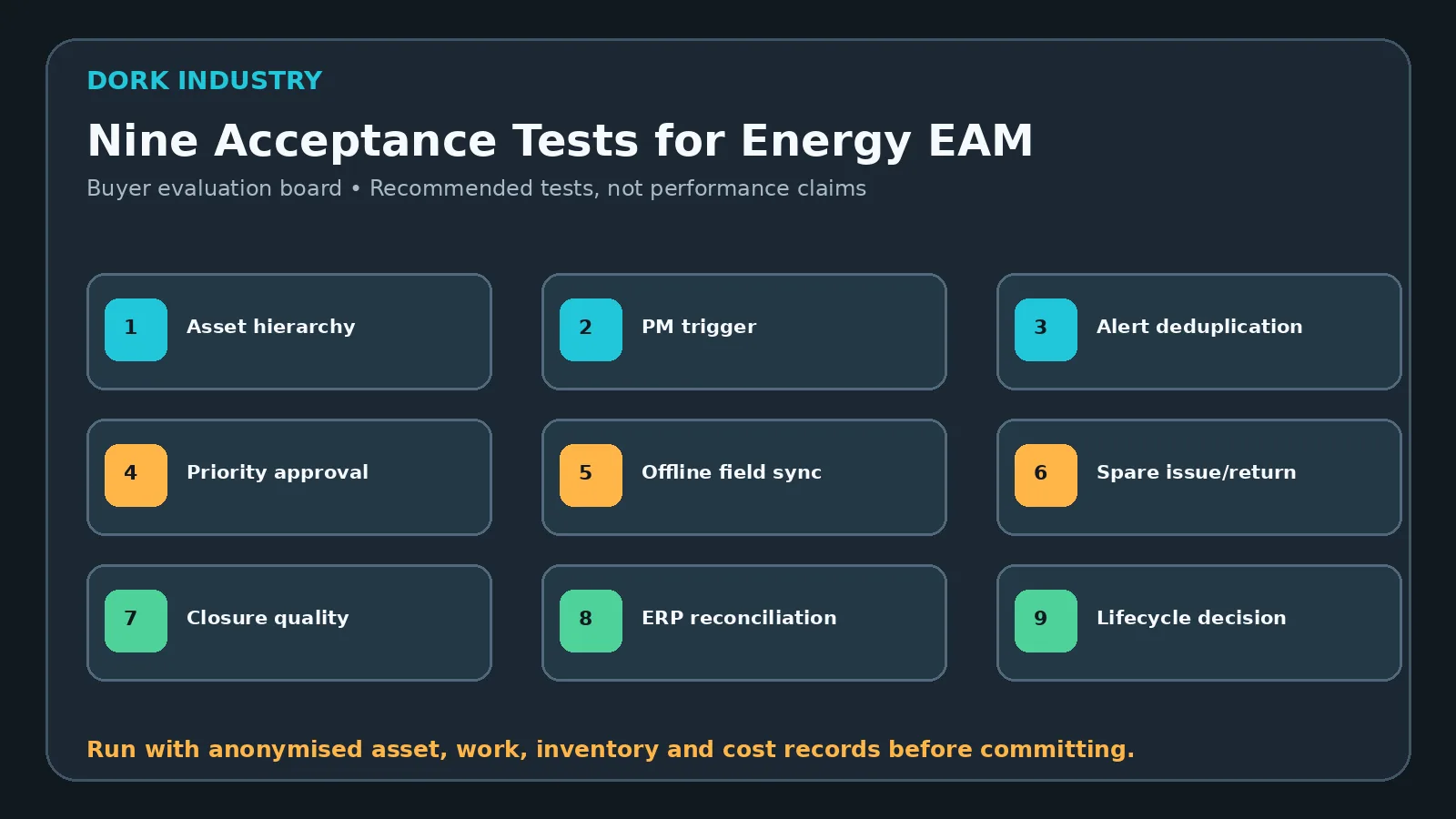
- Asset hierarchy: move a maintainable component between parent assets and confirm history, open work and cost remain traceable.
- Preventive trigger: cross a meter or calendar threshold and confirm exactly one correct work order is produced.
- Alert deduplication: send the same condition event twice and confirm the integration does not create duplicate work.
- Priority approval: raise a critical job and verify priority, escalation, approval and response responsibility.
- Offline field sync: complete steps without connectivity, reconnect, and verify readings and attachments appear once.
- Spare issue and return: issue two units, use one, return one, and reconcile job consumption with stock.
- Closure quality: try to close work without mandatory readings, failure code or evidence; the control should stop it.
- ERP reconciliation: post labour, material and contractor cost, force one interface failure, then recover it without duplication.
- Lifecycle decision: compare maintenance history and cost for repair-versus-replacement review while preserving the source trail.
How should a pilot be scored?
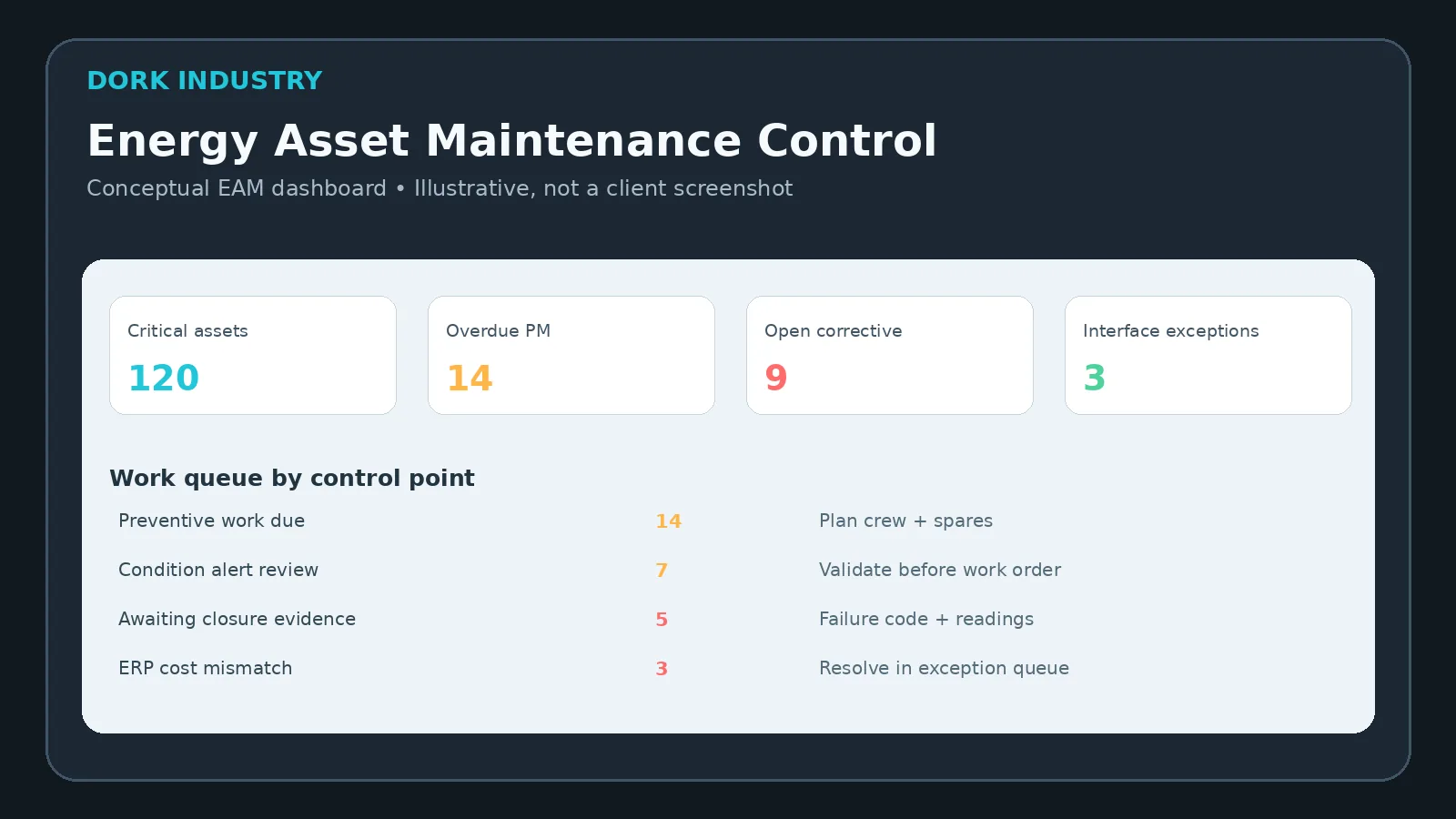
Use a small but representative pilot. The following fictional snapshot demonstrates the worksheet structure; it is not a customer benchmark or measured result.
| Illustrative pilot item | Example value | Decision question |
|---|---|---|
| Critical assets in scope | 120 | Does every asset have class, owner, location and criticality? |
| Overdue preventive jobs | 14 | Can planners explain every overdue status and dependency? |
| Open corrective jobs | 9 | Are severity, owner, crew and expected completion visible? |
| Committed job cost | ₹4.6 lakh | Do labour, parts and contractor commitments share one view? |
| Certified cost | ₹3.8 lakh | Can finance trace the difference to open or rejected items? |
| Interface exceptions | 3 | Can an authorised user resolve and replay them safely? |
A reasonable pilot recommendation is at least 20 anonymised records across multiple asset and work types, 100% traceability for tested transitions, zero duplicate work from replayed events, and 100% of failed integrations visible in an exception queue. These are suggested acceptance thresholds; each organisation should adjust them for risk and operating policy.
How should implementation risk be controlled?
- Define ownership first. Decide who owns asset, inventory, supplier, employee and financial master data.
- Design status rules. Document what each work status means, who can change it and what evidence is required.
- Clean only what the pilot needs. Map duplicates and missing fields rather than hiding them during migration.
- Prove exception handling. Test failed messages, retries, reversals and duplicate prevention before scale-up.
- Train by role. Planners, supervisors, technicians, stores, procurement and finance need different scenarios.
- Release in controlled waves. Start with representative assets and workflows, measure adoption and data quality, then expand.
Dork Industry’s industry software approach connects operational problems to enterprise workflows, integration and implementation controls. If your team is comparing, replacing or integrating an EAM/CMMS platform, an independent requirements and pilot design can expose gaps before a large rollout.
Need an asset-maintenance software evaluation plan?
Bring one representative workflow, your current systems and the decisions management cannot trust today. Dork Industry can help structure requirements, integration boundaries and acceptance tests.
Frequently asked questions
What is asset maintenance software for energy companies?
It is an enterprise system that connects asset records, preventive and corrective work, crews, spares, field evidence, failure history and maintenance cost. Depending on scope, buyers may call it EAM, CMMS or utility work and asset management software.
What is the difference between EAM and CMMS?
A CMMS commonly centres on maintenance work and equipment history. EAM usually covers a broader asset lifecycle, including planning, procurement, inventory, cost and replacement decisions. Product labels vary, so buyers should evaluate workflows and controls rather than the name alone.
Should EAM software integrate with ERP?
Usually yes when finance, procurement, stores, suppliers or workforce data are managed in ERP. The design should identify the owner of each master record and test failed transactions, retries, reversals and reconciliation—not only the successful path.
How can IoT data improve maintenance workflows?
Condition readings can help trigger review or maintenance, but raw alerts should pass validation, deduplication and priority rules. The integration must preserve the source event and prevent repeated readings from creating duplicate work orders.
What should an energy EAM pilot prove?
A pilot should prove asset hierarchy, work generation, approvals, field execution, spares, closure quality, cost reconciliation and exception recovery with representative anonymised data. It should produce auditable evidence for each acceptance criterion.