Shopify ERP inventory sync is a controlled integration that keeps sellable quantities aligned across Shopify, an ERP, warehouses and other channels. Overselling usually persists when two systems write stock, SKU or location mappings are incomplete, events are duplicated or missed, or the integration has no reconciliation process. Fixing it requires architecture and test evidence—not faster polling alone.
Inventory sync repair guide
What business problem does inventory drift create?
A store can show a unit as available after it has been sold or reserved elsewhere. Customer support then handles cancellations, warehouse staff investigate conflicting numbers, and merchandising may pause a product without knowing which system is wrong. The paid project is not “change a setting”; it is to find where stock truth diverges and make the integration recoverable.
Current competitor coverage repeatedly discusses sync lag, multiple writers, unit-of-measure errors and dropped events. That validates a commercial repair intent, but it does not prove search volume or a universal cause. A Dork Industry audit should trace actual SKUs, locations and events before recommending a connector replacement or custom development.
Why does Shopify ERP inventory sync fail?
| Failure | What happens | Project evidence |
|---|---|---|
| Two stock writers | ERP and Shopify overwrite each other | Source and API logs |
| Wrong quantity meaning | On-hand is published instead of sellable | Field mapping |
| SKU mismatch | Update reaches no item or the wrong variant | Mapping report |
| Location mismatch | Stock lands at the wrong fulfilment location | Location IDs and routing rules |
| Duplicate event | An adjustment is applied twice | Webhook and idempotency IDs |
| Missed event | Systems drift silently | Reconciliation exception |
Shopify documents distinct inventory states, including available, committed, reserved, incoming, quality-control and safety-stock quantities. The integration must select the business meaning that can be sold. It should not assume every number called “stock” is interchangeable.
Which system should own sellable inventory?
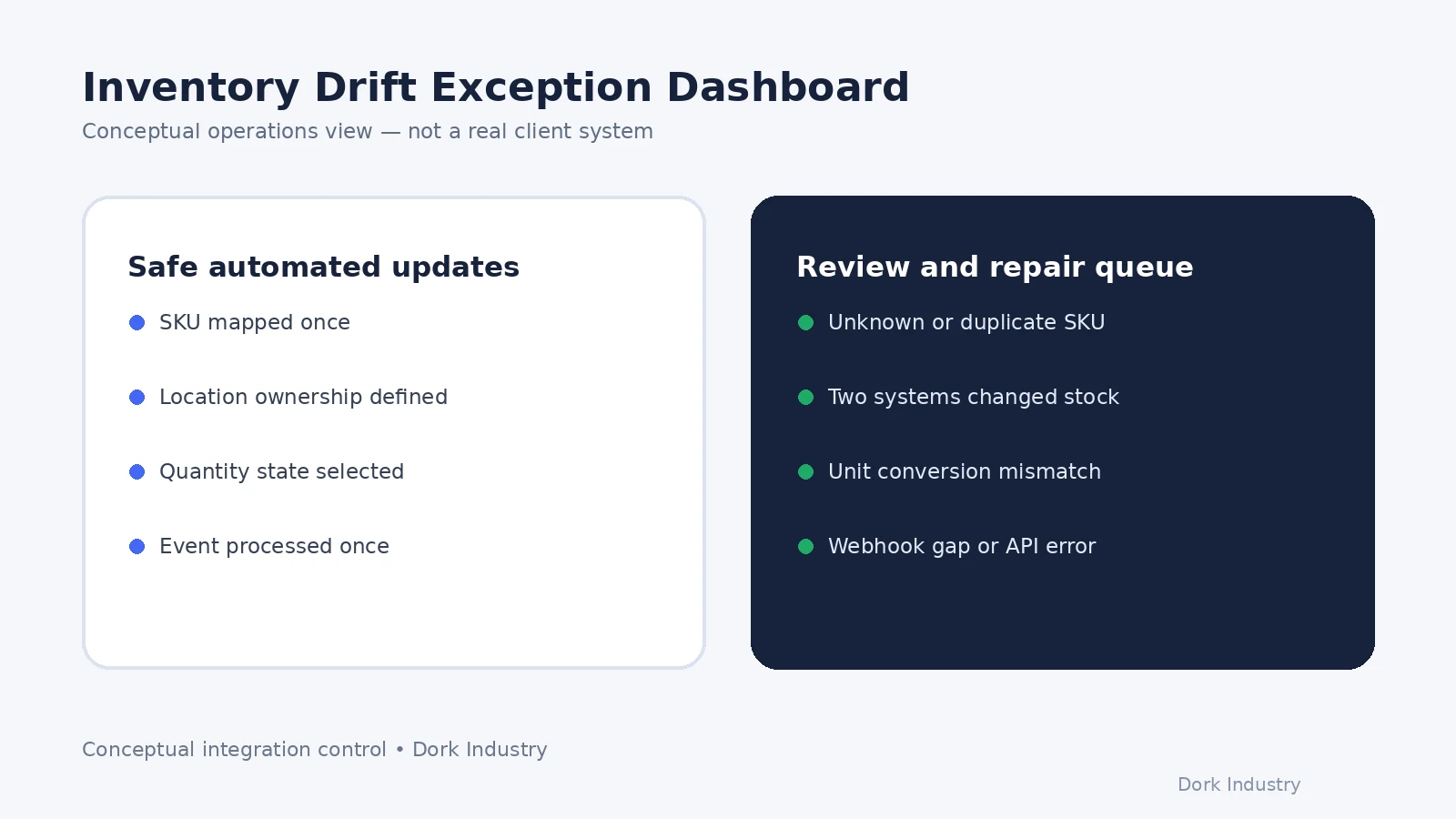
Choose one system of record for each inventory decision. The ERP or WMS may own on-hand and reservations, while Shopify presents the resulting available-to-sell quantity. In another operating model, Shopify may own direct-to-consumer allocation while the ERP owns wholesale stock. The important rule is explicit ownership; bidirectional writes without conflict rules create loops.
Define how returns, transfers, damaged stock, bundles, pre-orders, safety stock and manual adjustments affect availability. Also define whether location-level quantities can be pooled. Shopify’s location model associates stock and fulfilment with active locations, so a single total cannot safely replace location mapping.
How should the integration prevent stale or duplicate writes?
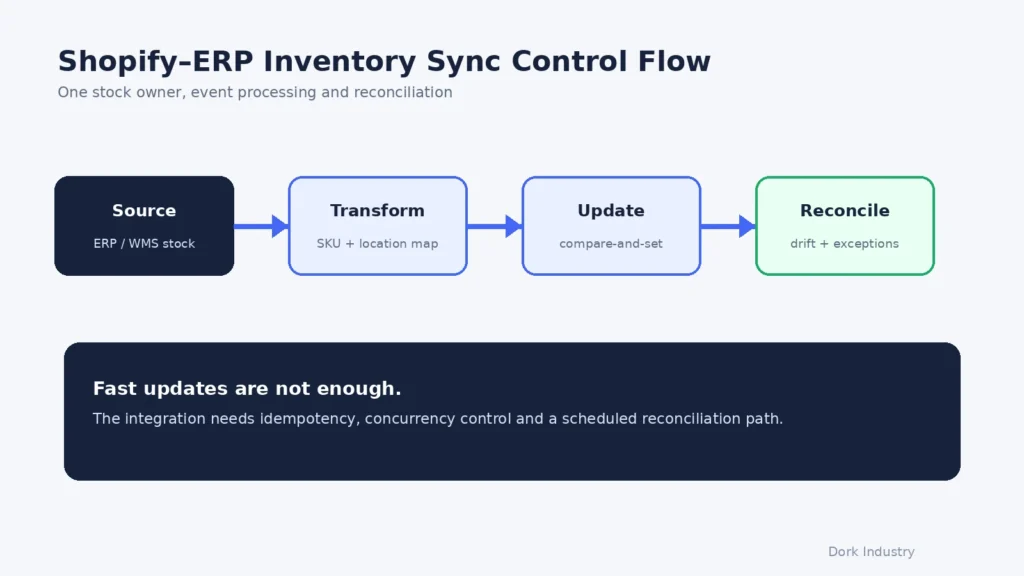
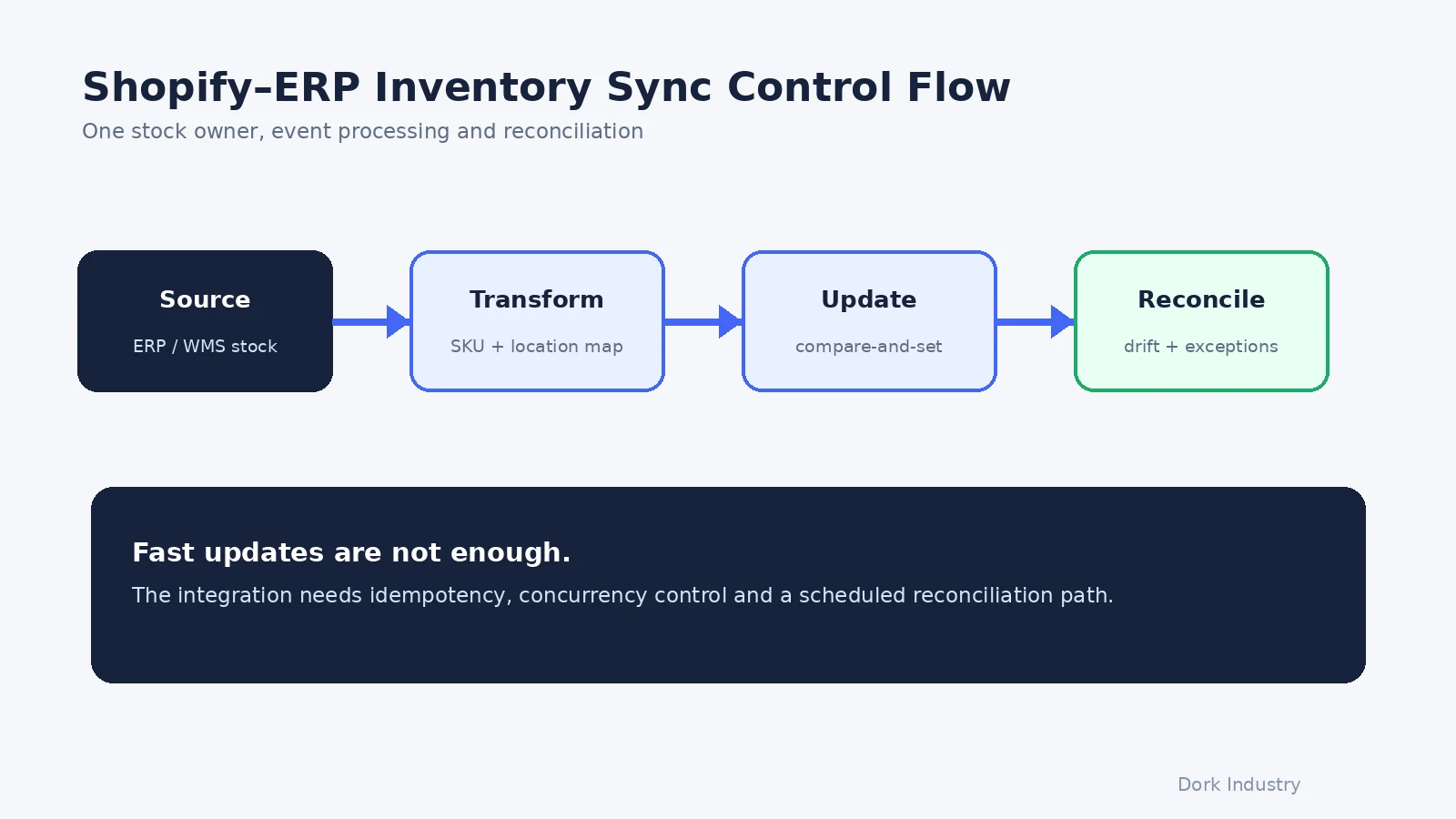
Process inventory changes as events, but design for delivery failures. Shopify webhooks expose identifiers that can be used to deduplicate deliveries. Shopify also provides a compare-and-set capability for absolute inventory updates: the write is rejected when the persisted quantity does not match the expected prior quantity. According to Shopify’s inventorySetQuantities documentation, this supports concurrency handling instead of blindly overwriting a newer value.
- Receive and authenticate the event.
- Store its unique identifier before processing.
- Map SKU, inventory item and location.
- Translate ERP quantity into the agreed Shopify quantity state.
- Use a guarded update or adjustment with an audit reference.
- Retry transient failures without applying the event twice.
- Run scheduled reconciliation to detect events that never completed.
- Route unresolved drift to an operations queue.
What should a Shopify inventory-sync repair project test?
Do not approve the integration after one happy-path SKU update. Use controlled edge cases: two simultaneous sales, a duplicate webhook, a failed API call, a renamed SKU, a location transfer, a return, a manual ERP correction and an event that is deliberately withheld. Each test needs an expected quantity in both systems and a traceable log.
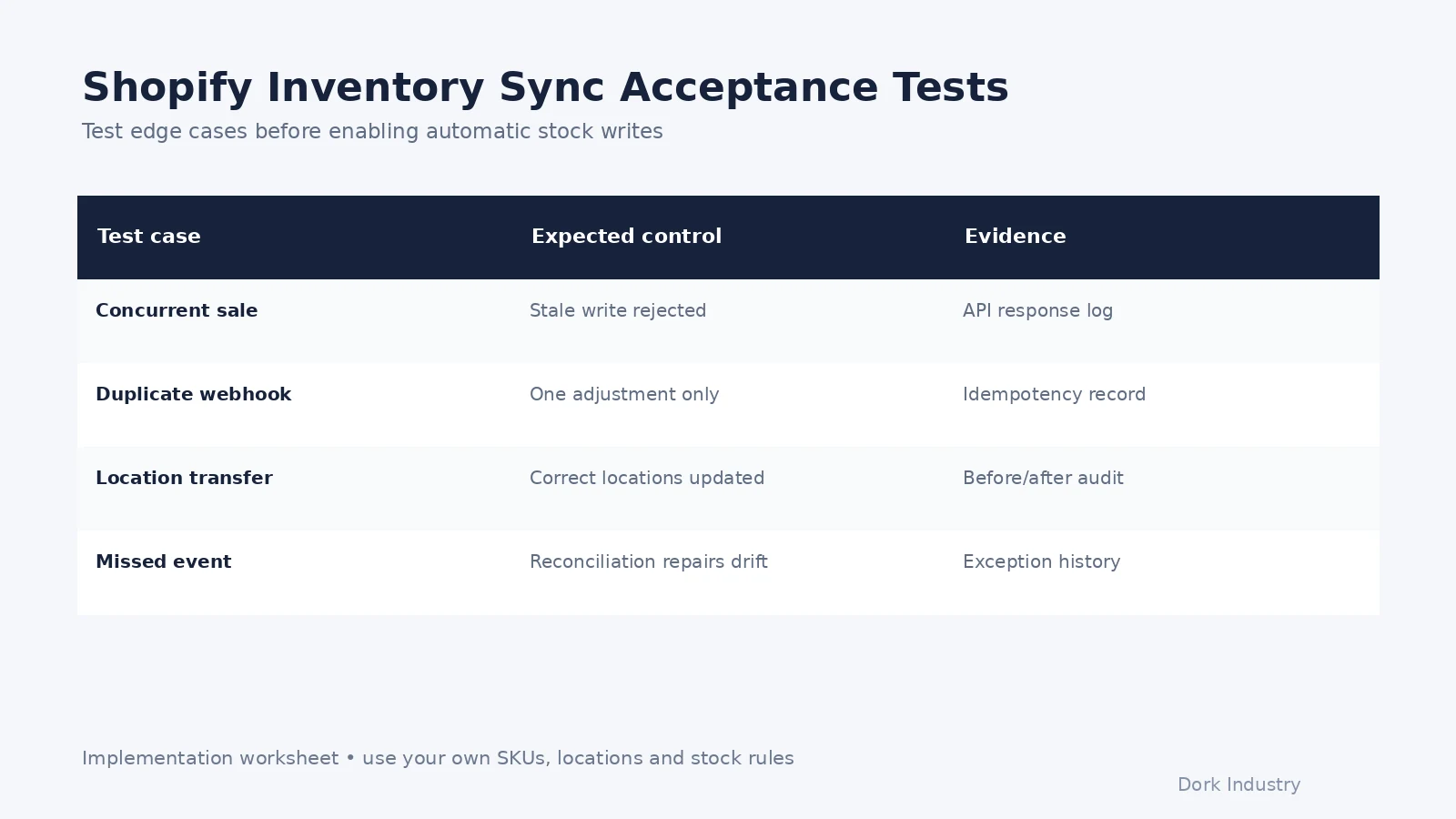
The pilot should show that drift is detected and repaired without inventing an ROI figure. Record actual error classes, recovery time and manual interventions during the controlled test. Those first-party results can later support a go-live decision and credible case evidence.
Should you use an app, middleware or custom integration?
Use a standard connector when its inventory meanings, locations and retry behaviour match the business. Middleware can suit multiple systems where visual mappings and monitoring are useful. A custom integration becomes relevant when the company has complex allocations, bundles, manufacturing, multiple warehouses, marketplace reservations or non-standard ERP rules.
Dork Industry can review the existing connector before proposing replacement. The work may involve custom software development, Shopify and web development, API integration, or a focused monitoring component. Teams that already have an architect can use Dork Industry’s developer hiring and staff-augmentation option.
How can Dork Industry repair Shopify ERP inventory sync?
Dork Industry can begin with one affected SKU family and one location. The assessment maps ownership, quantity meanings, webhook delivery, API responses, retry logic and reconciliation. A proof of concept can then repair one failure path before the business commits to a broader integration rebuild.
Bring examples of an oversold order, the corresponding ERP movements, Shopify inventory history, integration logs and the list of systems allowed to change stock. Dork Industry can turn that evidence into a repair scope, acceptance tests and an implementation plan.
Stop treating inventory drift as a manual correction
Request a Shopify–ERP integration audit or discuss a controlled repair proof of concept with Dork Industry.
Frequently asked questions
Can faster syncing prevent every oversell?
No. Faster updates reduce one risk, but they do not resolve duplicate events, incorrect SKU mappings, two systems writing stock or stale concurrent updates. The architecture still needs ownership, idempotency, guarded writes and reconciliation.
Should Shopify or the ERP be the inventory source of truth?
It depends on fulfilment and allocation rules. Many businesses use the ERP or WMS for stock ownership and Shopify for presentation, but the correct design must be documented per channel and location.
Why is location mapping important?
Shopify tracks inventory by inventory item and location. A correct total sent to the wrong location can still create an unavailable product, incorrect routing or overselling at another fulfilment point.
What does reconciliation add to webhooks?
Webhooks provide timely triggers. Reconciliation compares complete source and destination records later, catching events that failed, arrived out of order or could not be processed because mapping was incomplete.
Can Dork Industry repair an existing connector?
Yes, after reviewing its logs, available APIs and ownership rules. The outcome may be configuration, middleware repair, a monitoring layer or a custom integration rather than an automatic replacement.
What should we provide for an integration audit?
Provide affected SKUs, location mappings, oversold order examples, ERP movements, Shopify inventory history, connector logs, retry settings and a list of every system that can change quantity.