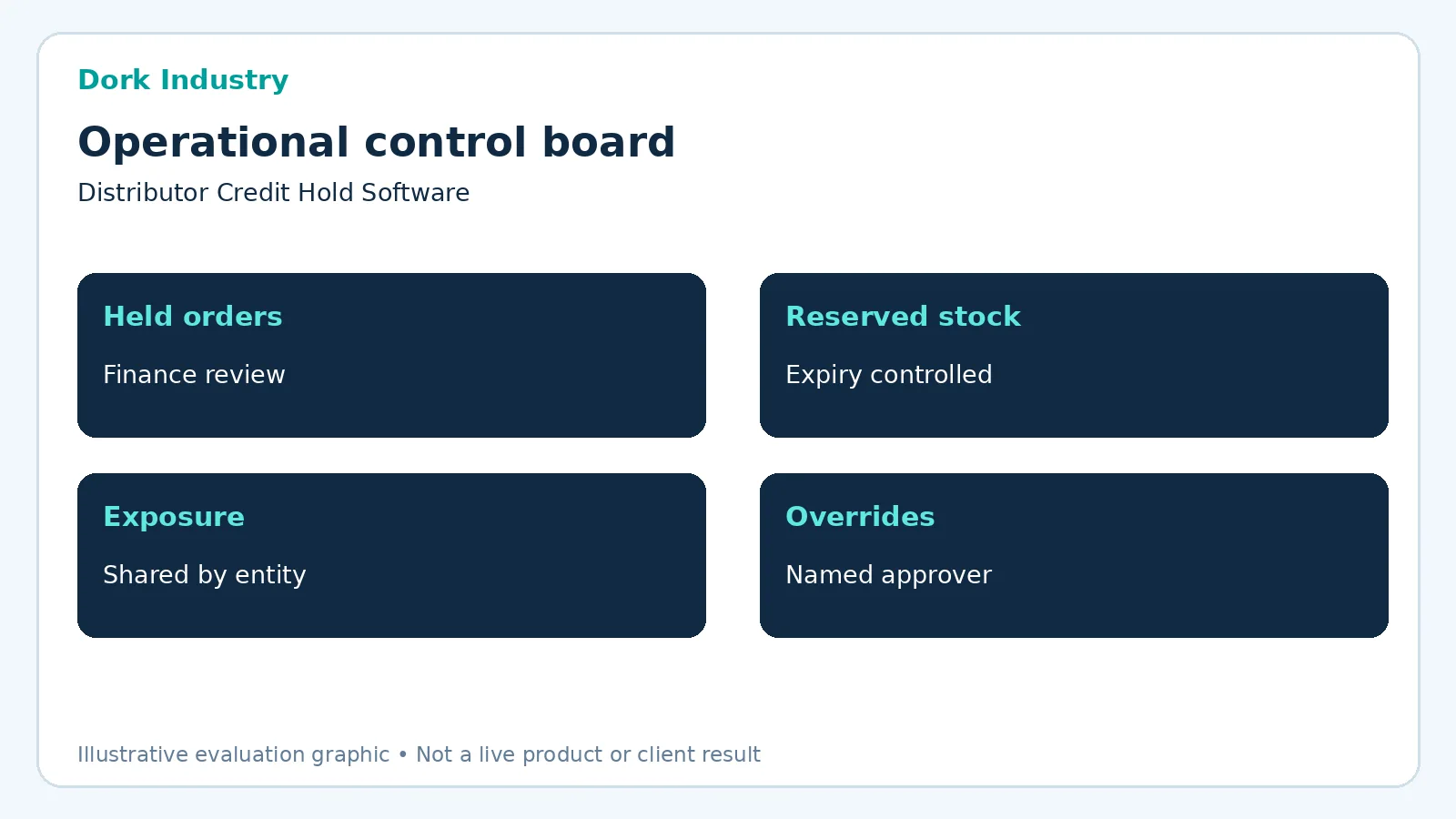
Distributor credit hold software should stop an order from becoming a dispatch commitment when the customer has insufficient approved credit. It must check shared exposure, open orders and stock reservations together, preserve authorised exceptions, and release held orders only when the underlying ledger has changed. Test these controls before selecting or integrating an ERP.
Prepared by Dork Industry. The examples and thresholds are illustrative evaluation recommendations, not client results or a regulatory certification.
What business problem makes this investment worthwhile?
A distributor can increase sales while tying up more working capital in unpaid invoices and reserved stock. The problem becomes harder when branches accept orders independently and each assumes the same customer still has available credit. A late finance check can leave picked goods waiting at dispatch while another paying customer cannot buy them. This guide is for owners, finance heads and distribution operations managers evaluating ERP replacement or CRM-to-ERP integration.
A Delhi distributor taking orders from a sales office while allocating goods from a warehouse in Naraina or Wazirpur needs a shared customer exposure calculation. The locality is relevant because sales acceptance and dispatch can happen at different sites; it does not change the credit policy. This is an illustrative operating scenario, not a Dork client project.
According to ERPNext’s official credit-limit documentation, credit controls depend on the customer, company and current exposure; open sales orders can also consume credit depending on configuration. Its stock-reservation documentation treats reservation as a separate inventory control. These are examples of implementation concepts, not a recommendation that every buyer must use ERPNext.
Which distributor credit hold software requirements matter?
How should policy boundary work?
Define whether the check occurs at order acceptance, invoicing, picking or dispatch. A bypass at one stage should never be mistaken for unlimited credit.
How should data ownership work?
Specify the customer and company IDs, opening receivables, unapplied payments, credit notes and stock locations used by each decision.
How should commercial control work?
Show why the order is held and what approved action can release it. Sales needs a usable explanation; finance needs an auditable decision.
How should integration contract work?
Agree how cancellations, amendments, partial invoices, refunds and customer merges alter exposure. Include recovery and reconciliation rules.
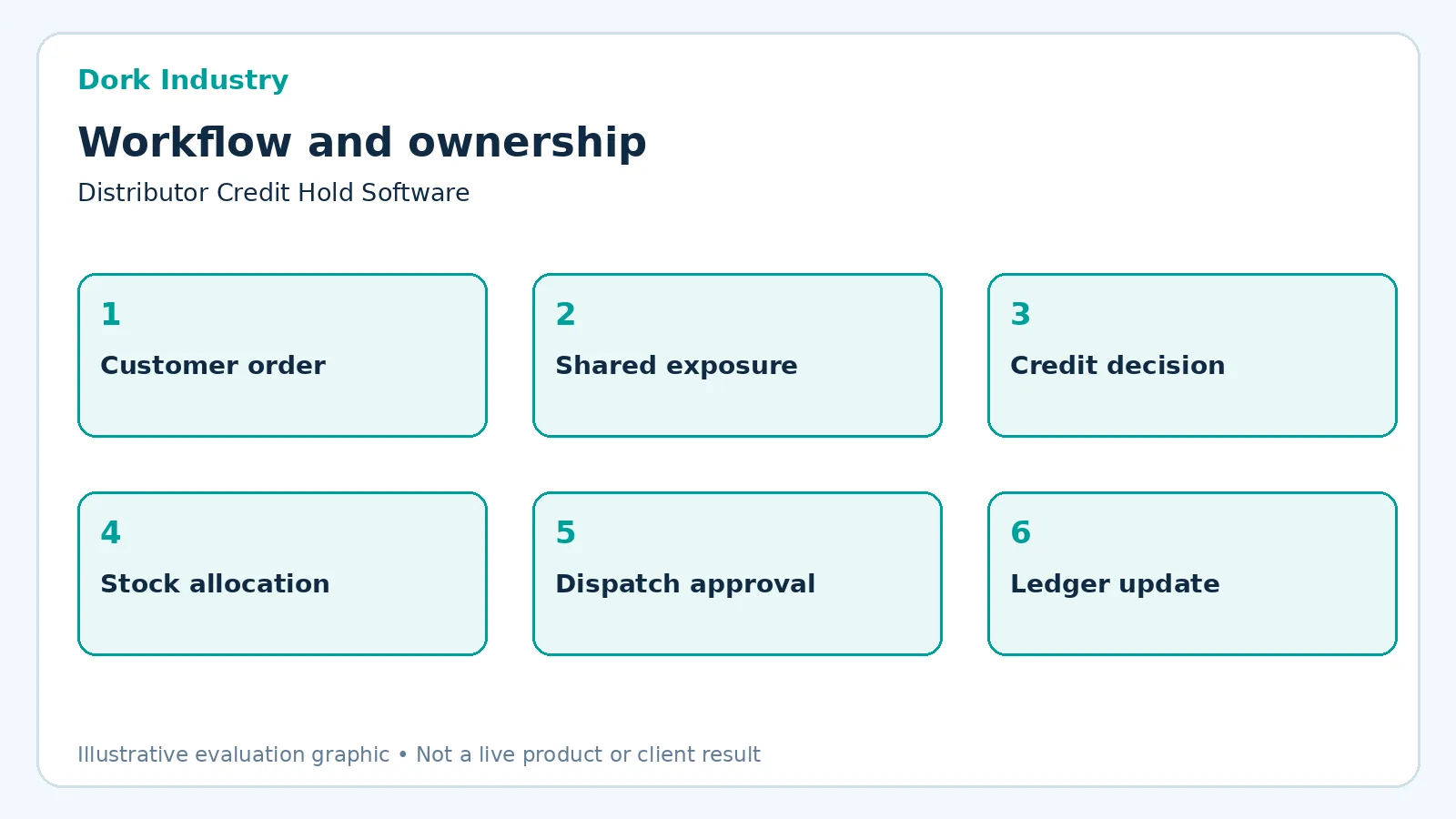
For each stage, record the source identifier, responsible role, allowed action, previous state, new state and failure route. Dork Industry’s ERP and enterprise integration services can be scoped around these boundaries. A mobile workflow may be useful when staff act away from a desk; its role should be justified by the actual process.
Which eight tests should the buyer run?
Run the demonstration with authorised anonymised records and a written expected outcome. Include normal transactions and deliberately difficult exceptions. Save the actual outcome, evidence reference, owner and severity before deciding whether a test passed. A polished dashboard cannot substitute for this evidence.
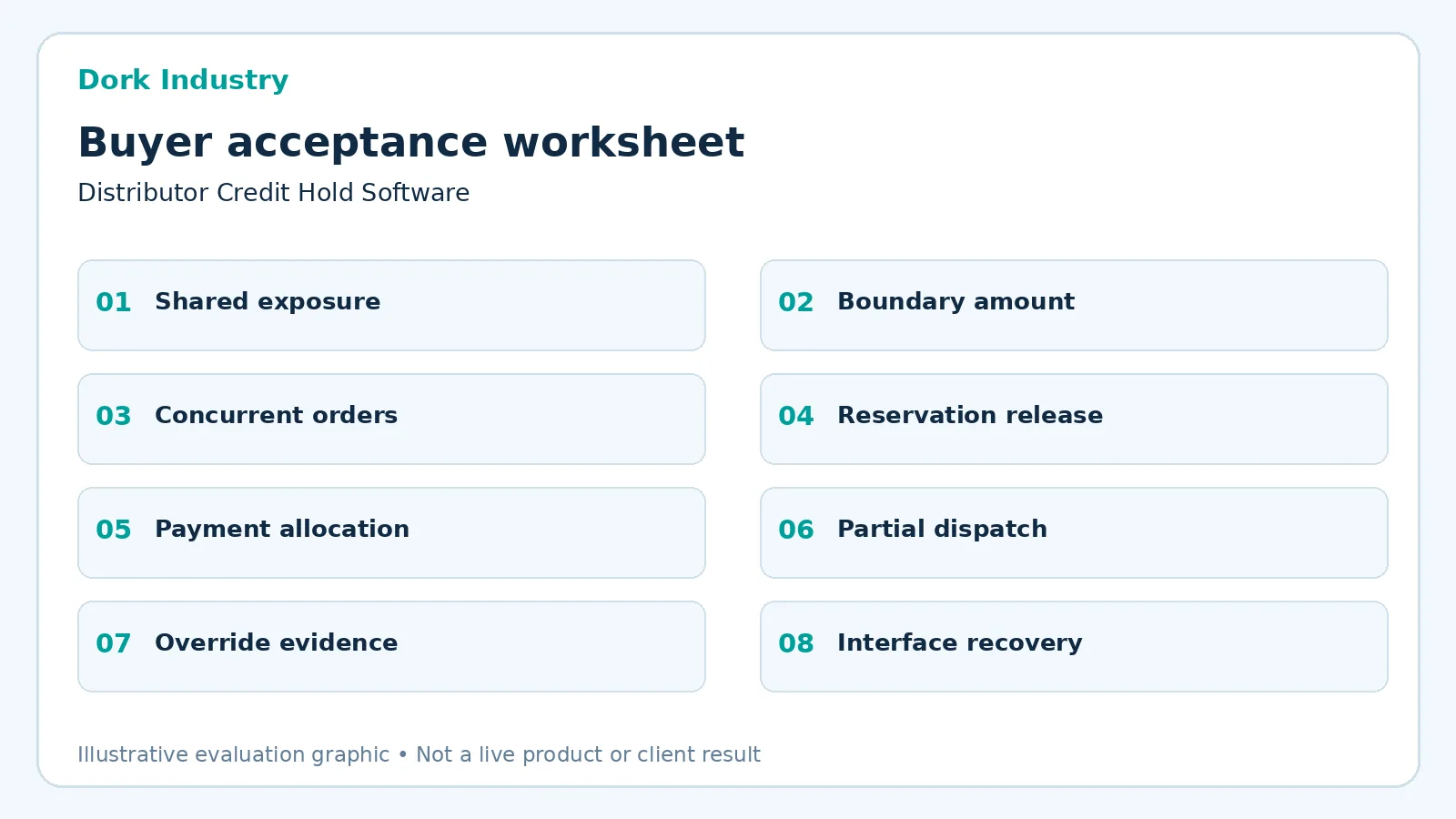
- Shared exposure: Submit orders from two branches for one customer. The second transaction must use the committed exposure from the first, not a cached branch balance.
- Boundary amount: Test an order exactly at the approved limit and another just above it. Record whether taxes, freight and open orders are included in the configured calculation.
- Concurrent orders: Submit two simultaneous orders competing for the same remaining facility. An atomic decision should prevent both from independently consuming the same available credit.
- Reservation release: Cancel or expire a held order. Verify that stock and credit reservations are released once, with a retained reason and timestamp.
- Payment allocation: Post a payment to the correct customer and legal entity. Release must follow the configured ledger update; a screenshot or unallocated receipt must not silently unlock dispatch.
- Partial dispatch: Ship part of an approved order and confirm the remaining order, stock commitment and invoice exposure do not double-count the same amount.
- Override evidence: Approve one exception with a restricted role. The record must retain amount, approver, reason, expiry and affected order.
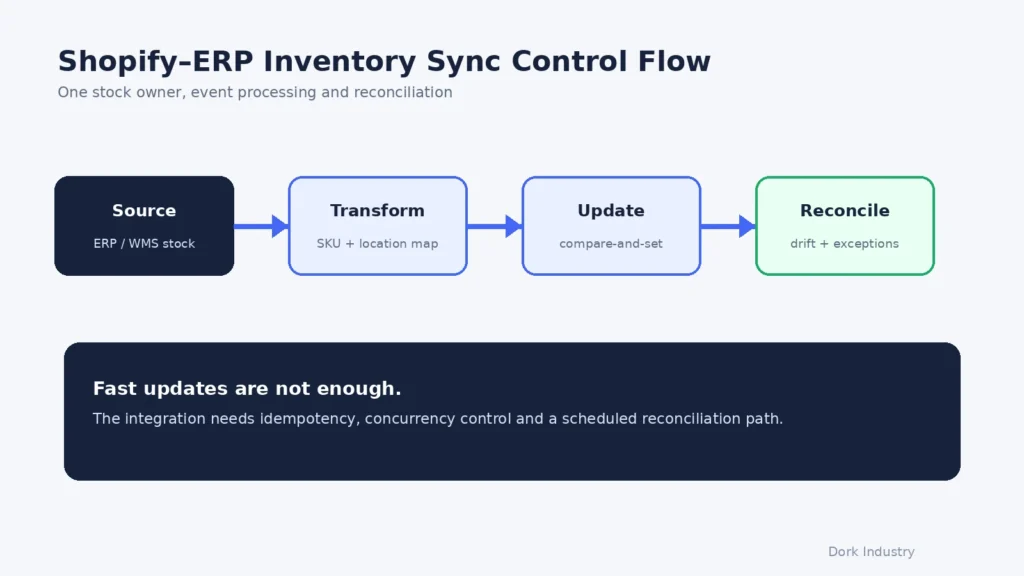
- Interface recovery: Replay a CRM order or payment event. There must be one order and one ledger effect, with failed events visible in an owned queue.
How should the worksheet be used?
Illustrative arithmetic: a customer has a Rs 500,000 approved limit, Rs 380,000 outstanding invoices and Rs 90,000 of open-order commitment. Available credit under this example policy is Rs 30,000. A new Rs 40,000 order is held. A verified, allocated Rs 50,000 payment reduces exposure and makes Rs 80,000 available. The exact treatment of tax, advances and orders must come from the distributor’s approved policy.
| Worksheet field | What to record | Decision supported |
|---|---|---|
| Scenario | Identifier, starting state and input | Can another reviewer reproduce it? |
| Expected outcome | Approved rule and required evidence | What does passing mean? |
| Actual outcome | Observed state, amounts and linked records | Did the system implement the rule? |
| Exception | Severity, owner, next action and due date | What prevents rollout? |
| Re-test | Corrected version and new evidence | Was the failure actually resolved? |
For a pilot, select at least 24 representative scenarios across three operational roles, including eight exception cases. Require 100% traceability for the tested transactions, zero duplicate business effects after replay and an assigned owner for every failed integration. These are proposed acceptance thresholds. The organisation must adapt them to its risk, volume and operating policy before contracting.
How should implementation and measurement work?
- Agree the rule before the screen. Have operations and finance approve the state model and definitions.
- Assign ownership. Identify the authoritative system for every shared record and who resolves a mismatch.
- Reconcile migration. Count imported records and validate identifiers, balances and statuses against signed-off source data.
- Test recovery. Simulate missing, duplicated and out-of-order events, then prove safe replay.
- Pilot a complete journey. Include the downstream financial or enrolment outcome rather than stopping at data capture.
- Expand after evidence review. Close critical failures, train the affected roles and retain a rollback and reconciliation plan.
Measure exception age, manual touches, correction reasons and transaction reconciliation before and after rollout. Use your own measured baseline; do not treat proposed thresholds as proven gains. A useful business case separates software investment, integration work, migration, training, ongoing support and the cost of the current manual process.
For broader context, read Dork Industry’s broader retail and wholesale inventory guide, and business finance visibility guide. This article focuses on a narrower buying decision, while the industry software overview connects that decision to wider operational requirements.
Frequently asked questions
Is a credit limit the same as payment terms?
No. A credit limit controls maximum permitted exposure, while payment terms define when a balance becomes due. A distributor may need both limits and overdue rules. Buyers should test how the selected ERP combines those controls.
Should held orders reserve stock?
That is a business policy choice. Reserving stock may protect an important order but can block other customers. Define the duration, approval conditions and automatic release rule, then test cancellations, expiry and partial fulfilment.
Can CRM accept orders without checking ERP credit?
It can technically capture a request, but it should clearly distinguish a request from an approved commitment. If ERP owns exposure and stock, the integration must obtain the required decision before promising dispatch.
What should a credit-control pilot prove?
It should prove shared exposure, correct limit boundaries, concurrent-order handling, authorised overrides, payment allocation, partial dispatch and safe message replay. Keep expected results and evidence for every representative scenario.