Direct answer: Hotel management software for multi-property hotels should keep room inventory, reservations, rates, housekeeping, guest folios, payments and property-level reporting consistent across every location. Before implementation, test double-booking prevention, room-status hand-offs, charge routing and financial reconciliation with realistic exceptions.
Prepared by Dork Industry. This guide presents a nine-test evaluation method and an illustrative daily-control worksheet. The figures explain a decision process; they are not customer results or market benchmarks.
For a Delhi hotel group, the growth problem is not merely accepting online bookings. It is maintaining one reliable operating picture when direct reservations, online channels, front desks, housekeeping, food and beverage charges and finance all update the stay record.
Hotel software decision guide
What should hotel management software for multi-property hotels solve?
The system should establish a controlled chain from sellable inventory to a reconciled stay. Availability, room status and commercial charges are related but different facts. A room may be physically vacant yet not ready to sell; a reservation may be confirmed while its payment is pending; and a checked-out folio may still contain an interface exception.
| Buyer problem | Required control | Evidence |
|---|---|---|
| Two channels sell the same room | Inventory and restriction synchronisation | Source, timestamp, acknowledgement and retry |
| Front desk and housekeeping disagree | Separate occupancy and housekeeping statuses | Status event, user, time and reason |
| Charges appear on the wrong folio | Routing rules and posting audit | Reservation, folio window, transaction code and user |
| Property reports use different definitions | Central metric and account mapping | Property mapping, currency, business date and version |
| Management cannot explain daily revenue | Night audit and exception reconciliation | Opening, postings, adjustments, payments and close status |
How should reservation-to-revenue control work?
A property management system should connect operations without erasing responsibility for each event. According to Oracle OPERA Cloud reservation documentation, reservation workflows include creating, updating and cancelling bookings, including multi-property itinerary capability. Separately, Oracle’s hotel operations guide documents housekeeping forecasts, room status and maintenance workflows. India’s National Council for Hotel Management also describes PMS and channel-manager integration as important to rate and inventory accuracy. Review the NCHM revenue-management resource.
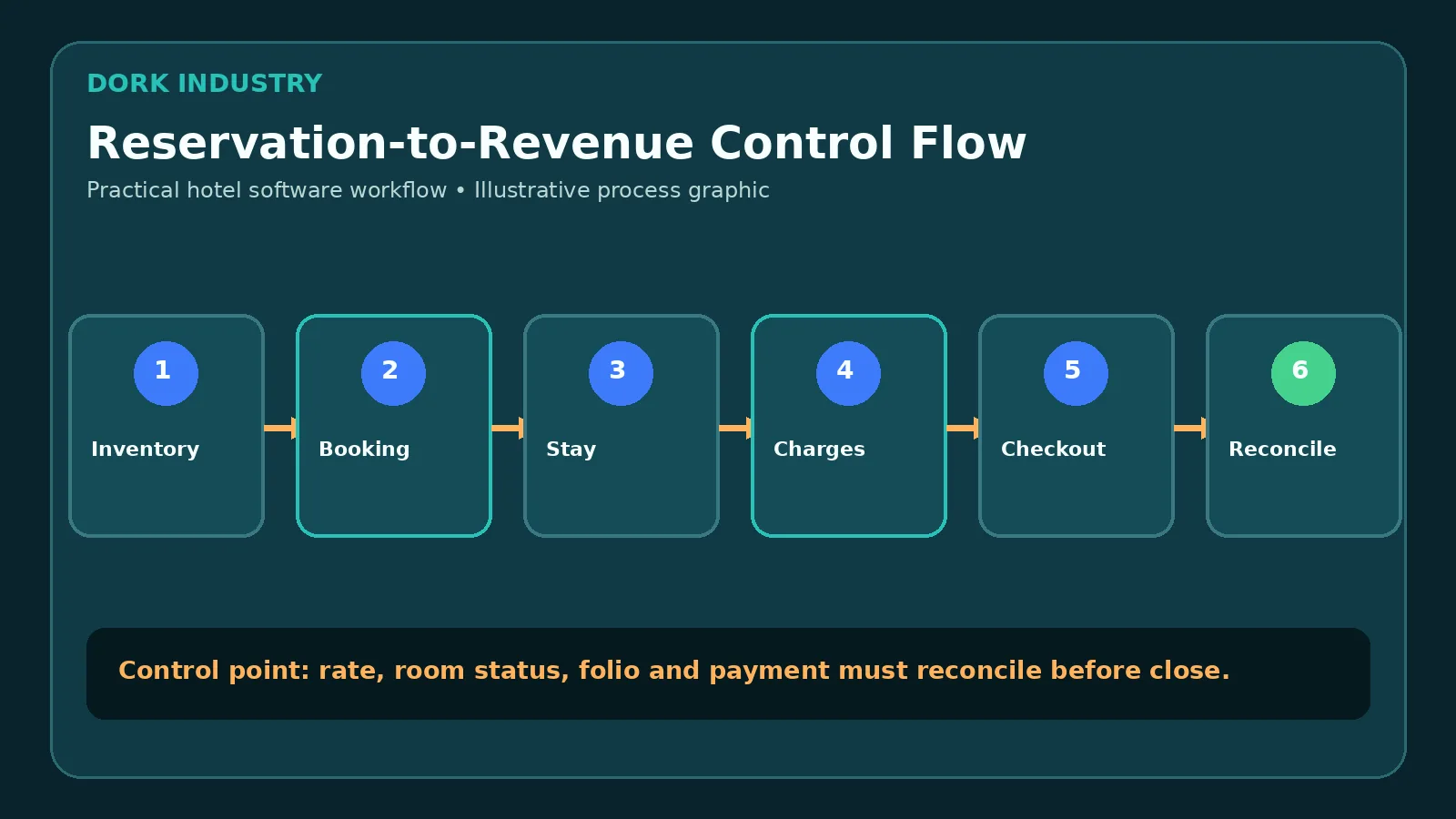
- Inventory: define room types, physical rooms, sell limits, restrictions and out-of-order status.
- Booking: capture source, rate, guarantee, guest, dates and change history.
- Stay: coordinate arrival, room assignment, room move and departure without losing the reservation trail.
- Charges: route room, tax, POS and other postings to the correct folio.
- Checkout: settle or explicitly manage approved outstanding balances.
- Reconcile: close the business date only after operational and payment exceptions are owned.
Which hotel software capabilities matter most?
How should reservations and distribution work?
- Maintain one availability and restriction model for direct and connected channels.
- Record reservation source, rate plan, guarantee and complete modification history.
- Support group, corporate and multi-room bookings when relevant.
- Expose failed channel updates instead of silently assuming success.
How should front desk and housekeeping work?
- Keep occupancy, housekeeping and maintenance states distinct.
- Support room moves, extensions, early departures and no-shows with audit history.
- Route room-cleaning tasks and inspections to the responsible team.
- Prevent a room from becoming sellable until the required readiness control passes.
How should folios and payments work?
- Support multiple folio windows and clear routing rules.
- Trace every charge, transfer, correction and adjustment.
- Handle payment retries idempotently so a repeated callback cannot post twice.
- Reconcile deposits, settlements, refunds and channel collections.
What makes the platform enterprise-ready?
- Property and chain roles with scoped access.
- Central masters with property-specific overrides where authorised.
- API integrations for channels, POS, payments, CRM and finance.
- Interface retry queues and reconciliation reports.
- Portfolio reporting with documented definitions and drill-down to source events.
Which nine acceptance tests should hotel software pass?
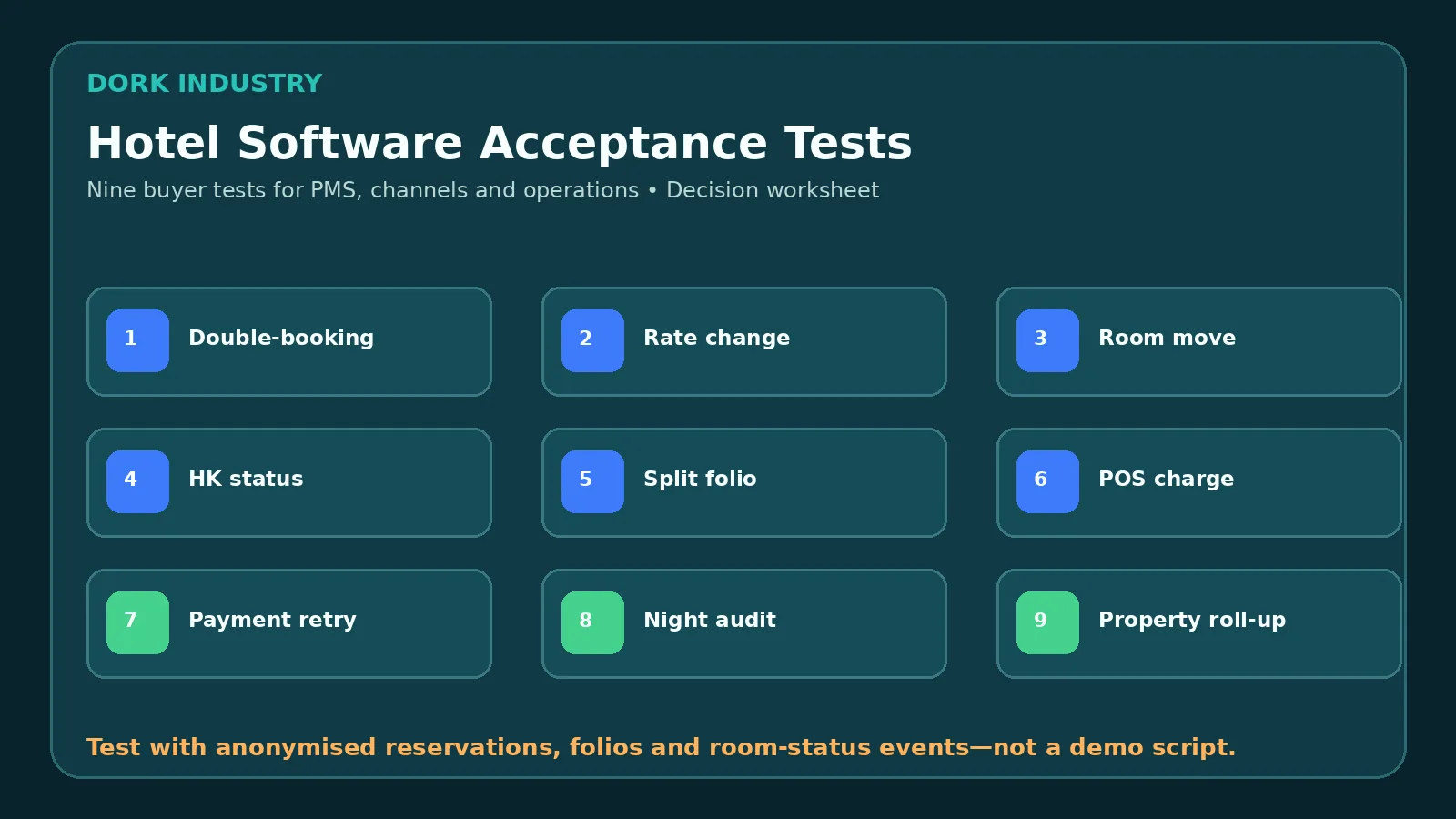
- Double-booking: submit two nearly simultaneous reservations for the last sellable room and verify the control result.
- Rate change: modify a future rate and confirm existing and new reservations follow the intended rule.
- Room move: move an in-house guest and preserve occupancy, housekeeping, key and folio history.
- Housekeeping status: check out a room, clean it, reject inspection and prove it cannot be sold prematurely.
- Split folio: route accommodation to a company and extras to the guest, then reverse one charge.
- POS charge: post a restaurant charge twice with the same external identifier and ensure only one valid posting remains.
- Payment retry: repeat a gateway callback and verify there is no duplicate settlement.
- Night audit: leave an unresolved posting and confirm close either blocks or creates an explicit owned exception.
- Property roll-up: reconcile property totals to the central portfolio report using the same business date and definitions.
Recommended pilot thresholds: test at least 20 anonymised reservation records across the nine scenarios; require 100% traceability from every folio posting to its source; require zero duplicate reservations, charges or payments during retry tests; and require 100% of failed interfaces to enter a visible exception queue. These are proposed acceptance thresholds—not customer performance claims.
How should a hotel daily-control worksheet work?
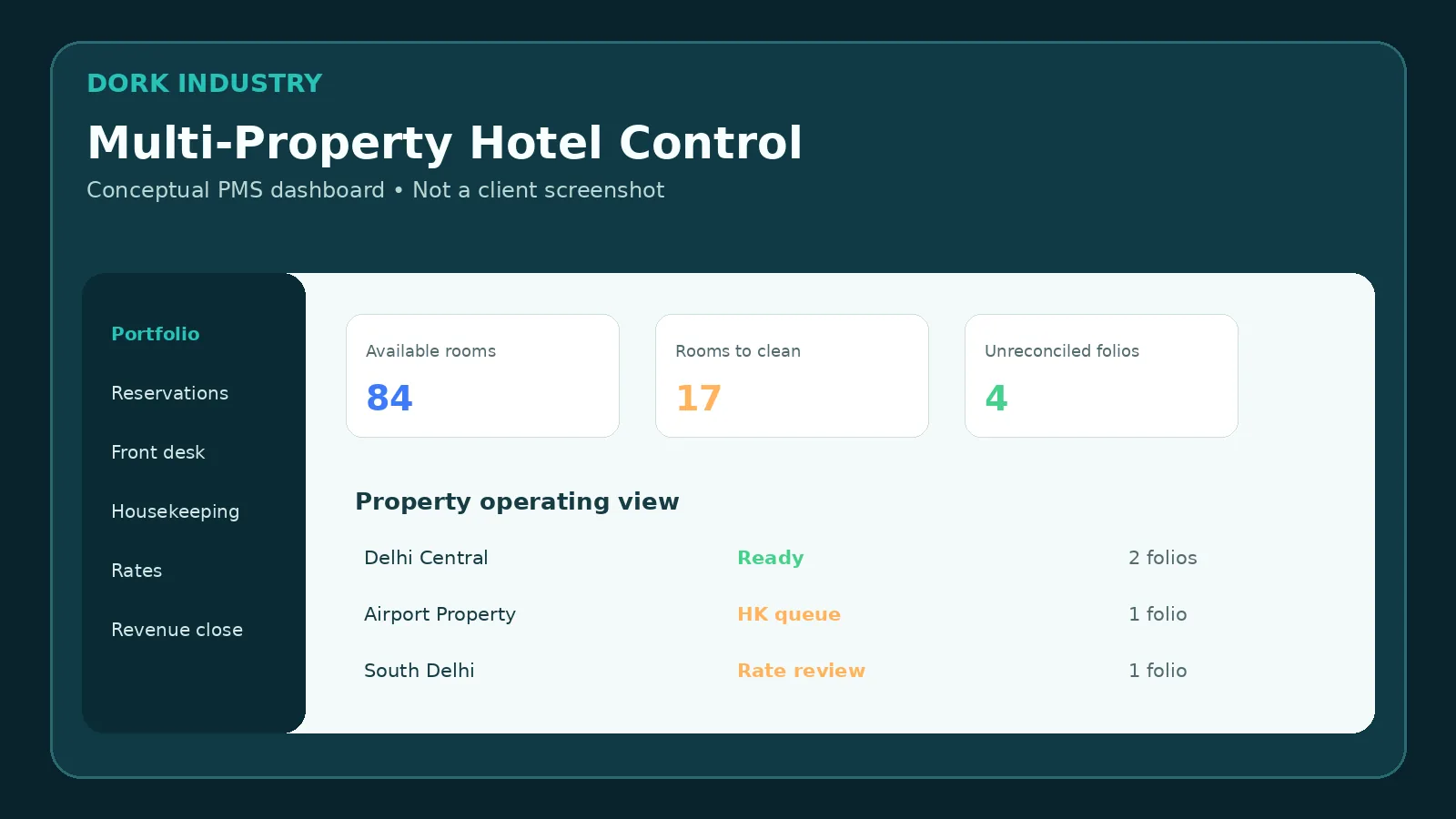
The following fictional example shows how an operational close can be tested. It is not a hotel result or industry benchmark.
| Illustrative control item | Count/value | Required evidence |
|---|---|---|
| Rooms available to sell | 84 | Physical inventory less valid exclusions |
| Rooms awaiting cleaning or inspection | 17 | Departure and housekeeping task events |
| Unreconciled folios | 4 | Named exception, value and owner |
| Duplicate payment callbacks tested | 3 | One settlement per unique transaction |
| Portfolio properties reconciled | 3 of 3 | Property close totals equal central totals |
A fictional revenue-control example can add a second reconciliation: ₹4.86 lakh of room charges plus ₹1.24 lakh of other valid charges minus ₹0.08 lakh of approved adjustments produces ₹6.02 lakh in net charges. If recorded settlements are ₹5.88 lakh, the system should expose the remaining ₹0.14 lakh as named open folios or another explained balance—not bury it inside a dashboard total.
The useful control is not a green dashboard. A manager should be able to open every exception, see the source event, determine the responsible role and confirm how the correction reaches finance.
How should multi-property hotel software be implemented?
1. Which workflows should be sampled?
Select direct, channel, corporate, amended, cancelled, no-show, room-move, split-folio and refund examples. Anonymise guest information.
2. Who should own master data?
Assign owners for properties, room types, rooms, rates, restrictions, transaction codes, taxes, payment methods, companies and user roles.
3. What should the pilot include?
Run one property through booking, stay, housekeeping, charge posting, checkout and daily close while connecting at least one real interface.
4. How should integrations be reconciled?
Document each source, target, unique identifier, field map, trigger, retry behaviour, exception owner and reconciliation report.
5. When should rollout expand?
Expand only when the nine tests pass, opening reservations and balances reconcile, and every role can explain its exception queue.
Dork Industry’s industry expertise, ERP solution capability and technology consulting approach can support requirements mapping, system integration and custom enterprise application decisions. The appropriate route may be PMS configuration, an integration layer or custom development.
Bring one reservation-to-revenue workflow to a review
Share anonymised reservation, room-status, folio and interface examples. Dork Industry can help convert them into requirements, acceptance tests and an integration scope.
What should hotel groups ask a software vendor?
- Which event changes sellable inventory?
- How are failed channel updates surfaced and retried?
- Can occupancy, housekeeping and maintenance status be audited separately?
- How are charges routed and corrected?
- What prevents duplicate reservations and payments?
- Can every central report drill down to a property event?
- Can the group export complete reservation and folio history?
- What evidence will be produced for each acceptance test?
Frequently asked questions
What is hotel management software?
Hotel management software, often centred on a property management system, coordinates reservations, front-desk activity, room status, guest folios, payments and reporting. It may integrate with channel managers, booking engines, POS, CRM and accounting systems.
What is multi-property hotel management software?
It supports several hotels under controlled shared masters, roles and portfolio reporting while preserving property-specific operations. A real multi-property design should reconcile central reports to the reservations, folios and business dates of each hotel.
Is a channel manager the same as a PMS?
No. A channel manager distributes rates, availability and restrictions to connected sales channels. A PMS manages the stay and property operation. They should exchange data reliably, but buyers must test failures, retries and reconciliation between them.
Should a hotel group buy or build its platform?
Buy when a PMS fits the operating model and supports required integrations. Consider custom development or an integration layer when cross-property workflows, reporting or surrounding systems materially differ. Decide through documented requirements and acceptance tests.
How should implementation success be measured?
Measure reconciliation accuracy, interface exceptions, room-status hand-off, duplicate prevention, unresolved folios, adoption by role and whether portfolio reports trace to source records. Login counts and dashboard availability alone do not prove business improvement.
Editorial note: all figures and interface examples are illustrative. Validate accounting, tax, payment and guest-data requirements with qualified professionals.