Pharma batch traceability software should prove that a manufacturer can reconstruct every material, process, result, approval and dispatch connected to a batch. Buyers should test that chain with representative records before selecting an ERP, electronic batch record or quality platform. A feature demonstration is not enough when production, quality, stores and distribution must agree.
Prepared by Dork Industry as an enterprise-software evaluation guide. All sample values and thresholds are illustrative recommendations, not customer results or compliance certification.
Decision guide
What business problem should traceability software solve?
The real problem is fragmented operational evidence. Procurement may know the supplier lot, stores may know the receipt status, production may know what was consumed, quality may hold test results, and dispatch may know where finished goods went. If these records cannot be joined quickly, release decisions, deviation investigations, inventory control and recall execution become slower and less reliable.
According to the US FDA’s current GMP records guidance, required manufacturing records must remain available for inspection, and electronic source records may contain essential context that a printout does not preserve. The guidance specifically references 21 CFR 211.68, 211.180(d), 211.188 and 211.192 for electronic equipment, retained records, batch records and production review. According to FDA’s Q7 guidance for active pharmaceutical ingredients, computerized GMP systems should have validated controls, protected access and records of data changes. These principles make traceability, audit history and controlled status changes practical buying requirements, not decorative features. See the FDA’s CGMP records Q&A and Q7 GMP guidance.
| Business risk | Required software control | Evidence to inspect |
|---|---|---|
| Wrong material status used in production | Approved, quarantined and rejected status blocking | Attempted issue is blocked and logged |
| Batch history split across departments | Unique IDs and linked genealogy | One query returns material, process, test and dispatch links |
| Unexplained yield or quantity variance | Expected-versus-actual calculations with approval | Variance, reason, reviewer and timestamp remain visible |
| Quality release occurs too early | Release checklist and segregation of duties | Missing result prevents release |
| Recall scope takes too long to establish | Forward and backward trace | Affected supplier lots, batches and dispatches are reconstructable |
What must the batch genealogy connect?
A reliable chain begins before production. It connects supplier and purchase information, receipt number, material lot, sampling and quality status, storage location, production issue, equipment and line, batch steps, in-process checks, yield, deviations, finished-goods release, packing, dispatch and customer or channel destination. Each transition needs an authorised actor, time, reason and retained history.
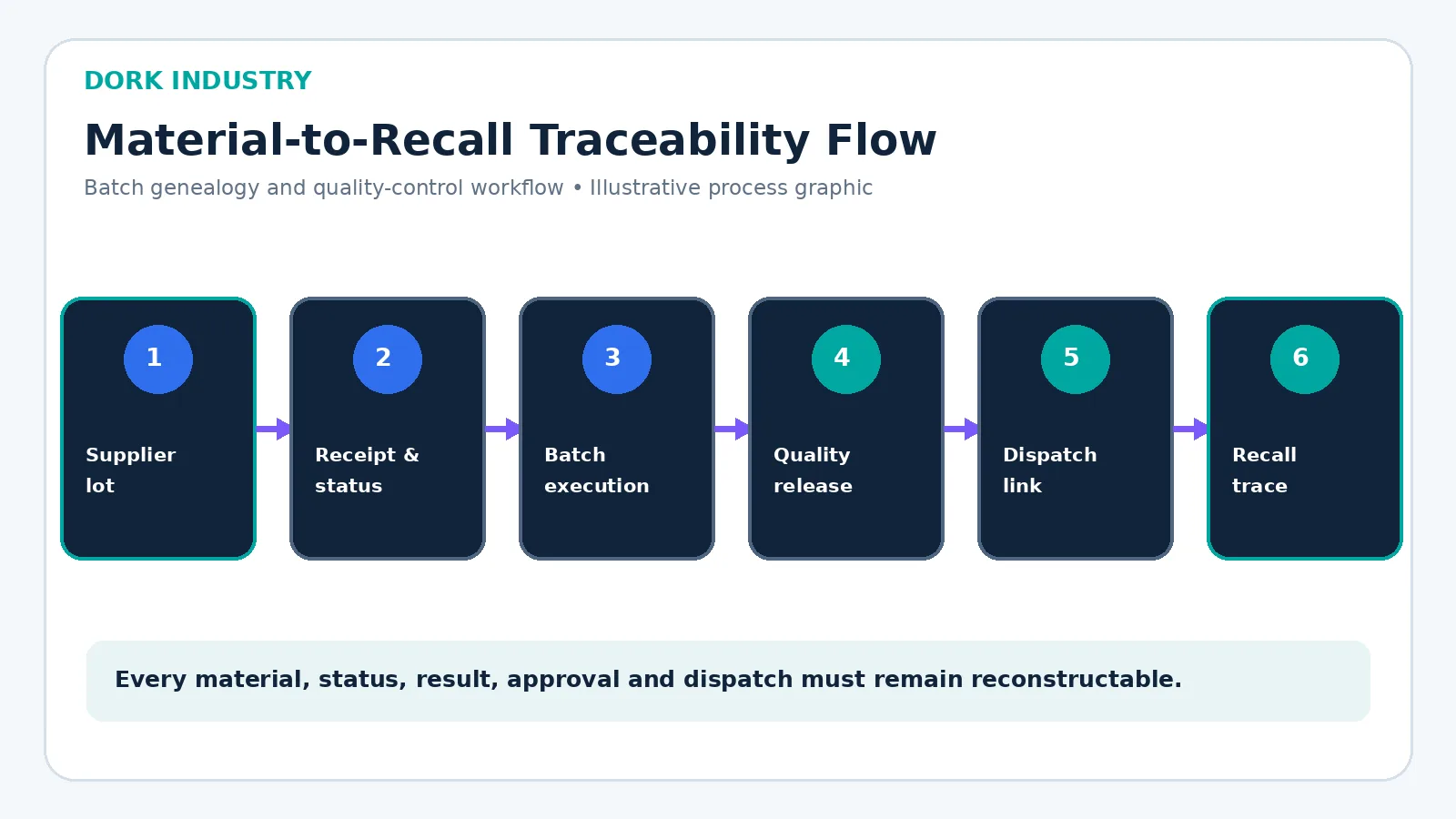
The system boundary matters. A manufacturer may use ERP for procurement and inventory, an electronic batch record for execution, LIMS for laboratory results and another application for distribution. Dork Industry’s ERP and enterprise workflow services focus on making ownership and interfaces explicit. Where equipment readings contribute evidence, IoT and industrial automation should deliver governed events with device identity, timestamp and exception handling.
Which pharma batch traceability software belongs on the shortlist?
How should master data and status work?
Require controlled materials, products, units, specifications, recipes or bills of material, equipment, locations and approved suppliers. Status rules should prevent quarantined or rejected material from being issued. Effective dates and revision history should show which approved instruction applied to each batch.
How should electronic records preserve history?
Test role-based access, electronic approvals where applicable, audit trails, reason-for-change capture, time synchronisation, backup and retrieval. The system should preserve the previous value and the actor behind a change. Buyers should confirm their own applicable regulatory and quality requirements with qualified specialists.
How should quality and deviations connect?
Sampling, specifications, results, out-of-specification handling, deviations, corrective actions and release decisions should remain linked to the affected batch. A hold should propagate across inventory and dispatch controls, while authorised release should preserve the completed evidence set.
How should ERP, LIMS and equipment interfaces behave?
Every interface needs ownership, mapping, monitoring and recovery. Test missing IDs, late results, duplicated messages and unavailable systems. Failures should enter an exception queue; they should never disappear or create duplicate inventory, results or batch events when replayed.
Which nine acceptance tests should pharma buyers run?
Use approved, anonymised test records that represent actual products, materials, units, quality states and integration paths. Record the expected result, actual result, evidence link, owner and severity for each test.
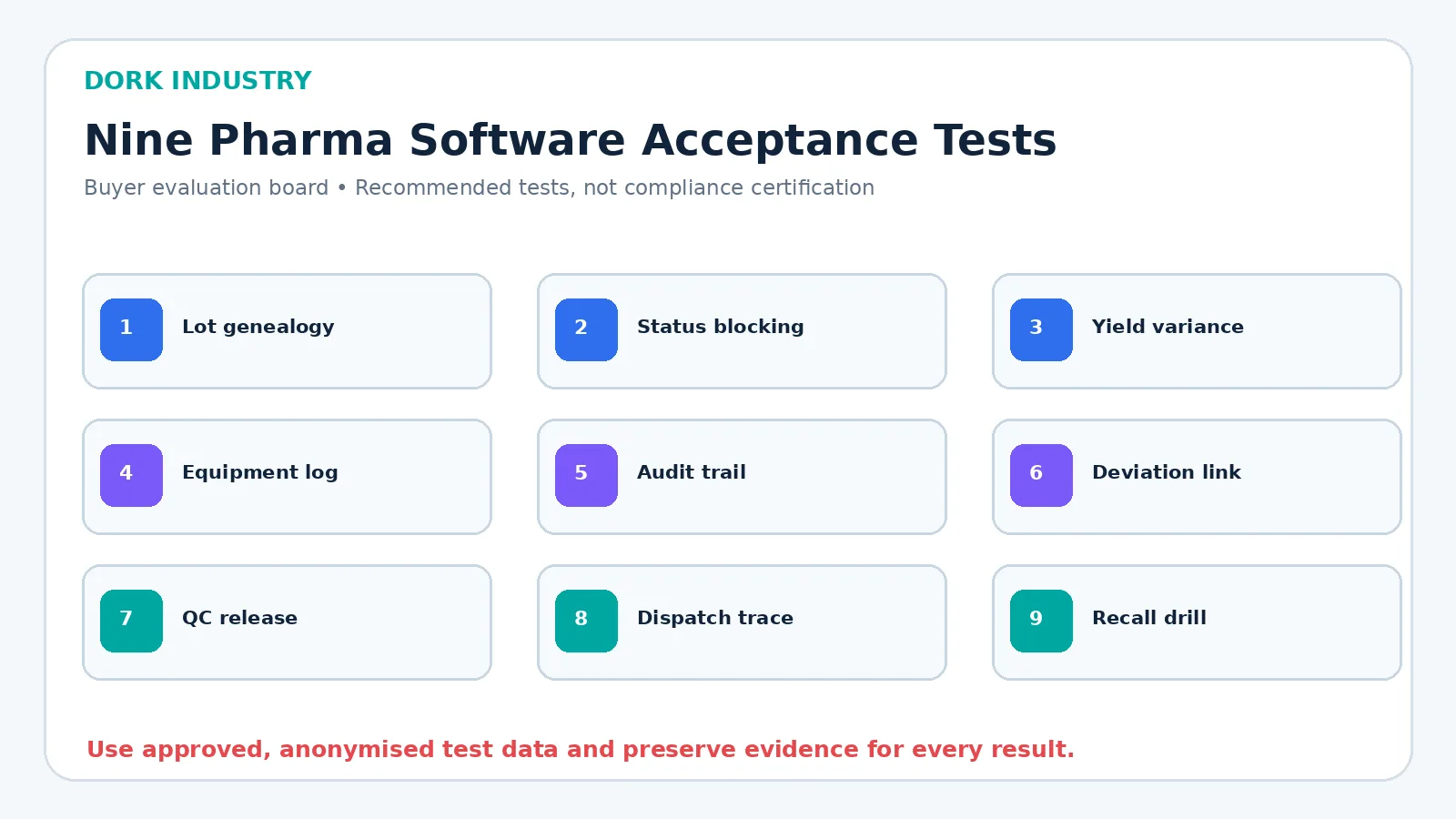
- Lot genealogy: select a finished batch and trace every consumed raw-material lot, quantity and status.
- Status blocking: attempt to issue quarantined material and confirm the system blocks and records the action.
- Yield variance: enter an out-of-limit variance and verify review, reason and approval controls.
- Equipment history: confirm the batch links to equipment identity, use record and relevant cleaning or maintenance status.
- Audit trail: correct an authorised field and verify old value, new value, actor, time and reason remain retrievable.
- Deviation link: create a deviation and confirm affected batch, material and decision records stay connected.
- Quality release: omit one required result and verify the batch cannot be released or dispatched.
- Dispatch trace: move forward from a material lot to every affected batch and dispatch destination.
- Recall drill: reconstruct backward and forward scope, preserve the query evidence and identify unresolved gaps.
How should a traceability pilot be scored?
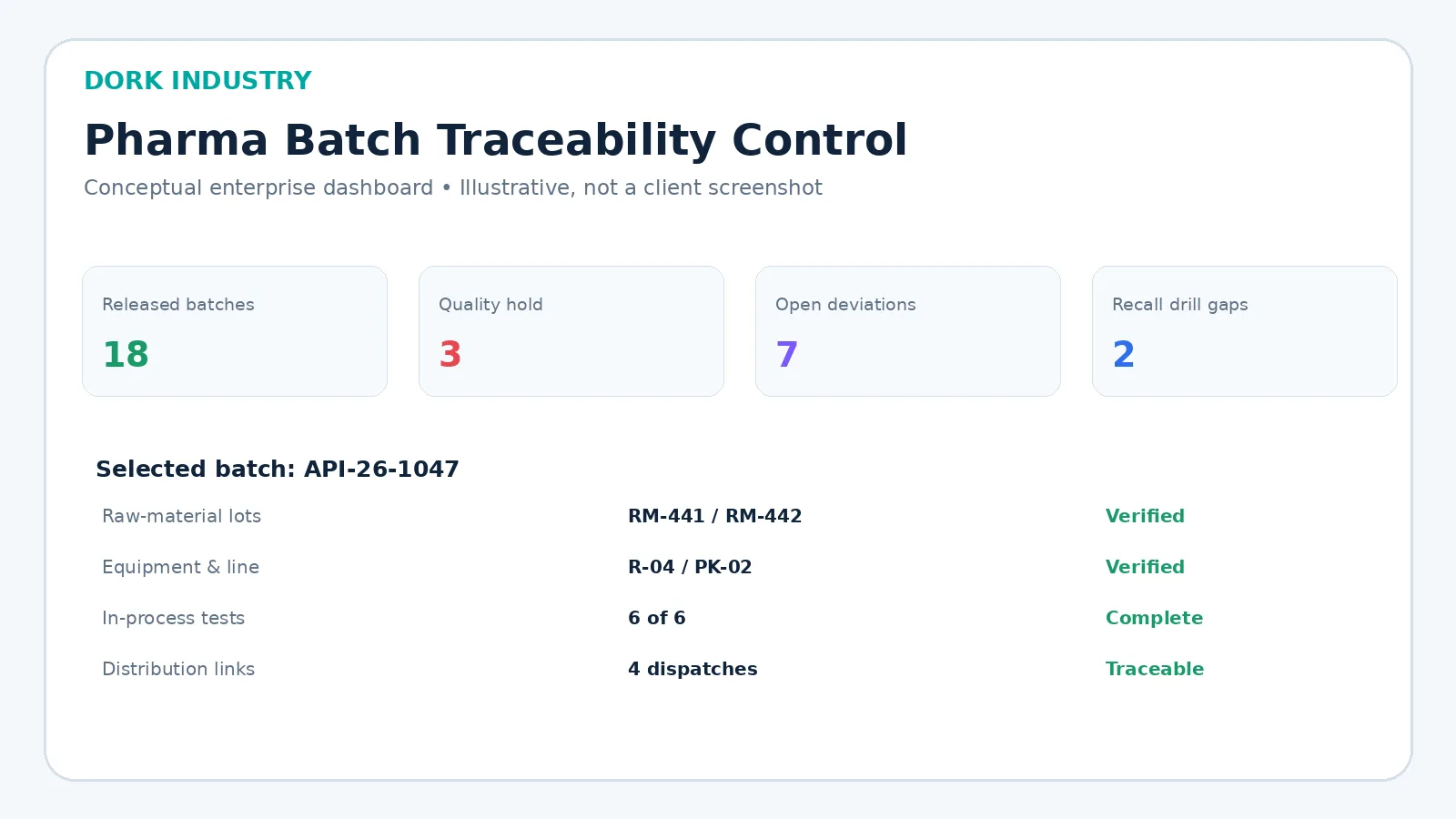
This fictional pilot snapshot shows the structure of a decision worksheet. It is not a customer outcome, benchmark or regulatory threshold.
For example, an illustrative test batch might receive a 500 kg supplier lot, issue 460 kg to production, record 452 kg of output and route the 8 kg difference for authorised variance review. The same test can require six in-process results, two approvals and four dispatch links across three destinations. These figures exist only to make the acceptance test reproducible.
| Illustrative item | Example value | Acceptance question |
|---|---|---|
| Finished batches in pilot | 18 | Can every batch reach approved source records? |
| Material lots tested | 42 | Are quantity, status and consumption traceable? |
| Quality holds | 3 | Are issue, release and dispatch blocked correctly? |
| Open deviations | 7 | Does each retain batch, owner and disposition links? |
| Interface exceptions | 4 | Can every failure be corrected and replayed once? |
| Recall drill gaps | 2 | Are the missing records assigned and resolved? |
A practical pilot recommendation is at least 20 anonymised transactions across receipt, issue, production, quality and dispatch; 100% tested-event traceability; zero unauthorised status bypasses; zero duplicate records after message replay; and 100% failed interfaces visible in an owned exception queue. These are evaluation recommendations and should be adjusted to the manufacturer’s risk assessment and quality system.
How should implementation risk be controlled?
- Define system ownership. Decide which application owns material, product, supplier, batch, result and customer records.
- Map the current process. Include real holds, rework, rejected material, deviations and interface failures—not only the happy path.
- Design controls before screens. Specify roles, status transitions, approvals and required evidence.
- Validate proportionately. Establish the documented testing and change-control approach appropriate to criticality and applicable requirements.
- Migrate with reconciliation. Count records, map IDs and document unresolved data-quality gaps.
- Pilot a complete chain. Release by representative product and workflow, then expand only after acceptance evidence is reviewed.
Dork Industry works across industry-specific enterprise software problems, integration and operational automation. A discovery engagement should begin with the decisions and evidence your teams cannot trust today—not with a generic software feature list.
Need a pharma traceability evaluation plan?
Bring one representative batch workflow, current system map and known evidence gaps. Dork Industry can help structure requirements, integration boundaries and acceptance tests.
Frequently asked questions
What is pharma batch traceability software?
It is software that links material lots, production events, equipment, quality results, approvals, finished batches and distribution records. The goal is to reconstruct what entered a batch, what happened during processing and where released goods were dispatched.
Is an ERP enough for batch traceability?
It depends on scope and configuration. ERP may control procurement, inventory and production, while LIMS, electronic batch records or quality systems hold other evidence. Buyers must test the complete chain across every system rather than assuming one product label guarantees coverage.
What is forward and backward traceability?
Backward traceability moves from a finished batch to its materials, results and production history. Forward traceability moves from a supplier or material lot to every batch and dispatch it affected. Both directions are important during investigations and recall drills.
Should traceability software maintain an audit trail?
For relevant electronic records, buyers should evaluate whether changes preserve the previous value, new value, actor, timestamp and reason. Applicable requirements vary by organisation and jurisdiction, so the control and validation approach should be reviewed by qualified quality and regulatory specialists.
What should a pharma software pilot include?
A pilot should cover receipt, material status, production consumption, yield, quality hold and release, deviations, dispatch trace and interface recovery. It should use approved anonymised data and retain evidence for every expected and actual result.