Retail return to stock software should keep a returned item unavailable for resale until its identity, condition and disposition are confirmed. It must connect the original sale, return authorisation, physical receipt, inspection, refund and inventory update. Buyers should test each state across stores, warehouses and online channels before replacing their returns workflow.
Prepared by Dork Industry. The examples and thresholds are illustrative evaluation recommendations, not client results or a regulatory certification.
What business problem makes this investment worthwhile?
A refund and a physical return are different events. When systems treat them as one, a retailer may refund an item that never arrived, sell damaged stock, or show a returned unit as available in two locations. The commercially important problem is recoverable inventory and margin visibility as sales channels expand. This guide is for retail operations, ecommerce, warehouse and finance leaders evaluating ERP or order-management integration.
A Delhi retailer may receive a website return at a shop while the original order was shipped from a separate warehouse. An illustrative furniture or electronics operation in Rohini could require inspection at a workshop before an item is sellable. The location matters only when it changes custody, condition checks or transport responsibility; it should not be inserted as a substitute for workflow design.
According to Shopify’s official Return API documentation, a return links the original order with return line items, refunds and reverse-fulfilment orders. This supports a useful integration distinction: merchandise movement and financial outcome need linked records. According to ERPNext’s stock-reservation documentation, stock commitment is a governed record rather than an informal promise. Confirm the actual capabilities and API version of every platform in your own stack.
Which retail return to stock software requirements matter?
How should state model work?
Keep requested, authorised, in transit, received, inspected, dispositioned and closed distinct. Refund status belongs beside that chain rather than replacing it.
How should inventory boundary work?
Separate physical on-hand from sellable stock. A unit awaiting inspection can physically exist without being available to a customer.
How should evidence ownership work?
Store inspection reason, supporting evidence, actor, time and disposition approval. Define who may change a grade and how earlier decisions remain visible.
How should financial mapping work?
Link refunds, exchanges and credit notes to the original transaction. Review channel fees, discounts, freight and tax adjustments with the finance owner.
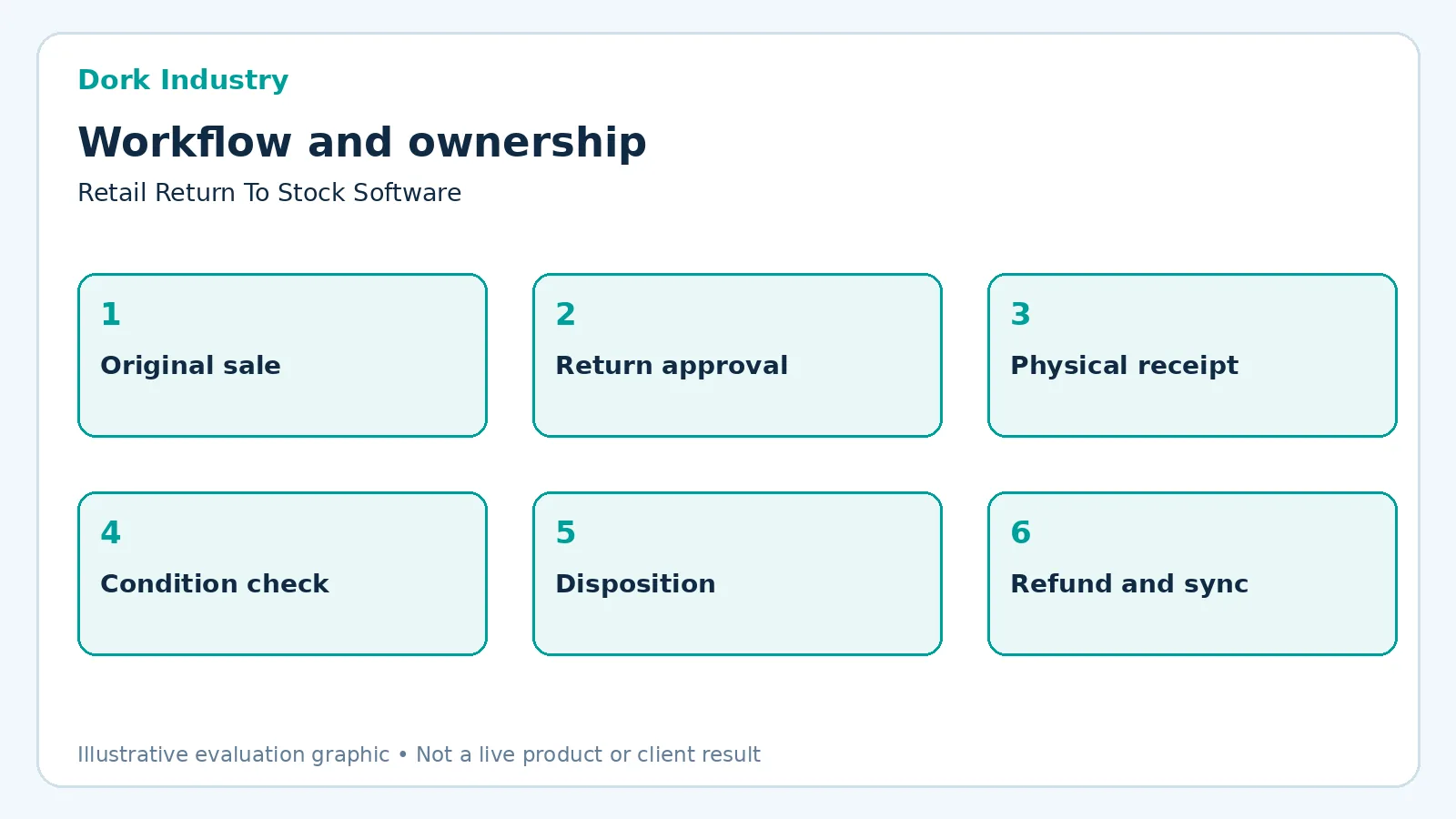
For each stage, record the source identifier, responsible role, allowed action, previous state, new state and failure route. Dork Industry’s ERP and enterprise integration services can be scoped around these boundaries. A mobile workflow may be useful when staff act away from a desk; its role should be justified by the actual process.
Which eight tests should the buyer run?
Run the demonstration with authorised anonymised records and a written expected outcome. Include normal transactions and deliberately difficult exceptions. Save the actual outcome, evidence reference, owner and severity before deciding whether a test passed. A polished dashboard cannot substitute for this evidence.
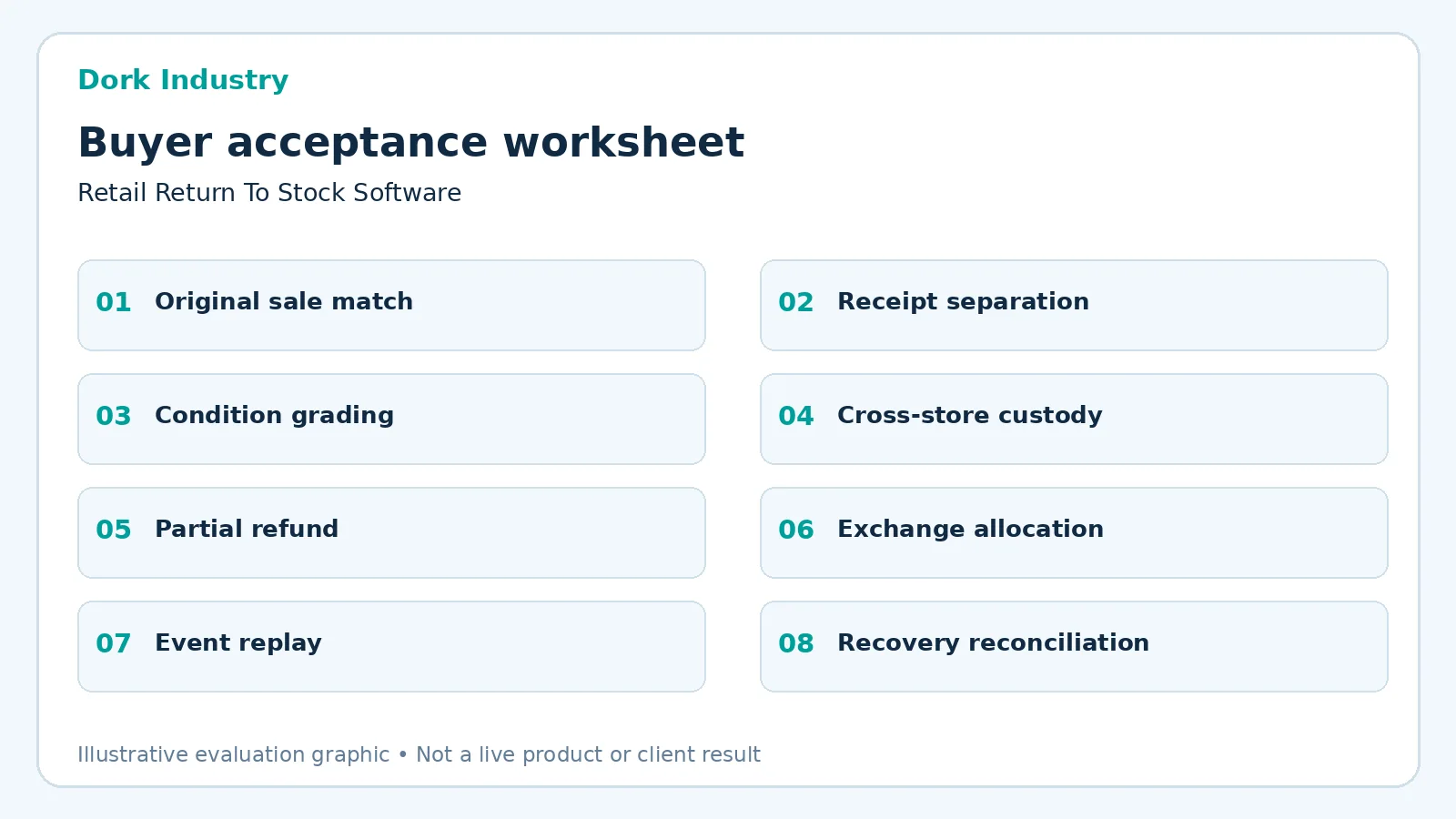
- Original sale match: Return one line from a multi-item order. Confirm SKU, quantity, serial number where applicable and original transaction remain linked.
- Receipt separation: Approve a return without receiving it. The item must not become available inventory solely because the return was authorised.
- Condition grading: Receive a damaged item. It should enter a restricted location or status until an authorised decision selects resale, repair, supplier return or write-off.
- Cross-store custody: Receive an online order at another store. Confirm the item exists in one physical location and that the original channel retains the return reference.
- Partial refund: Refund only the approved line or quantity. Preserve charges, discounts and tax treatment according to reviewed commercial and accounting rules.
- Exchange allocation: Create an exchange while replacement stock is scarce. Verify one reservation and trace the replacement order to the return.
- Event replay: Replay a receipt, refund or stock message. Inventory quantity and financial effects must occur once; duplicates should be visible in processing history.
- Recovery reconciliation: Disconnect one channel during inspection approval, then reconnect it. Reconcile location, status, quantity and refund references before selling the item again.
How should the worksheet be used?
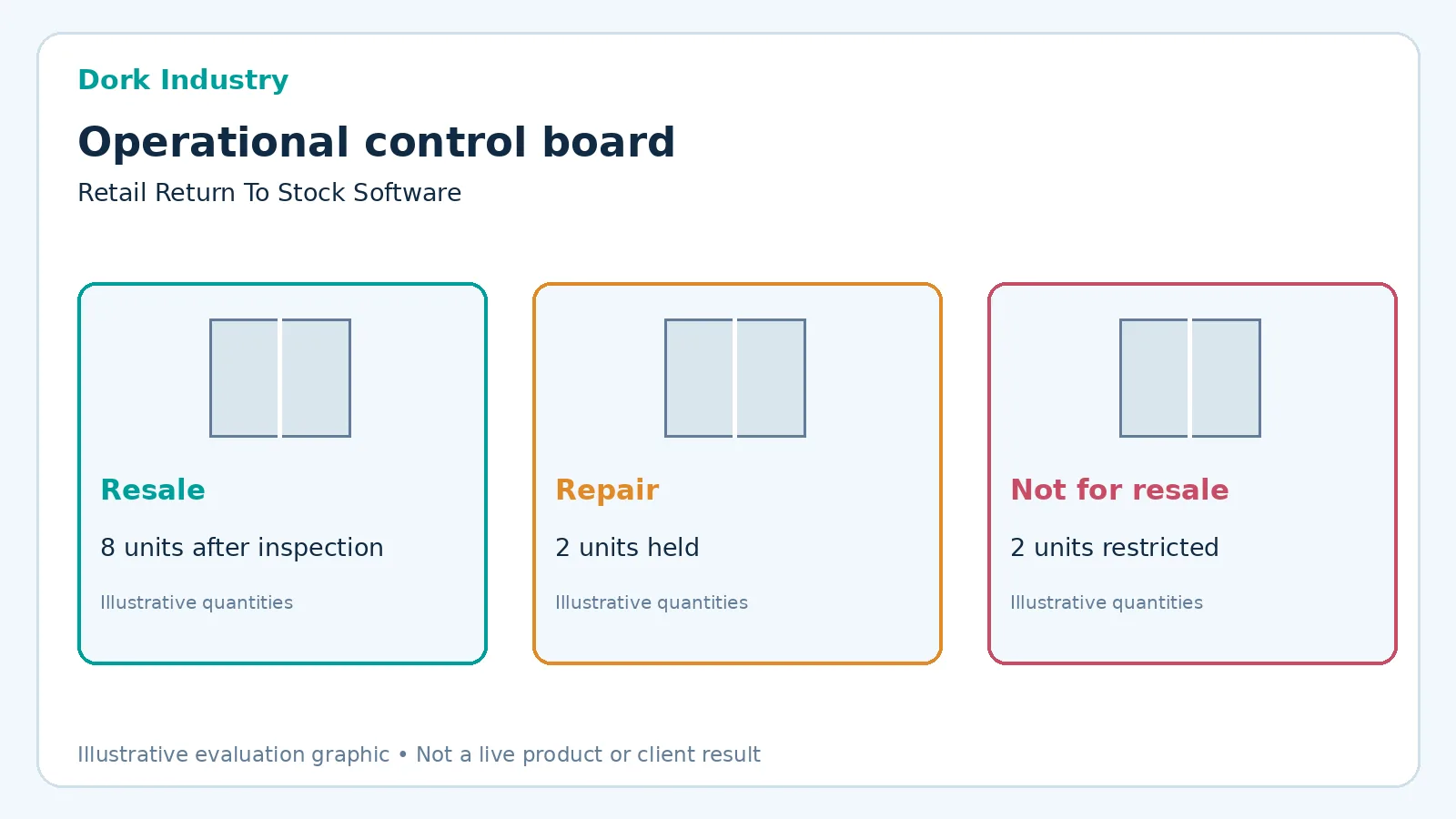
Illustrative stock arithmetic: a store receives 12 returned units. Eight pass inspection for resale, two require repair and two are rejected for resale. Physical stock is 12, but newly sellable stock is eight under this example policy. Publishing all 12 online would overstate sellable inventory by four units. No actual retailer performance is implied.
| Worksheet field | What to record | Decision supported |
|---|---|---|
| Scenario | Identifier, starting state and input | Can another reviewer reproduce it? |
| Expected outcome | Approved rule and required evidence | What does passing mean? |
| Actual outcome | Observed state, amounts and linked records | Did the system implement the rule? |
| Exception | Severity, owner, next action and due date | What prevents rollout? |
| Re-test | Corrected version and new evidence | Was the failure actually resolved? |
For a pilot, select at least 24 representative scenarios across three operational roles, including eight exception cases. Require 100% traceability for the tested transactions, zero duplicate business effects after replay and an assigned owner for every failed integration. These are proposed acceptance thresholds. The organisation must adapt them to its risk, volume and operating policy before contracting.
How should implementation and measurement work?
- Agree the rule before the screen. Have operations and finance approve the state model and definitions.
- Assign ownership. Identify the authoritative system for every shared record and who resolves a mismatch.
- Reconcile migration. Count imported records and validate identifiers, balances and statuses against signed-off source data.
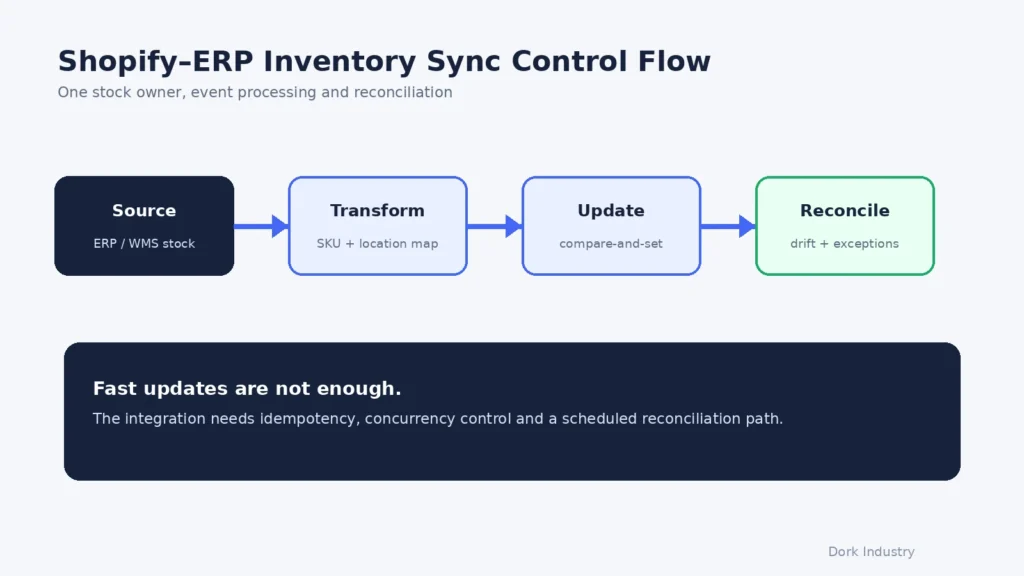
- Test recovery. Simulate missing, duplicated and out-of-order events, then prove safe replay.
- Pilot a complete journey. Include the downstream financial or enrolment outcome rather than stopping at data capture.
- Expand after evidence review. Close critical failures, train the affected roles and retain a rollback and reconciliation plan.
Measure exception age, manual touches, correction reasons and transaction reconciliation before and after rollout. Use your own measured baseline; do not treat proposed thresholds as proven gains. A useful business case separates software investment, integration work, migration, training, ongoing support and the cost of the current manual process.
For broader context, read Dork Industry’s retail inventory management guide, and offline mobile synchronisation tests. This article focuses on a narrower buying decision, while the industry software overview connects that decision to wider operational requirements.
Frequently asked questions
Does issuing a refund put stock back into inventory?
It should not automatically make the item sellable. A financial refund and physical receipt are separate events. Inventory should follow the approved receipt, inspection and disposition rules, with clear links to the original transaction.
What is return disposition?
Disposition is the approved next use of a returned item, such as resale, repair, supplier return or write-off. The software should retain the condition evidence and decision owner rather than simply adding every return to available stock.
Can an online purchase be returned at a store?
That depends on the retailer’s policy and integrations. Test the original order lookup, receiving location, inspection rules, refund responsibility and stock update before enabling cross-channel returns for customers.
What should a returns pilot measure?
Measure inspection age, unresolved dispositions, duplicate processing, inventory discrepancies and refund reconciliation. Establish a baseline from actual records; do not assume a software purchase alone produces a particular margin improvement.