Direct answer: Textile ERP software for garment manufacturers should connect buyer orders, style and size-colour demand, BOM revisions, fabric and trim allocation, in-house or job-work production, quality, shipment and order-level cost. Test the system with changed quantities, material shortages and job-work returns before relying on its margin forecast.
Prepared by Dork Industry. This guide presents a nine-test evaluation framework and a fictional order-costing worksheet. The method is original editorial guidance; the figures are not customer results or market benchmarks.
For Delhi garment and textile teams coordinating merchandising, stores, production units and outside processors, the buyer problem is commercial: can the business accept an order with a realistic delivery plan and margin, then keep that forecast explainable as materials, quantities and process costs change?
Textile ERP decision guide
What should textile ERP software for garment manufacturers solve?
The platform should preserve the commercial meaning of an order as it moves from merchandising to production and finance. A single style can contain several colours and sizes, while component consumption may differ by variant. A total order quantity is therefore not enough for material planning, allocation or margin control.
| Buyer problem | Required control | Evidence |
|---|---|---|
| Order totals hide size-colour demand | Variant matrix by style, colour and size | Ordered, planned, cut, produced and shipped quantities |
| BOM changes do not reach planning | Approved BOM versions and effective dates | Old value, new value, reason and approver |
| Fabric appears available but cannot be used | Allocation by roll, lot, shade or approved rule | On-hand, reserved, issued and usable balance |
| Job-work material is hard to reconcile | Issue-return and process-loss control | Challan, processor, quantity, stage and difference |
| Margin is known only after shipment | Planned versus forecast versus actual order cost | Material, labour, job work, overhead rule and variance |
How should the style-to-shipment workflow operate?
The system should treat fashion characteristics as operational data, not description text. According to SAP Fashion Management documentation, materials processes can manage articles using characteristics such as sizes and colours. Separately, SAP’s deviation-quantity guidance documents different component quantities for size and colour variants. India’s Ministry of Textiles garment study also identifies costing, order booking, procurement, production planning and monitoring as connected operational areas. Review the Ministry of Textiles study.
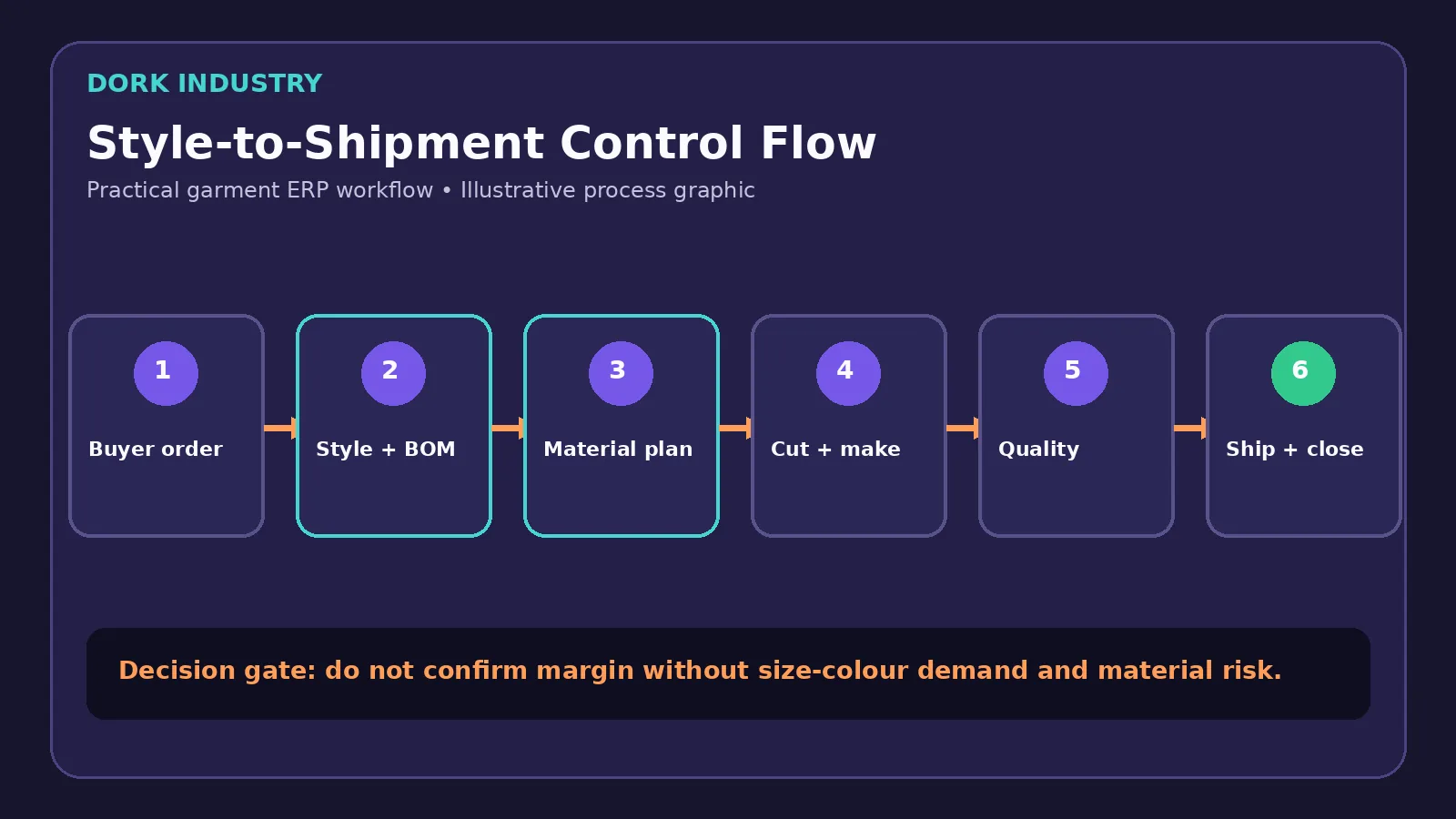
- Buyer order: capture style, delivery, colour-size quantities, price and commercial conditions.
- Style and BOM: approve specifications, component consumption and effective revision.
- Material plan: calculate need, inspect available stock and create allocation or purchase action.
- Cut and make: record in-house and outside-process movement without losing order identity.
- Quality: record inspected, accepted, rejected and reworked quantities by stage.
- Shipment and closure: reconcile planned, issued, produced, shipped and costed quantities before final margin review.
Which textile ERP requirements matter most?
How should style and BOM control work?
- Maintain style, colour, size and season or collection where relevant.
- Support variant-specific component consumption instead of one average BOM.
- Version specifications and approvals without erasing previous planning evidence.
- Separate sample, confirmed and revised order states.
How should fabric and trim inventory work?
- Track usable identity such as roll, lot, shade, width or quality when the workflow requires it.
- Distinguish physical stock, quality hold, reservation, issue and available-to-plan.
- Record unit conversions explicitly rather than hiding them in spreadsheets.
- Trace substitutions and their effect on cost and quality approval.
How should job work be controlled?
- Connect material issue, outside process, processor, return and accepted output.
- Record expected and actual loss using an approved rule.
- Keep rejected or rework quantities visible.
- Separate processor payable from buyer revenue.
What makes the platform enterprise-ready?
- Role-based approvals for BOM, material substitution, job work and commercial changes.
- Audit logs for order, rate, quantity and master-data changes.
- API or controlled integrations with finance, ecommerce, warehouse and production systems.
- Retry queues and reconciliation reports for failed interfaces.
- Exportable data that preserves style, variant, lot, order and document relationships.
Which nine acceptance tests should textile ERP pass?
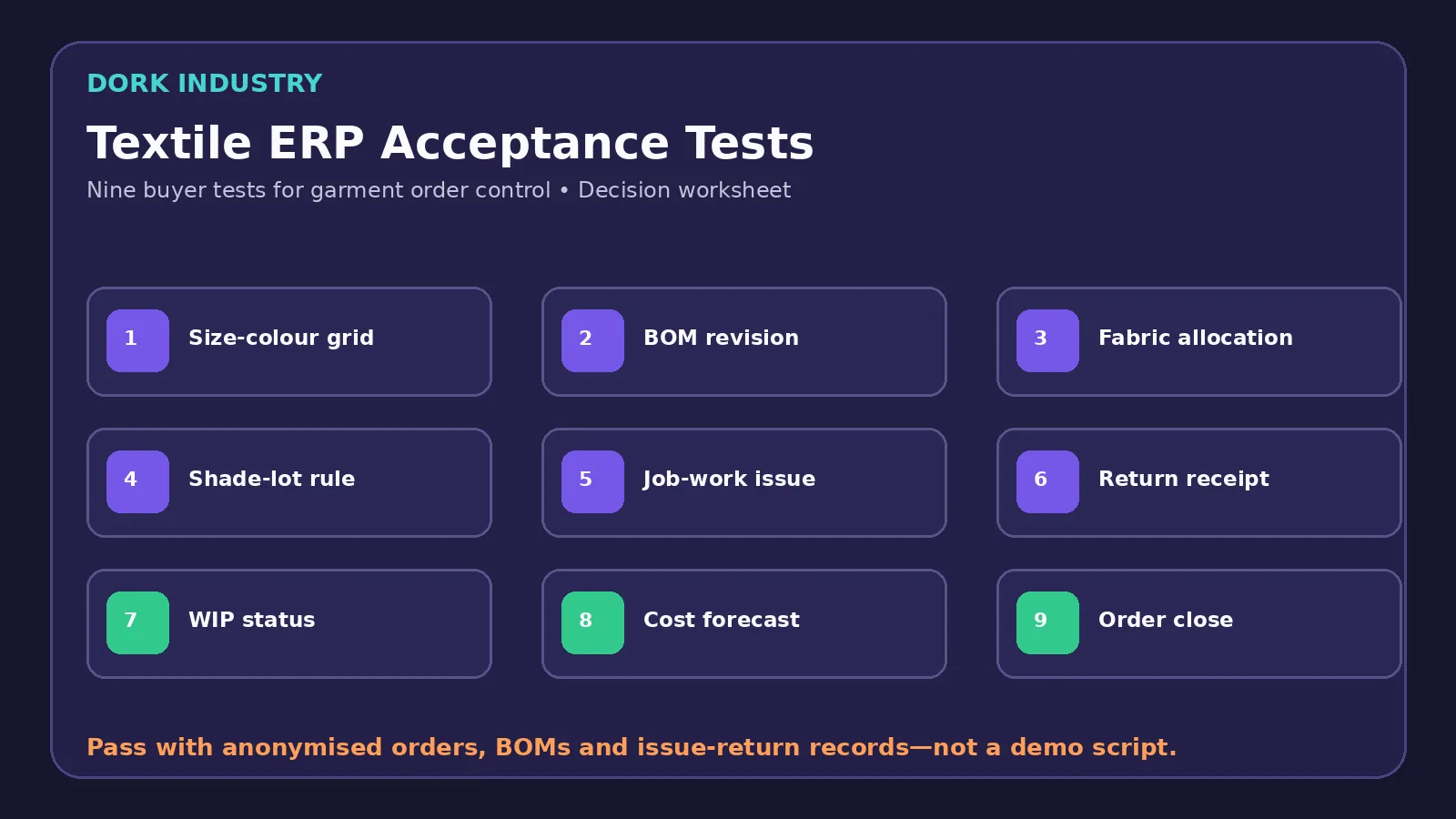
- Size-colour grid: change quantities for two variants and confirm planning and shipment balance update correctly.
- BOM revision: change component consumption with an effective date and preserve the earlier version.
- Fabric allocation: reserve material for one order and prove another order cannot silently consume it.
- Shade-lot rule: attempt an invalid mix and confirm the workflow blocks or routes an authorised exception.
- Job-work issue: issue material to an outside processor and trace order, process, quantity and document.
- Return receipt: receive good, rejected and short quantities separately without closing the full issue.
- WIP status: record partial completion at two stages while preserving the remaining balance.
- Cost forecast: change fabric price or process rate and confirm the order forecast explains the variance.
- Order close: reconcile ordered, allocated, issued, produced, rejected and shipped quantities before closure.
Recommended pilot thresholds: test at least 20 anonymised order records across the nine scenarios; require 100% traceability from shipment back to style, variant and material issue; require zero duplicate postings during integration retry; and require 100% of failed interfaces to enter a visible exception queue. These are proposed test thresholds—not customer performance claims.
How should garment order margin be tested?
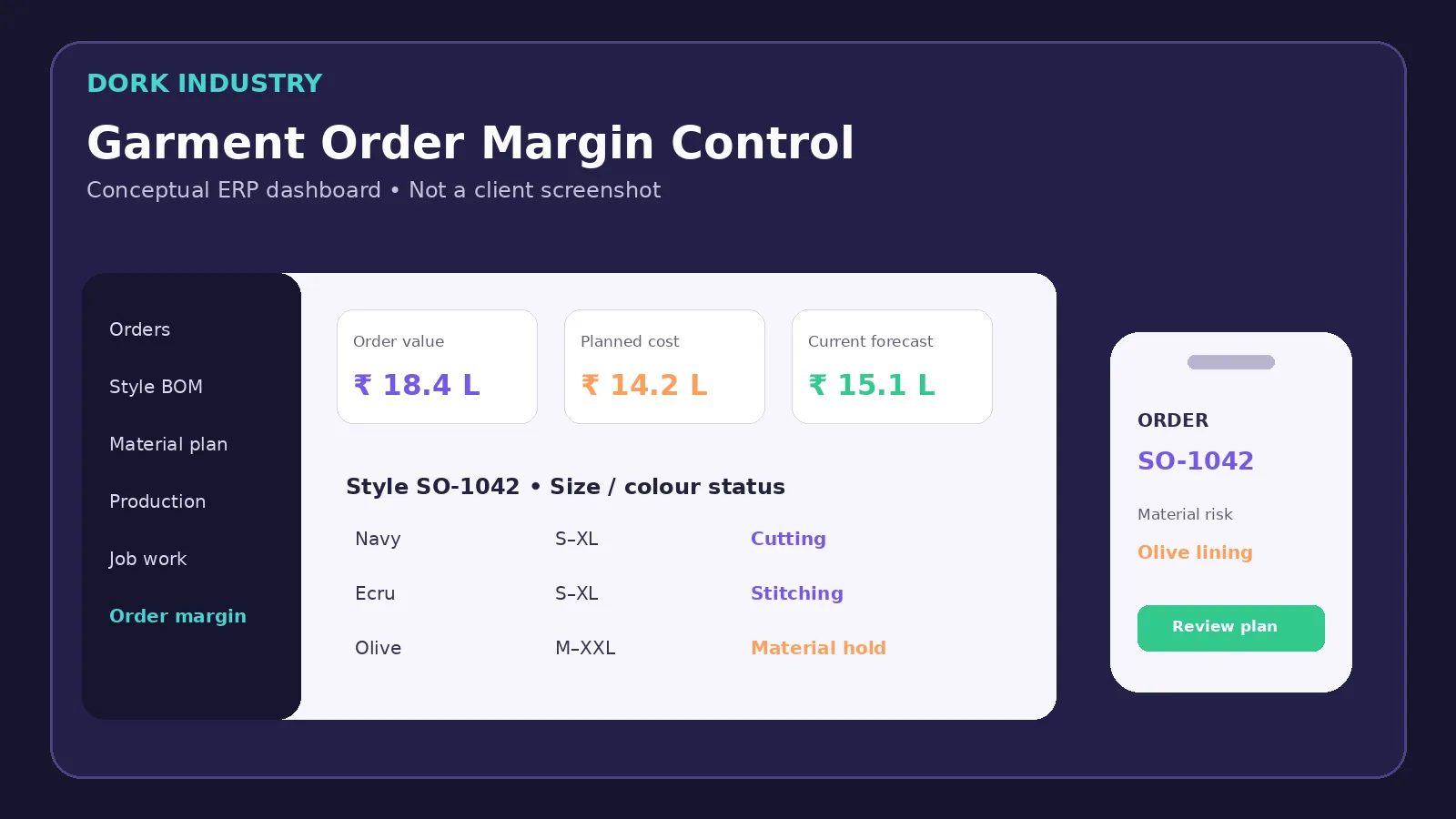
The following fictional worksheet explains how a forecast can change. It is not a customer case or pricing benchmark.
| Illustrative order item | Amount | Evidence |
|---|---|---|
| Confirmed order value | ₹18.40 lakh | Buyer order and approved price |
| Planned material cost | ₹9.20 lakh | BOM, variant quantities and planned rates |
| Planned conversion and job work | ₹3.10 lakh | Route and approved process rates |
| Other planned direct cost | ₹1.90 lakh | Approved costing rule |
| Current forecast cost | ₹15.10 lakh | Updated material, process and remaining-work assumptions |
| Illustrative forecast contribution | ₹3.30 lakh | ₹18.40 − ₹15.10 lakh |
The useful feature is not the ₹3.30-lakh number itself. A merchandiser or finance user should be able to open it and see which material rate, BOM revision, process variance or quantity change moved the forecast.
How should textile ERP implementation be phased?
1. Which workflows should be sampled?
Select completed and active orders covering variants, BOM changes, material shortage, job work, rejection and partial shipment. Anonymise commercial information.
2. Who should own master data?
Assign owners for styles, variants, BOMs, materials, units, processors, rates, quality status and approval limits before migration.
3. What should the pilot include?
Run one order family through planning, allocation, production, outside processing, quality, shipment and closure. A stores-only pilot cannot validate order margin.
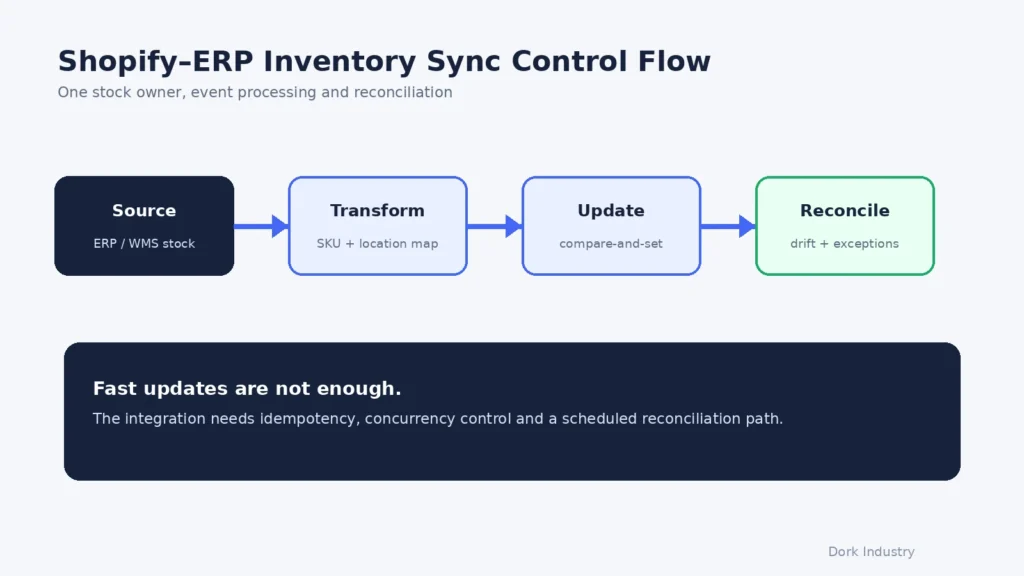
4. How should integrations be reconciled?
Document the source, target, unique identifier, field map, trigger, retry behaviour, error owner and reconciliation report for every interface.
5. When should rollout expand?
Expand only when the nine tests pass, opening balances reconcile and business owners can explain order and material status from source records.
Dork Industry’s industry expertise, ERP solution capability and technology consulting approach can support requirements mapping, integration design and custom application decisions. Product configuration, integration or custom development should be selected after workflow validation.
Bring one garment order workflow to a solution review
Share an anonymised order, style matrix, material flow and the point where delivery or margin visibility breaks. Dork Industry can help convert it into requirements, acceptance tests and an integration scope.
What should buyers ask a textile ERP vendor?
- Can one style be planned and reconciled by colour and size?
- How are BOM revisions and effective dates controlled?
- Can stock be reserved by order and usable identity?
- How are job-work issues, returns, shortages and rejection reconciled?
- Does the forecast show which assumption changed?
- How are duplicate integrations prevented?
- Can the company export complete order and material history?
- What evidence will be produced for each test?
Frequently asked questions
What is textile ERP software?
Textile ERP software connects orders, product or style data, material planning, inventory, production, outside processing, quality, shipment and finance. A garment-focused system should preserve colour-size variants and order identity throughout those workflows.
Why is a size-colour matrix important?
Different size and colour quantities affect material consumption, cutting, production and shipment. Treating only the total order quantity can hide shortages or excesses in specific variants and make BOM planning and reconciliation unreliable.
Should garment manufacturers buy or build ERP?
Buy when a product fits the required variant, material, job-work and costing workflows with limited configuration. Consider custom development or integration when business rules or existing systems materially differ. Use documented requirements and acceptance evidence.
What data is needed before implementation?
Prepare active orders, style and variant masters, approved BOMs, material and unit masters, stock by usable identity, processor balances, open production, rates, approval rules and integration mappings. Reconcile opening data before migration.
How should textile ERP success be measured?
Measure traceability, reconciliation accuracy, order-risk visibility, exception ageing, adoption by role and whether authorised users can explain forecast changes from source records. Dashboard availability or login counts alone do not prove commercial improvement.
Editorial note: monetary figures and interface examples are illustrative. Validate accounting, tax and contractual treatment with qualified professionals.