Direct answer: The right transport management software for logistics companies should connect trip planning, vehicle or vendor assignment, delivery proof, exception approval, invoicing and trip contribution in one auditable workflow. A polished map is not enough. Before buying or building a TMS, test it with completed, delayed, partially delivered and disputed trips.
Prepared by Dork Industry. This guide presents Dork Industry’s nine-test evaluation framework for transport software decisions. The tests and worked example are a practical methodology, not customer results or market statistics.
For a Delhi logistics operator moving goods between industrial clusters such as Bawana, Narela, Okhla, Naraina, Wazirpur and Patparganj, the commercial problem is rarely “Where is the truck?” alone. The harder question is: Can operations turn a completed movement into an accurate invoice and explain whether the job made money?
On this page
What should transport management software for logistics companies solve?
A TMS decision should solve a measurable operating bottleneck, not simply replace spreadsheets with screens. Start by documenting the hand-offs that delay billing, hide costs or create disputes. For many transport teams, that means linking the dispatch record to proof of delivery (POD), approved extra charges, the customer invoice and the transporter or driver payable.
A useful buying objective is specific: “Every completed trip should reach an invoice-ready or exception state, with its revenue, direct costs and supporting documents visible to authorised users.” That objective gives operations, finance and management a shared definition of done.
| Buyer problem | Software control | Evidence to review |
|---|---|---|
| Completed trips wait for documents | POD capture, document queue and ageing | Timestamp, uploader, trip ID and missing-document reason |
| Extra charges are disputed | Detention, loading and route-deviation approval | Rate rule, approver, note and attachment |
| Invoice status is unclear | Invoice eligibility and accounting hand-off | Ready, blocked, sent, accepted and paid states |
| Lane profitability is guessed | Trip-level revenue and direct-cost allocation | Contracted freight, fuel, tolls, vendor, handling and approved extras |
| Teams re-enter the same data | ERP, CRM, accounting and customer-portal integration | Field mapping, ownership, retry log and reconciliation report |
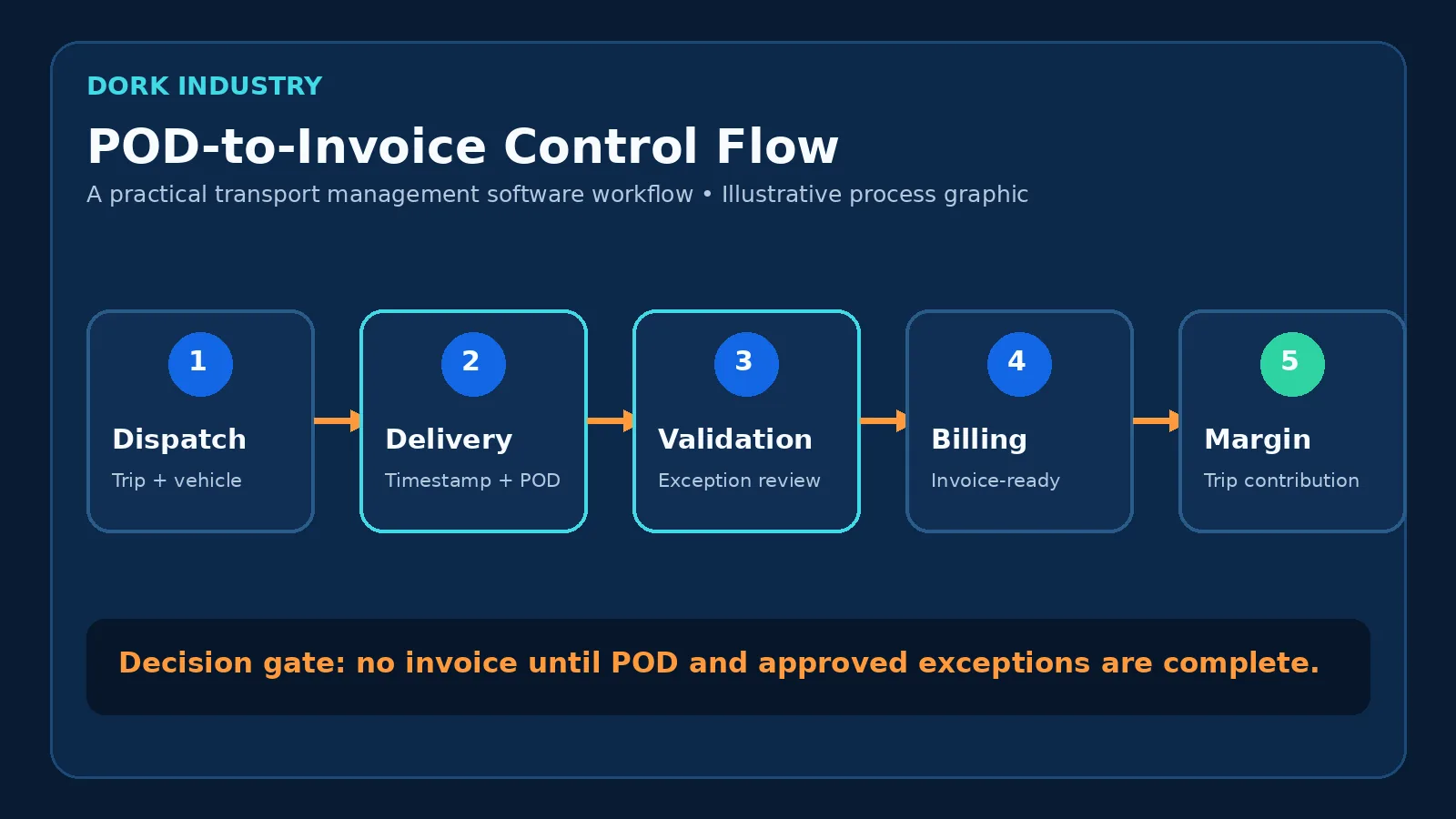
How should the POD-to-invoice control flow work?
- Dispatch creates the commercial record. The trip stores the customer, lane, agreed rate, vehicle or vendor, planned stops and required documents.
- Delivery creates operational evidence. The driver or operations user records the delivery time, recipient, POD image and any shortage, damage or refusal.
- Validation separates clean trips from exceptions. A clean delivery can advance automatically; an exception goes to an authorised reviewer with a reason and deadline.
- Billing uses an explicit eligibility rule. The system should show why an invoice is ready or blocked instead of relying on a person’s memory.
- Management reviews contribution, not just revenue. Direct trip costs and approved extras should be visible alongside billed revenue. This is an operating contribution view, not a substitute for audited accounting profit.
This design matters when a team serves several Delhi industrial areas, uses both owned and attached vehicles, or bills customers under different POD and rate-card rules. Locality names should never be cosmetic fields; they should connect to lanes, service windows, customer locations and commercial rules.
Which core requirements should transport management software cover?
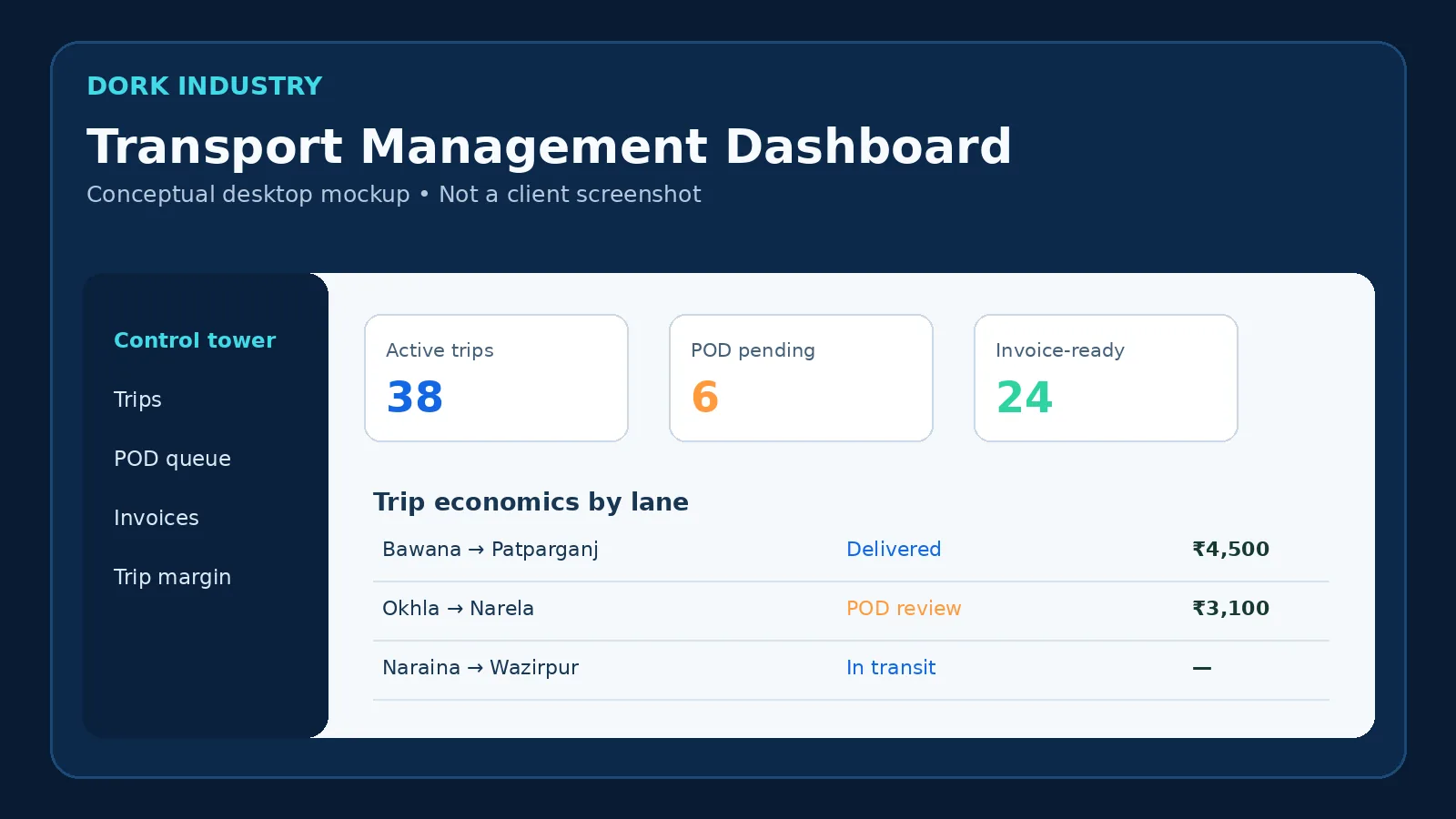
What must operational control cover?
- Order, consignment and trip creation with customer-specific mandatory fields
- Owned vehicle, market vehicle and contracted transporter assignment
- Multi-stop pickup and delivery sequences
- Driver mobile workflow with low-connectivity or offline capture
- Delivery, shortage, rejection, damage and return statuses
- Document versioning so a corrected POD does not erase the audit trail
What must commercial control cover?
- Customer rate cards by lane, vehicle, weight, trip or agreed rule
- Approval controls for detention, unloading, route change and other additions
- Vendor payable rules separate from customer billing rules
- Invoice eligibility, blocked reason and ageing
- Trip and lane contribution with drill-down to source costs
What makes a TMS enterprise-ready?
- Role-based access for dispatch, drivers, finance, management and customers
- API or controlled file integration with ERP, CRM and accounting systems
- Idempotent imports so a retry does not create duplicate trips or invoices
- Audit logs for rate, status and document changes
- Export and reconciliation reports that finance can independently verify
Which nine acceptance tests should a TMS pass?
Ask the vendor or development team to run these tests using anonymised examples that reflect your operation. Record the input, expected result, actual result, evidence and owner for every failure.
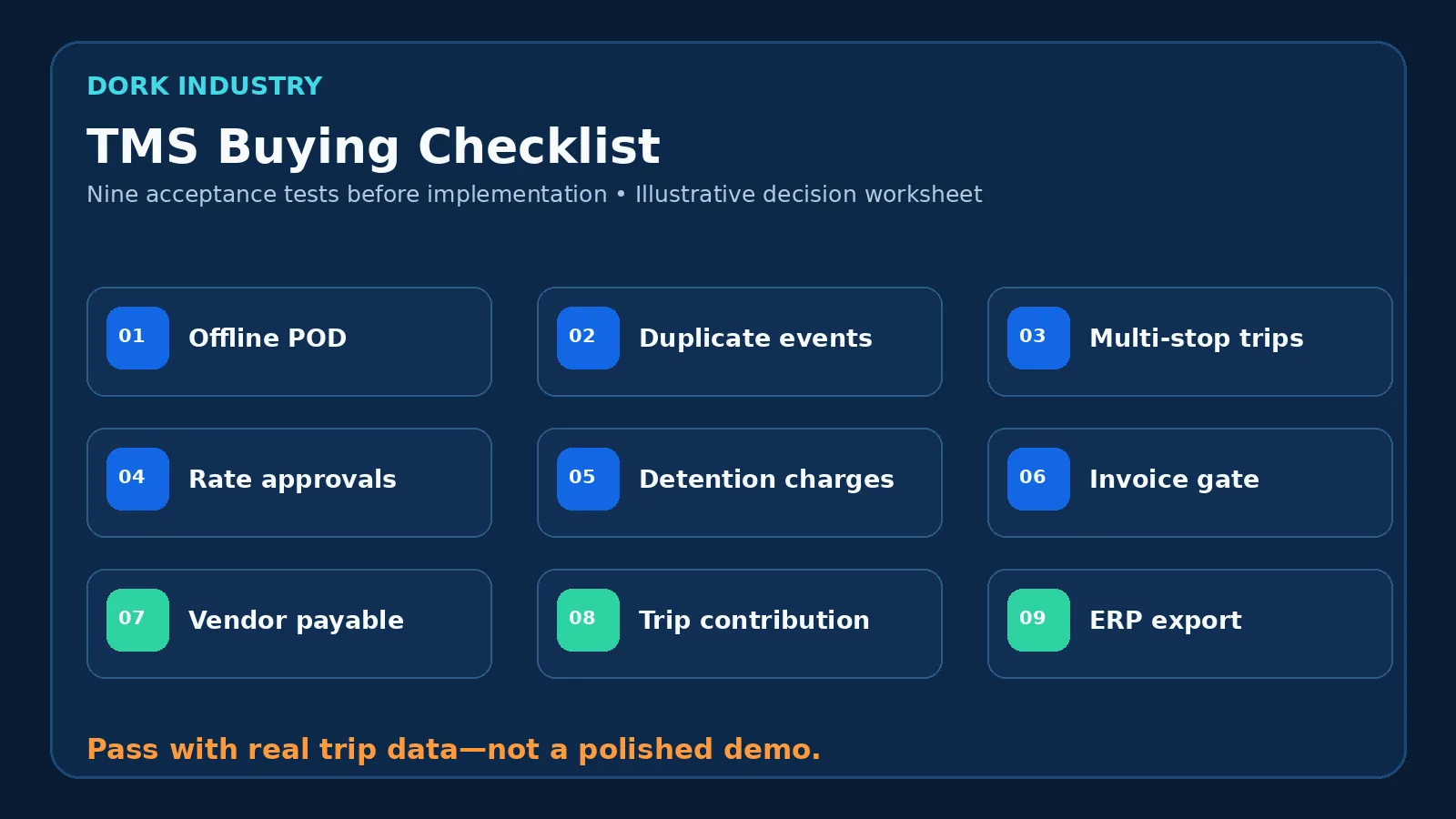
- Offline POD: capture delivery evidence without a stable connection, then confirm it synchronises once and keeps the original timestamp.
- Duplicate event: submit the same POD or integration event twice. The system should recognise the duplicate, not create a second delivery.
- Multi-stop trip: complete one stop, report an exception at another and leave the third open without closing the entire trip incorrectly.
- Rate approval: change a contracted rate and confirm that authorisation, effective date and previous value remain visible.
- Detention charge: add a charge with supporting evidence, route it to approval and verify that rejection does not enter the invoice.
- Invoice gate: remove a mandatory POD and confirm the trip becomes blocked with a clear reason and owner.
- Vendor payable: confirm that an attached-vehicle payable follows the vendor agreement rather than copying the customer charge.
- Trip contribution: change a direct cost and confirm the lane and trip views recalculate without altering historical source records silently.
- ERP export: force an integration failure, retry it and reconcile the receiving system without duplicate invoices.
Pilot acceptance targets: test at least 20 anonymised trips spanning the nine scenarios; require 100% traceability from invoice-ready status back to trip evidence; require zero duplicate invoices in the retry test; and require 100% of failed integration events to appear in an owned exception queue. These are recommended test thresholds for the pilot—not claimed performance results.
How does a worked trip-profitability worksheet look?
The figures below are a fictional demonstration, not a Dork Industry customer result or market benchmark. They show how to test whether a system makes its calculation understandable.
| Illustrative Bawana–Patparganj trip item | Amount | System evidence |
|---|---|---|
| Contracted freight | ₹25,000 | Customer rate card and trip version |
| Approved detention | ₹1,500 | Approval plus supporting note |
| Vehicle/vendor cost | ₹15,500 | Vendor agreement or owned-fleet allocation rule |
| Fuel, toll and handling | ₹5,000 | Imported or approved direct-cost records |
| Illustrative operating contribution | ₹6,000 | (₹25,000 + ₹1,500) − (₹15,500 + ₹5,000) |
The useful test is not whether the dashboard displays ₹6,000. It is whether a finance user can open that number, trace every component, identify the governing rule and reconcile it to the accounting hand-off. Overheads, taxes, depreciation and other accounting items are outside this simplified trip-contribution example.
How should a TMS implementation be planned?
1. How should the current-state baseline be established?
Sample recent trips across clean delivery, missing POD, disputed charge, return and attached-vehicle scenarios. Measure current hand-offs: who creates the trip, who captures evidence, who approves exceptions and who decides an invoice is ready.
2. Who should own master data and workflow decisions?
Assign one source of truth for customers, locations, vehicles, vendors, rate cards and invoice numbers. A system integration will not resolve conflicting ownership rules; it will distribute them faster.
3. How should a narrow pilot be configured?
Choose one customer workflow and a manageable set of lanes. Include at least one exception-heavy scenario. The pilot should test the complete commercial loop, not only dispatch and tracking.
4. How should every interface be reconciled?
For each ERP, CRM or accounting integration, document the field map, trigger, unique identifier, retry behaviour, error owner and reconciliation report. Enterprise systems should fail visibly and recover predictably.
5. When is the system ready to expand?
Move beyond the pilot only after the nine tests pass and the business owners accept the evidence. Track operational adoption, POD ageing, invoice-blocked reasons, exception resolution time and contribution completeness. Do not promise a financial improvement before the workflow has been measured.
Dork Industry’s transportation and logistics industry work and ERP solution capability can be used to assess whether an existing product, an integration layer or a custom enterprise application is the appropriate route. The decision should follow requirements and evidence—not the other way around.
Where routing is part of the scope, review the technical constraints in the Google Maps Platform Routes documentation rather than assuming every route engine behaves the same way. Where invoice or e-way-bill integration is required, validate the design against the applicable guidance on the official GST e-invoice portal and official e-Way Bill portal with qualified tax advisers. These links support implementation due diligence; they are not endorsements of a particular TMS.
Bring one real transport workflow to a solution review
Share an anonymised trip lifecycle, your present systems and the point where billing or profitability visibility breaks. Dork Industry can help convert it into a requirements map, acceptance-test plan and integration scope.
What should you ask a TMS vendor or development partner?
- Which event makes a trip invoice-ready, and can that rule vary by customer?
- How does the system behave when mobile connectivity is poor?
- How are duplicate API events and repeated uploads detected?
- Can users see who changed a rate, document or delivery status?
- How are customer charges separated from vendor payables?
- Can finance reconcile every exported invoice to its source trip?
- Can the business retrieve its documents and transaction data in a usable format?
- What evidence will be produced for each acceptance test?
Frequently asked questions
What is transport management software?
Transport management software is an enterprise application used to plan, execute and review freight movements. Depending on scope, it can manage trips, vehicle or transporter assignment, proof of delivery, exceptions, rates, invoices, payables, integrations and operational reporting.
Is fleet GPS tracking the same as a TMS?
No. GPS tracking primarily reports location and movement. A TMS should connect transport execution to commercial controls such as customer rates, POD validation, invoice eligibility, vendor payables and trip contribution. The two systems can be integrated.
Should a Delhi logistics company buy or build TMS software?
Buy when a product fits the required workflows with limited configuration. Consider custom development or an integration layer when rate logic, exception handling, customer portals or ERP connections are materially different from standard products. Decide through documented requirements and acceptance tests.
What should be included in a TMS pilot?
Include clean and exception trips, owned and contracted vehicles where relevant, low-connectivity POD capture, a rate change, an additional charge, an invoice block, a vendor payable and an ERP or accounting reconciliation.
How should TMS success be measured?
Use verified operational and commercial measures such as POD ageing, invoice-block reasons, exception resolution time, reconciliation failures, adoption by role and the percentage of completed trips with traceable revenue and direct costs. Do not treat software adoption alone as proof of business impact.
Editorial note: dashboard figures and the worked trip are illustrative. They are provided to explain requirements and testing, not to claim customer performance.