AI quotation automation for distributors should convert incoming enquiries into a reviewable draft quote while deterministic rules protect product compatibility, customer pricing, margin, tax, credit and approval limits. AI can interpret unstructured emails or spreadsheets, but it should not independently invent a product match, discount or delivery commitment.
For industrial distributors, the commercial opportunity is faster, more consistent quote preparation without removing accountable sales and finance approvals. Dork Industry can scope this as CRM/ERP integration, a custom quotation module, document automation or a dedicated development-resource engagement.
Why do distributor quotations become a growth constraint?
A distributor may receive an enquiry as an email, PDF, spreadsheet, WhatsApp message or copied list of informal product descriptions. A salesperson then searches SKUs, checks the customer’s price list, confirms stock or lead time, applies a discount, verifies margin and waits for approval. The difficulty is not generating a PDF; it is preserving commercial rules while translating inconsistent requests into a reliable order proposal.
Salesforce describes CPQ as software for configuring products, applying pricing rules, managing discounts and approvals, and producing quotes. It also highlights CRM and ERP integration and deterministic logic for compatibility and commercial policies. That distinction matters: an AI model can assist interpretation, while the pricing and approval engine remains controlled. See Salesforce’s CPQ explanation.
How should AI quotation automation for distributors work?
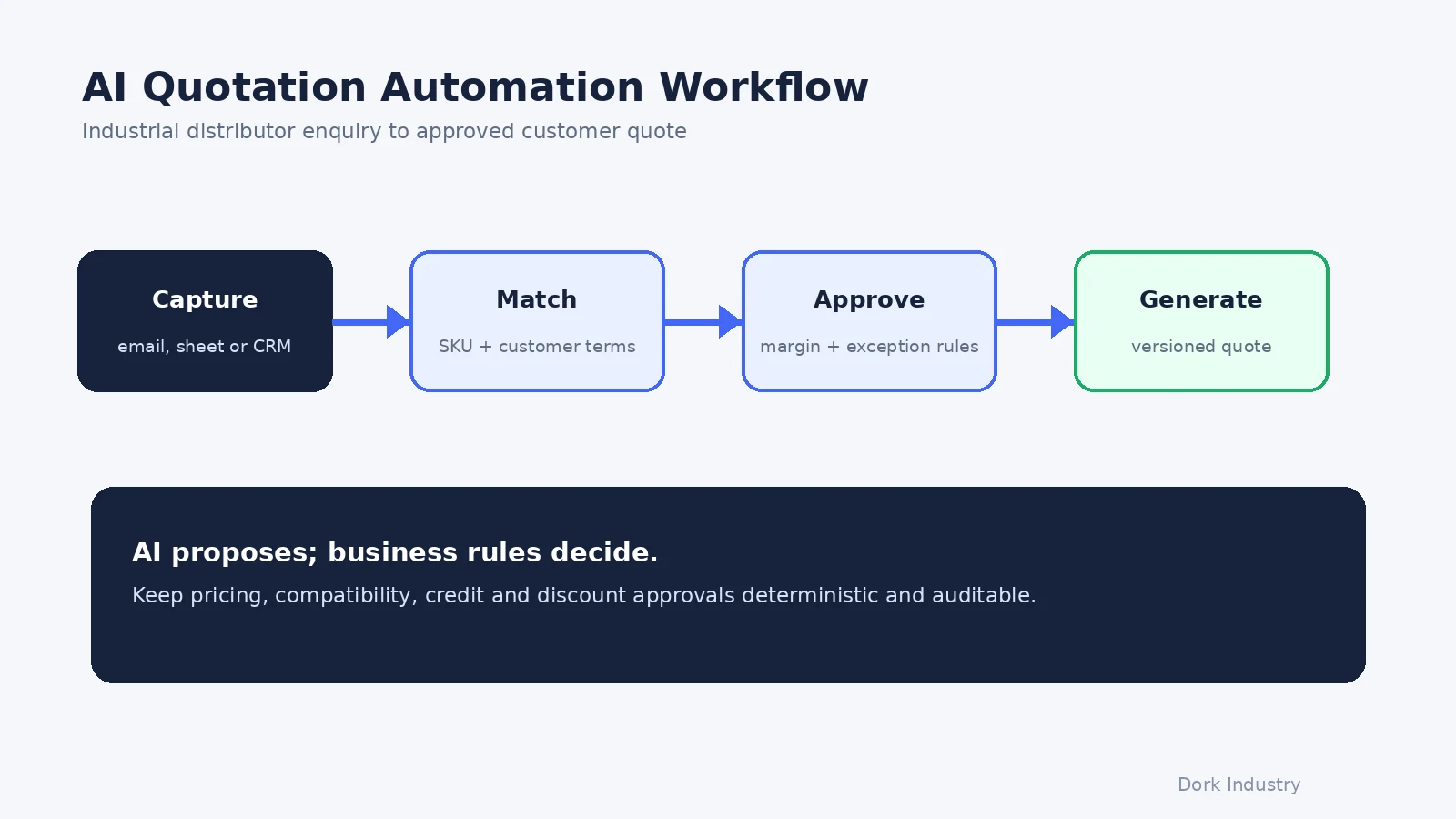
- Capture the enquiry. Preserve the original message and attachments as evidence.
- Identify customer and context. Link the request to the correct account, branch, currency and agreement.
- Extract requested products. Interpret part numbers, descriptions, quantities, units and requested dates.
- Match the product catalog. Return confidence and alternatives instead of silently selecting an uncertain SKU.
- Apply controlled commercial rules. Use approved price lists, contract terms, taxes, freight and margin policies.
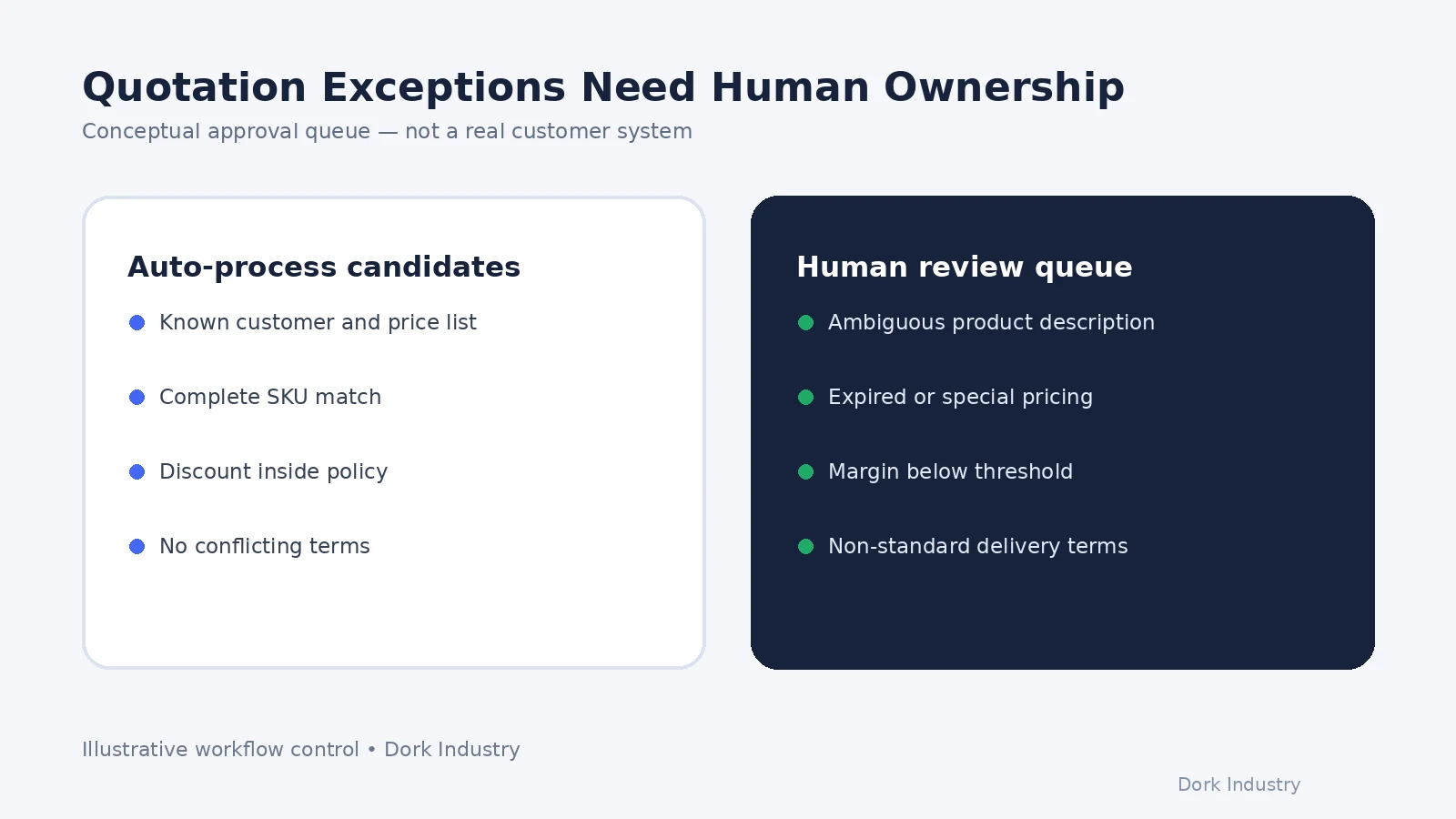
- Route exceptions. Send ambiguous matches, low margin, unusual terms or expired prices to named owners.
- Generate a versioned quote. Record who approved it and which source data was used.
If the distributor already has ERP and CRM systems, the project is primarily integration and workflow design. If pricing still lives in spreadsheets and individual knowledge, data cleanup and rule definition must precede AI.
According to Salesforce’s official guidance on CPQ product and price rules, validation and alert rules can control configuration while price rules automate defined calculations. This supports keeping critical quote constraints explicit rather than hiding them inside generated text.
Which quotation decisions should remain rule-based?
| Decision | Recommended control | Exception owner |
|---|---|---|
| Product match | AI suggestion plus catalog validation | Product specialist |
| Customer price | ERP/contract price source | Sales operations |
| Discount and margin | Threshold and approval matrix | Manager or finance |
| Delivery promise | Inventory and procurement evidence | Operations |
Should a distributor buy CPQ, configure an existing system or build?
Choose an existing CPQ product when the catalog, pricing model and approval paths fit its configuration model. Extend the existing ERP or CRM when it already owns product and customer truth but lacks a usable quote workflow. Build a focused custom layer when enquiries are highly unstructured, compatibility rules are proprietary, or several legacy systems must participate.
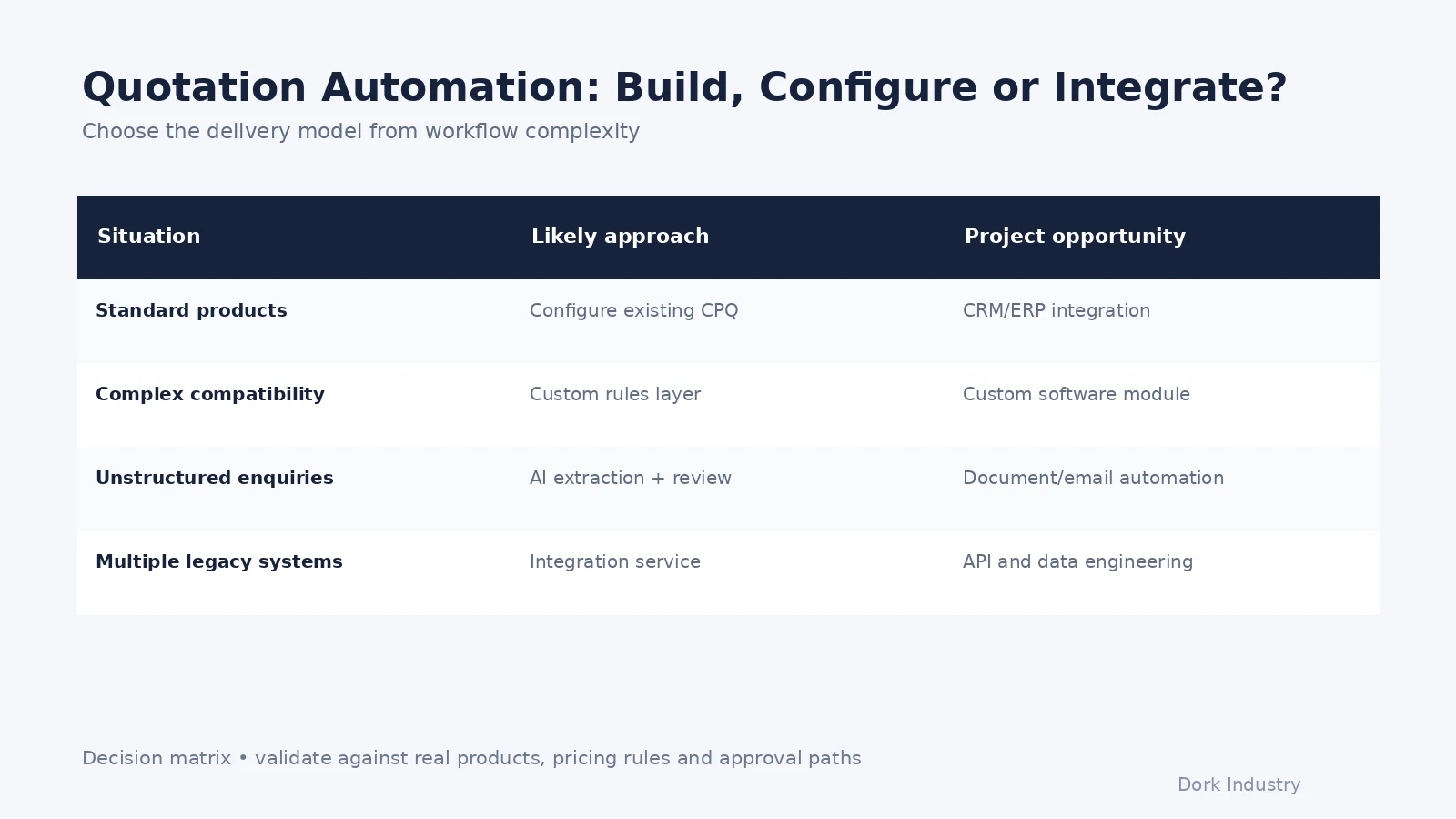
Dork Industry’s custom software development and AI/ML implementation services can be considered after the current pricing, approval and system ownership are verified. Related credit controls should be evaluated separately; see the guide to distributor credit-hold software.
How should an AI quotation automation pilot be tested?
Build a representative test pack from anonymised enquiries: clear SKU requests, description-only requests, discontinued products, ambiguous units, customer-specific prices, low-margin lines, incompatible combinations and non-standard delivery terms. Record field-level results and whether each exception reaches the correct reviewer. Do not declare success from a polished demo using only easy quotes.
When should you request an automation consultation?
Request a consultation when quotation delays affect sales capacity, prices are copied manually, approvals are difficult to audit, or the ERP and CRM do not share a dependable quote workflow. Dork Industry can assess the current process, identify the system of record, define a pilot and estimate whether configuration, integration or custom development is appropriate.
Discuss an AI quotation automation project
Bring one representative enquiry, the required quote output, product/pricing sources, approval rules and existing system list. Dork Industry will use them to scope a practical workflow rather than a generic AI demo.
Frequently asked questions
Can AI create distributor quotations from emails?
AI can extract customer requests, quantities and product descriptions from emails and attachments. The workflow should still validate the customer, product match, price list, tax, margin and delivery information against controlled systems before producing an approved quotation.
Should AI decide the final selling price?
Not by itself. Final pricing should follow authorised price sources, customer agreements, margin policies and approval thresholds. AI may identify relevant context or propose a match, but deterministic rules and accountable people should control commercial commitments.
Does quotation automation require a new ERP?
No. A focused workflow can integrate with an existing ERP, CRM and document system if they provide reliable APIs or data access. The technical design depends on which system owns products, customer terms, inventory, approvals and final orders.
What should go into the pilot test set?
Include normal enquiries and difficult exceptions: unclear descriptions, old part numbers, customer-specific prices, incompatible products, unusual units, low-margin requests and unavailable stock. Evaluate field accuracy and exception routing separately.
Can Dork Industry build a custom quotation module?
Dork Industry can assess the workflow and confirm the relevant integration and software-development capability. The scope may include enquiry capture, product matching, pricing rules, approvals, quote generation and CRM or ERP integration.
What is needed for a quotation automation consultation?
Provide anonymised sample enquiries, quote templates, product and pricing sources, approval rules, system names and the most common exception types. Do not send passwords or confidential customer data in the initial enquiry.